THE SHORT ANSWER
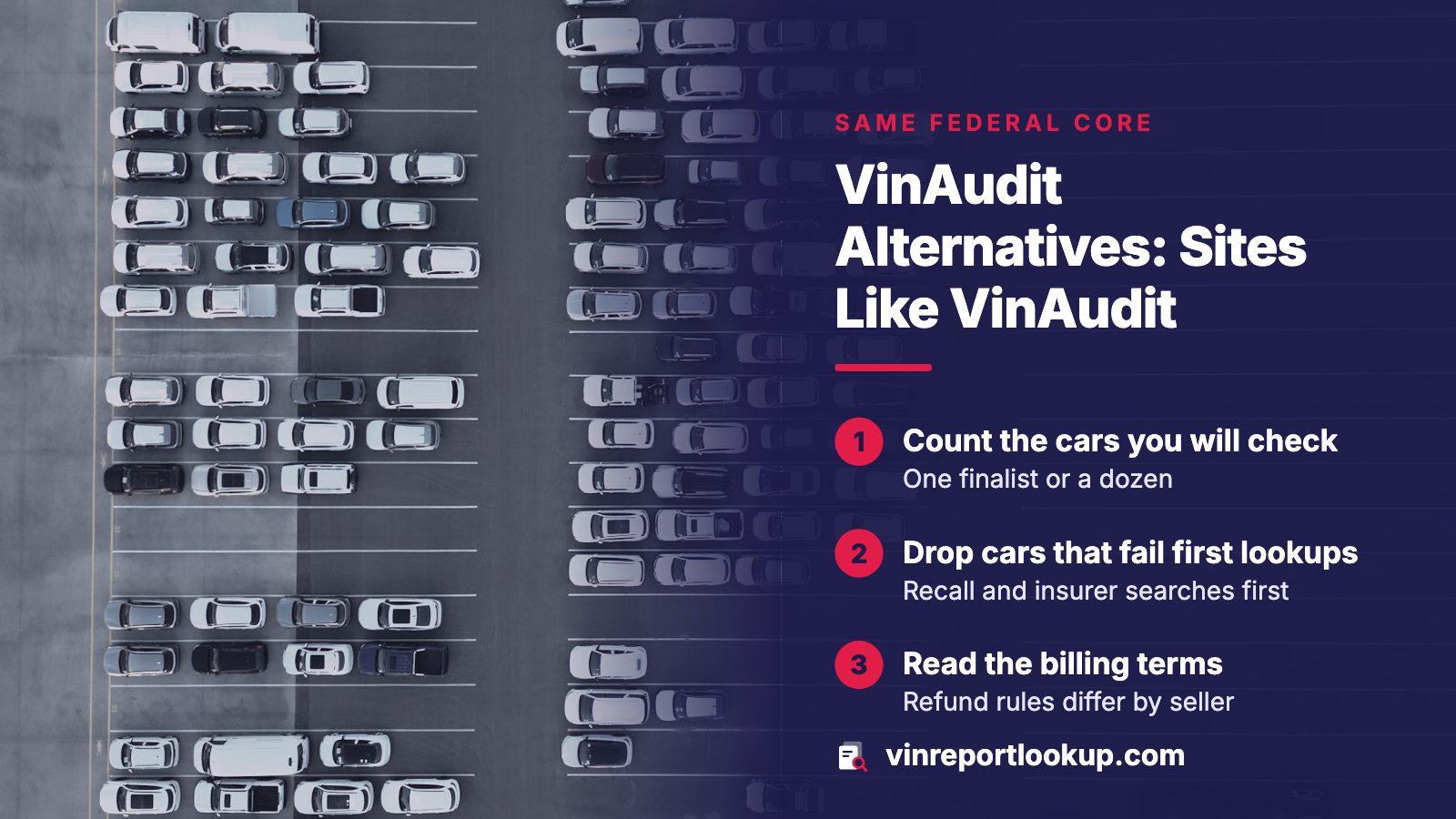
Sites like VinAudit fall into three groups. Other Justice Department approved NMVTIS providers sell the same federal title, brand, odometer, total-loss and salvage record. Subscription services such as Bumper charge monthly. One-time VIN reports, this site's included, show a free preview and then take a single payment. Compare what the report shows for your VIN, then how it bills.
- VinAudit's stated prices
- $9.99 single, $19.99 for five, $29.99 for ten
- Federal record price
- The Justice Department says to expect up to $4
- Bumper's stated start
- Plans from $27.99 per month
- Refunds at VinAudit
- None once a report is delivered, per its terms
Why buyers look past VinAudit
VinAudit is a legitimate name in this market: the Justice Department lists Vinaudit.com among the approved NMVTIS data providers that may sell to the public. Shoppers still compare for ordinary reasons. Some want a second source for a car they are close to buying, some want a different presentation, and some dislike a pricing model that includes a monthly plan next to the one-time purchase.
The comparison is easy to get wrong in one way. Several providers own more than one storefront, and the federal list says so. Two brand names can sit on one data source, so a second report from a sibling site is a repeat, not a second opinion. A real cross-check uses a different kind of source, such as a free insurer-run lookup or an open-recall search.
What VinAudit's own pages say about its report
Its homepage describes a free summary after you enter a VIN and an order form for the full report. Its data page lists the record types it gathers, and the table below keeps only the parts that matter when you compare.
| Topic | What VinAudit states |
|---|---|
| Core data | NMVTIS title, brand, salvage and junk records, with title brands covering more than 60 labels |
| Extras beyond NMVTIS | Theft, lien, impound, export and sale records |
| Accident records | Shown only when a match exists, usually tied to a police report |
| Prices on its homepage | $9.99 for one, $19.99 for five, $29.99 for ten |
| Billing | One-time purchase or a monthly subscription with per-report fees |
| Refunds | Not available once a report has been delivered |
Check the live price on its own site before buying. The figures here were read from its pages on the date at the foot of this guide.
The three kinds of alternative
Most lists of sites like VinAudit mix products that work differently. Sorting them by price model first saves time.
| Kind | Examples | How it bills | What stands out |
|---|---|---|---|
| Other NMVTIS providers | ClearVin, GoodCar, Bumper, among others on the federal list | Varies by seller | Same federal title record, different packaging |
| Subscription services | Bumper | Monthly, from $27.99 per its own page | Fits someone running many cars, hard to justify for one |
| Single-payment reports | This site, ClearVin, AutoCheck | Pay per report, no recurring charge stated | Suits one shortlisted car |
| Free layers | NICB lookup, NHTSA recalls | No charge | Narrow, but they check different data |
AutoCheck's page offers a one-time fee with no recurring charges for the plan it shows, a scoring system, and Experian buyback protection for registered, qualifying cars. It displayed no price on the page opened for this guide, so look at the live checkout. Carfax pages would not open for an automated read, so nothing here relies on them.
The federal record is the shared core
Approved providers all pull from NMVTIS, and the Justice Department keeps its scope narrow on purpose: where the car is titled now, any brands a state has applied, the mileage on record, and whether it was ever written off or sent to salvage. Because the report is meant to be brief, an empty result counts as good news. The feeds come from titling agencies, scrap and salvage yards, recyclers and insurers, all bound by federal reporting law.
That is why a very low price can be fair. The same department tells buyers to expect up to $4 for the federal record alone. Extra cost above that pays for something else: auction photos, a market value, liens, theft data or an easier layout. Ask which of those you will use.
Who cannot sell to you
On the Justice Department's roster, three names are marked as dealer-side only: Carfax, DMVDesk and Experian. A private buyer will not get the federal record from them. Carfax's entry is further limited to business customers in California. Whatever a shopper buys from Carfax directly is its own product, a separate thing from this channel.
What the other sellers add on top
ClearVin's page promises a preview before you pay and no plan to sign up for, then lists odometer order, salvage auction sales with photos, liens and impounds, insurance entries, theft and recalls. Its page shows a handful of dollar amounts with no clear captions, so this guide quotes none. GoodCar says it is an approved provider run by InfoPay, adds a loan calculator and recall tools, and likewise shows amounts that are not clearly labeled.
Bumper's page mentions accident, theft, listing history, market value and ownership cost where data exists. Plans begin at $27.99 monthly, and a cheaper trial turns into the regular rate if you do nothing. Stopping it means using account settings or writing to support.
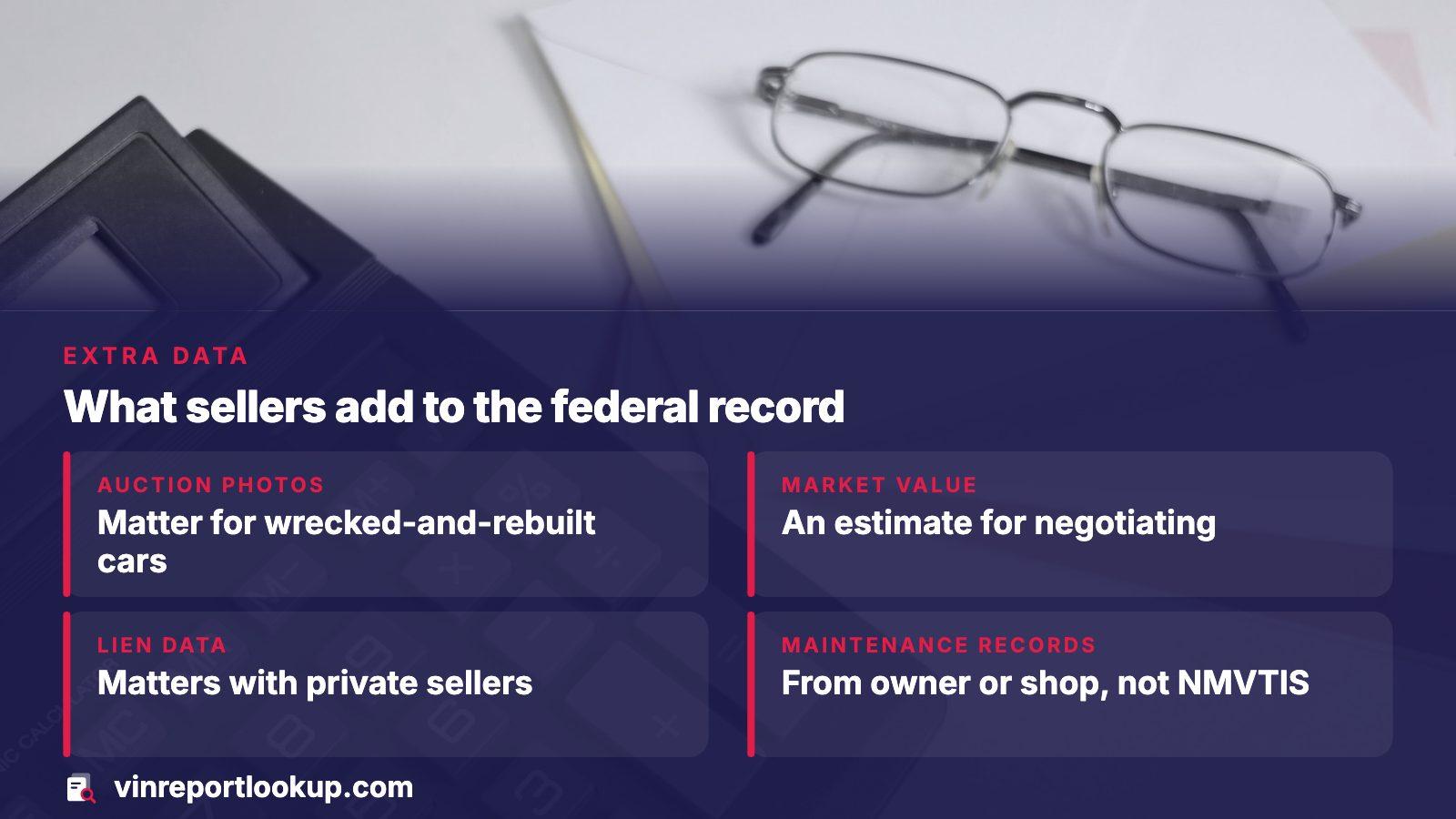
- Auction photos matter most when the car may have been wrecked and rebuilt.
- A market value matters when you are negotiating, though it is an estimate.
- Lien data matters when buying from a private seller who still owes on the loan.
- Maintenance records come from the owner or the repair shop, not from NMVTIS.
What to run before you pay anyone
Two free steps cost nothing and cover ground a paid title record does not. The insurer-run NICB database includes flood damage and other flags, as the Justice Department's own buying tips point out. NHTSA's recall search tells you whether a safety fix is still open on that VIN. Both are separate from the title data, which is the point of using them.
Then add a mechanic's inspection. Federal guidance puts an independent inspection next to the history report as a step buyers should take, not as an alternative to it. A clean record cannot show a worn transmission.
No entry is not proof
On its report-sections page VinAudit concedes that a missing accident entry says little about whether a car was ever hit. Any seller shares that blind spot. An empty section means the databases held no match for that VIN.
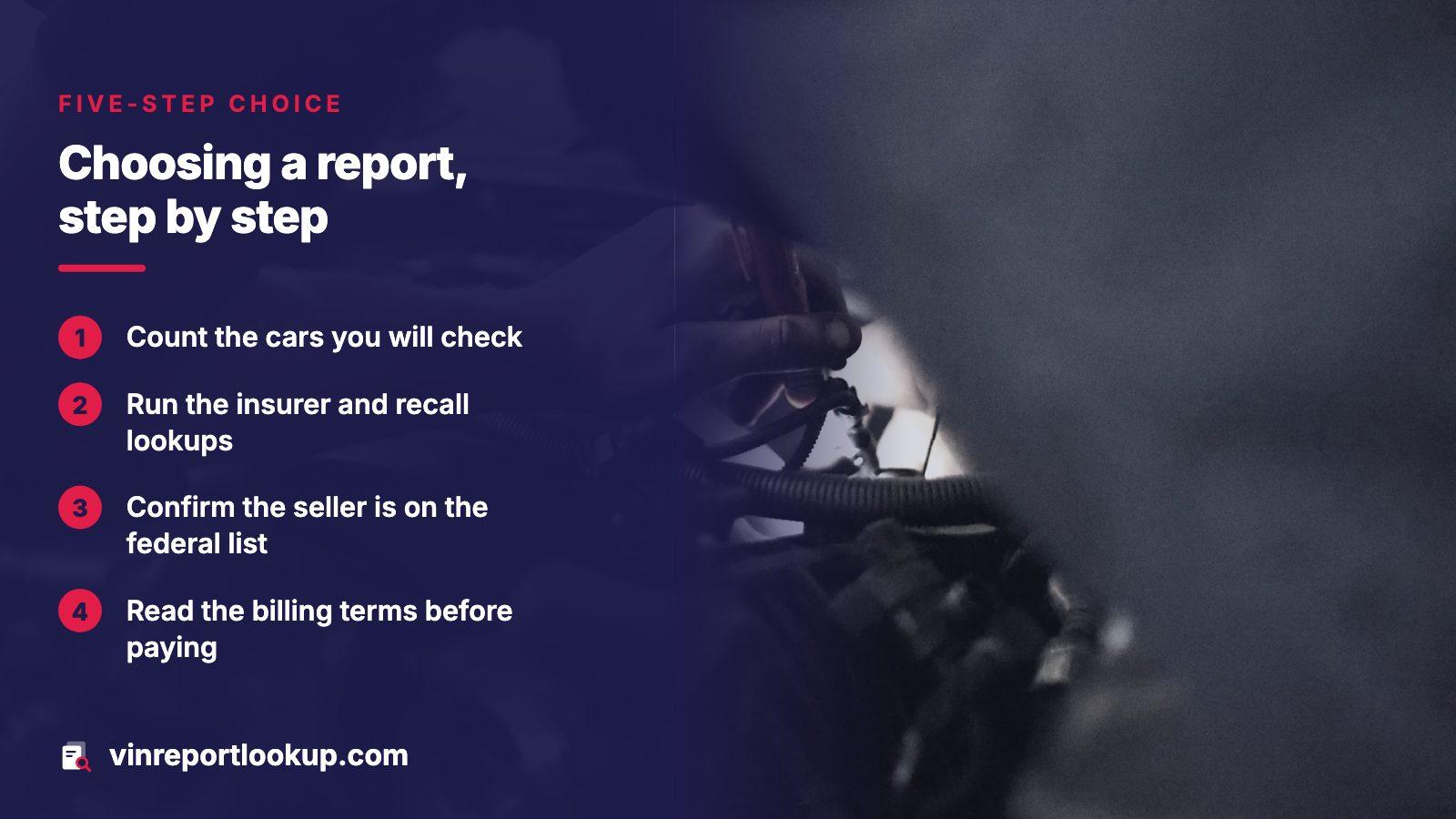
Choosing in five steps
- Count the cars. One finalist points to a single payment; a dozen listings could justify a pack or a plan.
- Run the free NICB and NHTSA lookups on each VIN first and drop any car that fails.
- Confirm the seller appears on the Justice Department's provider list, or is a named brand under one of its entries.
- Read the billing terms before you enter a card: recurring fee, trial rollover, refund wording.
- Open the sample report and check that it shows the record you actually need, such as photos or liens.
Running a check with this site instead
Here the order of events is simple. Enter the VIN, read the preview, and decide. A purchase is one payment for one report, or a pack of 3, 5 or 10 if you are weighing a few listings, and no charge repeats later. The pricing page lists amounts.
To be exact about cost, the preview carries no fee while the report does. Buy it after the free lookups pass the car, then take the printout along when a mechanic looks it over.
Where this information comes from
- Justice Department: approved NMVTIS data providers — who may sell federal title data to the public, and the dealer-only entries
- Justice Department: understanding an NMVTIS report — the five indicators and why a short report is normal
- Justice Department: used car buying tips — the up-to-$4 figure, the free insurer database and the inspection advice
- VinAudit: data sources — record types, brand coverage and which sections need a match
- VinAudit: terms and conditions — one-time versus subscription billing and refund wording
- Bumper: vehicle history report — plan start price, trial rollover and cancel routes as Bumper states them
Sources and photos: Facts checked against the sources above in November 2026. Photos by Iain, Mustafa Sheikhmouss and Cht Gsml on Unsplash; diagrams by VINReportLookup.
Keep reading
- Carfax vs VinAudit: six steps to pick the report you pay forA head-to-head of the premium name against the budget federal-data seller
- How to cancel a VinAudit subscription and stop the monthly chargeWhat its terms say about stopping a monthly plan
- Vehicle history report providers: who sells VIN reports and how they differWho sells reports and where the title data originates
- Best VIN check: how to choose a report and what each one includesChoosing a report by the question you still need answered
Frequently asked questions
What is the best alternative to VinAudit?
It depends on the gap you want filled. For the same federal title record, any other approved NMVTIS provider works. For salvage auction photos or lien detail, look for a report that names those sections. For a single car with no recurring charge, a one-time report after a free preview is the simplest fit.
Are there free sites like VinAudit?
Free tools exist but they are narrower. The insurer-run NICB lookup includes flood damage and other flags, and NHTSA lists open recalls by VIN. Neither shows the federal title history. VinAudit's own homepage offers a free summary, then asks you to order the full report.
Does VinAudit charge a subscription?
Its terms describe two options: a one-time purchase and a subscription plan with a monthly fee plus per-report charges. The terms say paid fees are non-refundable, so read the checkout page closely and confirm which option you are selecting before you enter card details.
Is a cheaper report as accurate as an expensive one?
On federal title data, price does not change the underlying record. The Justice Department says to expect up to $4 for it. What costs more usually adds photos, market value or presentation. Accident detail is patchy for every provider because it depends on police reports and other sources.
Can I get a Carfax report through the federal system?
No. The government roster tags Carfax, DMVDesk and Experian as dealer-side, with Carfax's entry covering California business customers only. A private shopper after the federal record needs a seller that the roster lists for the public. Carfax's own consumer reports are a separate product.
Now check the car itself
The guide explains what to look for. The report shows what this VIN has on record.