THE SHORT ANSWER
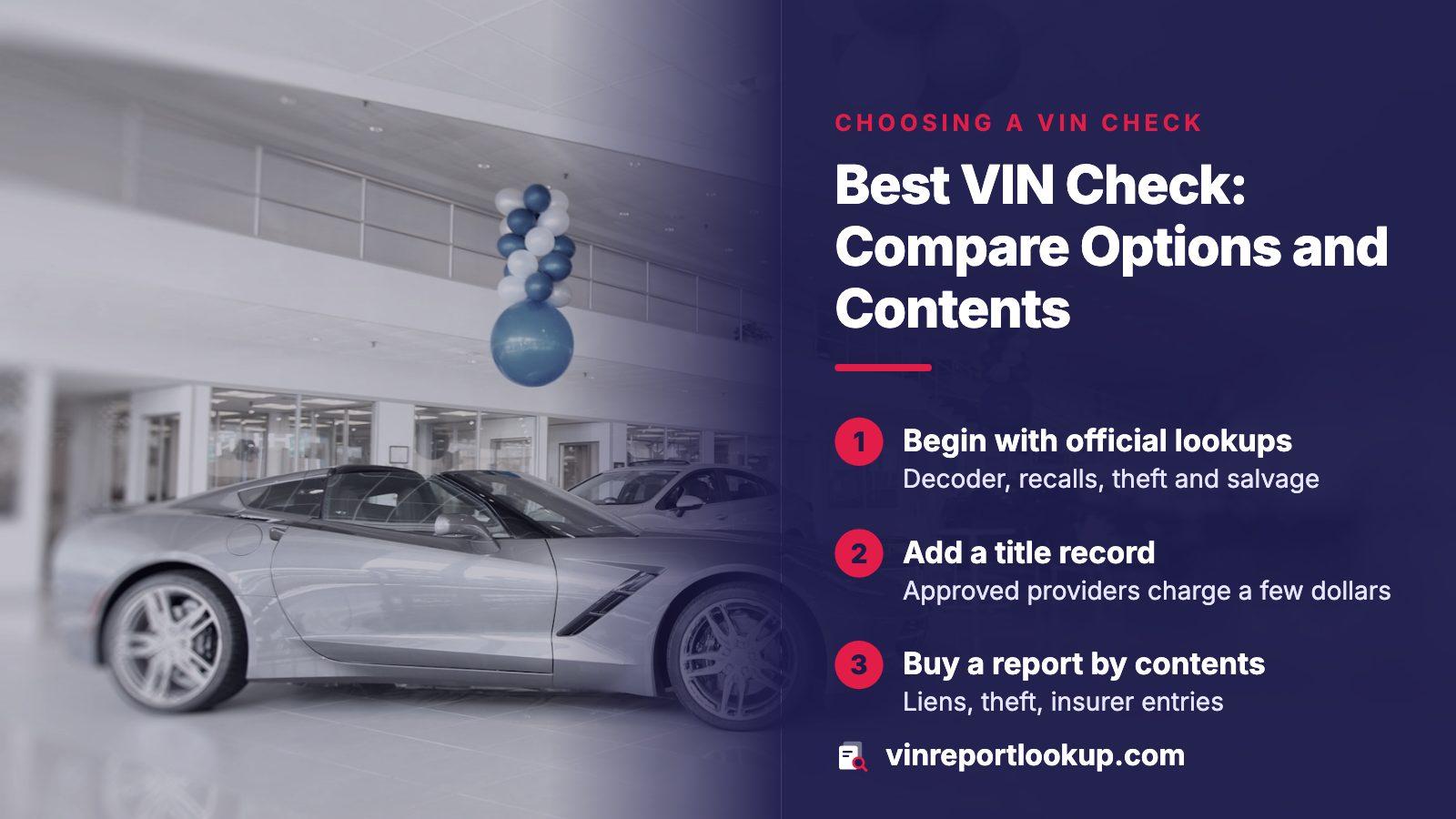
No single service wins on every car. NHTSA's decoder and recall lookup and NICB's VINCheck cost nothing, so use them first. Then pick a history report by what it contains: open recalls, liens, theft and insurance entries, salvage and auction photos, accidents and damage, odometer readings and title brands. A VINReportLookup report covers all of these, and the preview before checkout is free.
- Official lookups
- Build data, recalls, theft and salvage flags cost nothing
- Federal title record
- A few dollars from an approved provider
- Carfax on the federal list
- Commercial customers only, California only
- VINReportLookup
- Free preview, then one payment, no subscription
What best should mean when money is about to change hands
Lists that crown one winner usually rank by who pays for placement, not by what sits inside the report. A fairer test asks two things: do the records match your question about this car, and how does the service charge for them.
These services are not rival copies of one product. Some pass along the manufacturer's build data and the safety agency's recall campaigns. Some pass along the federal title record. Some add their own feeds from dealers, garages and auctions. A report strong on one can be thin on another, so a single ranking hides what you care about.
That is why this page sorts options by what they hold and cost, and prints no price for any company. Amounts move, and comparisons built on them go stale quietly.
Four tiers of VIN check, from nothing to premium
| Tier | What it holds | What you pay |
|---|---|---|
| Official VIN decoder and recall lookup | Factory build, specifications and open safety recalls | Nothing |
| NICB VINCheck | Theft and salvage records reported to the nonprofit | Nothing |
| Federal title record from an approved provider | Title brands, odometer readings and total-loss records from states, insurers and salvage yards | A few dollars |
| Full history report (Carfax, AutoCheck, VINReportLookup) | Title data where the seller has it, plus accident, damage, auction, lien and insurance entries the company gathers | More, set by each seller |
The two no-cost rows are not trial versions of the paid ones. A decode repeats what the manufacturer filed, and recall results come straight from the agency's campaign records, so no paid report holds a better copy of either. Paid reports earn their fee in the last two rows.
What a full report should show before you hand over money
Compare contents line by line, because a thin report can look as polished as a thorough one. A VINReportLookup report is organized around these groups of records:
- Title and mileage: brands on the title, plus odometer readings logged over the life of the car
- Damage: accident records and damage records, with salvage and auction entries and their photos
- Money and law: liens, impounds and insurance records
- Theft records and open recalls
- Ownership and use type (private, rental, taxi), market value and factory specs
Hold any other service to the same standard. A site that says only that it searches many sources, and never shows a layout, leaves you guessing which rows it fills. This site's sample report shows the format in advance, and the preview covers your own VIN before payment.
The one official list in this market, and what it settles
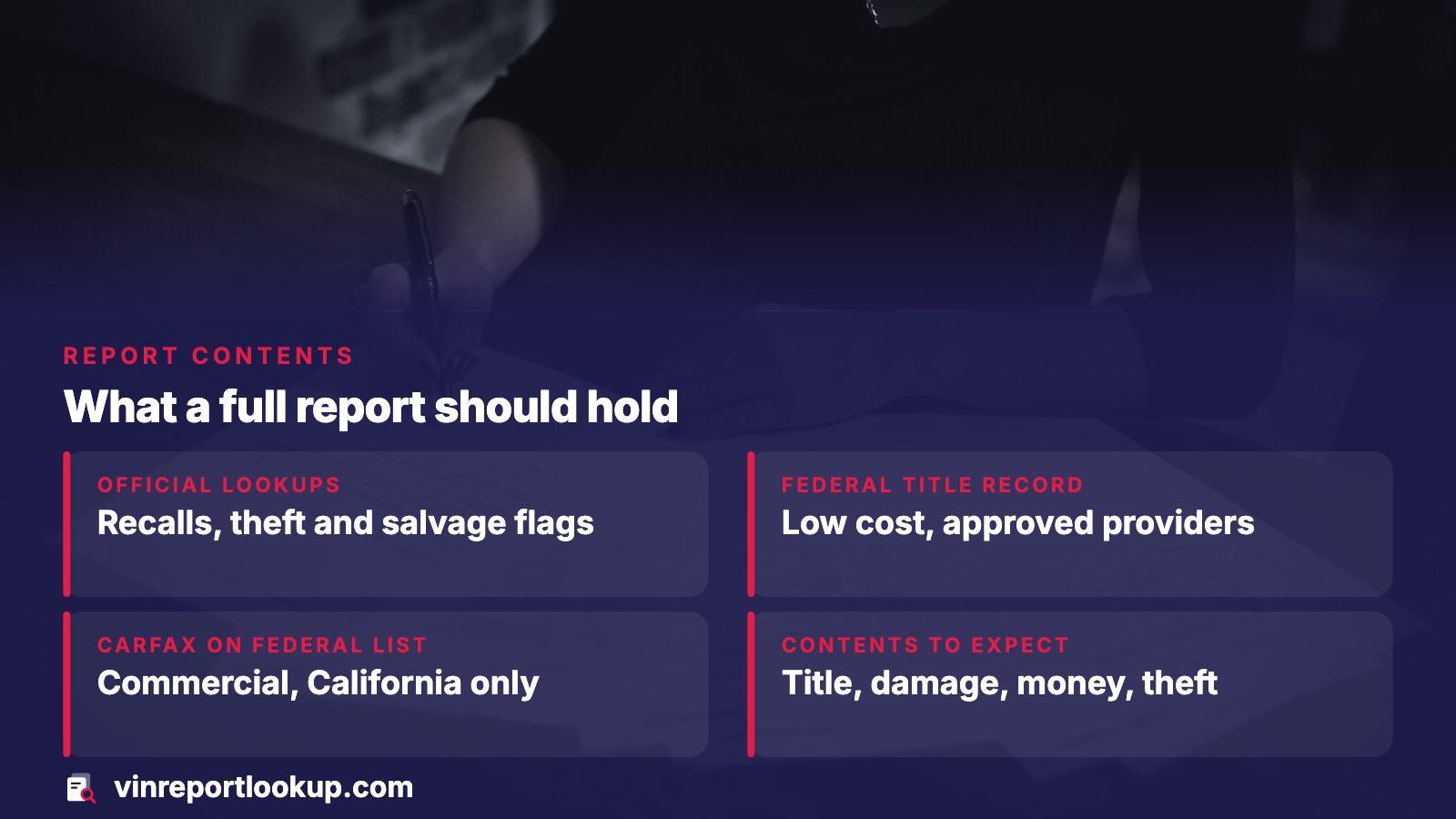
The Justice Department's Bureau of Justice Assistance publishes the businesses approved to sell records from NMVTIS, the federal title database. About a dozen may sell to the public. A separate group of six is approved for commercial customers only.
The commercial-only group matters most to a shopper. Carfax sits there, with an entry that limits its NMVTIS data to business customers in California, and Experian, the company behind AutoCheck, sits beside it. The page adds that consumers cannot receive NMVTIS reports from those firms, because they supply dealerships. That does not make their own reports weak. It means a private buyer does not get the federal title record from them.
What the list does not tell you
Approval means the federal title data inside a provider's report is genuine. It does not grade quality or promise good support or refunds. Some approved providers also run extra storefronts selling the same federal data, so two sites can be one approval in two layouts.
How reports charge, and what to look for at checkout
Prices follow the data. Official lookups cost nothing, a federal title record costs a few dollars, and full histories from commercial networks cost more, with a wide spread. VINReportLookup works differently: enter a VIN, read the free preview, and pay only if the car stays on your list.
After that it is one payment per report. Shopping between several cars? Bundles of 3, 5 or 10 cost less per VIN. There is no subscription to remember to cancel. The pricing page lists the current amounts.
- The checkout shows a total and calls it a single or one-time charge.
- The fine print never mentions a trial, renewal or monthly billing.
- A sample report is readable without paying.
- The included records are described before the payment step.
Running the check on the car you plan to see
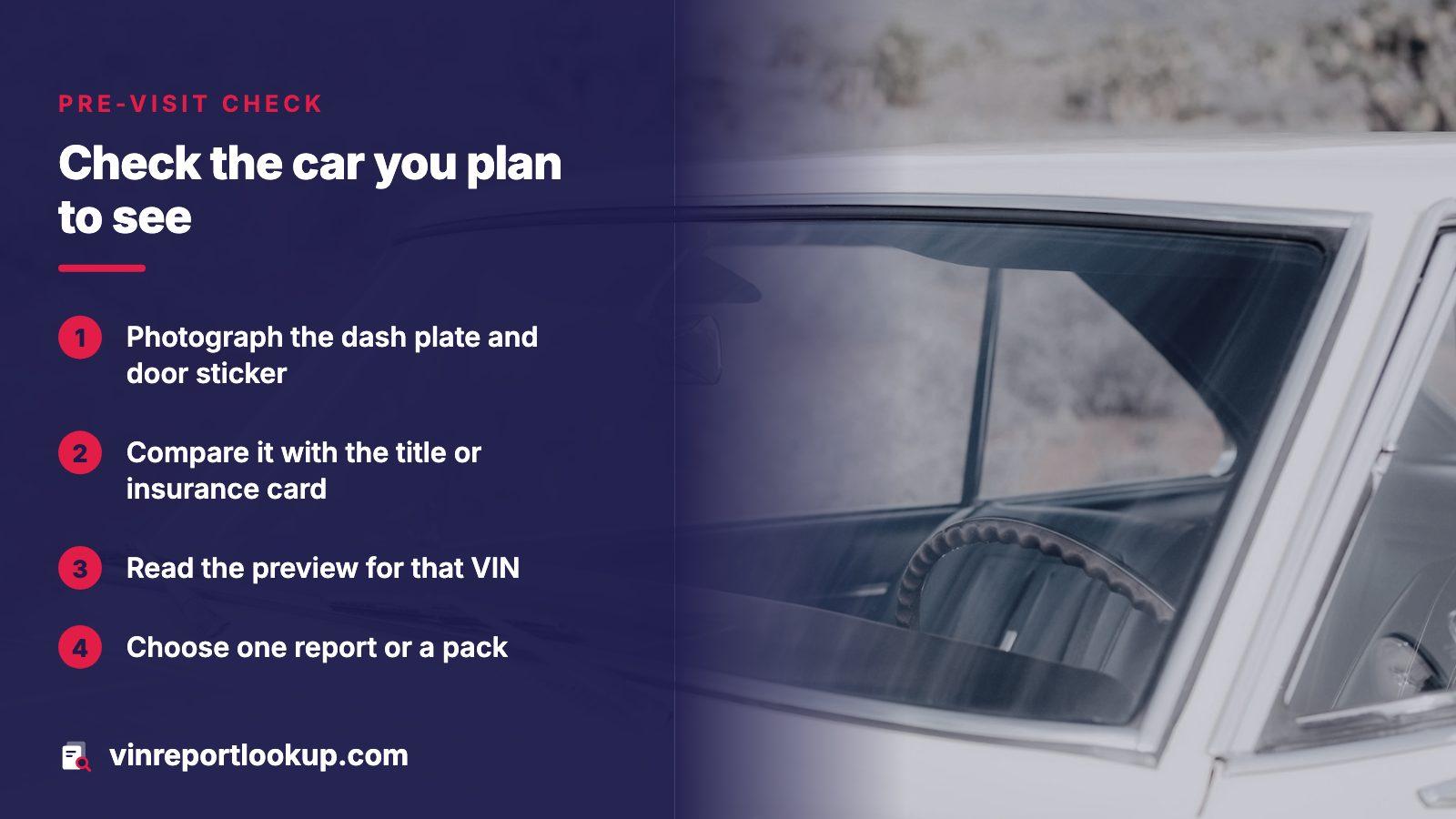
You need the 17-character VIN, and it is worth reading it off the car rather than trusting the listing.
- Take a photo of the dash plate and another of the door-jamb sticker; both VINs must match.
- Compare it with the title, the registration or the insurance card. If the characters differ anywhere, stop and ask the seller why.
- Type it into the VIN box on this site and read the preview.
- Decide whether to buy one report for this car, or a pack if two or three cars are still in contention.
Meanwhile, open NHTSA's recall page and NICB's VINCheck in other tabs. Both take seconds. An open recall is work the manufacturer does at no charge, so ask whether anyone has booked it.
Reading the result: entries that should change your plan
| Entry in the report | What it can mean | Your next step |
|---|---|---|
| Title brand | A state or insurer has labeled the car, for example as salvage | Weigh the discount against the repair history, then inspect |
| Odometer reading lower than an earlier one | A rollback, a replaced cluster or a keying error | Ask for repair or replacement paperwork |
| Insurance or total-loss record | An insurer paid on a claim or wrote the car off | Find out what was fixed and by which shop |
| Auction or salvage photos | Visible damage the listing never mentioned | Compare the photos with the car's panels, gaps and paint |
| Lien or impound entry | A lender may still hold a claim, or authorities held the car | Get the lien release in writing before paying |
| Open recall | A safety repair nobody has done yet | Book the repair with a franchised dealer before you buy |
| Rental or taxi use type | Harder use than a private owner gives | Factor the wear into your offer and inspect |
One entry rarely settles a deal. Two or three together usually do.
A buying order that wastes the least money, and what reports miss
Reports describe what somebody reported. Repairs paid in cash, damage nobody claimed and worn suspension parts leave little or no trace, so a clean report lowers risk without removing it.
- Decode the VIN and check recalls with NHTSA, then run NICB VINCheck. Both cost nothing.
- Run the preview for each car still on the shortlist.
- Buy the full report for the one or two cars you will actually go and see. A pack covers a longer list.
- Have an independent mechanic go over the car you are ready to buy.
The report tells you what the car has been through. The inspection tells you what condition it is in now.
Where this information comes from
- Bureau of Justice Assistance: NMVTIS approved data providers — The government's list of who may sell federal title records to the public and who serves commercial customers only, including the Carfax and Experian entries.
- NHTSA: Recalls — The safety agency's lookup of open recalls by VIN, which costs nothing and leads to a no-charge repair.
- NHTSA: vPIC VIN decoder — Decodes factory build and specifications from a VIN, the first layer of any check.
- NICB: VINCheck — A theft and salvage screen to run before spending anything.
Sources and photos: Facts checked against the sources above in November 2026. Photos by Richard R, Wesley Tingey and Dimitri Karastelev on Unsplash; diagrams by VINReportLookup.
Keep reading
- Carfax alternatives: what each VIN report option covers and costsA closer look at each rung of the ladder when Carfax is the starting point.
- Vehicle history report cost: what each kind charges and coversWhy report prices spread so widely and what the extra money buys.
- Sample reportA worked example showing every section of a full report.
- PricingThe single-report price, and how a bundle of three, five or ten lowers it per car.
Frequently asked questions
Which VIN check should I use on a used car?
Use the one whose records match your question at the lowest cost. Start with NHTSA's decoder and recall lookup and NICB's VINCheck. Then buy one history report for a car you plan to view, since only a report shows title brands, odometer readings and accident records. VINReportLookup puts a free preview ahead of one payment.
Is a free VIN check enough for a used car purchase?
Only for some questions. The official lookups return the factory build, open recalls, and theft and salvage flags, and no paid report improves on those. They do not show title brands, odometer readings, accident detail or auction photos, which come from records that cost money. Run them first, then pay for the history.
Do all VIN check sites use the same data?
No. Providers approved for the federal title record sell the same underlying records, so they differ mainly in layout and price. Commercial networks add their own feeds, and coverage varies with who reported what. If a service is not on the Justice Department list, ask what it is selling before you pay.
How much does a VIN check cost?
Official lookups cost nothing, a federal title record costs a few dollars and premium history reports cost more. At VINReportLookup the free preview comes first, then a single payment per report, with a pack option for a shortlist. The pricing page has the current amounts, and nothing renews.
Does a VIN report replace a mechanic's inspection?
No. A report describes what was recorded about the car, such as brands, accidents, odometer readings and recalls. Repairs paid in cash and wear nobody logged do not appear. An independent mechanic examines the car itself, so use the report to pick cars to inspect and the inspection to decide whether to buy.
Now check the car itself
The guide explains what to look for. The report shows what this VIN has on record.