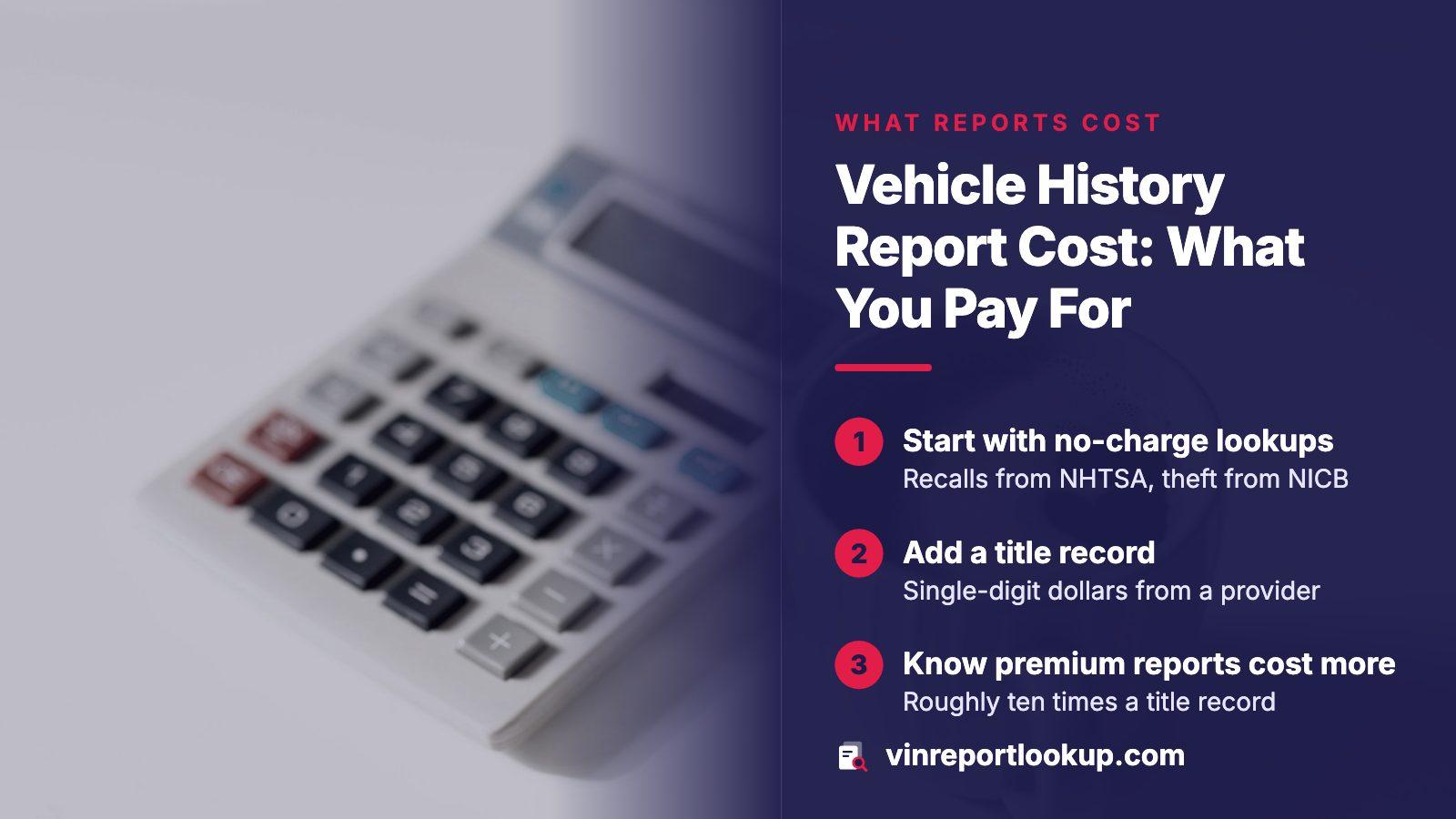
THE SHORT ANSWER
Expect no charge for NHTSA recall and NICB theft lookups, single-digit dollars for a title record from an NMVTIS provider on the federal approved list, and about ten times that for Carfax or AutoCheck. VINReportLookup works differently: you see a preview at no cost, then buy once, either one report or a bundle sized for several cars. Nothing renews; see the pricing page for amounts.
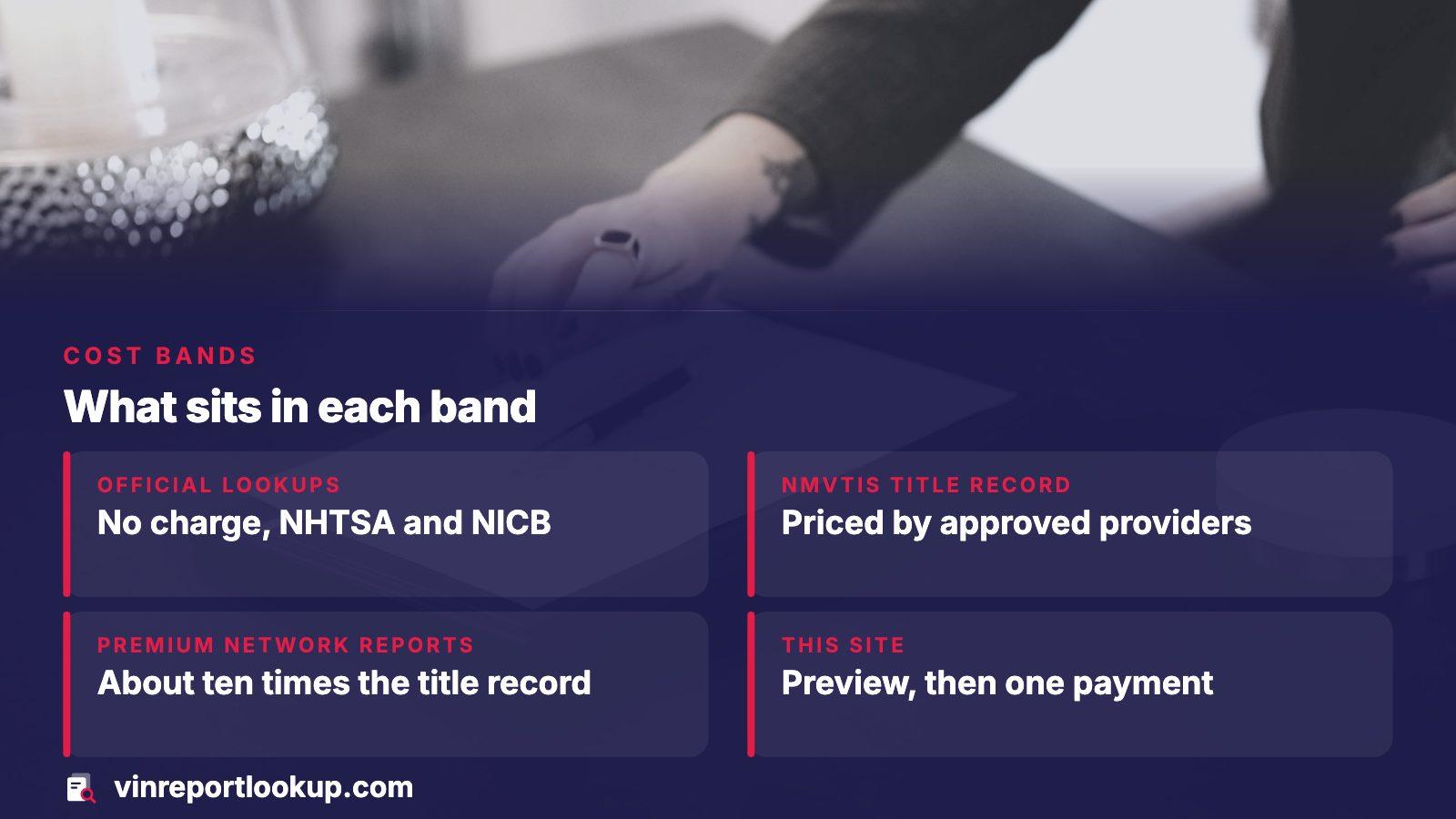
- Official lookups
- No charge, from NHTSA and NICB
- NMVTIS title record
- Single-digit dollars from an approved provider
- Premium network reports
- About ten times the title record
- VINReportLookup
- Free preview, then one payment, no subscription
Three price bands, and where this report sits
Sort any report by where its records come from and the prices stop looking random.
| Band | Typical charge | Records behind it |
|---|---|---|
| Official lookups | No charge | NHTSA recalls, NICB theft and total-loss flags, and a few state tools |
| Title record from an NMVTIS provider | Single-digit dollars | The federal title system, which carries brands from state to state |
| Premium network report | About ten times the title record | Carfax and AutoCheck: service visits, accidents, auctions, owners |
| VINReportLookup report | One payment after a free preview, listed on the pricing page | Title, damage, odometer, auction, lien, theft, insurance, recall and value records |
Treat the figures as ranges, since each provider sets its own. The costly errors sit at both ends: paying for what an agency hands out, and skipping the title record on a car worth thousands.
What a VINReportLookup report shows about the car
- Damage and loss: accidents and damage entries, salvage and auction history with photos, theft records.
- Paperwork: title brands, liens and impounds, and insurance records.
- The car itself: odometer readings, ownership and use type, open recalls, its factory specs and an estimate of market value.
The free preview comes before any payment. It confirms year, make, model and trim, gives the open recall count, and counts the title and auction records on file, which is enough to show whether there is anything to read.
It is not a dealer service log. If a maintenance history would change your offer on one particular car, that is where a premium report earns its price.
Finding the VIN and running the check
- Locate the 17-character VIN: the label at the driver's-side dashboard corner, visible through the windshield, the sticker on the driver's door frame, or the title, registration or insurance card.
- Compare it with the VIN in the ad. If the two differ, get an explanation before going further.
- Enter it in the box on this site and read the preview: vehicle details, open recalls, and title and auction record counts.
- If the car is still a contender after the preview, buy the report, or a pack when you are weighing several.
Position ten of a VIN gives the model year, so a listing that claims a different year deserves a question before you drive out.

Reading the result: entries that change the plan
The preview counts show where to look; the report shows what happened. These entries deserve a pause.
- Any title brand: ask when and why it was issued, and have a mechanic judge the repair.
- An odometer entry lower than an earlier one.
- Auction or salvage photos that do not match the car, or a sale the seller never mentioned.
- A lien or impound record. Get any lien cleared in writing before you pay.
- A theft record, which ends the discussion until the seller explains it.
- An open recall: seldom a reason to walk away, but one to sort out before you commit.
Check the date as well. A report reflects the day it was run, so an older copy can miss newer entries.
The no cost vehicle history report: what is genuinely free
Agencies and industry bodies run a few checks that cost nothing. Run them on every listing first.
| Check | Run by | What it covers |
|---|---|---|
| Recall lookup by VIN | NHTSA | Safety recalls still open on that exact vehicle |
| VINCheck | NICB | Stolen-vehicle and total-loss flags reported by member insurers |
| VIN decode | Decoders online | Factory build and specifications |
| State tools | Some states | Title status in some, such as Florida; California's Bureau of Automotive Repair publishes Smog Check history |
Paid reports mostly repackage the recall and theft parts, so buying those twice is the one pure waste. None of these show a salvage brand issued in a different state, which is the gap a title record fills.
A full history at no cost
A page that promises every record on any VIN without payment is usually a lead-capture form that takes your details and then sells you something. A preview differs: it outlines the record and keeps the detail behind a purchase.
Matching the report to the car and the stage of the search
Budget for the whole search, not one document: a dozen listings, a few drives, one purchase. Spending should rise as the list shrinks.
- Listings you have only read: official lookups and the free preview.
- Two or three cars you plan to view: a full report on each, which a pack of three covers.
- A price far below comparable ads: run the preview before you drive anywhere.
- A recent model at a premium price: the full report, plus a premium report if a service log would change your number.
- A report from the seller: read it, then run your own. The seller picked the vendor and the date, and you cannot rerun that copy.
A car only a year or two old has had little time to gather records, so a clean result there tells you less than the same result on an older car.
What it costs here: a free preview, then one payment
The preview costs nothing. If you continue, you pay once: a single report is one purchase, and packs of three, five or ten lower the cost per report when you are checking several cars. There is no subscription, so nothing renews. The pricing page lists the current amount for each option.
Read the checkout, not the headline
Some services price one report near a month of unlimited access, or roll a trial into recurring billing. Scan any payment page for the words trial, renews and subscription before entering a card.
After the report: the mechanic and the Buyers Guide
The Federal Trade Commission notes that accidents and flood damage can show up in a history report, but mechanical problems typically do not. It recommends an independent mechanic's inspection, even on a car the dealer calls certified, with a written report listing make, model, VIN and repair estimates to negotiate with.
Every used car at a dealer carries a Buyers Guide marking it as sold with a warranty or as is, which no VIN report can settle. Anything promised aloud should be put in writing.
When a car is still in the running, enter its VIN and read the free preview. Buy the full report only when the record counts justify it.
Where this information comes from
- Bureau of Justice Assistance: NMVTIS approved data providers — Names the providers that sell federal title reports and says which well-known brands do not sell them to consumers.
- NHTSA: Recalls — The regulator's VIN lookup for open safety recalls, which costs nothing to run.
- NICB: VINCheck — A theft and total-loss lookup drawn from participating insurers, usable before any money is spent.
- FTC: Buying a Used Car From a Dealer — Source for the inspection advice and for the Buyers Guide a dealer must display.
Sources and photos: Facts checked against the sources above in November 2026. Photos by Ben Wicks, Justin Cron and Annika Wischnewsky on Unsplash; diagrams by VINReportLookup.
Keep reading
- Carfax alternatives: what each VIN report option covers and costsProviders that sell below premium prices, and how their reports compare.
- AutoCheck vs Carfax: which VIN report to buy, and when to buy bothHow the two premium networks differ before you pay either.
- Sample reportA worked sample showing each section of a full report.
- PricingWhat one report costs today, and what each pack size costs.
Frequently asked questions
What should I budget for a vehicle history report?
Official recall and theft lookups cost nothing, a title record from an NMVTIS provider runs single-digit dollars, and Carfax or AutoCheck cost roughly ten times that. VINReportLookup bills once after a free preview; the pricing page lists amounts for one report or a pack.
Is there a no cost vehicle history report?
Only parts of one. Recall and theft lookups from official sources cost nothing, and some states publish title or emissions records. Full title records are a paid product, so a site offering them at no charge is usually collecting your details. VINReportLookup gives a free preview and sells the full report.
Is a car history report worth paying for?
On a car priced in the thousands, usually yes, because title and damage records are things a test drive cannot show. Read the preview first, buy the report once a car is a serious candidate, and still hire a mechanic, since reports record events rather than the condition of parts.
Why do Carfax and AutoCheck cost so much more?
The money pays for a private network of dealers, repair chains, insurers and auctions rather than a database lookup. The federal approved-provider list marks Carfax and Experian as unavailable to consumers for NMVTIS reports, so the premium is not buying federal title access.
Is it better to pay for a report before viewing the car?
Yes. A report costs less than a wasted trip, and a branded title or open lien is easier to handle from home. Use the official lookups and the preview on every listing, buy the full report for cars you will view, and keep the mechanic for after the viewing.
Now check the car itself
The guide explains what to look for. The report shows what this VIN has on record.