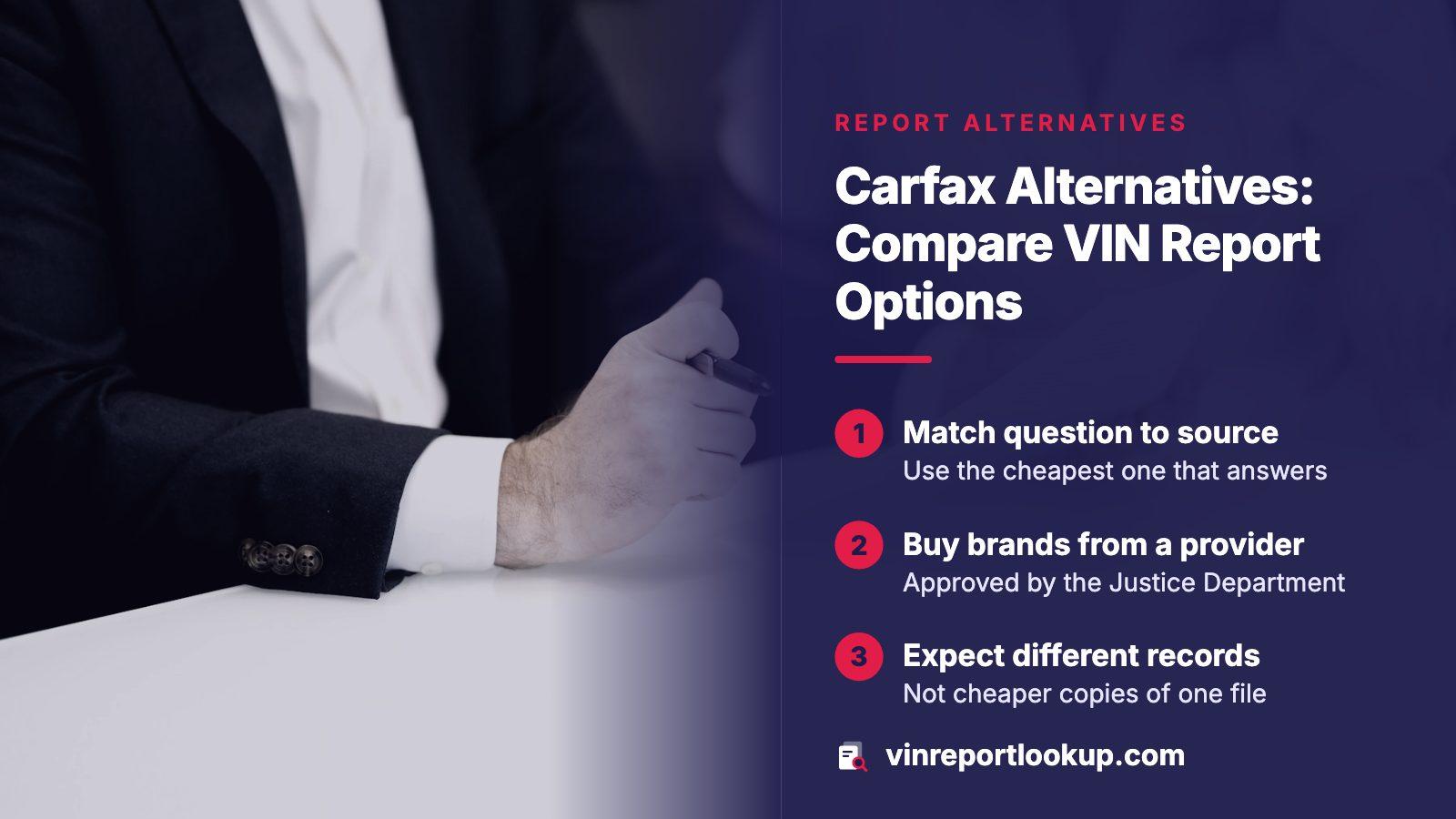
THE SHORT ANSWER
For title brands, buy a title record from an NMVTIS provider that the Justice Department approves. For accident, damage, auction and theft history in one document, a one-time VINReportLookup report follows a free preview. For a premium commercial history with service records, AutoCheck is the nearest rival to Carfax and costs more. Recall and theft flags from NHTSA and NICB cost nothing. No honest service gives away a complete history.
- Official lookups
- Recalls from NHTSA, theft and total-loss flags from NICB, no charge
- Title record
- A few dollars from an NMVTIS approved provider
- Carfax on the federal list
- Commercial customers only, California only
- VINReportLookup
- Free preview, one payment, no subscription
Match the question to the cheapest source that answers it
People type "Carfax alternative" when they mean one of several different things. Name your question first, and the cheapest correct source usually becomes obvious.
| What you need to know | Where the answer lives | Cost pattern |
|---|---|---|
| Does the car match the ad? | A VIN decode from NHTSA | No charge |
| Do safety recalls remain unrepaired? | NHTSA's lookup by VIN | No charge |
| Is the title branded? | A title record bought from an approved NMVTIS provider | A few dollars |
| Was it reported stolen or written off? | NICB VINCheck, then the title record | No charge, then the small fee |
| Accidents, salvage photos, liens, insurance entries? | A paid history report | One payment per report |
| Dealer service visits? | A premium network report | The highest of these |
| Is it mechanically sound? | An independent mechanic | An inspection fee |
What each option includes, side by side
Compare the contents before you compare the prices, because the options are built from different records.
| Option | What is inside | What is missing |
|---|---|---|
| Federal and nonprofit lookups | Factory build, open recalls, theft and salvage flags | Title brands, accident and ownership records |
| NMVTIS title record | Brands, plus the odometer readings logged when a title changes hands | Detailed accident and service records |
| VINReportLookup report | Title brands and odometer readings, accident and damage entries, auction photos where they exist, and flags for liens, theft and open recalls, with a market value to weigh against the asking price | Dealer service logs |
| Carfax or AutoCheck | Accident, service and ownership detail gathered from dealers, garages and auctions | Anything those businesses never reported |
Why alternatives draw on different records, not cheaper ones
Shopping for a cheaper copy of Carfax assumes every report draws on the same records. It does not. The federal title system fills up because state agencies and insurers are required to report into it, so its coverage is complete in a narrow field.
Commercial history networks run on voluntary feeds from dealers, repair shops and auctions, so coverage depends on who signed up. The gaps are invisible from outside, because a report cannot list the garage that never sent it anything. Pick the dataset that answers your question, then pay as little as you can to reach it.
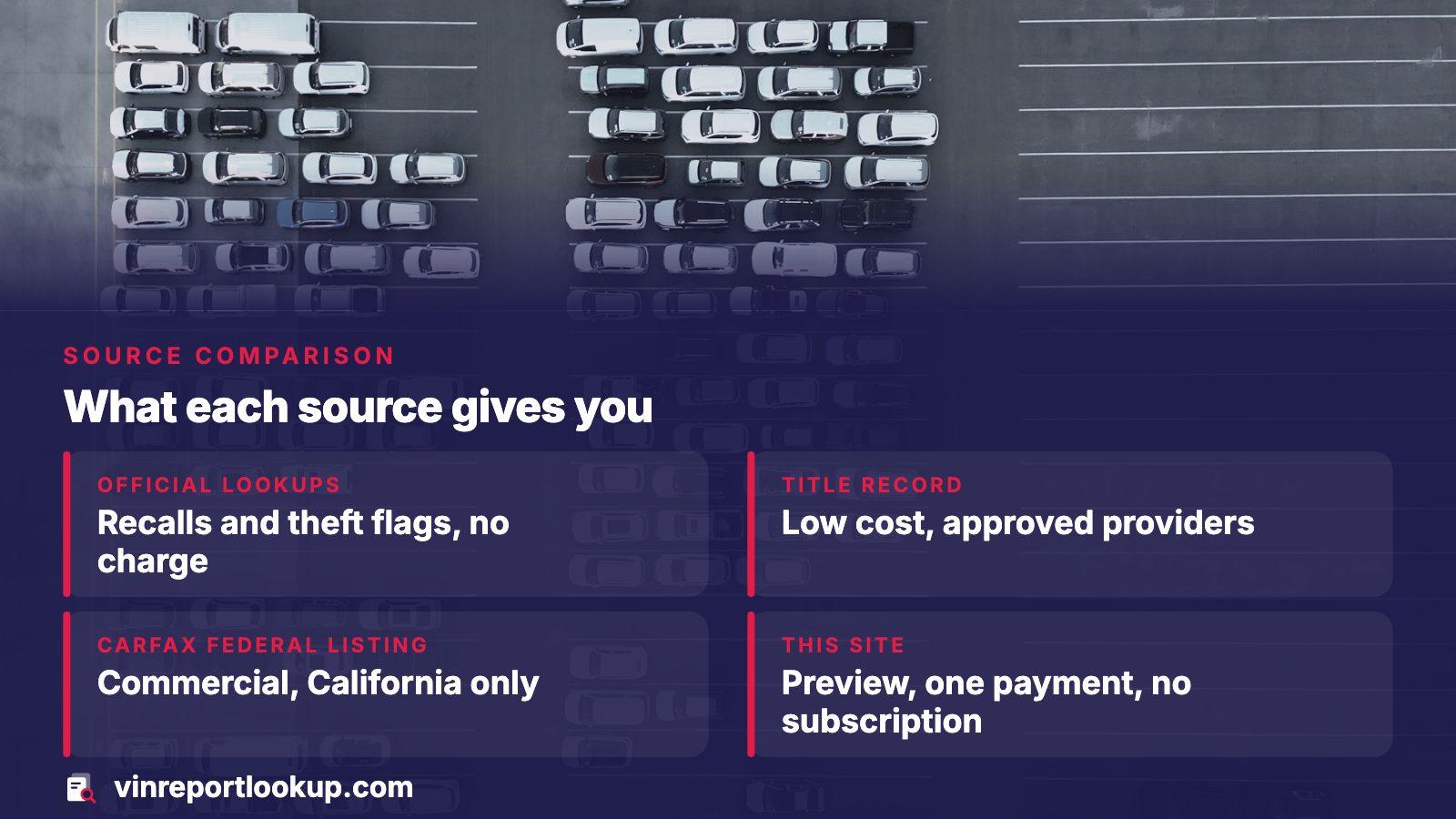
Carfax and AutoCheck on the federal approved-provider list
Read the Justice Department's approved-provider list for NMVTIS before assuming a famous brand sells you the federal title record. CARFAX.com sits under a commercial-only heading, and its entry limits that data to business customers in California. Experian.com, the company behind AutoCheck, appears in the same commercial-only group.
A standing note on the page says private buyers cannot get title reports through Carfax or Experian, because both serve dealerships only. That says nothing about the rest of what those companies sell. It only means the federal title record is not what an individual buys from them.
Check it yourself
Anyone can open the list, and reading it takes about ten seconds. This page was checked against it on the update date shown above. Providers can be added or dropped, so read the list on the day you buy.
How the options charge, and where this site fits
Pricing follows the same tiers. Official lookups cost nothing. A title record from an NMVTIS provider costs a few dollars per report. Carfax and AutoCheck sit in a premium tier above that.
VINReportLookup works differently from all three. You enter a VIN, read a free preview, and pay only when the car is still a contender. A single report is available, and so are bundles of 3, 5 or 10 when you are weighing a shortlist. Nothing renews, so no cancellation is ever needed, and the pricing page has the up-to-date amounts.
One report or a plan?
Some sites present a subscription as a single report. Before you enter card details, look at the checkout for the words trial, renews and monthly, and confirm the amount shown is the total.
Vetting a lower-priced provider before you pay
Cheaper services exist and some are good value, but many resell federal title data in a different layout. That suits you when brands are all you need. It is not a commercial history, and a seller of title data alone cannot show accidents that never reached the title system.
- Ask what the provider sources, in plain terms, before any payment.
- If it claims federal title data, find it on the Justice Department list yourself rather than trusting a badge on a landing page.
- Look for a published sample report. One that appears only after checkout is a poor sign.
- Be wary of coverage described only after you pay.
- Confirm the checkout shows a one-time charge, not the first month of a plan.
Try a service on a car whose history you already know
Any page ranking these options, this one included, depends on your trusting a service you have never tried. A cheap test: pick a car you know well, such as yours, a family member's, or one you sold recently, and run its VIN.
You know whether it was in a collision, roughly what the odometer read at its last sale, and whether it ever carried a brand. Compare that with the output. A perfect match is not the goal, since records are never complete. What matters is whether the service finds anything on a car that plainly has history. If it hands back a spotless report for a car you know was hit from behind, its silence is worth little on any other VIN.
Reports you may be handed, and how to check them
Before buying anything, find out whether a report already exists. Dealers often provide one on cars they stock, a seller who ran one may share it, and some certified pre-owned programs include one. A copy handed to you is evidence about one VIN on one day, so check three things.
- The VIN on the report matches the car in front of you, character for character.
- The run date is recent. A year-old report is a year out of date.
- Who ran it and with which service. The seller chose both.
Reading the seller's copy costs nothing. Running your own on a car you are serious about costs a little and removes the question of what changed since.
What no report replaces, and a sensible order of steps
Every report in every tier describes what somebody reported. Cash repairs, unclaimed damage, deferred maintenance and corrosion often leave no record at all. An inspection by an independent mechanic runs about the price of a premium report, yet it examines the car itself rather than its paperwork.
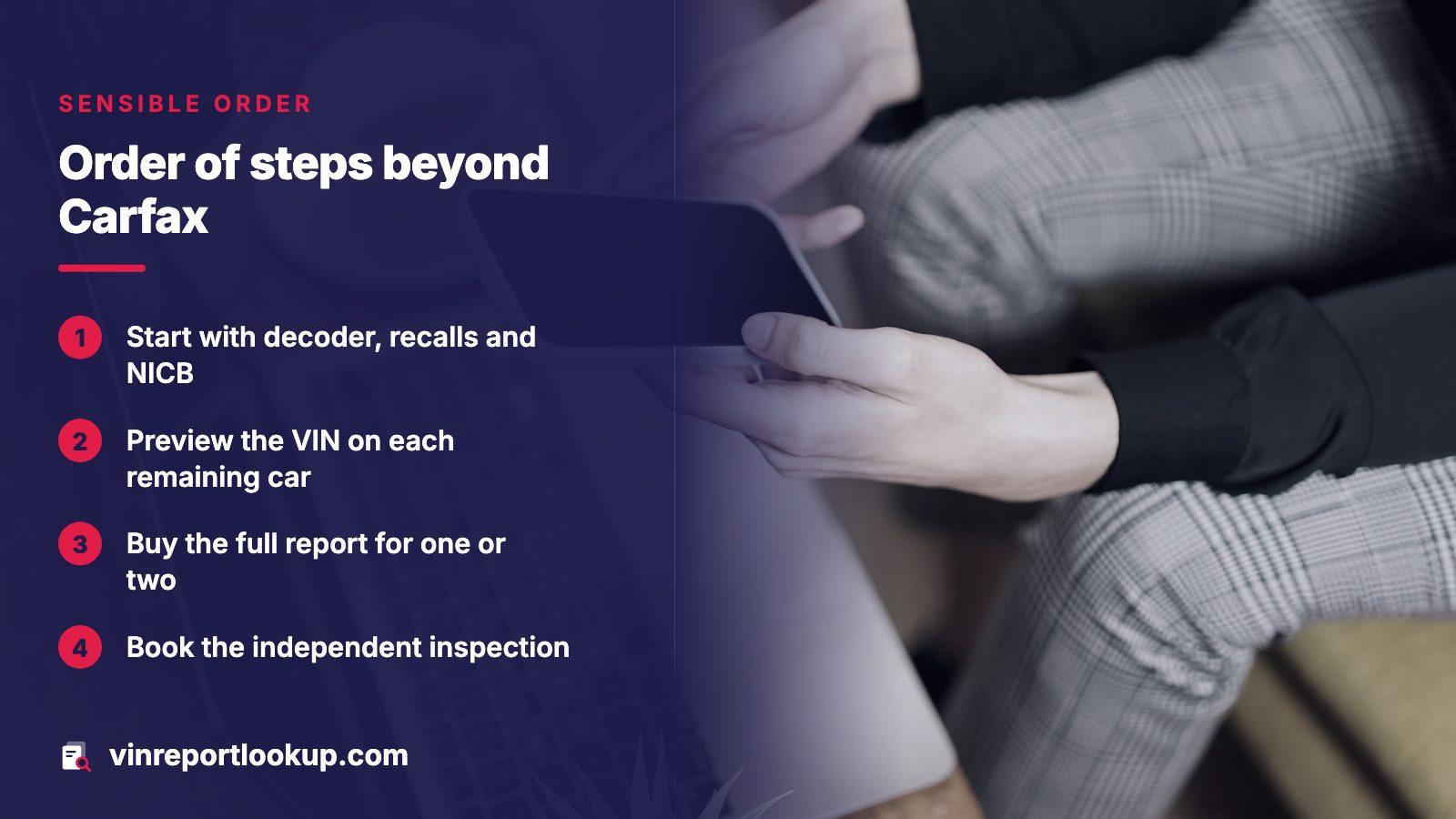
- Start with the VIN decoder, NHTSA's recall lookup and NICB VINCheck, which allows five searches a day.
- Enter the VIN for a free preview on each car still in the running.
- Buy the full report for the one or two cars you plan to view. A pack covers a shortlist.
- Book the independent inspection for the car you are ready to buy.
Where this information comes from
- Bureau of Justice Assistance: NMVTIS approved data providers — Shows which providers may sell the federal title record to the public and which, including Carfax and Experian, serve commercial customers only.
- NHTSA: Recalls — The regulator's open-recall lookup by VIN, usable without an account.
- NHTSA: vPIC VIN decoder — Factory build details for a VIN, to confirm the car matches its listing.
- NICB: VINCheck — A theft and salvage lookup fed by participating insurers, limited to five searches a day.
Sources and photos: Facts checked against the sources above in November 2026. Photos by Carrie Allen www.carrieallen.com, Jakub Żerdzicki and Iain on Unsplash; diagrams by VINReportLookup.
Keep reading
- AutoCheck vs Carfax: which VIN report to buy, and when to buy bothHow the two premium networks differ before you pay either.
- Vehicle history report cost: what each kind charges and coversWhat each kind of report charges and why the prices spread so far.
- Sample reportA worked sample showing what a full report contains.
- PricingThe pricing page has one-report amounts and the amounts for packs of three, five or ten.
Frequently asked questions
Is there a free alternative to Carfax?
Partly. NHTSA offers a recall lookup and a VIN decoder at no charge, and NICB VINCheck flags theft and total-loss records from member insurers. Accident, ownership and service detail is licensed data, so no genuine free equivalent exists. VINReportLookup shows a free preview of a VIN, then sells the full report as a single payment.
Is AutoCheck a good Carfax alternative?
Yes, as the nearest like-for-like option, since both are premium commercial reports. Each compiles from its own reporting network, so neither holds everything the other does. Choosing between them comes down to whether service records or auction coverage matters more for the car you are checking.
Can I buy the NMVTIS title record from Carfax?
Not as an individual. The Justice Department list puts CARFAX.com in its commercial-only group, with a California-only note, and warns that private buyers cannot get federal title reports through Carfax or Experian. Use a provider listed for public customers instead. Carfax sells other products, and this says nothing about them.
Which VIN check site is the most reliable?
Reliability depends on the claim. For title brands, look to an NMVTIS record from a provider the list marks for public customers. For open recalls, go to NHTSA, and for theft and salvage flags, to NICB. A paid site is reliable to the extent it can say where its data comes from, and a published sample report helps.
Do alternatives show the same accident records as Carfax?
Not necessarily. Each commercial network is built from businesses that choose to report, so one service can hold an entry another never received. A clean result can mean a clean car or thin coverage, and the two look identical on the page. That is why a test on a known VIN and an inspection are worth the effort.
Now check the car itself
The guide explains what to look for. The report shows what this VIN has on record.