THE SHORT ANSWER
For one car where maintenance history matters, Carfax is generally the stronger single purchase. For a shortlist, or a car that may have passed through auction, AutoCheck's score and auction coverage fit better. Neither report is a superset of the other, so on an expensive car the careful answer is both, plus an inspection. A one-time VINReportLookup report, bought after a free preview, is a third route when title, accident and salvage records are the question.
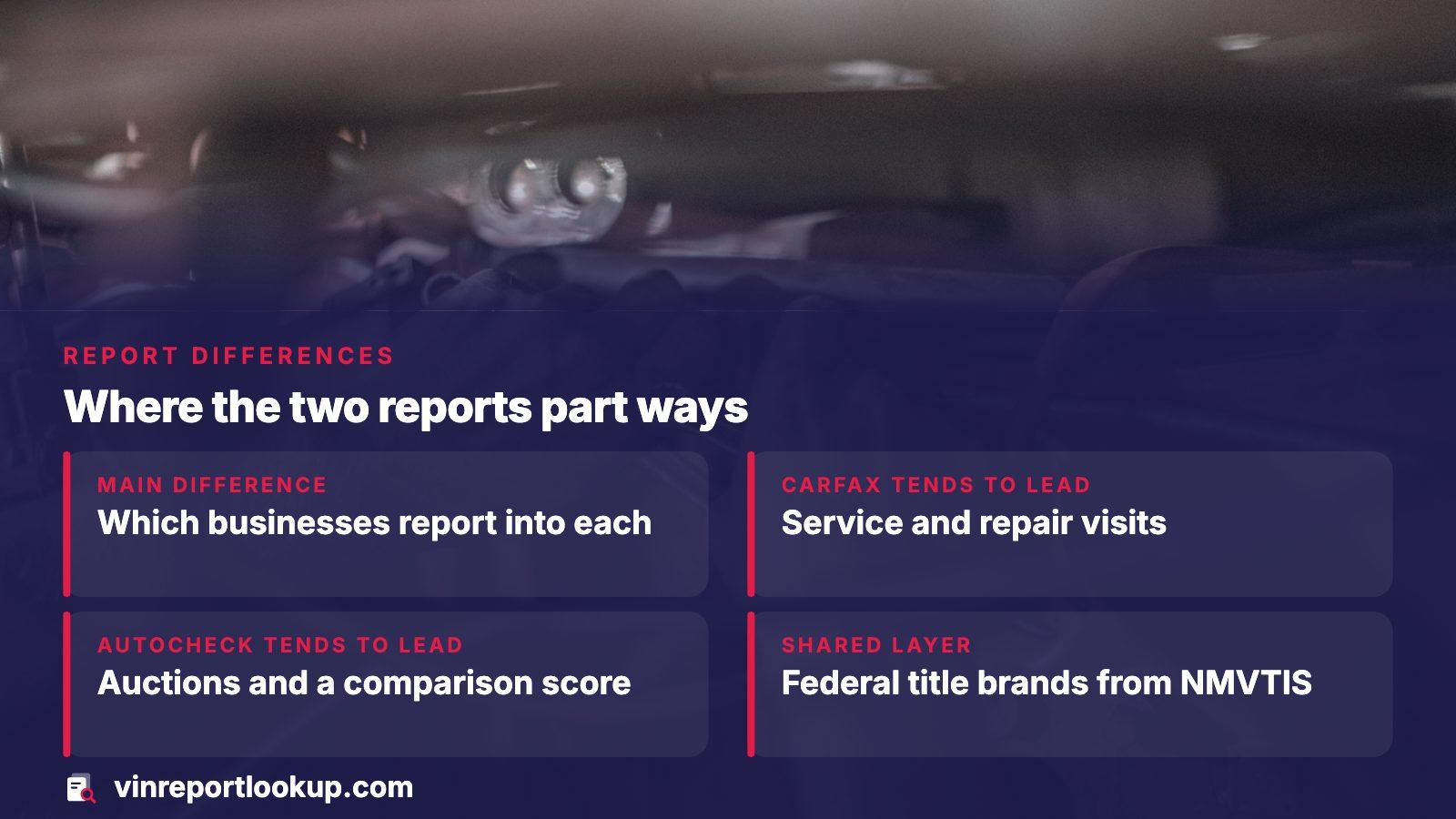
- Main difference
- Which businesses report into each service
- Carfax tends to lead on
- Service and repair visits
- AutoCheck tends to lead on
- Auction history and a comparison score
- Shared layer
- Federal title brands from NMVTIS
Why the two reports disagree: they hear from different businesses
A history report is not an investigation. It is a stack of entries that insurers, garages, dealerships, auctions and state agencies chose to send in. Carfax and AutoCheck, an Experian product, signed up different contributors, so the two stacks overlap without matching.
That is the buying problem. A spotless result from either company means only that nothing reached that company. A collision or an auction sale may sit in one file and not the other, which is why neither report can promise the full story.
Side by side: what each report is known for
Read these as tendencies. Both companies change what they collect.
| Area | Carfax | AutoCheck |
|---|---|---|
| Service and repair visits | Historically the wider network of shops and dealers, so a fuller maintenance timeline | Thinner on maintenance in the tests below |
| Auction history | Generally seen as the weaker side | Generally the stronger side, handy for ex-wholesale cars |
| Summary format | A record timeline, no headline number | A proprietary numeric score |
| Guarantee | Has offered a buyback promise for a missed title brand; read the current terms | Check its site for any equivalent |
Treat the AutoCheck score as a shortlist tool: it summarizes one provider's records, so a high number says little unusual was reported, not that the car is sound.
What Edmunds found when it ran both on the same cars
Spec sheets promise coverage; a test shows delivery. Edmunds ran both reports against the same vehicles.
- A 2014 Porsche Boxster from Florida: Carfax returned fifteen service records, AutoCheck only three.
- The same Boxster showed five owners on one report and three on the other. Carfax tallied dealers that took the car between private sales, while AutoCheck tallied buyers only.
- A 2017 Honda Accord carrying a salvage brand: AutoCheck listed two crashes, one a total loss declared by an insurer. Carfax listed the same two and added front-end damage dated November 2024.
- The newest AutoCheck entry for that Accord was dated July 2022, though the reports were run in December 2024.
That is two data points, and the lead could flip on another car. What carries over: neither report contained the other, and the newest events are likeliest to be missing from one.
A figure to skip
An exact overlap percentage for the two services circulates online, with no publisher, method, sample size or date attached. This page does not repeat it.
The federal title record: the layer under both, and not sold to you by either
Both sit on top of the National Motor Vehicle Title Information System (NMVTIS), where states file salvage, flood, junk and odometer brands. That layer is the same whichever report you buy, so it is not where they compete. The rule behind it, 28 CFR 25.53, lists five things the system must let a user establish. They concern title paperwork and the odometer disclosure at titling, not service history.
The Justice Department publishes the approved-seller list. The version read on August 17, 2026 put CARFAX.com in a commercial-only group, with a note limiting that data to business customers in California. AutoCheck's owner, Experian, sat in that group as well. A standing note warns that private buyers will not get these federal reports through Carfax, DMVDesk or Experian, since all three serve car dealerships.
That says nothing about their own consumer reports. If brands alone are your question, a provider approved for the public sells a title record for a few dollars.
What you pay: two premium reports, a title record, or one report after a preview
Prices move, so this page prints none. Look up Carfax and AutoCheck on their own sites the day you buy; a figure in an older article is stale. Both sit in the premium tier.
| Route | What you get | How it charges |
|---|---|---|
| Carfax | A service-heavy history | Per report, price on its site |
| AutoCheck | A score plus auction coverage | Price on its site, with packaging for many cars |
| NMVTIS approved provider | Title brands and the odometer entry made at titling | A few dollars |
| VINReportLookup | A free preview of the VIN, then the full report | Pay once: one report, or a set of 3, 5 or 10; no subscription |
Current amounts for each VINReportLookup option sit on its pricing page. Wherever you buy, read the checkout for the words trial, renews and monthly, and confirm the amount shown is the total.
Pick by the car, not by the brand
| Your situation | Better buy |
|---|---|
| One car, and maintenance history is the priority | Carfax |
| Cutting ten listings down to three | AutoCheck, for the score |
| The car looks like an ex-auction unit | AutoCheck |
| You only care whether the title is branded | A title record from an NMVTIS provider |
| You only want recalls and the factory spec | Neither; NHTSA's lookups cover both |
| Brands, accidents, salvage photos, liens and theft entries in one document | A one-time VINReportLookup report after the preview |
| An expensive car bought at a distance | Both, plus an inspection |
Model year shifts the answer. NHTSA owner complaints show when a known weakness tends to appear. For a 2010 Toyota Prius, service-brake complaints cluster at a median age of 0.1 years, with 72% filed inside three, so a used example is already past that window and a mechanic beats a second report. A 2016 Honda Pilot's engine complaints cluster at 7.4 years, only 8% inside three, so maintenance depth is worth paying for. These are complaints, not failure rates.
When buying both reports pays for itself
A second report is small money beside a missed collision. Buy both if any of these fits:
- The price is high enough that a hidden repair would sting.
- The car has been titled in several states, where reporting turns patchy.
- It may have been through an auction that only one service sees.
- One report looks cleaner than the odometer and model year suggest.
- The seller's account and the paperwork disagree on a detail.
- You cannot inspect the car yourself.
A mismatch is information
When one report has an accident the other lacks, keep the union of the entries, not just the overlap.
What neither report can see
Both services relay only what someone reported, and plenty of a car's history never gets reported.
- Body work paid for in cash, with no insurance claim.
- Minor crashes with no police report and no claim.
- Servicing at independent garages that feed neither company.
- Maintenance that was skipped, since a gap leaves no entry.
- Tire, fluid and brake wear today, plus rust underneath.
Hiring an independent mechanic to inspect the car costs about as much as one report and examines the car itself. If the budget allows only one of the two, pay for the inspection.
Before you pay for either: lookups and shortcuts
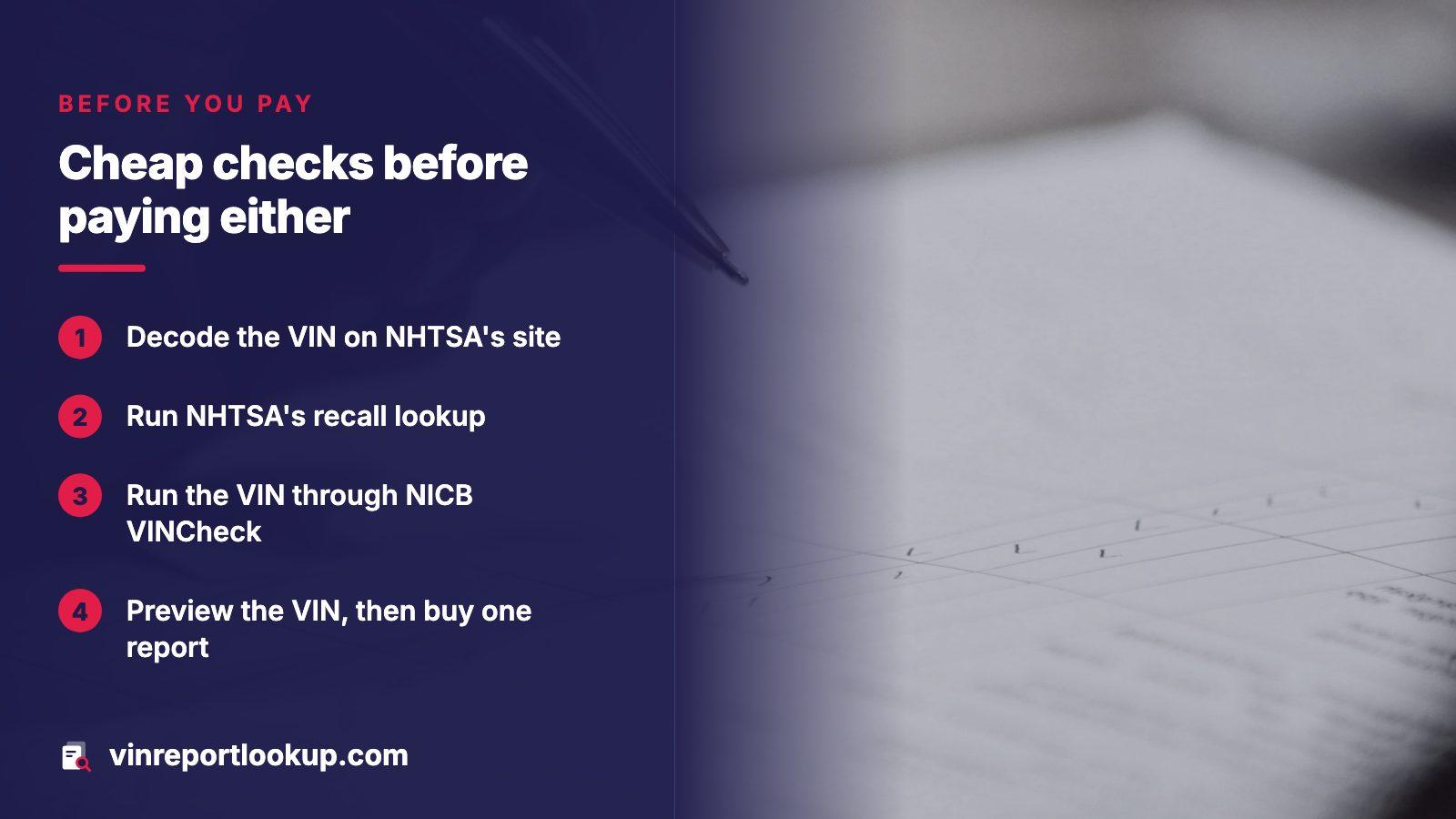
- Decode the VIN on NHTSA's site. If the result differs from the ad, stop there.
- Run NHTSA's recall lookup for open recalls.
- Run the VIN through NICB VINCheck, which flags theft and total losses at member insurers. It allows five searches a day, so a clean result is encouraging, not a clearance.
- If the car survives, enter its VIN here for the preview, then buy whichever report matches the table above.
Also ask whether a report exists already. Dealers often hand one over on stock they hold, a seller may share the one they ran, and some libraries and certified pre-owned programs include access.
Where this information comes from
- Bureau of Justice Assistance: NMVTIS approved data providers — The Justice Department's list of approved sellers, including the commercial-only group that holds Carfax and Experian.
- 28 CFR 25.53: what the national title record must let a user establish — The federal rule listing the five things the system supports, none of them service history.
- NHTSA: Recalls — The regulator's open-recall lookup by VIN, usable with no account.
- NHTSA: vPIC VIN decoder — Factory build details for a VIN, to confirm the car matches the listing.
- NICB: VINCheck — A theft and total-loss lookup fed by participating insurers, limited to five searches a day.
Sources and photos: Facts checked against the sources above in November 2026. Photos by Jakub Żerdzicki, Masjid MABA and Nina Mercado on Unsplash; diagrams by VINReportLookup.
Keep reading
- Carfax review: is the report worth buying, and what else to compareA closer look at what a Carfax report holds before you pay for one.
- AutoCheck review: when it earns its fee, what it misses, and what else to buyHow the AutoCheck score and auction coverage hold up on their own.
- Carfax alternatives: what each VIN report option covers and costsEvery option from official lookups to a one-time report, sorted by what it answers.
- PricingWhat one report and the 3, 5 and 10 bundles cost today.
Frequently asked questions
Is AutoCheck or Carfax more accurate?
Neither wins across the board, because each shows what reached it. A shop or insurer that reports to one may never report to the other. When they disagree, nobody has made an error, so treat the extra entry as real and verify it.
Why do the two reports show different owner counts?
They define an owner differently. In the Edmunds test, Carfax counted dealer stops between private sales and AutoCheck counted buyers only. Compare the dates of each ownership change, not the total.
Do I need Carfax or AutoCheck if I only want title brands?
No. Brands live in the federal NMVTIS record, which approved providers sell for a few dollars. Carfax and Experian sit in the Justice Department's commercial-only group, so buy the title record elsewhere and keep the premium reports for service and accident detail.
Can I get a Carfax or AutoCheck report without paying?
Often. Dealers frequently provide one on cars they stock, some libraries offer database access, and a seller who ran one may share it. Check the VIN character for character, check the date, and remember the seller picked the service.
How does VINReportLookup differ from these two?
You enter a VIN and read a free preview, then pay once if the car stays on your list. Its report covers title brands and odometer readings, accidents and auction photos, liens, theft, insurance, open recalls and market value. Nothing renews.
Now check the car itself
The guide explains what to look for. The report shows what this VIN has on record.