THE SHORT ANSWER
AutoCheck is worth buying when auction history is the unknown: it records how a car sold, how the loss was classed, where it was damaged and whether it could be driven. It is thinner on service visits, and its 1 to 100 Score is a dealer shortcut. Use free recall and theft lookups and a preview first, then buy it only if the car's story still has an auction-shaped hole.
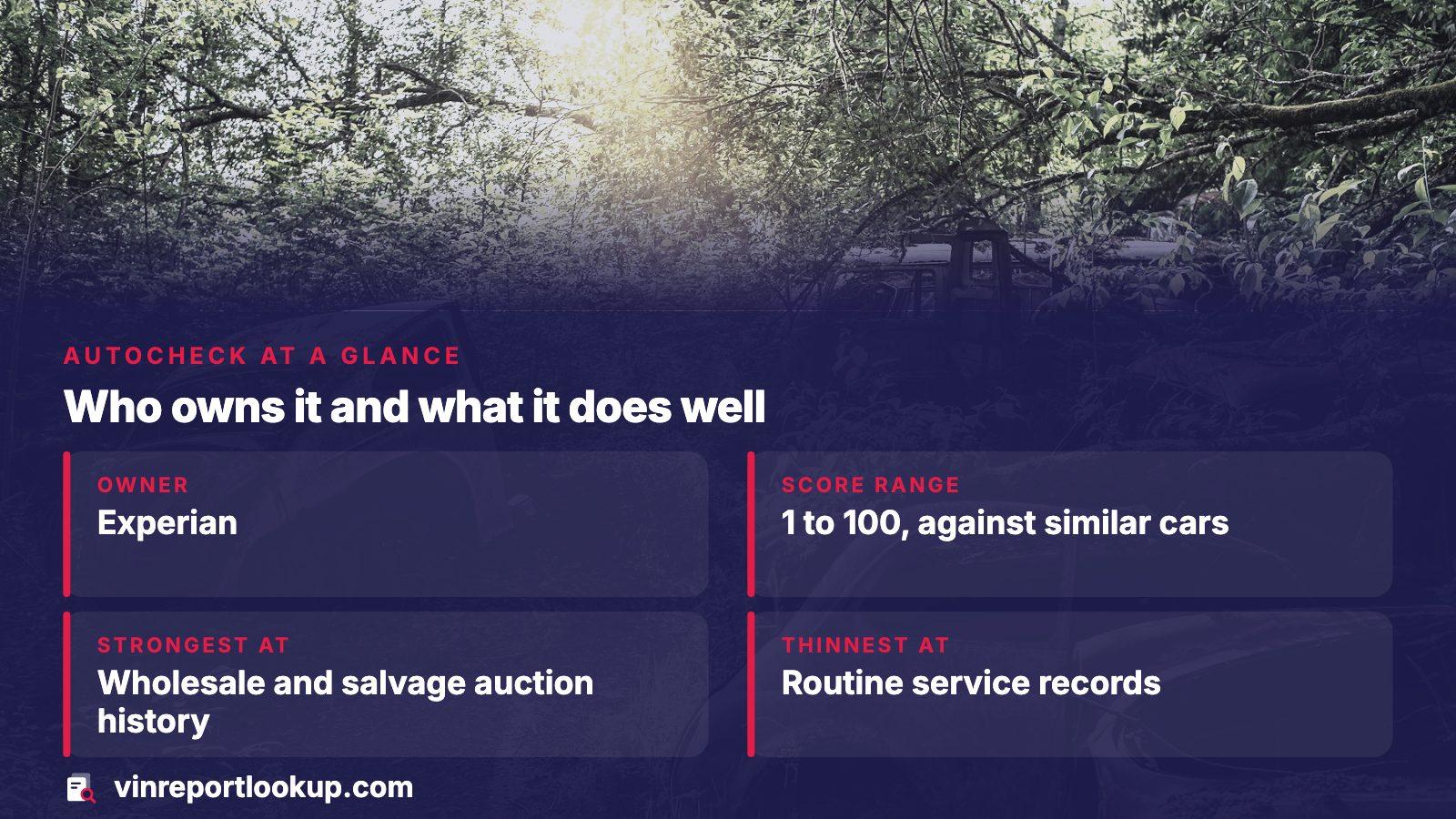
- Owner
- Experian
- Score range
- 1 to 100, shown against similar cars
- Strongest at
- Wholesale and salvage auction history
- Thinnest at
- Routine service records
Choose the report by the question still open
A history report is a purchase, and the surest way to spend less is to know what you are trying to find out. Recalls, theft and total-loss screens, federal title brands, service history and auction history each live in different places, and no single product is the best source for all five.
These are the situations in which AutoCheck's strength matters most:
- A price noticeably below comparable listings
- A seller who calls the car lightly used but cannot show where it spent the last year
- A dealer unit whose earlier life is blank on the paperwork
What the auction lines add
AutoCheck is known for wholesale and salvage auction coverage, tied to feeds such as Manheim and ADESA on one side and IAAI and Copart on the other. An entry carries the sale date, the recorded loss type, the primary damage area and a run-and-drive flag.
Those fields matter because they survive a clean-up. A car can be sold through a salvage lane, repaired, retitled and listed on a retail lot, and the paperwork the seller hands over may mention none of it. An auction line also puts a date on a wholesale purchase, which helps when a seller describes long family ownership and the car reached auction weeks ago.
The Score in a buying decision
Experian's Score is a figure between 1 and 100. It forecasts whether a car will still be driven five years on, measured against similar cars, and the report prints the usual range beside it. A 78 is encouraging when comparable cars land between 70 and 90, and unimpressive when they land between 40 and 60.
It was built so dealers could rank piles of cars in minutes. One buyer with one car has time to read the underlying entries, and those carry more weight than the number derived from them.
Facts outrank estimates
If a high Score sits beside a salvage-auction entry, trust the entry. It describes this car, while the Score describes a peer group.
Why one report is rarely the whole story
Edmunds published a test that ran AutoCheck and Carfax against the same vehicles. On a 2014 Boxster, Carfax returned 15 service records to AutoCheck's 3. Ownership differed as well, five owners against three, because one report counted each dealership that took the car in trade, and the other counted only the people who bought it.
A salvage-titled 2017 Accord showed the timing problem. Carfax listed front-end damage from November 2024 that AutoCheck lacked when both were pulled in early December 2024, with its latest incident dated July 2022. The damage may reach it later, which is the point: each report is a snapshot of what its network had received by that day.
| What the test showed | What to do with it |
|---|---|
| 15 service records against 3 on one car | Pick the report whose strength matches your worry |
| Five owners on one report, three on the other | Ask how each report counts owners before comparing them |
| Newer damage on one report only | Pull the report close to purchase and expect recent events to lag |
Experian's listing on the federal NMVTIS page
The Justice Department keeps a list of approved NMVTIS sellers, divided by who they may serve. AutoCheck is not listed under that name. Experian.com is listed, and only in the commercial group, not among providers cleared to sell to the public. Both are facts about a page, not judgments of the report's quality.
If the federal title-brand record is what you need, 11 providers are listed for consumers and their federal data is identical, so pick among them on presentation and cost. Use AutoCheck alongside that record rather than instead of it, since auction detail sits outside what the federal data carries.
What AutoCheck leaves out, and what every report does
- Routine service such as oil changes, which Carfax's dealer network records more densely
- Minor accidents fixed privately, with no insurance claim, police report or title event
- Warranty repairs done at a shop that sends records to neither network
- Who owned the car, since federal privacy law shields owner identity from providers
- How the car drives today, which only an inspection can measure
An independent mechanic closes the last gap. A history report, the federal title record and an inspection each catch problems the other two cannot. At a dealership, the FTC's guide to buying a used car explains the Buyers Guide and your rights, which no report covers.
Alternatives, side by side
| Open question | Where to look | Note |
|---|---|---|
| Is a safety recall unrepaired? | NHTSA recall lookup | Free, direct from the regulator, with any report |
| Was it stolen or declared a total loss? | NICB VINCheck | A free screen that sits outside both report networks |
| Does the federal title record show a brand? | An NMVTIS provider approved for the public | 11 are listed, all drawing on the same record |
| Was it serviced regularly? | Carfax | Denser service history in the Edmunds test |
| Did it pass through an auction lane? | AutoCheck, or a report with auction records and photos | Look for loss type, damage area and sale date |
A VINReportLookup report covers odometer readings and title brands, plus salvage and auction records with photos, accident and damage entries, liens and impounds, theft and insurance records, recalls that are still open, market value, factory specs, and ownership and use type. It does not match the service-visit depth Carfax is known for.
Single report, package or preview first
AutoCheck offers one-off reports and bundles of several, and the terms change, so confirm them with AutoCheck before you pay. A package pays off only if you will check several cars in a short window. The common mistake is buying a package, running one car and letting the rest lapse, so note any expiry date on the day you buy.
VINReportLookup starts with the preview, shown at no charge, and you pay only if the car stays in contention. Buyers can take a single report or step up to a bundle of three, five or ten, and nothing renews. Current amounts are on the pricing page. Enter the 17-character VIN to see the preview, then decide whether an AutoCheck on top is worth it.
Where this information comes from
- NMVTIS: approved data providers — The federal list that places Experian.com among commercial customers and names the providers approved for the public.
- Edmunds: AutoCheck vs. Carfax tested on the same vehicles — The Boxster and Accord comparisons, a dated hands-on test rather than an unattributed statistic.
- NHTSA: recalls lookup — Open recalls by VIN, direct from the regulator.
- NICB: VINCheck — A theft and total-loss screen that sits outside both report networks.
- FTC: Buying a used car from a dealer — The Buyers Guide and your rights when you shop at a dealership.
Sources and photos: Facts checked against the sources above in November 2026. Photos by Iain, Alejandro Escamilla and Patrick von der Wehd on Unsplash; diagrams by VINReportLookup.
Keep reading
- AutoCheck vs Carfax: which VIN report to buy, and when to buy bothThe head-to-head, for when you can only justify one premium report.
- Carfax review: is the report worth buying, and what else to compareThe same questions put to the other major report.
- Carfax alternatives: what each VIN report option covers and costsThe wider field of VIN report options and what each covers.
- Vehicle history report cost: what each kind charges and coversWhat each kind of report costs before you decide where to spend.
Frequently asked questions
Is AutoCheck worth the money?
It is worth it when auction history is the open question: a suspiciously cheap car, a possible salvage past, or a dealer car you suspect was bought at wholesale recently. It is worth less on a car from a long-term owner with a stack of service receipts, where maintenance records tell you more. Check current terms first, and skip a package for one car.
What counts as a good AutoCheck Score?
No single number is good everywhere. The Score runs from 1 to 100 and is read against the range for comparable vehicles, which the report prints beside it. A figure near the top of that range is a mild positive, but it never cancels a salvage or total-loss entry in the records.
Is AutoCheck the same as an NMVTIS report?
No. The Justice Department list shows Experian.com in the commercial-only group, and AutoCheck does not appear there by its own name. For the federal title-brand record sold to the public, use one of the approved providers on that list, then add AutoCheck if auction detail matters to your purchase.
Can AutoCheck miss an accident?
Yes. Any report shows only what reached its network by the day you pull it. In the Edmunds test, front-end damage from November 2024 appeared on Carfax but not on AutoCheck in early December 2024. Private repairs with no claim or police report may never reach either one.
Should I buy AutoCheck or run a preview first?
Start with the no-charge options: the NHTSA recall lookup, NICB VINCheck and a VINReportLookup preview. Then decide. If the car's story still has gaps, such as a price below similar listings or an owner who cannot explain the history, add AutoCheck for the auction detail.
Now check the car itself
The guide explains what to look for. The report shows what this VIN has on record.