THE SHORT ANSWER
A Carfax report is assembled from whatever repair shops, insurers, agencies and auctions choose to send in, so it is detailed on dealer-serviced cars and quiet where nobody reported anything. The Justice Department says Carfax does not supply the federal NMVTIS title record to consumers, and no report shows damage that was never reported. Run the no-charge recall and theft lookups first, buy the report that matches your open question, then inspect the car.
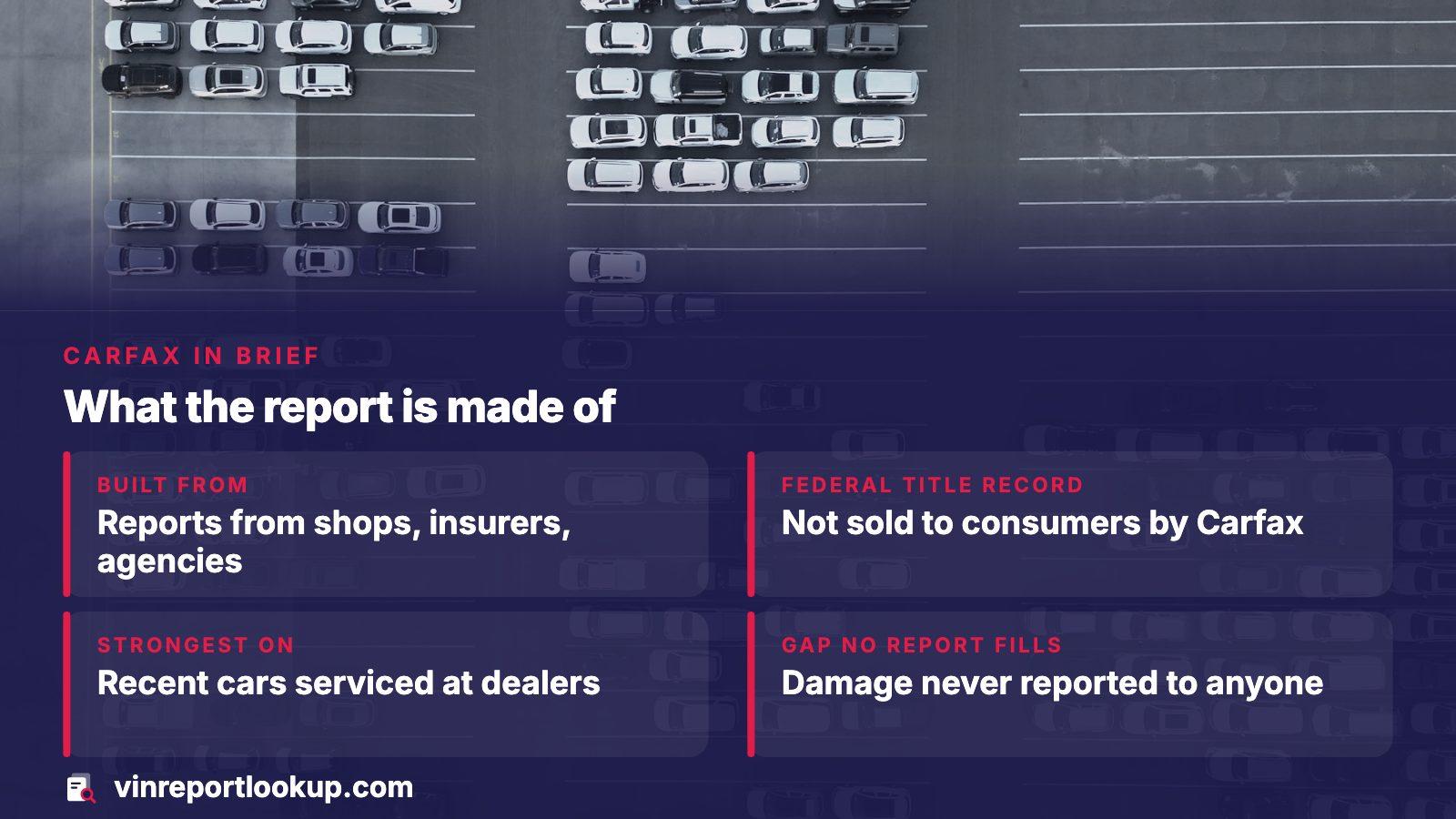
- Built from
- Records sent in by shops, insurers, agencies and auctions
- Federal title record
- Not sold to consumers by Carfax, per the Justice Department
- Strongest on
- Recent cars serviced at dealers
- Gap no report fills
- Damage that was never reported to anyone
What you are actually buying when you buy Carfax
A Carfax report is a summary of what one private company has been told about one VIN. Nobody is legally required to tell it anything. Repair shops, insurers, state agencies, auction houses, inspection stations and fleet operators send records when they have a relationship with it, and each relationship covers one slice of a car's life.
That is why two identical cars can read so differently. A vehicle serviced at businesses that report gets a long, dated history. One kept running by an independent mechanic who reports to nobody looks thin, even if it was looked after better. A sparse report is a gap in the feed, not proof of neglect, so treat a short history as a question for the seller rather than a verdict.
Where the report earns its price
Scale is the product. After decades of building reporting relationships, it can lay a dealer-serviced recent car's maintenance visits, changes of owner, registrations and reported collisions out in one timeline, much of which a smaller database never received.
- Cars that lived at franchised dealers and chain shops, where servicing is routinely reported.
- Cars you plan to resell, because many buyers expect the brand and a clean report from a name they know shortens the conversation.
Where a Carfax report runs out
Most disappointment with history reports comes from asking one for something outside its reach. This table sorts common questions by the route that answers them best.
| Your question | Does a commercial report settle it? | Better route |
|---|---|---|
| Are there open safety recalls? | It can mention them, but it adds nothing to the official lookup | NHTSA recall search by VIN, no charge |
| Has an insurer declared it stolen or a total loss? | Only if that event reached the database | NICB VINCheck, no charge, then the federal title record |
| Was a brand applied in another state? | It reports brands it hears about, which is not the federal record | The title record, from a provider approved to serve consumers |
| Was it damaged, repaired privately and paid for in cash? | No, and no report from any company can | An independent pre-purchase inspection |
The federal title record is not part of the deal
NMVTIS is the federal database where states file titles. It records brands on the title, junk and salvage designations, and insurer total-loss declarations. The Justice Department site that runs it makes two statements about Carfax. A note under the provider list says private buyers cannot get these federal reports from Carfax or from Experian, the company behind AutoCheck, because both supply dealerships only. And Carfax's own entry limits its federal data to commercial customers in California.
Texas's motor vehicle agency states the same dealership-only limit on its own title-check page, so the point does not rest on a single source.
Check it yourself
The restriction and the list of businesses approved to sell the federal record to the public sit on one Justice Department page. When this page was researched, that list named 11 businesses. Providers can be added or dropped, so read it on the day you buy.
None of this makes a Carfax report inferior. Two different datasets exist, and paying for one gets you nothing of the other. A commercial report may list service visits that no government system holds. The federal record may carry a brand that never reached the commercial feeds.
How Carfax compares on contents and cost with the other routes
Price follows the data underneath. Official lookups cost nothing, a federal title record from an approved provider costs a fraction of a premium report, and Carfax and AutoCheck sit in the premium tier. VINReportLookup is shaped differently: you enter a VIN, read a free preview, and pay once if the car stays on your list.
| Route | What it answers | How you pay |
|---|---|---|
| NHTSA and NICB lookups | Open recalls, theft and total-loss flags | No charge |
| Federal title record from an approved provider | Brands on the title, junk or salvage designations, insurer write-offs | A fraction of a premium report |
| Carfax or AutoCheck | Service, ownership and reported-event history from private feeds | Premium price per report |
| VINReportLookup | Recalls, title brands, odometer readings, accident and damage entries, auction and salvage photos, liens and impounds, theft and insurance entries, ownership and use type, a market value and the factory specs | Preview at no charge, then a one-time payment: one report, or a multi-report pack sized three, five or ten. Nothing renews. |
The pricing page shows the current amounts for each report size.
If the seller hands you a Carfax report
Dealers commonly subscribe, so a report is often one question away and costs you nothing. Take it, then check it.
- Confirm the 17-character VIN in the report is the same one you see on the car and on the title. A report for a different car is worthless.
- Note when the report was run. It is a snapshot, so recent events may not have arrived.
- Read gaps in the service history as questions, and ask for receipts.
- If the report mentions a brand, or conspicuously does not, confirm the title position against the federal record, most of all when the car has history in several states.
- Run the recall and theft lookups yourself. A seller's report does not replace them.
What a buyback guarantee does and does not promise
Reports often come with a buyback promise that buyers mistake for coverage of the vehicle itself. It covers something narrower: the accuracy of particular data the service holds, usually that a qualifying brand sitting in a named government record failed to appear on your report. It has its own terms, time limits and claim steps, so read them before giving it any weight.
Unreported damage falls outside it by definition, because that damage sits in no record that could be wrong. A guarantee is a small reason to trust the data, never a reason to skip the inspection.
Who should pay for Carfax, and who can skip it
- Pay for it when the car is recent, spent its life at dealers, and the unknown is maintenance and ownership history.
- Buy something narrower when the only worry is a title brand or a total loss. The federal record answers that directly and costs less.
- Expect little from any commercial feed on an older car kept running by an independent mechanic.
The order to check a car in, cheapest steps first
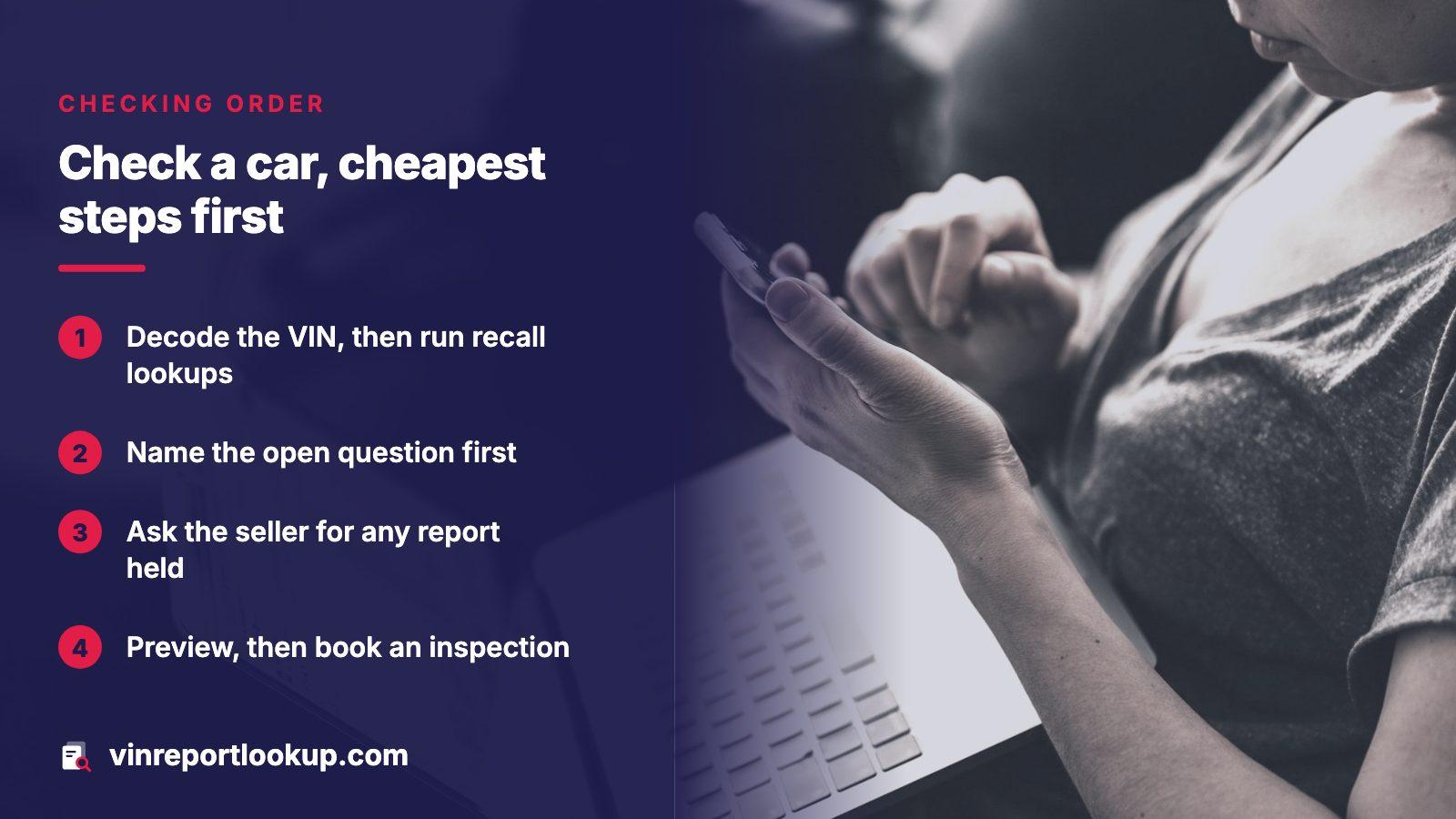
- Begin with a VIN decode, then the NHTSA recall lookup, then NICB VINCheck. None of the three costs anything.
- Name the open question: a title brand, a service history, or damage and auction history.
- Ask the seller for any report they already hold.
- Put the VIN through the VINReportLookup preview and see what records exist before paying anything. Pay for the report once, and only if the car still deserves a place on your shortlist.
- Buy a premium service-history report only when maintenance records are the missing piece.
- Book an independent inspection on anything you intend to buy. The Federal Trade Commission's guidance on buying from a dealer is worth reading before you sign.
Where this information comes from
- NMVTIS: approved providers and consumer access — Source for the dealership-only note covering Carfax and Experian, the California-only entry for Carfax, and the list of providers that serve the public.
- TxDMV: Title Check, Look Before You Buy — A state agency repeating the dealership-only limit independently.
- NHTSA: recalls — Open safety recalls by VIN, the no-charge lookup mentioned in the buying order.
- FTC: buying a used car from a dealer — Federal consumer guidance to read before signing at a dealership.
Sources and photos: Facts checked against the sources above in November 2026. Photos by Martin Fennema, Michal Biernat and Iain on Unsplash; diagrams by VINReportLookup.
Keep reading
- Carfax alternatives: what each VIN report option covers and costsOptions matched to the question you still have, from no-charge lookups to premium reports.
- AutoCheck vs Carfax: which VIN report to buy, and when to buy bothHow the two best-known services differ and when buying both makes sense.
- Vehicle history report cost: what each kind charges and coversWhat drives the price of a report and how to avoid paying twice for the same data.
- Best VIN check: how to choose a report and what each one includesA way to choose a VIN check by the records that matter for your car.
Frequently asked questions
Is Carfax worth paying for?
It is when your open question is service and event history on a recent car that spent its life at dealers and chain shops. For a plain title-brand worry, the federal record from an approved provider costs a fraction as much. Decide what you still need to know, run the no-charge lookups, then buy the one report that fits.
Can I get the NMVTIS title record from Carfax?
A private buyer cannot. According to the Justice Department's NMVTIS page, Carfax and Experian supply those reports to dealerships only, and its provider list confines Carfax's federal data to commercial customers in California. Other businesses on the same list serve the public, so that page is the place to start.
Does Carfax show every accident?
No report does. A report holds records of accidents, not the accidents themselves. A collision fixed at a shop that does not report, and paid for without involving an insurer, leaves nothing for any database to collect at any price. A pre-purchase inspection is the only tool that reaches it.
Why does a Carfax report look nearly empty on some cars?
Coverage follows who reports in. A car serviced by an independent shop that sends nothing to the database can look barely documented while being well kept. Ask the seller for maintenance receipts, and check that the VIN in the report is for the car you are actually looking at.
Should I look at a preview before buying a full report?
Yes. The recall and theft lookups from NHTSA and NICB cost nothing, and the VINReportLookup preview costs nothing either, so you can screen several cars before paying for the one you will really buy. The report is paid once and nothing renews.
Now check the car itself
The guide explains what to look for. The report shows what this VIN has on record.