THE SHORT ANSWER
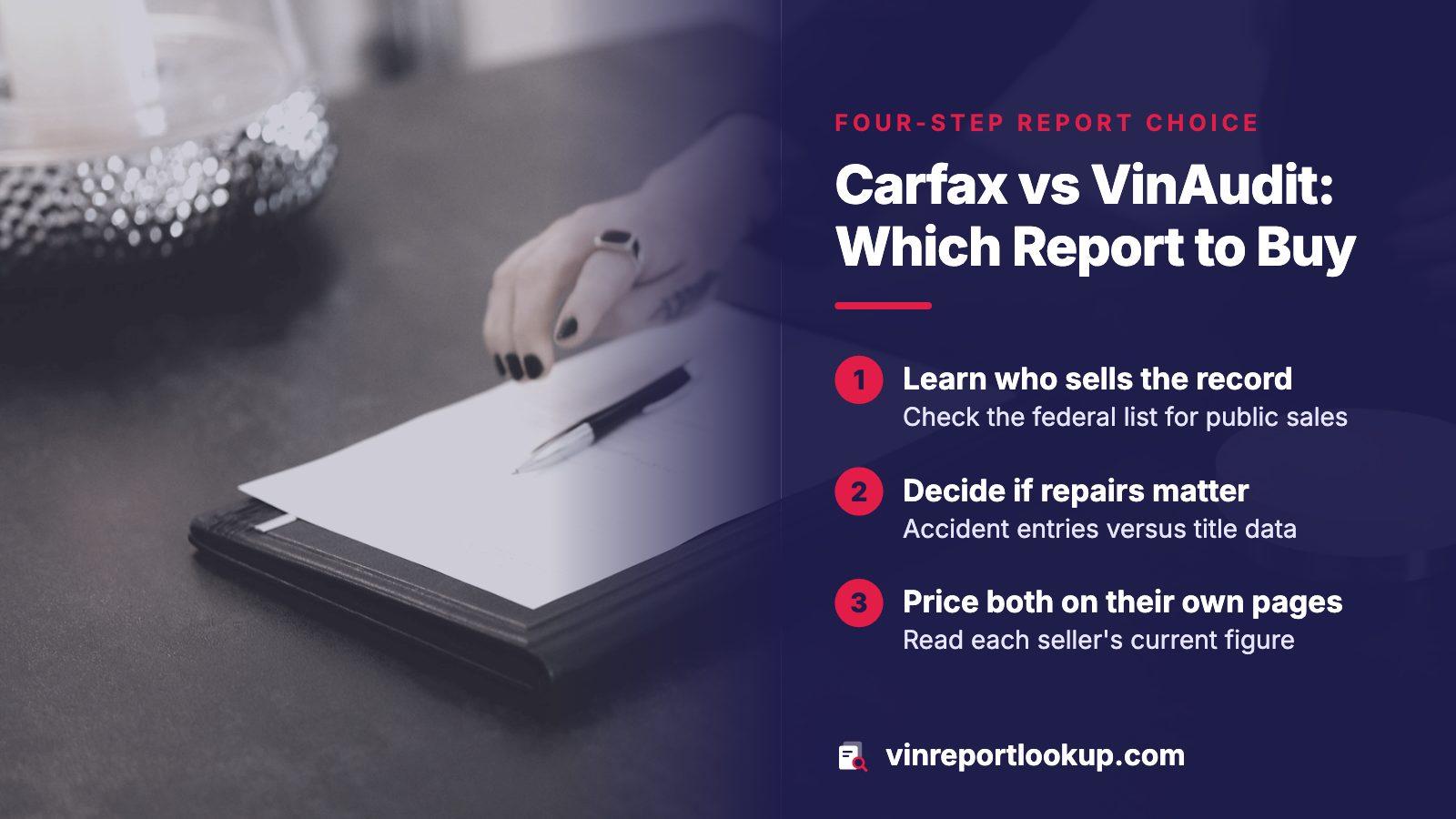
Choose VinAudit when the federal title record is what you are buying: the Justice Department lists it for public customers, and its home page shows what one report costs. Choose Carfax when you want to learn whether accident and repair entries exist, which the FTC says its reports sometimes hold, and read its price on its own order page. Either way, look at a free preview of the VIN first.
- Federal title record for the public
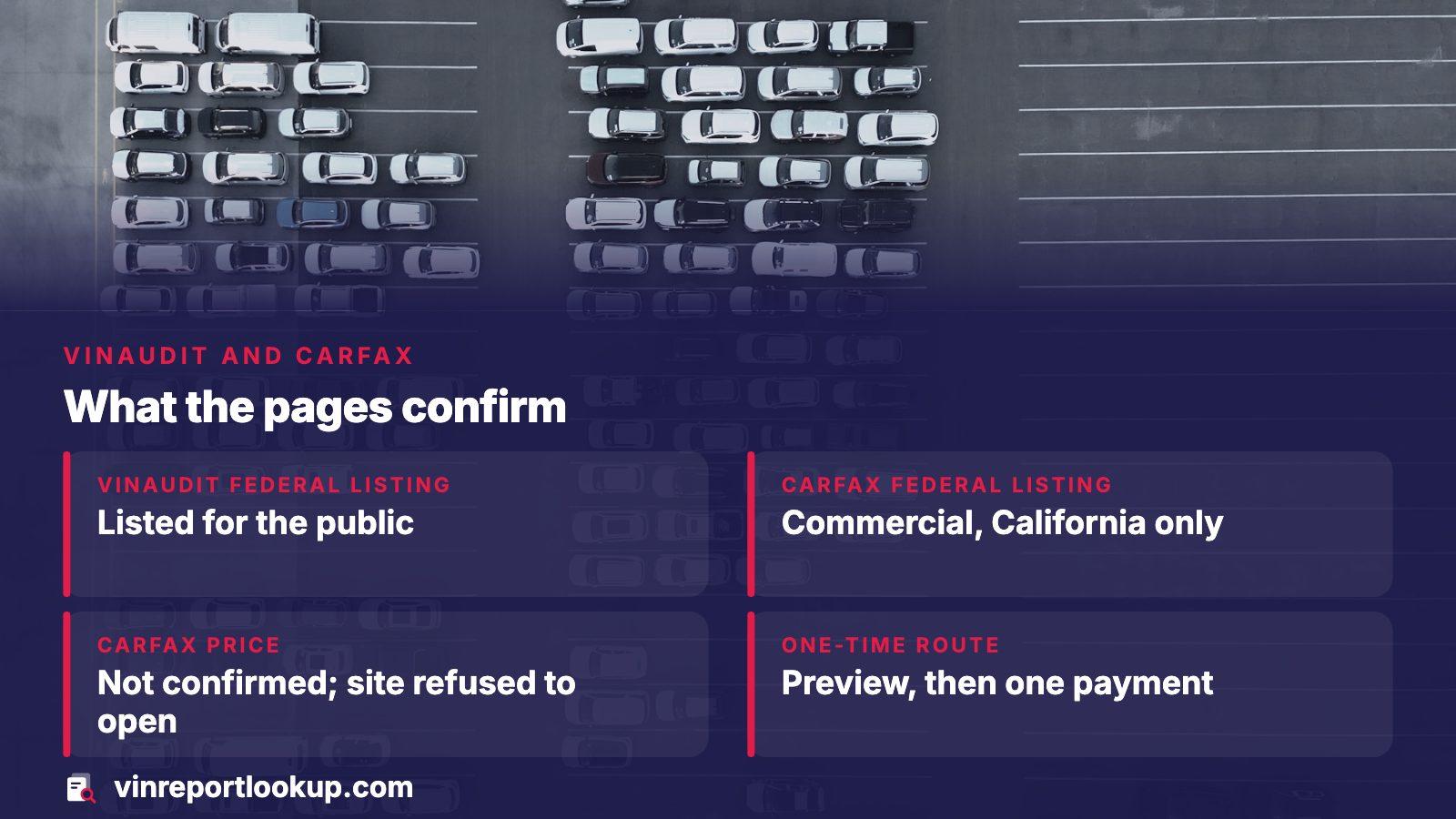
- VinAudit is listed; Carfax is commercial only, California only
- VinAudit's listed price for one report
- $9.99, with bundles of five and ten shown
- Carfax's price
- Not confirmed: its website refused to open during research
- Buying route that never renews
- Free preview, then one payment
Carfax and VinAudit side by side, from the pages that opened
Four kinds of public page describe these two sellers: the Justice Department's provider roster and consumer pages, an FTC buying guide and VinAudit's own site. Carfax's website refused to load, so its price and report layout are yours to read there.
| Question | Carfax | VinAudit |
|---|---|---|
| May it sell you the federal title record? | No. Its listing is for commercial customers in California only | Yes. Filed with the sellers that serve the public |
| Accident and repair entries | The FTC says its reports sometimes carry them | The FTC says the same; its own section list shows accident records but no repair section |
| Where accident entries come from | Not confirmed, because the site would not open | Police departments, state agencies and industry sources |
| Price | Read it on Carfax's order page | $9.99 for one report, $19.99 for five, $29.99 for ten, as its home page listed them |
| Refunds and plans | Read its terms before paying | One-time purchases are non-refundable once delivered; a monthly plan also exists |
Step 1: find out who may sell you the federal record
State titling agencies, insurers and salvage yards all report into one national title system, and the Justice Department publishes a roster of firms approved to sell its records. The roster has two groups. Vinaudit.com is in the group that serves everyone. CARFAX.com is in the group for commercial customers, with a note limiting it to California.
A note on the same page goes further: consumers cannot receive these reports from Carfax or two other named firms, which supply dealerships only. That sentence is about one government feed. It does not grade whatever else Carfax collects, and the FTC names Carfax among sellers whose reports can hold more.
Reach the seller from the roster
Use the link beside the company's entry, or type the web address yourself. A link in an ad, an email or a text message is not the same thing. Then compare the spelling of the name with the entry.
Step 2: decide whether accident and repair entries matter
The federal record is short on purpose. The Justice Department lists five items: where the car is titled and when, any brands, the latest odometer figure, whether an insurer declared it a write-off, and its salvage history. It adds that private sellers offer things the system was never meant to hold, repair histories among them. The FTC lists Carfax and VinAudit, plus one more seller, as places where a report may include accident and repair history.
VinAudit's section list includes accident records drawn from police, state and industry sources, and the company says a missing match does not prove a clean past. It names no repair or service section. For Carfax, only the FTC's wording is available here, so judge its repair detail from its own sample report.
Step 3: price both from the sellers' own pages
When this page was checked, VinAudit's home page showed a single report at $9.99, then bundles of five and ten reports at $19.99 and $29.99. It says current pricing appears once records are found. Carfax's amount sits on its order page. Neither the FTC's page nor the Justice Department's roster shows a price for either seller.
Compare the payment terms as carefully as the sticker price.
- VinAudit's terms call a single report non-refundable once it has been delivered.
- The same terms describe a monthly plan with per-report fees that renews until you cancel, so choose the one-time option when only one car is on your list.
- On Carfax's order page, look for pack sizes and for what happens when a VIN returns very little.
Step 4: enter the VIN and reach the seller safely
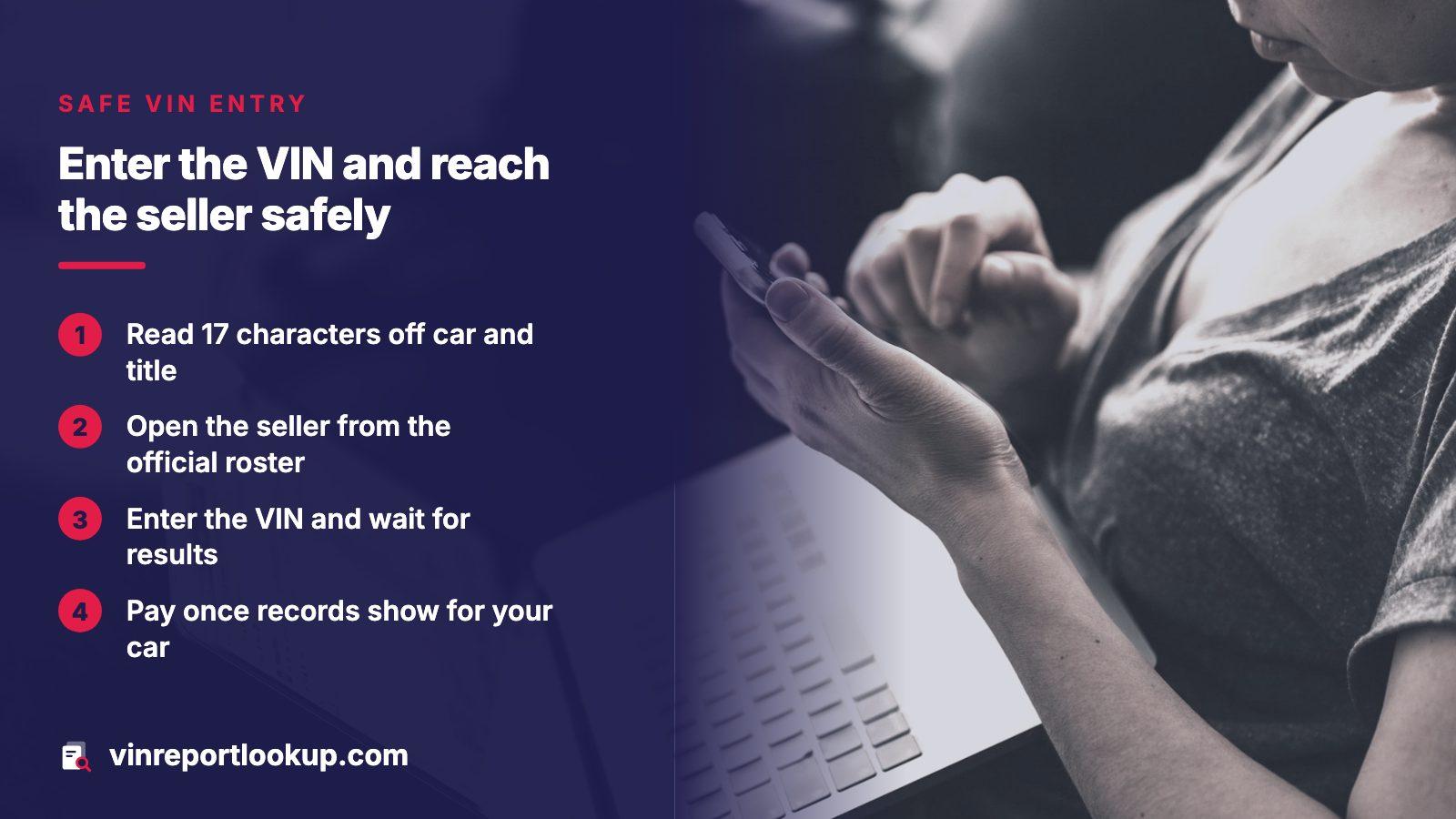
- Read the 17 characters off the car, then off the title or registration, then off the listing, and stop if any of the three differ.
- Open the seller from the Justice Department's roster, or type the address yourself, so a copycat spelling cannot catch you.
- Enter the VIN and wait for the search. VinAudit's own steps run from the VIN, to a free summary of the records found, to an order form.
- Pay only after the summary shows records exist for the car you are looking at, and keep the receipt and the report together.
A report ordered for the wrong VIN describes a different car, and VinAudit's terms make a delivered one-time purchase non-refundable. Slow down at step one.
Step 5: read the result for what it can and cannot say
A clean page feels like an answer. It is closer to a gap in the record, and the Justice Department explains why.
- States feed the federal system unevenly. Over half send data, and the Justice Department puts its reach at 87 percent of US vehicles, so a search can come back falsely empty.
- Each state labels damage by its own rules. One may stamp a car salvage or flood where another stamps nothing, which is why a brand from an earlier state matters.
- A total-loss entry can mislead. Insurers sometimes use it for a theft that has not turned up within 30 days, and the entry stays even when the car is found unharmed.
- VinAudit's accident and sale sections appear only when a match is found, so an absent section proves little.
Step 6: add the free recall lookup and a mechanic
A paid report is one layer, not the whole check. NHTSA's website lists open safety recalls by VIN at no charge, and VinAudit's report points to that same lookup. An open recall is one the maker has announced for that car but not yet repaired.
The FTC states that no history report replaces a separate inspection by a mechanic. Neither seller's price changes that. A mechanic looks at brakes, rust and leaks, none of which a database can see.
Where a VINReportLookup preview fits the decision
VINReportLookup starts from the VIN and puts a free preview on screen before it asks for money, so you learn whether title, damage or mileage entries turn up at all. You pay once for the full report, covering one car or a pack sized for three, five or ten. Nothing renews afterwards, and the pricing page holds the figures.
- One car, with a brand or damage as the worry: preview first, then a one-time report if the preview shows records.
- A shortlist of several cars: one pack, one payment, one VIN per car.
- You want a service narrative: read Carfax's sample report and terms before buying.
- You want the federal record from a named seller: VinAudit, reached from the roster.
Where this information comes from
- Bureau of Justice Assistance: approved NMVTIS data providers — The public and commercial-only groups, where each seller is filed, and the note about Carfax and consumers.
- Bureau of Justice Assistance: NMVTIS for consumers — Coverage figures, false negatives, state brand differences and the total-loss caveat.
- FTC: Used cars — Where the FTC names Carfax and VinAudit, what other sellers may add, and why an inspection still matters.
- VinAudit: home page — Its listed prices, its buying steps and its statement that some details may be limited by state reporting.
- VinAudit: report sections — The record types in a full report and the company's own warning about accident records.
- VinAudit: data sources — Where its records come from and which sections appear only on a positive match.
- VinAudit: terms and conditions — One-time purchase and monthly plan terms, and the refund wording.
Sources and photos: Facts checked against the sources above in November 2026. Photos by Annika Wischnewsky, Michal Biernat and Iain on Unsplash; diagrams by VINReportLookup.
Keep reading
- Carfax vs NMVTIS: what each report shows and which to buyWhat the federal title record holds that a Carfax report may not, and the reverse.
- Carfax alternatives: what each VIN report option covers and costsOther routes to a history report, sorted by the question each one answers.
- How much a Carfax vehicle history report costs and what it coversWhere to read the current Carfax price and what to set it against.
- PricingWhat a single report and each larger pack cost today, once the free preview has run.
Frequently asked questions
Is VinAudit a legitimate seller of vehicle history reports?
The Justice Department's roster lists Vinaudit.com among sellers approved for public and commercial customers, which is the listing to check for any seller. That entry covers the federal title feed only. It says nothing about how complete the rest of a report is, so read the free summary before you order.
Can a private buyer get a federal title report through Carfax?
Not according to the Justice Department. Its note says consumers cannot receive these reports from Carfax and two other firms that supply dealerships only, and Carfax's entry is limited to commercial customers in California. The note covers one government feed and does not describe what else Carfax collects.
Does a VinAudit report show accident history?
It has an accident section fed by police departments, state agencies and industry sources, and the section appears only when a match is found. VinAudit itself says no match does not prove an accident-free past. Treat an empty result as no record found, then book a mechanic to inspect the car.
Can I get my money back on a VinAudit report?
Its terms say a one-time purchase is non-refundable once the report is delivered, and that fees paid on a monthly plan are non-refundable too. Order only after the free summary shows records for your VIN, and read the terms again on the day you buy, because wording changes.
Do I need either seller to check one used car?
Neither is required. VINReportLookup shows a free preview from the VIN, then sells a single report or a larger pack for one payment, with no plan attached. Whichever route you take, the FTC advises a separate mechanic's inspection on top of any history report.
Now check the car itself
The guide explains what to look for. The report shows what this VIN has on record.