THE SHORT ANSWER
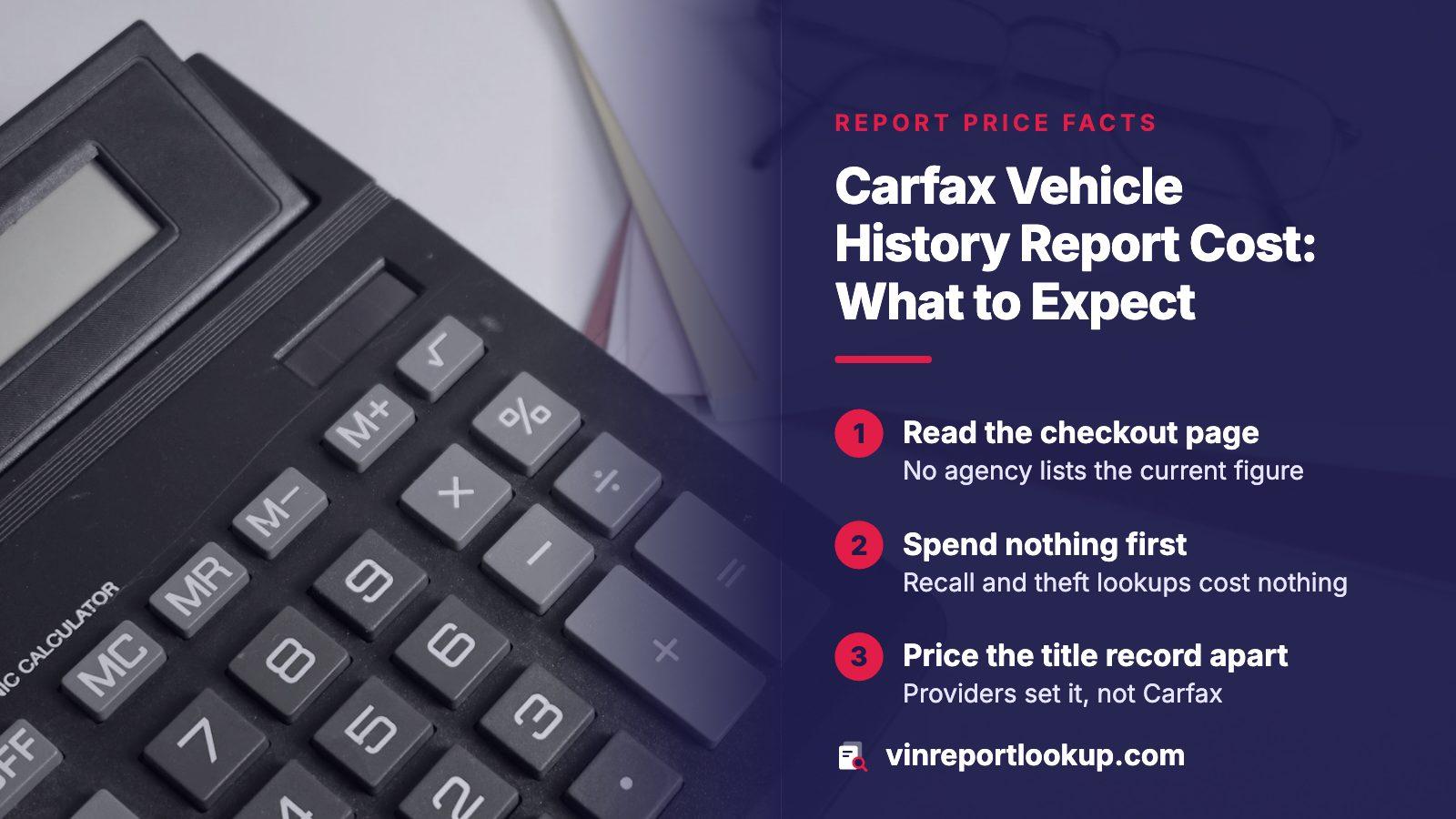
Carfax sets its own price, and its checkout page is the only place to read the current figure; federal and state pages do not list it. Official pages do cover the neighbours: NHTSA recall and NICB theft lookups cost nothing, and a title record from an approved provider has been quoted anywhere from a couple of dollars to $12.99. Carfax is a paid report assembled from private feeds, so compare its order page with those benchmarks before you pay.
- Carfax price
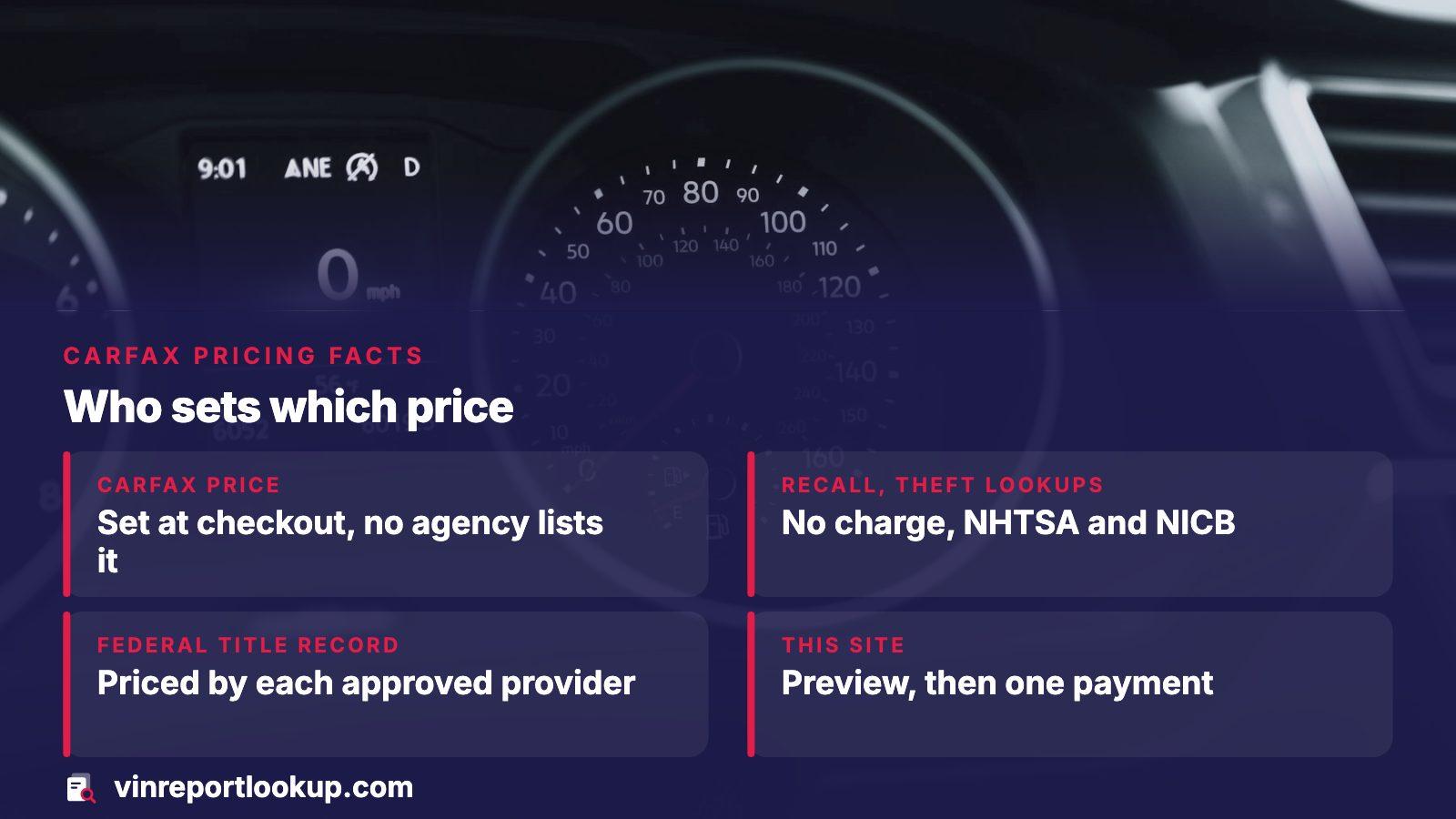
- Set by Carfax at checkout; no agency lists it
- Recall and theft lookups
- No charge, from NHTSA and NICB
- Federal title record
- Priced by each approved provider, not sold by Carfax to consumers
- VINReportLookup
- Free preview, then one payment, no subscription
What a Carfax price pays for, and what it leaves out
A Carfax report is a private company's product, so its price pays for that company's data feeds, not for a government record. The FTC names Carfax among providers whose reports can add accident and repair history, and the Texas motor vehicle agency says reports of that kind generally carry maintenance and repair entries.
The federal title record is a separate product. The Justice Department's list of approved sellers states that private buyers cannot obtain it from Carfax, DMVDesk or Experian, because all three serve dealerships only. Paying Carfax buys service and accident detail from private sources. The brand and total-loss record comes from an approved provider instead.
The prices official pages do put in writing
No agency lists a Carfax figure, and Carfax can change its own at any time, so we print none. Read the number on its order page the day you buy. Here is what public pages do state about the checks around it.
| Check | Run by | What it costs |
|---|---|---|
| Open recalls by VIN | NHTSA | No charge |
| Stolen, salvage and flood screen | NICB VINCheck | No charge, limited to five searches per 24 hours from one IP address |
| Title record: brands, odometer, total loss, salvage | Providers approved by the Justice Department | Set by each provider; the department's FAQ reported a range of $8 to $12.99 a report in May 2020 |
| Accident and repair detail from private feeds | Companies such as Carfax | Set by the company, shown at checkout |
Official pages do not agree at the low end, since each provider sets its own charge: the Texas motor vehicle agency puts the starting price of a title check at just a couple of dollars. Use every figure as a yardstick for judging an order page, not as a quote.
Spend nothing first: the two lookups that cost nothing
NHTSA's VIN search tells you which recalls on that specific car have not been fixed yet. It skips repaired ones, anything issued more than 15 years ago unless the manufacturer offers longer cover, small makers and non-safety campaigns, and a very new recall may be missing while VINs are still being loaded.
NICB's VINCheck matches a VIN against participating insurers' records of theft never resolved, salvage declarations and flood losses. It holds insurance records only. NICB itself says a clean result guarantees nothing and that most full history reports are sold at a cost, so treat these two as a screen, not a verdict.
The title record: priced by provider, and not sold by Carfax
The federal system holds the state of title now and before, the issue date, the latest odometer figure, any theft history, brands with the date each was applied, and salvage entries including total-loss declarations. State agencies, salvage and junk yards, recyclers and insurers must report into it, which is how a brand can follow a car across state lines.
Federal law makes the system pay for itself through user fees, so every approved provider sets its own charge. Compare vendors on price and on what each one includes. The record is deliberately short and holds no repair history, so a clean result is good news but not the whole story.
When a private network report such as Carfax earns its price
Use the title record for a title question and a private report for a service question. The Texas agency suggests exactly that pairing: the title check plus a fuller private report for the maintenance side.
- A recent car whose service history would move your offer up or down.
- A car with several owners, where you want the ownership trail.
- A seller who already holds a report: ask for it, then check that its VIN and run date fit the car you are looking at.
If the owner kept receipts from an independent shop, ask to see them. No company can sell you paperwork that was never reported to it.
Reading any report's order page before you pay
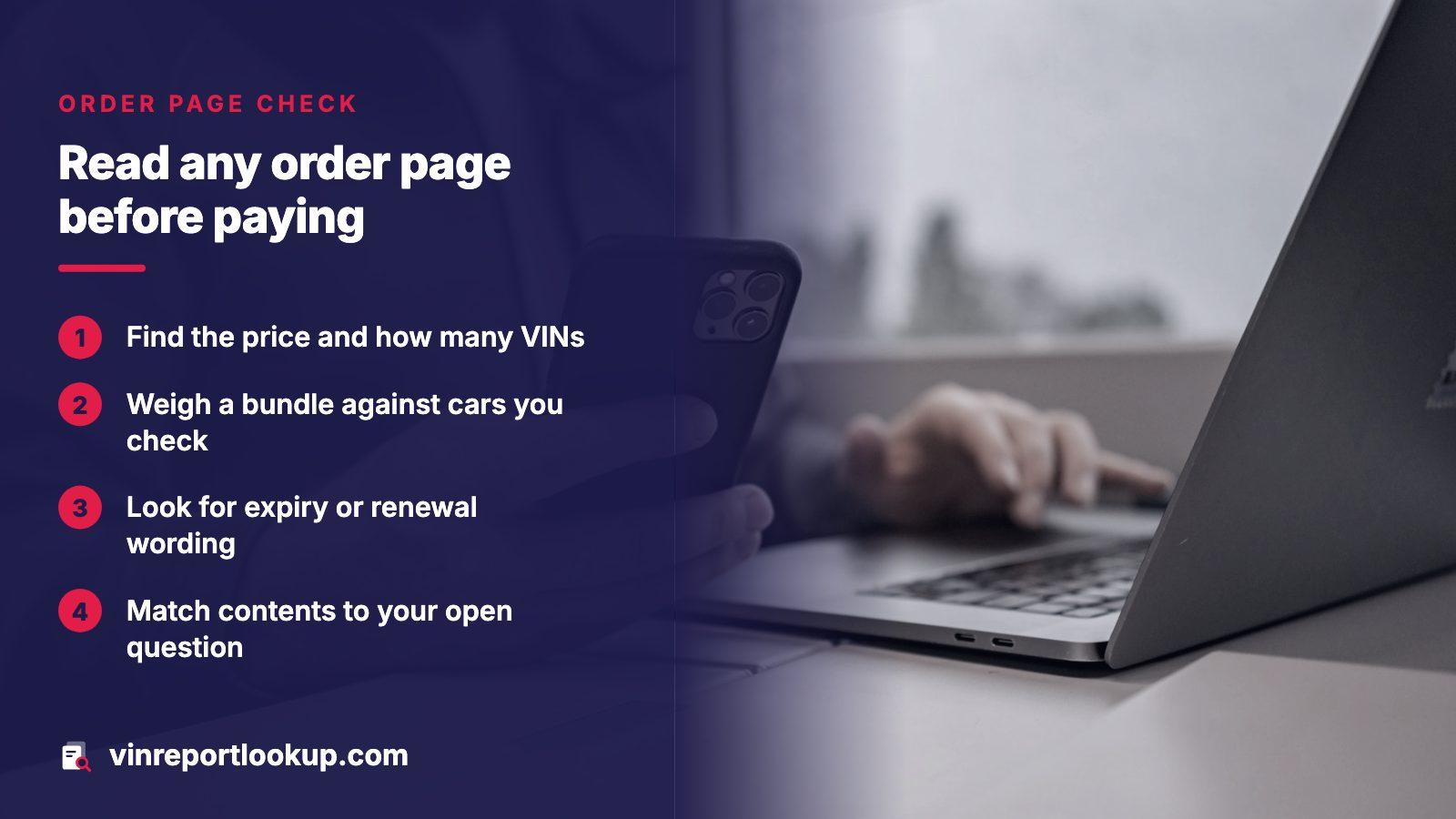
- Find the price for one report and whether it covers one VIN or several.
- Weigh any bundle against the number of cars you will really check.
- Look for wording on expiry, renewal or membership. A one-time purchase and a recurring charge are different deals.
- Compare the 17-character VIN you typed with the car and its paperwork before you pay.
- Match the listed contents to your open question: brands, damage or service visits.
The VIN is on a small plate visible through the glass, low on the driver's end of the dash. Registration papers carry it as well, and so do some insurance cards.
How the VINReportLookup report is priced and what it shows
VINReportLookup begins with a free preview that shows whether a VIN has records worth paying to read. Then comes a single payment, either for one report on its own or for a set of three, five or ten reports that suits a shortlist of several cars. No renewal ever happens, and the pricing page carries today's amounts.
- Title brands and odometer readings, which overlap with what an approved title provider supplies.
- Accident and damage entries, together with salvage and auction records and their photos.
- Lien and impound flags, theft entries and insurer records, plus any open recalls and a market-value estimate.
It carries no dealer service log. A recent car whose maintenance story drives your offer is the case for adding a private network report on top.
Matching the spend to the car and the stage of the search
A report fee is small beside the price of most used cars, yet it is still wasted when you buy the same record twice. Let spending rise as the shortlist shrinks.
- Reading listings: the recall lookup, the NICB screen and a VINReportLookup preview.
- Two or three finalists: a full report on each, which a three-report bundle covers.
- One recent, dealer-serviced car where maintenance decides the price: add a private network report after reading its checkout price.
- Before signing: a mechanic's inspection of the car itself.
An FTC page stresses that a history report cannot stand in for an independent inspection, the step that can reveal hidden damage.
A stranger's link to buy a report is not a price quote
Seller warning from the FTC
The FTC described a scam aimed at people selling cars online. A supposed buyer insists the seller pay about $20 by card on a named website, then goes quiet. The sites redirected to .vin addresses, and some may only be collecting your details to pass on.
If you are selling and a buyer wants a report, hand over the VIN and let them run their own, or run one yourself from a provider you chose. As a buyer, pick the provider yourself from the Justice Department's approved list, and pay only on a page you reached on your own.
Where this information comes from
- Justice Department NMVTIS: approved providers — Who may sell the federal title record to the public, and the notice that consumers cannot get it from Carfax or Experian.
- Justice Department NMVTIS: frequently asked questions — Provider-set fees, the user-fee funding design, the May 2020 fee range and what the record omits.
- TxDMV: Title Check, Look Before You Buy — A state agency on low title-record prices and on adding a fuller private report.
- FTC: Used Cars — Which reports add accident and repair history, and why an inspection still matters.
- FTC: Steering clear of vehicle history report scams — The seller scam built around a report bought on a stranger's chosen site.
- NHTSA: Check for recalls — What the no-charge VIN recall search shows and what it leaves out.
- NICB: VINCheck — The no-charge theft, salvage and flood screen, its daily limit and its limits.
Sources and photos: Facts checked against the sources above in November 2026. Photos by Cht Gsml, Anastasiia Nelen and Nathan Dumlao on Unsplash; diagrams by VINReportLookup.
Keep reading
- PricingWhat a single report and each bundle size cost today.
- Vehicle history report cost: what each kind charges and coversThe same cost question across every kind of report, not one brand.
- Cheap Carfax: legitimate ways to pay less for a vehicle history reportAnother angle on paying less for a history report.
- Carfax alternatives: what each VIN report option covers and costsOther ways to check a VIN, matched to the question you still have.
Frequently asked questions
How much does a Carfax vehicle history report cost?
Carfax sets the price and shows it on its order page, and no government source publishes it, so we quote no figure. Open the page on the day you buy and note whether the price covers one report or a bundle, and whether anything renews. Then compare it with the title record, which approved providers price on their own.
Does paying for Carfax get me the federal title record?
No. The Justice Department says private buyers cannot receive that record from Carfax, because it supplies dealerships only. The record comes from providers approved to sell to the public, and the department's provider page lists them. Each one sets its own price.
Can I find out some of what a Carfax report shows without paying?
Some of it. NHTSA's VIN search lists unrepaired recalls and NICB's VINCheck screens for theft, salvage and flood records from participating insurers, both at no charge. Accident and service history sit in private reports, and NICB says most full reports are sold at a cost.
Does a higher-priced report mean the car is safer?
No. A price reflects what a company sells, not the condition of the car. The FTC cautions that a record is no alternative to having an independent mechanic examine the vehicle, because an inspection can uncover hidden damage that no entry captured.
What does VINReportLookup charge?
You run the free preview first, then pay once if the car survives your first look. The choice is one report or a bundle sized three, five or ten, and nothing is billed again afterward. The pricing page shows the amounts in force.
Now check the car itself
The guide explains what to look for. The report shows what this VIN has on record.