THE SHORT ANSWER
To pay less than a Carfax price, split the job into layers. NHTSA recall and NICB theft lookups cost nothing. A title record from an approved federal provider covers brands and odometer data, with official pages quoting $4 to $12.99, and the Justice Department says Carfax does not supply that record to consumers. Accident and service detail is the pricey layer, so buy it only for a car you plan to see. Treat any cut-rate report from a stranger or a look-alike domain as unverified.
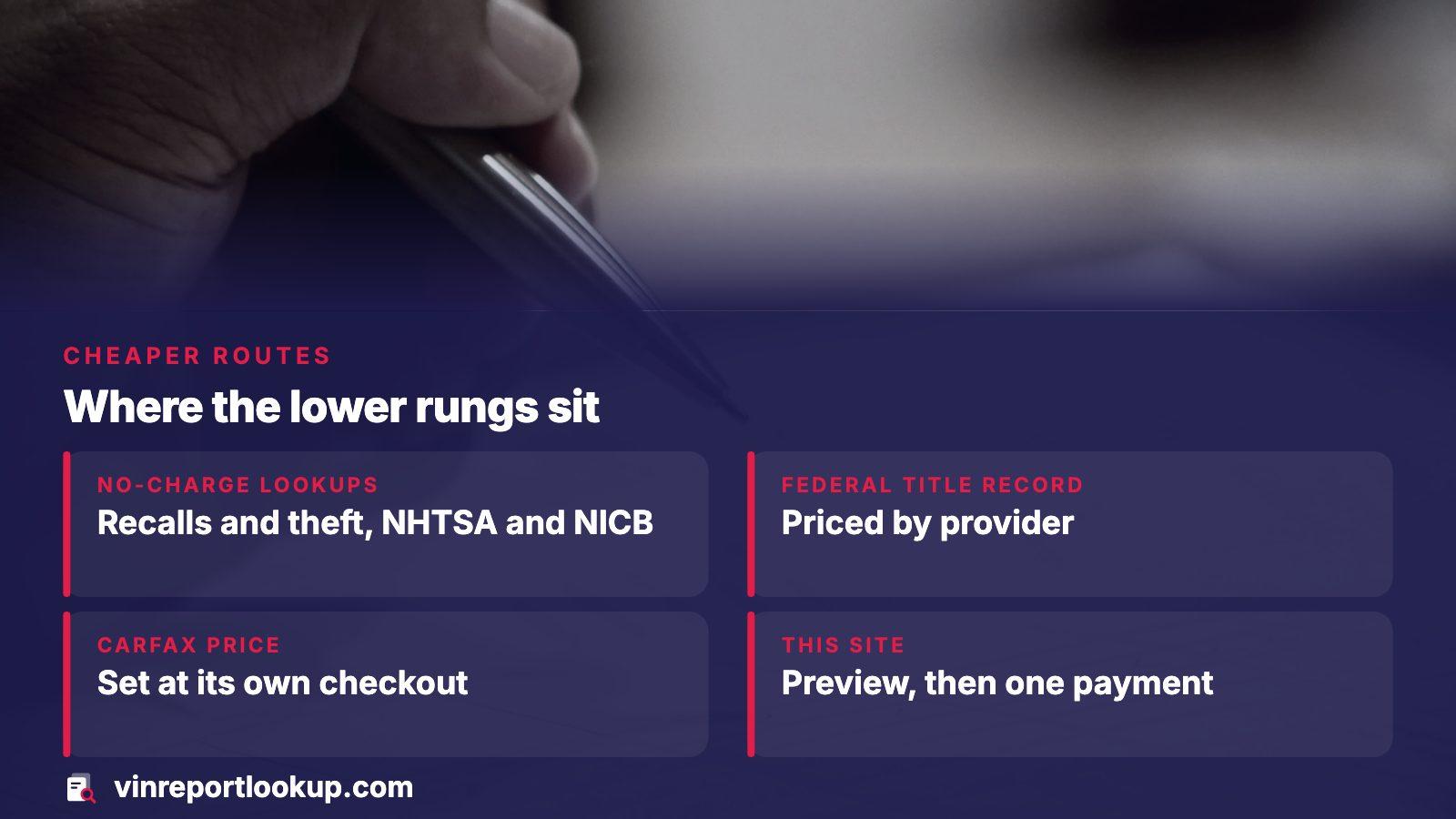
- Recall and theft lookups
- No charge, from NHTSA and NICB
- Federal title record
- Priced by provider; official pages quote $4 and $8 to $12.99
- Carfax price
- Set at its own checkout; no agency lists it
- VINReportLookup
- Free preview, then one payment, no subscription
What a cheap Carfax search is really asking for
Three separate questions hide inside this search, and each has its own price. One is whether the title carries a brand. Another is whether accidents were reported. The third is whether anyone kept up with service. No single discount covers all three, because the answers come from different record sources.
Carfax is a private company that sets its own price. Official pages only place it in the market: the FTC lists Carfax and AutoCheck among providers whose reports sometimes add accident and repair history to the federal title data. So decide which of the three your car still needs answered, and pay for that layer alone.
The price ladder, from no charge to a full report
Each rung answers a different question. Start at the top and stop climbing the moment a car fails one.
| Rung | Run by | Price as stated | What it settles |
|---|---|---|---|
| Open recalls by VIN | NHTSA | No charge | Safety recalls still unrepaired on that car |
| Theft, salvage and flood screen | NICB VINCheck | No charge, five searches per 24 hours per IP address | Insurer-reported unrecovered thefts, salvage and flood records |
| Federal title record | Providers approved by the Justice Department | Set by each provider; official pages quote $4 and $8 to $12.99 | Brands, odometer, total loss, salvage, theft |
| Accident and service detail | Private-network sellers such as Carfax and AutoCheck | Set at their own checkout; no agency lists it | Reported accidents and repair entries |
| Full VIN report | VINReportLookup | One payment after a free preview; amounts on the pricing page | Title brands, damage and odometer entries, auction photos |
The first two rungs are filters, not substitutes. The recall search skips repaired recalls and some brand-new ones, and NICB sees only participating insurers, never police files.
The few-dollar rung: the federal title record
Official pages disagree on what this record costs, which is a warning in itself. One Justice Department page says to expect up to $4 a report. Its FAQ says fees ran from $8 to $12.99 as recently as May 2020. Federal law funds the system through user fees, so each provider charges and sets its own number. Treat both figures as dated quotes, not a price list.
Compare two or three providers and what each price includes; the approved list shows no prices or samples. The record covers brands, the latest odometer reading, theft history if any, and salvage or total-loss status, but no repair history.
A clean result is good news, not proof. The Justice Department says 87 percent of vehicles are in the system and more than half of states report, so a search can miss a brand a state never sent in.
Spending less on the accident and service layer
A Carfax price pays for private feeds, since the Justice Department says individual buyers cannot get the federal title record from Carfax or Experian. Those feeds add accident and repair entries. The FTC cautions that accident and flood entries can appear, while mechanical faults usually do not.
- Ask the seller whether a report already exists for that exact VIN, and read its VIN and run date before relying on it.
- Cut the list with the no-charge lookups, so a paid report goes only on cars you will view.
- Compare cost per report when several cars are in play. AutoCheck offers a multiple-report option for shoppers still comparing and a single report for a buyer ready to commit; VINReportLookup packs come in 3, 5 or 10.
- Skip the paid report on a car that already failed a lookup. A theft or salvage flag settles that car.
Reports resold on marketplaces, by message and from look-alike domains
Marketplace listings are where the price-cutting stories live, and no federal or state page we opened describes reports resold that way, so we cannot vouch for any listing. The FTC has documented a related trap: a supposed buyer tells an online seller to buy a vehicle report on one specified website, about $20 on a card, then goes quiet.
That site forwarded to a .vin web address, chosen to sound VIN-related with no actual link to vehicle numbers. The FTC says such sites may take card details or act as lead generators that sell contact data, and it advises asking why a buyer insists on one site.
A pattern the FTC has flagged
A report you are told to buy from a named site, for a flat card payment, by someone you have never met, matches the FTC's description of the scam. Any PDF you are handed shows only what its provider knew on the day it ran, so match its VIN to the car and check the date.
Five checks before trusting a site that sells cheap reports
- Find the provider on the Justice Department's approved list before believing a claim about federal title data. The list is alphabetical, with no ranking.
- Search the company's name beside words such as complaint, rating or scam, as the FTC advises.
- Look for a sample report, or a plain list of contents, before typing in a card.
- Scan the payment page for trial, renewal or subscription wording. A one-report price should not renew.
- Ask where the data comes from. NICB says full histories pull from sources such as DMV title files, auction sales and service records; a seller that cannot say which it holds is guessing.
A link from an official page is no endorsement either: NICB lists partners that sell full reports and says it takes no liability for those purchases.
Where a VINReportLookup report fits on the ladder
VINReportLookup is built for the last step on the ladder. Enter the VIN and the free preview confirms the year, make, model and trim, gives the open recall count, and reports the number of title and auction entries on file, usually enough to decide whether the rest is worth reading.
If the car stays on your list, you pay once for the full report, which adds liens, auction photos, odometer history, damage entries and any title brand. Buy a single report, or a pack if several cars are in the running. Nothing recurs, and the pricing page lists current amounts.
A spending order that keeps money for the mechanic
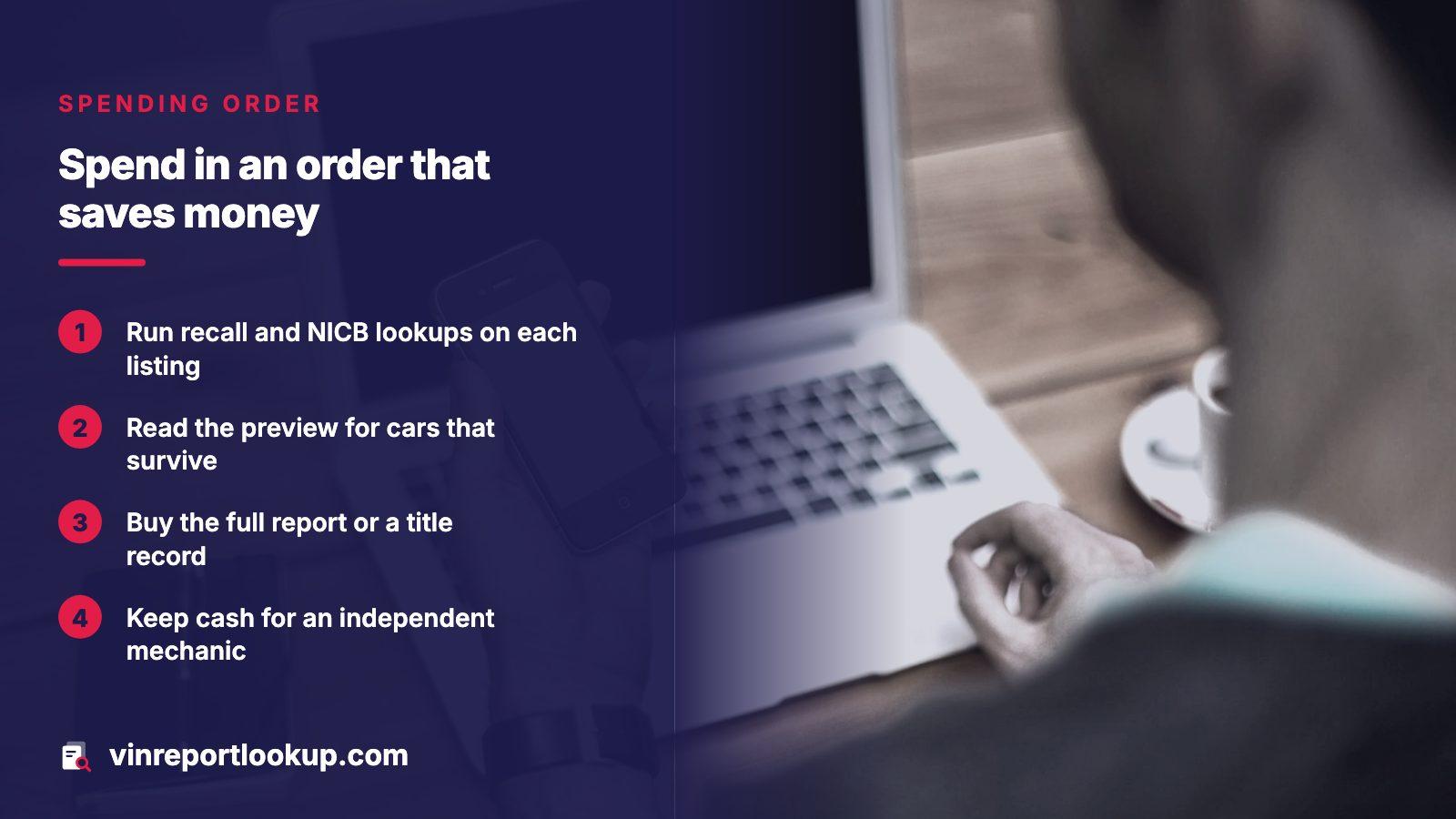
- Put every listing through NHTSA's recall lookup and NICB's VINCheck.
- Read the free preview for the cars that survive.
- Buy the full report, or only a title record if a brand is your sole worry, for cars you plan to see.
- Add a premium report only when a service history would change your offer.
- Keep cash for an independent mechanic.
Hidden damage is what the FTC says an independent inspection can find, and no report stands in for one. It suggests asking the mechanic for findings and repair costs in writing, which gives you a figure to negotiate with.
Where this information comes from
- Justice Department NMVTIS: approved providers — Which providers sell to the public, and the notice that Carfax and Experian do not.
- Justice Department NMVTIS: frequently asked questions — The fee history for a title record and what that record holds.
- Justice Department NMVTIS: used car buying tips — The older fee wording and the advice to get an independent inspection.
- FTC: Buying a Used Car From a Dealer — What a report tends to omit, and the written repair estimate from a mechanic.
- FTC: Steering clear of vehicle history report scams — The pay-for-a-named-report pattern and the FTC's vetting advice.
- FTC: Used Cars — What reports can show, which providers add accident detail, and why to inspect.
- NICB: VINCheck — The no-charge theft, salvage and flood screen, its limits, and the partner notice.
Sources and photos: Facts checked against the sources above in November 2026. Photos by Sasun Bughdaryan, Alejandro Escamilla and Masjid MABA on Unsplash; diagrams by VINReportLookup.
Keep reading
- How much a Carfax vehicle history report costs and what it coversWhat official pages do and do not say about the Carfax price itself.
- Carfax alternatives: what each VIN report option covers and costsOther report options matched to the question you need answered.
- Sample reportA worked example of what a full report shows, before you pay.
- PricingWhat one report or a pack costs today.
Frequently asked questions
How can I get a cheap Carfax report?
Pay for layers instead of one large report. NHTSA recalls and NICB theft screening cost nothing, a federal title record is quoted at $4 to $12.99 by official pages, and a paid accident report earns its price only on cars you will view. Ask the seller for an existing report as well, and check its VIN and run date.
Is there a cheaper alternative to Carfax?
For title brands and odometer data, yes: a provider on the public side of the Justice Department's approved list. For accident detail, the closest options are other private-network reports, each with its own price. VINReportLookup shows a free preview first and bills once for the full report, with packs for shoppers weighing several cars.
Are cheap Carfax reports on Etsy legitimate?
No official source we opened describes reports resold through marketplaces, so none can be confirmed. If you weigh one, read the VIN on the document against the car's own, digit by digit, note the run date, and ask which data provider produced it. A report for another car, or an old one, tells you little.
Is a cheap Carfax website legit?
Check before paying. If it claims federal title data, look for the company on the Justice Department's approved list, search its name beside words like complaint or scam, and ask for a sample report. The FTC warns that you may have no way of knowing who runs an unfamiliar site.
Can I get a Carfax for free?
Not a full history from an official source. NICB VINCheck and NHTSA's recall search cost nothing but cover only theft, salvage, flood and recalls, and NICB says most full histories cost money. Carfax's own pages would not open during research, so any offer it makes is unconfirmed here.
Now check the car itself
The guide explains what to look for. The report shows what this VIN has on record.