THE SHORT ANSWER
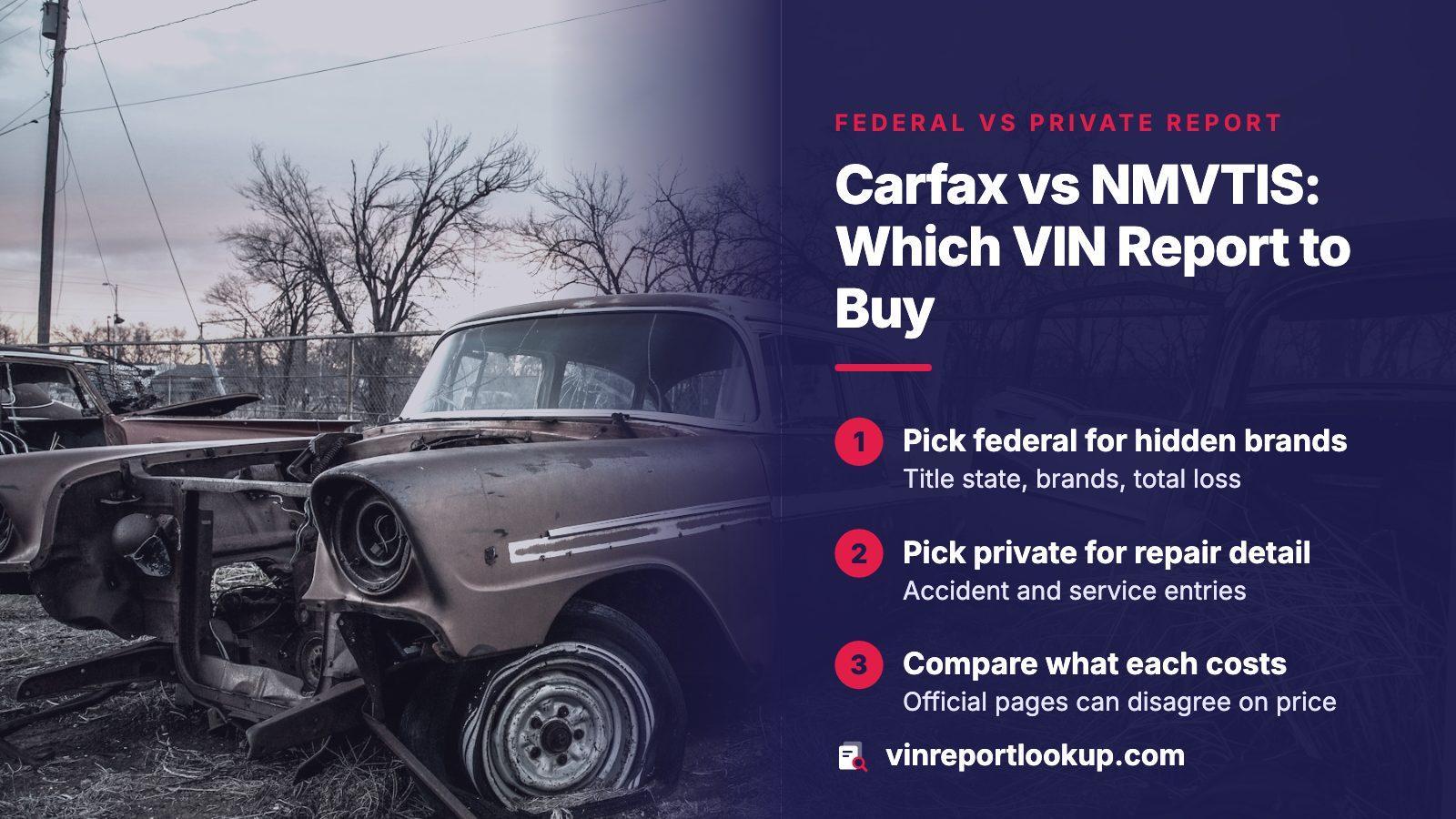
Pick the federal NMVTIS record when the fear is a hidden title brand, a write-off or a salvage-yard stop. Pick Carfax when accident and repair entries on one car would change your offer, since the FTC says such providers sometimes add them and the federal record leaves them out. You cannot buy the federal record from Carfax. For a single car, start with the free preview on VINReportLookup and pay once when the car earns a closer look.
- Federal record, five items
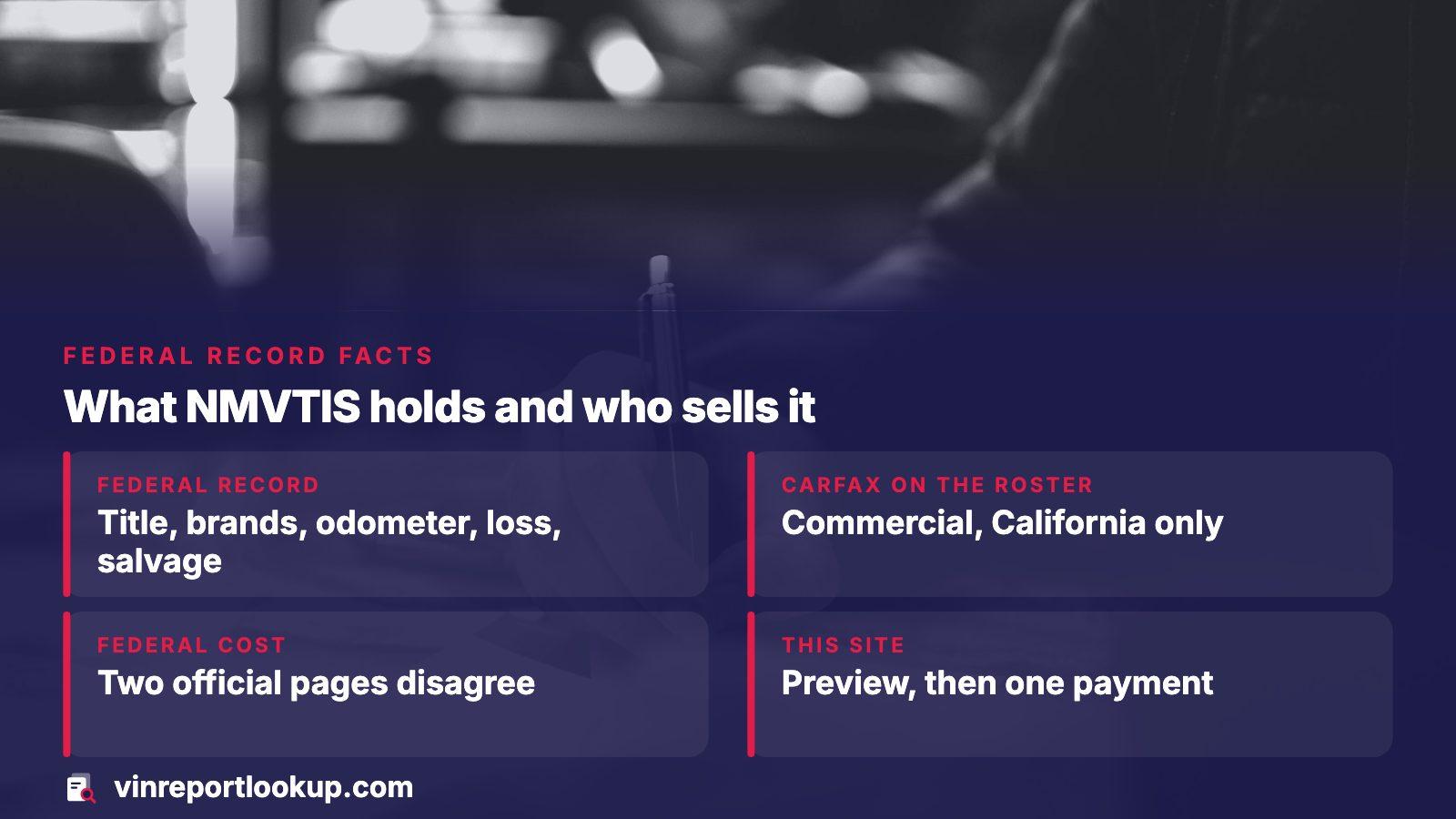
- Title state, brands, odometer, total loss, salvage
- Carfax on the federal roster
- Commercial customers only, California only
- Federal price per official pages
- Up to $4 on one page, $8 to $12.99 on another
- VINReportLookup
- Free preview, then one payment, no subscription
A federal record and a private report, side by side
These two are not rivals for the same job, and the table shows why. NMVTIS sits under Justice Department oversight, with AAMVA, a group of state motor vehicle administrators, as its operator since 1992. Carfax is a company product that the FTC lists among other providers while endorsing none. Where the table speaks for Carfax, it repeats only what the Justice Department and the FTC say.
| Question | NMVTIS record | Carfax report |
|---|---|---|
| Where the data comes from | State titling agencies, insurers, salvage yards and recyclers, all bound by federal law to report | Not described on the official pages read for this guide, so read its sample before paying |
| Accident and repair entries | Not among its five items, and the Justice Department says repair history is outside it | The FTC says such providers sometimes add accident and repair history |
| Sold to a private buyer? | Yes, by any provider on the public side of the roster | Not the federal record: the Justice Department warns that Carfax is no route to it for consumers |
Who may sell a private buyer the federal record
The Justice Department publishes a roster of approved providers in two groups. One group serves public and commercial customers. The other serves business customers alone, and CARFAX.com is listed there with a note that its federal data goes only to such customers, and only in California. A separate bold warning tells consumers that Carfax will not supply them with the federal report.
That warning covers one data feed only. It is silent on accident or repair entries Carfax gathers elsewhere, which the FTC says such providers sometimes hold. It settles where to buy the federal record: from a public-side provider on the list, or a site shown beneath one.
Read the roster on the day you buy
Providers are added and dropped. Open the Justice Department list yourself and find the seller's name before you enter a card. A seller that appears neither as a provider nor beneath one gives you no official backing for a claim of federal data.
What the federal record holds and why it carries weight
By the Justice Department's account, a federal report is meant to cover five items: the current title state and its last date, any brand a state has applied, the latest odometer figure, total loss history and salvage history. Repair histories, recall information and maintenance data are named as things private providers sell, not things NMVTIS holds.
Its strength is that reporting is compelled. States, insurers and salvage businesses must file, so the record can hold events no private company chose to buy. An insurer's total loss decision has to be reported even if no claim was ever paid. Every brand any state applied is also kept, which is how the system is meant to stop flood cars moving to a state with no flood brand, as happened after Hurricane Katrina.
Where the federal record runs short
Coverage is wide but uneven. The Justice Department puts 87 percent of the nation's vehicles in the database, yet not every state reports; more than half do. A search can therefore come back clean for a car that deserves a flag. Roughly 20 million write-off and salvage records are on file, and private databases, it adds, carry similar holes.
- The insurer feed stops at five model years: the current one plus four earlier. A write-off on an older car may never have arrived that way, though salvage yards report every year.
- A hit that earns a salvage brand in one state may go unbranded in another, because each state sets its own rules.
- A total loss label can stick when it should not, for instance on a stolen car that turns up undamaged after 30 days.
- A repaired collision that never became a brand, total loss or salvage entry has no slot among the five items.
- The report summarizes the title. The state agency holds the full file.
What each costs, and where two federal pages disagree
The Justice Department's buying tips page says to expect up to $4 for a federal title report. Its FAQ page says prices vary by provider and, as recently as May 2020, ran from $8 to $12.99. Both pages sit on the same site, so treat either figure as a guide and trust only the amount on the seller's checkout screen.
None of the official pages read for this guide prints a Carfax price, so this guide prints none. Read it on Carfax's own order page the day you buy, and remember that no Carfax purchase gets you the federal record. The VINReportLookup pricing page lists its current amounts.
Which one fits the car in front of you
Choose by the question you need answered, not by the brand name.
| Your situation | Better fit | Reason |
|---|---|---|
| The car may have been written off, flooded or retitled across a state line | The federal title record from an approved seller | Brands plus insurer and salvage reports are its main job |
| Accident and repair entries on this one car matter to you | A Carfax report | The FTC says such providers sometimes carry that history, which NMVTIS leaves out |
| Several cars on your shortlist | A VINReportLookup bundle of 3, 5 or 10 | Cost spreads across cars and nothing recurs |
| A deposit is about to change hands | Any report plus a mechanic's inspection | The FTC says no history report substitutes for the inspection |
Running the check and reading what comes back
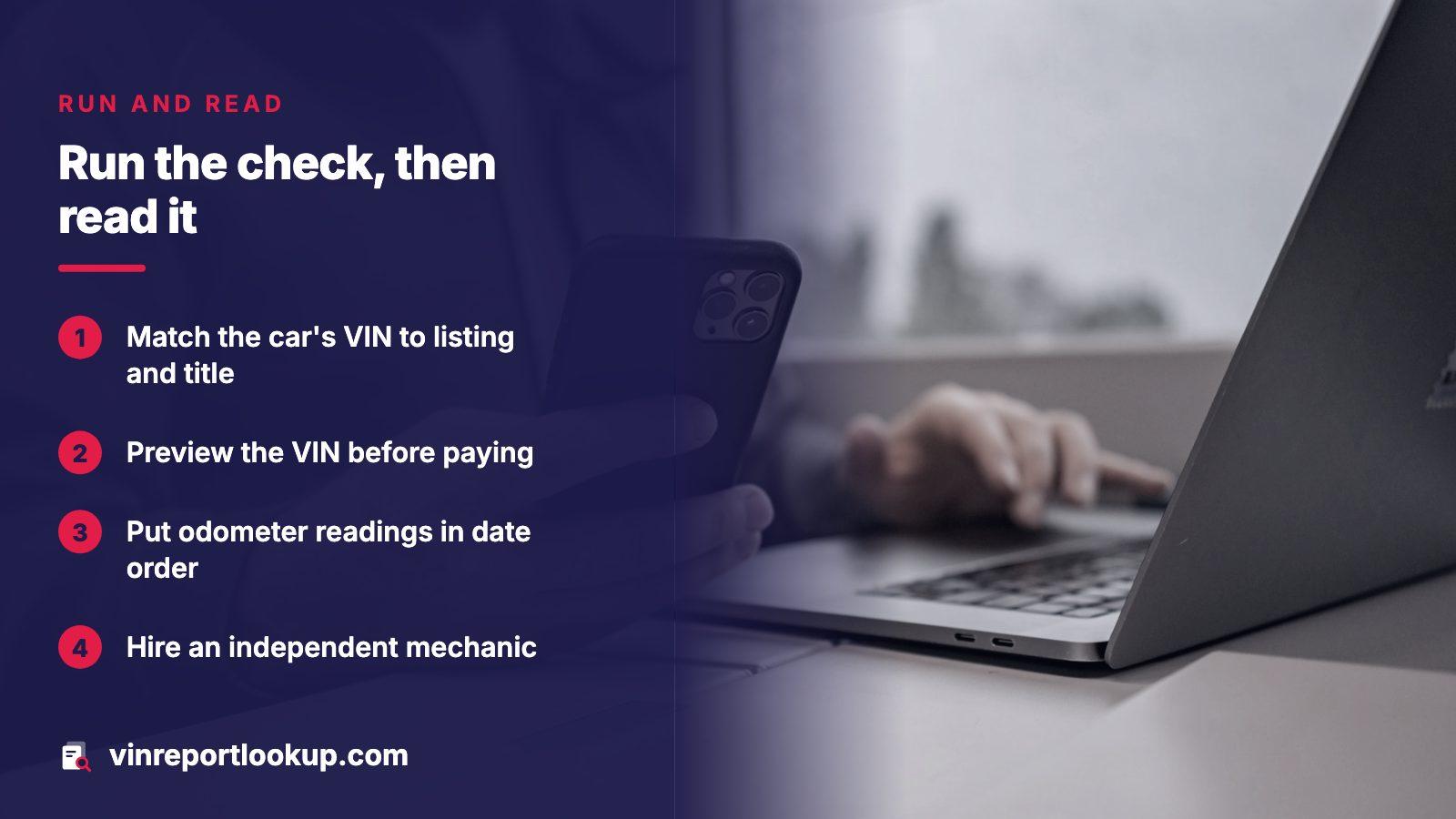
- Read the VIN off the car, then match it against the listing and the title papers. A difference means stop.
- Enter it in the VINReportLookup preview and see what turns up before you pay.
- Once the car survives the preview, buy the report and read the title lines first: brands, total losses, salvage entries.
- Put the odometer readings in date order and set them against the seller's story.
- Ask the state titling agency for its own title record, since it holds more than the federal summary.
- Hire an independent mechanic for an inspection.
A clean federal result is good news, in the Justice Department's words, but it is a short report. Treat a brand, total loss or salvage entry as a warning that the car may be unsafe, and ask for repair paperwork before you talk price.
What a VINReportLookup report adds after the preview
VINReportLookup takes a VIN, shows a free preview, and asks for money only after that. You pay one time, either for a lone report or for a multi-report bundle in sizes of three, five or ten, and no plan carries on afterward. The title records inside come from ClearVin LLC, an approved provider on the Justice Department's public list, whose service the site resells.
Alongside the title data you get the odometer history, crash or damage records that insurers or auctions logged, with photos where they exist, plus liens, theft flags and recalls still open. It is a title-and-damage picture, not a dealer's service log, so ask the seller for maintenance receipts if shop visits matter.
Where this information comes from
- Bureau of Justice Assistance: Approved NMVTIS data providers — The two provider groups, where CARFAX.com is listed, and the warning that consumers cannot receive NMVTIS reports from it.
- Bureau of Justice Assistance: Understanding an NMVTIS report — The five items the federal record covers and the repair and recall data it leaves to private providers.
- Bureau of Justice Assistance: NMVTIS for consumers — Coverage figures, false negatives, state differences in branding and the advice to get the state title record.
- Bureau of Justice Assistance: Used car buying tips — The up-to-$4 price statement and the inspection and maintenance-record advice.
- Bureau of Justice Assistance: NMVTIS frequently asked questions — The operator, the second price statement, which model years insurers report and the rule on total losses with no claim paid.
- FTC: Used cars — Where Carfax is named as another provider that sometimes adds accident and repair history, and why no report replaces an inspection.
- FTC: Buying a used car — What history reports can and cannot reveal, and how to use a mechanic's written report when bargaining.
Sources and photos: Facts checked against the sources above in November 2026. Photos by Leo_Visions, Anastasiia Nelen and Owen Michael Grech on Unsplash; diagrams by VINReportLookup.
Keep reading
- Carfax alternatives: what each VIN report option covers and costsEvery way to check a VIN, from free lookups to private reports, sorted by what each answers.
- Vehicle history report providers: who sells VIN reports and how they differWho sits on the Justice Department roster and how providers differ.
- How much a Carfax vehicle history report costs and what it coversWhere to read the current Carfax price and what to compare it against.
- Carfax vs inspection: what each shows and which to buy firstWhat a mechanic's inspection finds that no report can.
Frequently asked questions
Is the federal record better than Carfax?
Each answers a different question. The federal record centers on title brands, total losses, salvage-yard stops and odometer readings, and the Justice Department says it leaves out repair history. The FTC says providers like Carfax sometimes add accident and repair entries. Neither replaces a mechanic's inspection.
Can I buy an NMVTIS report from Carfax?
Not as a private buyer. The Justice Department lists CARFAX.com among providers serving business customers only, limited to California, and a bold line on that page warns consumers off Carfax as a source for the federal report. Check the roster on the day you buy, because it changes.
Why did my federal report come back empty?
An empty report is usually good news, since a brand, total loss or salvage entry is what the system exists to flag. It can also mean no state has reported anything for that VIN yet. The Justice Department warns that gaps cause false negatives, so pair an empty result with the state's own title record and a mechanic's look.
Do I need both a Carfax report and an NMVTIS report?
Often not. If title brands and write-offs are your worry, one title-based report answers that, and a one-time VINReportLookup report after a free preview suits a single car. Add Carfax only when accident and repair entries on that particular car would change your offer.
Should I also request the state title record?
For a car you plan to buy, yes. The Justice Department says the federal report is intentionally concise and that the state's own title file holds more. Contact the titling agency and ask what it charges and how long it takes, since the official pages read for this guide give neither.
Now check the car itself
The guide explains what to look for. The report shows what this VIN has on record.