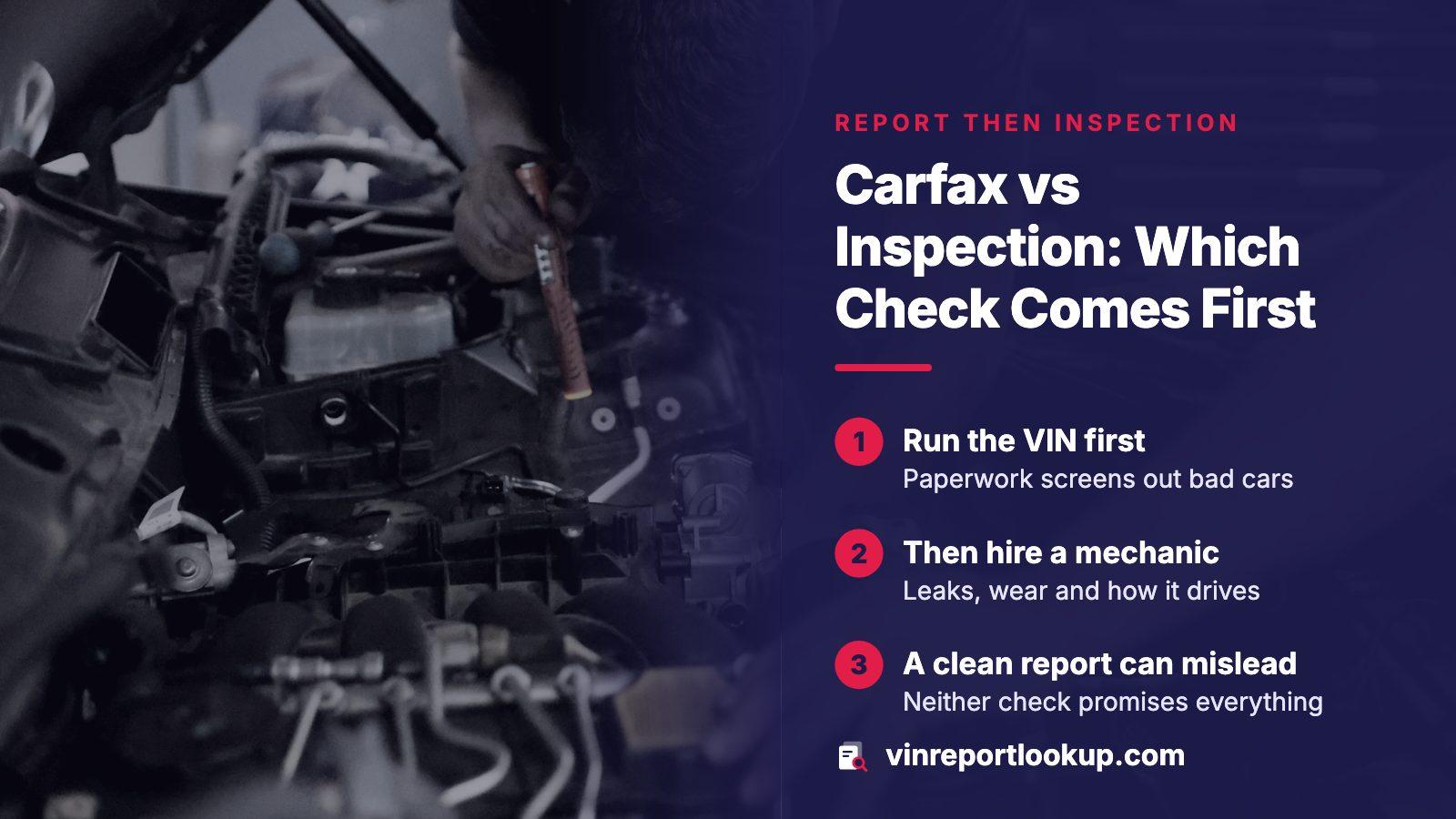
THE SHORT ANSWER
Run the VIN first, then hire a mechanic. A VIN report shows paperwork history: title brands, total losses, odometer readings and open recalls. An inspection shows condition today, such as leaks, wear and how the car drives. The FTC treats them as separate jobs, and no history report excuses you from an independent inspection. Preview every car on your list, buy the full report for finalists, and pay a mechanic only for the one you would sign for.
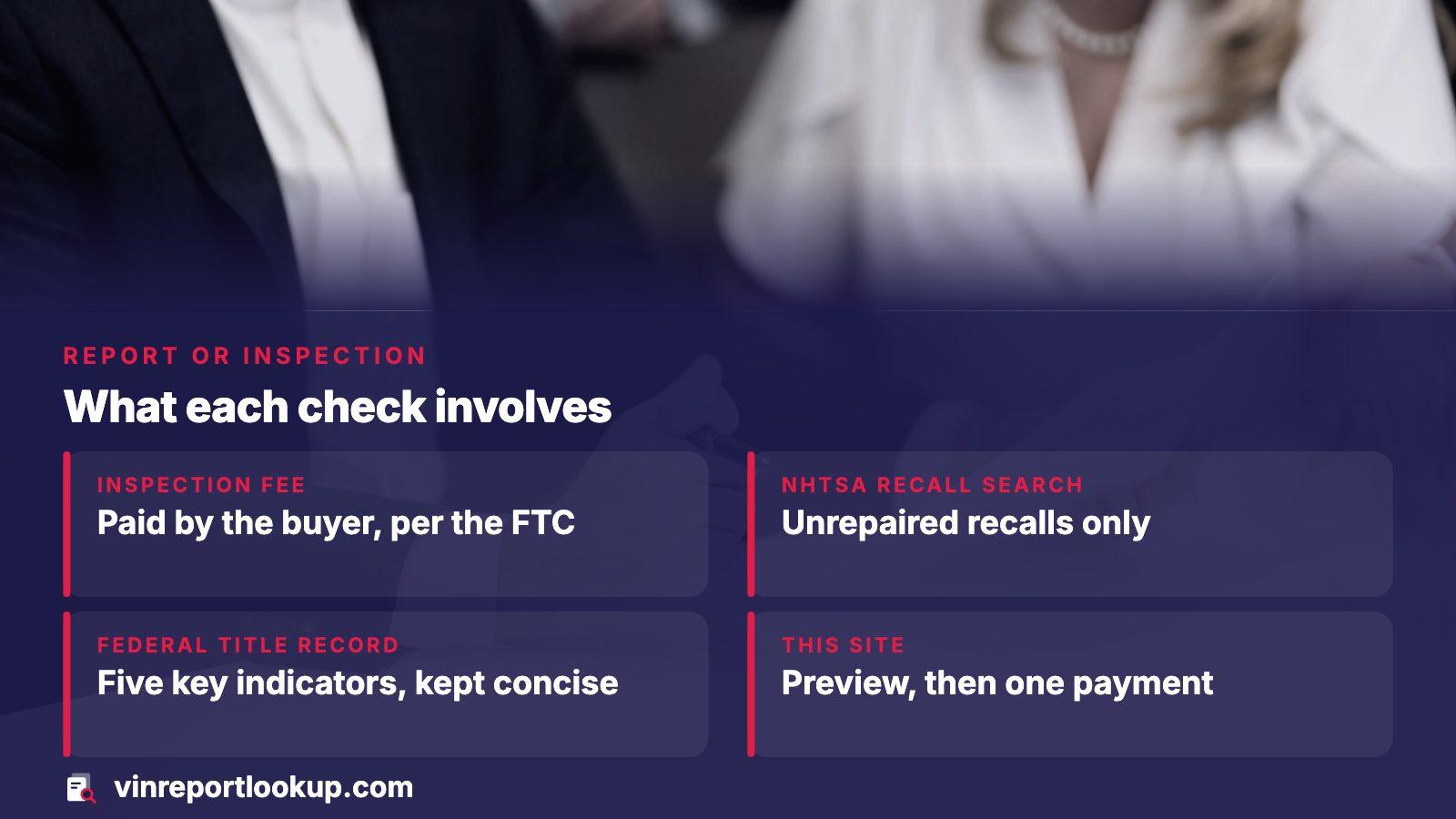
- Inspection fee
- Paid by the buyer, per the FTC
- NHTSA recall search
- Shows unrepaired recalls only
- Federal title record
- Intentionally concise, five key indicators
- VINReportLookup
- Free preview, then one payment
A report reads the paperwork, an inspection reads the car
Every used car has two histories. One lives in records: who titled it, which state branded it, what an insurer decided after a loss, what the odometer said each time someone wrote it down. The other is physical: how worn the brakes are, how the transmission shifts, where fluid seeps. A VIN report covers the first. A mechanic covers the second.
| What you want to know | VIN history report | Mechanic's inspection |
|---|---|---|
| Was it ever branded salvage or flood? | Yes, from title and insurer records | No, though repairs can leave clues |
| Do the odometer readings add up? | Yes, entries in date order | Only through wear that looks wrong |
| Is a safety recall still open? | Yes, listed by VIN | No, that is a database fact |
| Are brakes, tires and suspension worn? | Rarely | Yes, checked on the car |
| What will repairs cost? | No | Yes, in a written estimate |
What the VIN record catches that a mechanic cannot
No mechanic can see a title brand applied in another state, an insurer's total loss decision or the odometer figure from two owners back. The Justice Department calls its federal title record intentionally concise, built on five key indicators that include brand history, odometer readings and salvage or total loss entries. Private reports add more, and the FTC says Carfax and a few others sometimes include accident and repair history.
- Brands such as salvage or flood, which a fresh coat of paint can hide.
- Odometer entries logged on different dates, so a rollback shows up as a number that drops.
- Auction and salvage stops, with photos where a report carries them.
- Open safety recalls tied to the VIN, which dealers repair at no charge, according to NHTSA.
What an hour with a mechanic finds that no record holds
The FTC's view is that accident and flood entries turn up in reports while mechanical trouble generally does not. That gap belongs to the mechanic. Hire an independent shop for a mechanical inspection. A safety inspection is narrower, the FTC notes, aimed at defects that make a car dangerous on the road.
- Leaks, worn parts and play in the suspension, found on a lift and a road test.
- A written estimate that carries your car's make, model and VIN and prices every needed repair.
Book it even if the dealer markets the car as certified, says it passed an in-house check, or bundles a warranty or service contract. The FTC still advises the independent look, and the buyer pays the fee.
A clean report can still hide a bad car
Reports are only as complete as the sources behind them. By the Justice Department's count, 87 percent of vehicles are in its database and over half the states send data. It also warns that a clean result may be a miss, since not every entity reports. And no report can describe how a car drives.
From an NHTSA owner complaint
A 2014 Jeep Cherokee owner bought the SUV from a dealer in January 2016 with about 40,000 miles on it and a Carfax that checked out. Over that year it stalled at stops three times. On the first service visit the dealership finished two safety recalls and a stack of software updates that, the owner says, were still open at the time of sale.
A clean history entry says nothing about recalls the seller never got to. Look up the VIN on NHTSA's recall site, and treat the report as a filter that removes the worst cars, not a verdict on the one you keep.
What an inspection cannot promise either
An inspection is one person's judgment on one day. It will not show a title brand from another state or an insurer's write-off, and a car that passes now can still fail soon after. On a dealer car sold as is, the FTC says every repair bill after the sale lands on the buyer.
From an NHTSA owner complaint
A buyer of a 2011 Hyundai Sonata bought it used in September 2020, had it inspected, and says it passed. Six weeks after the purchase it died in the middle of a Philadelphia street. A shop found a locked engine, and the owner says Hyundai told them no recall covered that VIN.
Pay for the inspection anyway, because it finds faults no record can. Read a pass as a snapshot, price the car with that in mind and, on an as-is sale, keep money aside for repairs.
When one check tells you what to ask the other
The pair works best when each result shapes the next question. NHTSA's 2024 consumer alert shows how. It reports three deaths and two serious injuries in the preceding year from cheap replacement air bag inflators, all in cars that had crashed earlier. NHTSA's advice: get a history report, and when it records a collision with an air bag going off, have a reputable independent mechanic or dealer verify that the replacement parts are genuine.
| Report shows | Mechanic shows | Your move |
|---|---|---|
| Clean | Clean | Buy, and fold any small estimate items into your offer |
| Clean | Faults found | Price the repairs into the offer or walk away |
| Brand, write-off or odometer drop | Not booked yet | Stop and ask for repair papers before paying a mechanic |
| Crash with air bag deployment | Not booked yet | Have the mechanic check the air bags in particular |
A buying order that puts the cheap steps first
- Take the VIN from the car, not just the listing, and compare it with what the title and registration say. Any difference is a reason to leave.
- Run the free VINReportLookup preview on every car on your list.
- Look up each VIN on NHTSA's site, which accepts up to 100 VINs in one search.
- Buy the full report for the finalists. Packs of 3, 5 or 10 let one payment cover several cars, and no subscription follows.
- Pay a mechanic only for the car you would sign for, and ask for the written estimate.
Current prices live on the pricing page, so none is printed here. The preview itself carries no charge; a report is a single purchase and no plan follows it.

Which report to put next to the mechanic's
Choose by the gap you need filled.
| Option | What official pages say | Where it fits |
|---|---|---|
| Carfax report | The FTC lists it among providers that sometimes add accident and repair history, and endorses none of them. | Read its sample and price on its own site; this page quotes neither. |
| Federal title record from an approved seller | Intentionally concise, built on five key indicators including brands, odometer and salvage. | A narrow screen for hidden brands and write-offs. |
| VINReportLookup report | Preview first, then one payment; multi-report packs suit a long shortlist. | Title brands, damage records, odometer history, salvage photos and open recalls in one document for finalists. |
Where this information comes from
- FTC: Buying a Used Car From a Dealer — Independent inspection advice, safety versus mechanical inspections, the written estimate and as-is sales.
- FTC: Used Cars — Which providers sometimes add accident and repair history, and where open recalls are checked.
- NMVTIS: Information for consumers — Coverage figures, the five key indicators and why a clean result can be a false negative.
- NHTSA: Check for Recalls — What the VIN recall search shows and leaves out.
- NHTSA: Consumer alert on substandard replacement air bag inflators — The advice to pair a history report with a mechanic's air bag inspection.
- NHTSA owner complaint 10916263 — owner experience, paraphrased
- NHTSA owner complaint 11366886 — owner experience, paraphrased
Sources and photos: Facts checked against the sources above in November 2026. Photos by Mustafa Sheikhmouss, Jakub Żerdzicki and Carrie Allen www.carrieallen.com on Unsplash; diagrams by VINReportLookup.
Keep reading
- Sample reportSee what each report section looks like before you pay for one.
- Can you negotiate car price at a dealership? Using a history reportTurn report findings and an inspection estimate into a lower offer.
- Carfax vs NMVTIS: what each report shows and which to buyHow a private report differs from the federal title record.
- Rebuilt title inspection cost: state fees and what a buyer paysWhat the inspection step looks like on a car with a rebuilt title.
Frequently asked questions
Is a Carfax report enough without an inspection?
No. The FTC says reports carry accident and flood entries but generally skip mechanical problems, and it recommends an independent mechanical inspection on any used car. Screen cars with the report, then pay a mechanic for the one you plan to buy.
Should I get the report or the inspection first?
The report. It needs only the VIN and takes minutes, so it can end a deal before anyone travels to see the car. A brand, write-off or odometer drop is a reason to stop. Book the mechanic once the car clears the records.
Does a history report show mechanical problems?
Generally not. The FTC points to accident and flood entries as what a report may hold, while some private providers add repair entries. Wear, leaks and how the engine and transmission behave are for a mechanic to judge. If shop history matters, ask the owner for maintenance receipts.
Who pays for the inspection, and what if the seller says no?
The buyer pays, says the FTC, which gives no dollar figure, so ask the shop for a quote. Some dealers cannot release a car from the lot. Then look for a mobile inspector, or ask the dealer to take the car to a shop you pick. A dealer that refuses any independent inspection is one the FTC says to leave for another.
Does NHTSA's recall search replace a history report?
No. It covers recall status only, and only for unrepaired recalls: repaired ones, some newly announced campaigns and recalls older than 15 years are left out. It is a good free first screen, and it pairs well with the VINReportLookup preview.
Now check the car itself
The guide explains what to look for. The report shows what this VIN has on record.