THE SHORT ANSWER
The state charge falls on whoever repaired the car, and each state sets its own: $200 in New Jersey, a $65 rebuilt salvage fee in Texas, an appointment with the State Patrol in Wisconsin. Buying a car that already carries a rebuilt brand adds no state fee for you. Budget for an independent mechanic, and read the VIN record first so the inspection money goes only to a car that still deserves it.
- New Jersey inspection
- $200 per car, $100 per motorcycle
- Texas rebuilt fee
- $65 on top of the title application fee
- Buyer of a finished rebuild
- Owes no state fee; pays a mechanic
- VINReportLookup
- Free preview, then one payment
Who pays the fee, and who does not
A rebuilt brand reaches a title after someone repairs a car that carried a salvage brand and the state signs off. The repairer pays for that step. A shopper looking at a finished car arrives after the state has been paid, so the bills left to you are of your own making, sorted below.
| Cost | Who pays it | Where the amount comes from |
|---|---|---|
| State charge to retitle a repaired salvage car | The person who repaired it | Set by each state; examples follow |
| Independent mechanic's inspection | The buyer | The shop's quote; the FTC says the buyer covers it |
| Title-history report | The buyer | The provider's price, after a free preview here |
No single national figure exists, since each state sets its own.
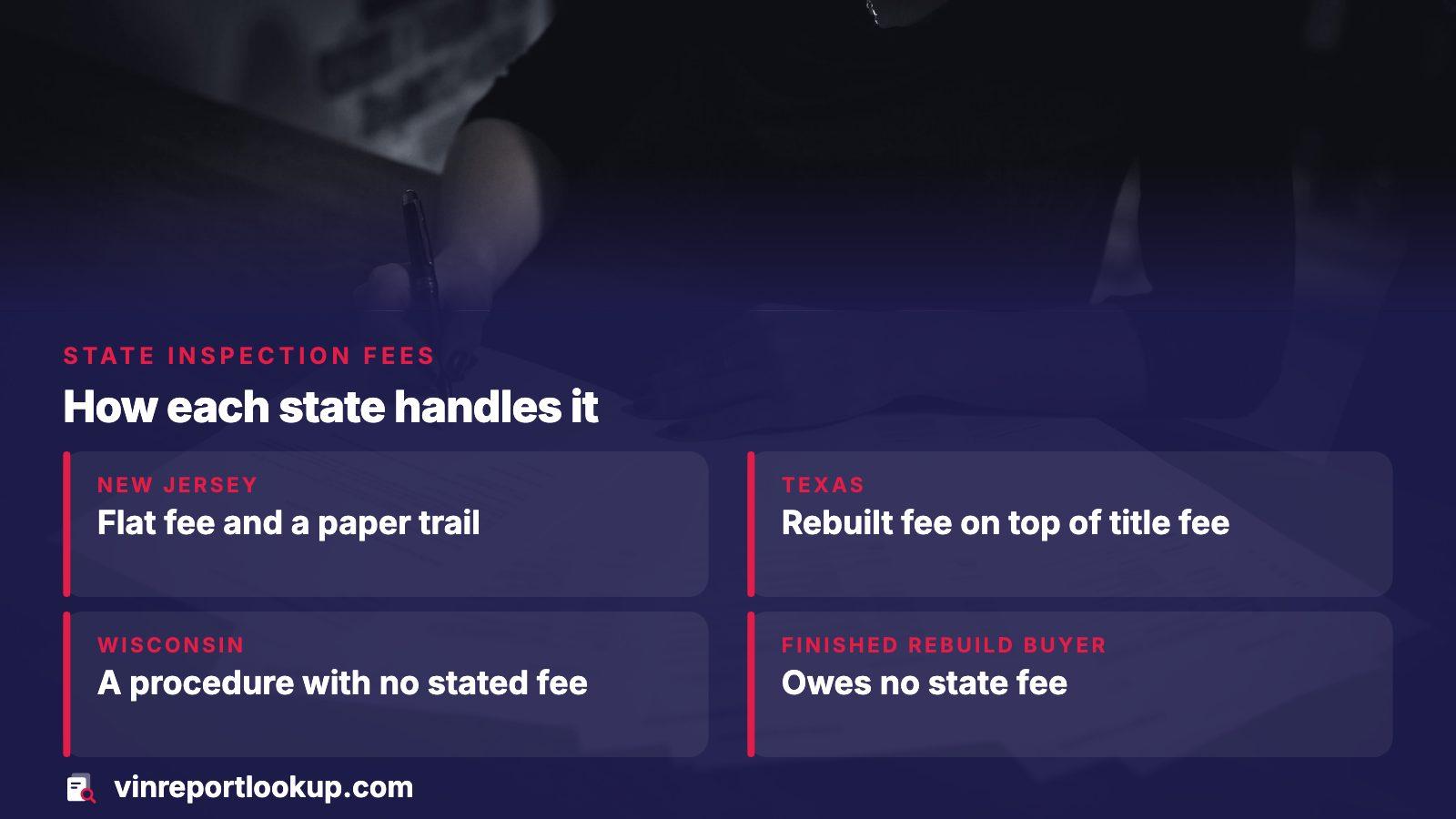
New Jersey: a flat $200 and a paper trail
New Jersey is one of the few states to print its inspection price on the form itself. The Salvage Inspection Fee Application sets $200 for cars and trucks and $100 for motorcycles. Payment is non-refundable, valid for a year, and taken only by check or money order. A late arrival or a no-show forfeits it, and a reschedule with under five days of notice triggers a second fee under the regulation.
Documents go by email and must be approved before the state books a slot:
- The salvage title, with the fee receipt attached.
- Purchase paperwork for each major part replaced, naming the donor car's VIN when the part was used.
- Color photos from before and after the repair, covering all four sides.
- A work order listing every repair.
The appointment runs about an hour, the owner may not watch, and the car arrives on a tow or under a temporary registration.
Texas: $65 on top of the title fee
Texas prices the same step another way. The TxDMV manual adds a $65 rebuilt salvage fee to the statutory title application fee, which it gives as $28 or $33. The filing goes to the county tax assessor-collector with a signed Rebuilt Vehicle Statement, and the form asks what was repaired and where any replacement body, frame or engine part came from.
Two provisions matter to a buyer. Someone who bought a car already repaired may write "Repairs unknown" and skip the form's second page, so a Texas rebuilt title can rest on a record that says nothing about the work. An owner who cannot trace a replaced major part must go through a hearing or a bonded title, a slower road than the ordinary filing.
Wisconsin and elsewhere: a procedure with no price
Wisconsin shows how a state can publish a procedure without a figure. Its inspector list says repaired salvage vehicles may be examined only by authorized inspectors, by appointment, and the agencies named are State Patrol posts plus a handful of sheriff and police departments. No fee appears, so an owner learns the cost by phoning the agency or reading the current fee schedule.
Before you repeat any figure
Fees change, and states publish them in different places. Quote a number only after reading the agency's own page, and if a seller claims the inspection cost a fortune or next to nothing, ask for the paperwork.
What the state fee buys, and what it leaves out
The fee pays for an identity check, not a grade on the repair. New Jersey's form says the aim is to match the car against the description and identification on its salvage title, with the owner consenting to parts being removed during verification. The regulation then names what fails a car: it is stolen, it contains a stolen major part, or it wears the plate or number of a stolen vehicle. Workmanship is never named.
What to take from this
A rebuilt brand says the paperwork cleared a state review aimed at theft. It says little about welds, structure or airbags, which is why the FTC advises hiring an independent mechanic even for a car a dealer calls certified.
New Jersey also treats these inspection reports as not public records, so any copy has to come from the seller.
Run the VIN before you pay a mechanic
An inspection fee is wasted on a car whose record already rules it out. Read the VIN off the dashboard's driver-side corner, where it shows through the glass, or off the label on the door frame, and confirm it matches the listing and the title.
- Put the VIN into the form on this site. The free preview confirms the car, flags open recalls, and shows whether title or auction records exist.
- If records exist, buy one report, or a bundle when several cars are on your list.
- Read the brands on the title, the damage and auction entries, the odometer history and any theft or insurance flags.
- Take what you found to the seller first, then to the mechanic.

Reading a rebuilt-title car's report
A rebuilt car usually leaves a trail, and the report is where you look for it.
| Entry you find | What it hints at | Ask the seller for |
|---|---|---|
| A salvage or total-loss entry, then a rebuilt brand | The usual route, with a repair in between | The repairer's name and the parts receipts |
| Auction photos of heavy damage | The car as it looked before repair | The repairer's own before-and-after photos and work order |
| A rebuilt brand with no earlier damage entry | A gap in what was reported | When and where the brand was issued, plus a copy of the title |
| A theft record | The reason inspections focus on where parts came from | The police recovery report and donor VINs for replaced parts |
The federal title record calls itself concise, and reporting gaps can produce a clean-looking result. A quiet report is a reason to keep checking, not a pass.
What the check costs next to the inspection
Set the bills side by side. New Jersey charges a repairer $200 for an inspection, and a mechanic's visit is yours to pay for in every state, per the FTC. The record check is the small line: TxDMV says approved providers price title checks from a couple of dollars, and VINReportLookup lets you read a free preview before making one payment for the full report.
Costs for a single report and for the bundles are posted on the pricing page, and with no subscription nothing renews. One report costs well under what New Jersey charges a repairer, and it shows whether the car earns the mechanic's hour.
Turning a rebuilt brand into a decision
Once the record looks acceptable, four moves turn a rebuilt brand into a price you can defend.
- Ask the seller for repair invoices, parts receipts and the photos taken before the work began.
- Get a quote from the mechanic before booking, since each shop sets its own price.
- Compare the asking price with similar cars carrying clean titles.
- Move on from a dealer that refuses an independent inspection, as the FTC advises, and treat a private seller's refusal the same way.
Where this information comes from
- NJ MVC: Salvage Inspection Fee Application (OS/SS-3) — The posted inspection fee, how it is paid and forfeited, and the paperwork the state wants first.
- NJ MVC: salvage certificate regulations, N.J.A.C. 13:21-22 — The fee schedule in rule form, the grounds for failing, and the rule that reports are not public.
- TxDMV: Salvage/Nonrepairable Motor Vehicle Manual — The rebuilt salvage fee, the title application fee, the Rebuilt Vehicle Statement and the repairs-unknown provision.
- Wisconsin DOT: Salvage Vehicle Inspecting Agency List — Who may inspect a repaired salvage vehicle there, and that an appointment is required.
- TxDMV: Title Check, Look Before You Buy — The agency's advice to run a title check on the VIN and its statement on what such checks start at.
- FTC: buying a used car from a dealer — That the buyer pays for an independent inspection, and that a history report does not replace one.
- NMVTIS: information for consumers — What the federal title report contains and why a clean result is not a guarantee.
Sources and photos: Facts checked against the sources above in November 2026. Photos by Patrick von der Wehd, Anastasiia Nelen and Dimitri Karastelev on Unsplash; diagrams by VINReportLookup.
Keep reading
- Vehicle history report cost: what each kind charges and coversWhat official lookups, title records and premium reports each charge, side by side.
- Carfax minor vs moderate damage: what each label tells a buyerHow to weigh a damage label on a report before deciding a car needs an inspection.
- Sample reportThe sections a finished report fills in, shown before you buy one.
- Best VIN check: how to choose a report and what each one includesHow to choose a VIN check when several services offer one.
Frequently asked questions
What does a rebuilt title inspection run?
It depends on the state. New Jersey's form lists $200 for cars and trucks and $100 for motorcycles, Texas charges a $65 rebuilt salvage fee plus its title application fee, and Wisconsin's inspector list gives no price. The repairer pays, so read your own state's current page before quoting anything.
Do I pay the inspection fee if I buy a car that is already rebuilt?
No state inspection fee lands on you, since the repairer paid before the rebuilt brand was issued. You still pay for any mechanic you hire, any history report you buy, and the usual title and registration charges when the car goes in your name.
Does passing the state inspection mean the repair is sound?
Not under New Jersey's rules, where the grounds for failing concern stolen vehicles and stolen parts. The inspection checks identity and the origin of major parts. Whether the structure and safety systems were rebuilt properly is a question for a mechanic, which is the FTC's advice too.
Can I see the state inspection report on a rebuilt car?
In New Jersey the regulation says these reports are not public records, so ask the seller for their copy with the parts receipts and photos. Other states differ. A VIN report adds title brands, auction photos and damage entries to compare against whatever the seller hands over.
How does a VIN report's price compare with the inspection?
VINReportLookup shows a free preview first, then takes one payment for the full report, with larger bundles for shoppers comparing cars. The pricing page has the amounts. TxDMV puts title-check prices at a couple of dollars and up, so the record check is the low-cost step to take before booking a mechanic.
Now check the car itself
The guide explains what to look for. The report shows what this VIN has on record.