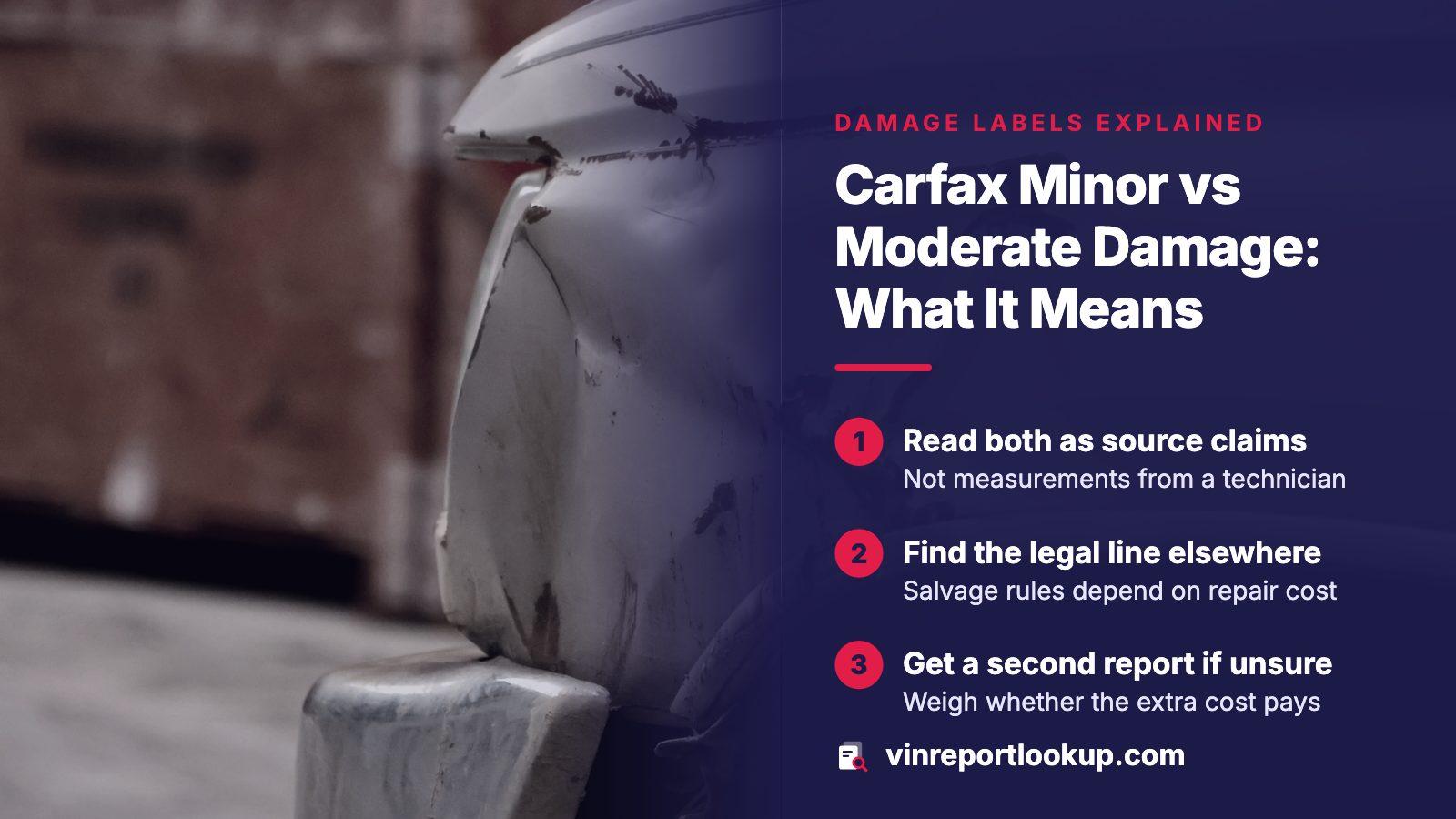
THE SHORT ANSWER
Moderate is the heavier of the two labels, yet both record what a reporting source said about an event, not what a technician measured afterward. Neither equals a salvage or rebuilt brand, which depend on total-loss rules and state titling. Ask the seller for the repair invoice, have an independent mechanic inspect the affected area, and compare the entry with a title-record report before you decide.
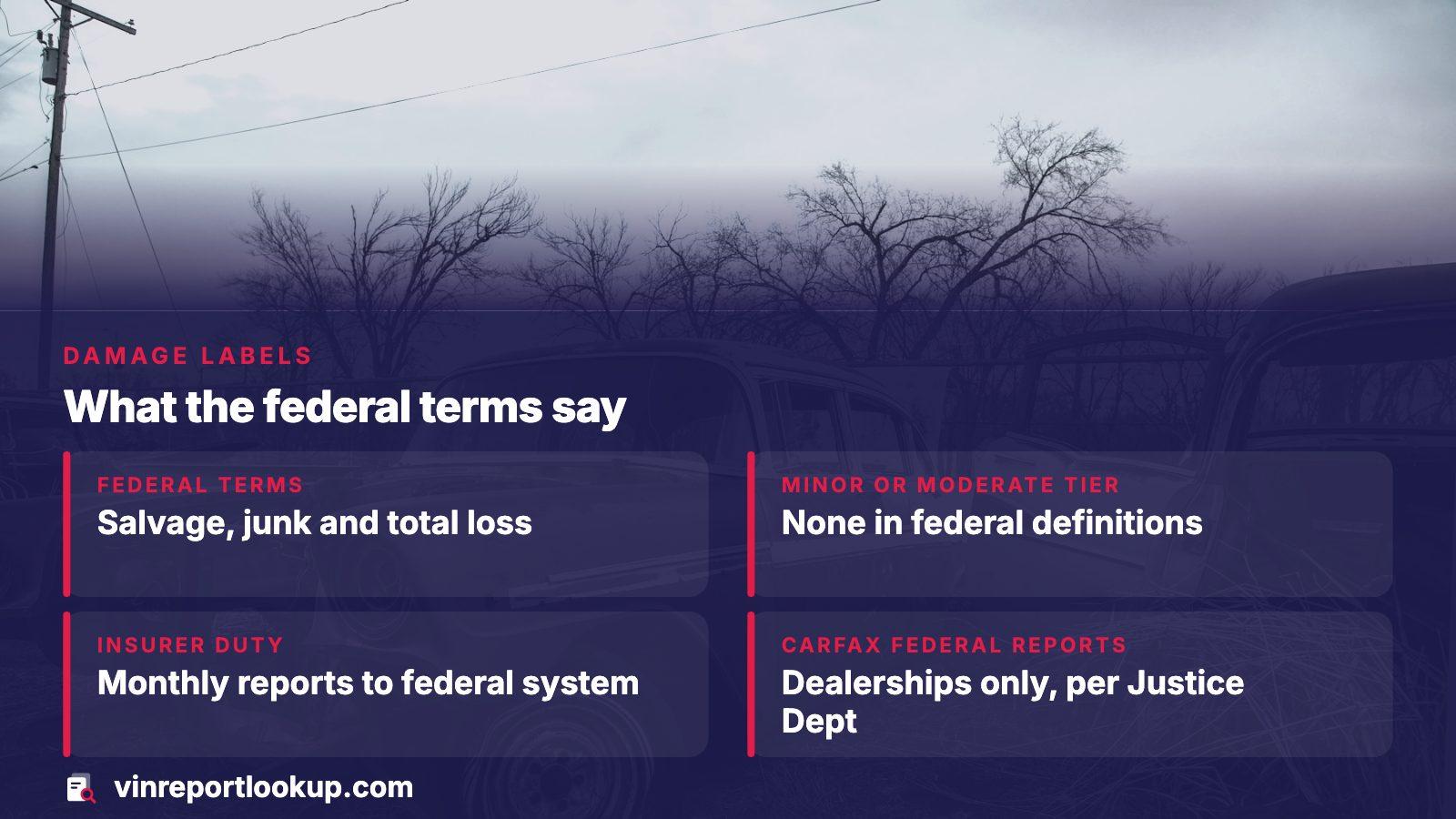
- Federal definitions
- Salvage, junk and total loss, with no minor or moderate tier
- Salvage test
- Repair cost plus salvage value, set against pre-damage market value
- Insurer duty
- Monthly reports on junk, salvage and total-loss cars to the federal title system
- Carfax federal reports
- Dealerships only, according to the Justice Department
Two severity words, not two grades of repair
A damage entry on a Carfax report does two jobs. It says something happened to the car, and it pins a severity word to that event. The entry is a short summary of an incident that someone reported. It is not a record of the work that followed, and nothing in it tells you how well the fix was done.
Carfax keeps a glossary of its terms, and any company can reword a glossary whenever it likes. Read the current wording next to your own report instead of trusting a paraphrase, this page's included. What stays constant is the kind of statement you are holding: a label a business applied to a reported event.
What neither word settles
Buyers often ask a damage label for answers it was never built to give. This table sorts four common questions by where the answer actually lives.
| Question you still have | What a severity word tells you | Where the answer lives |
|---|---|---|
| Was the repair done well? | Nothing about the workmanship | An independent mechanic's inspection, in writing |
| Did an insurer write the car off? | Nothing; severity is not a total-loss finding | The federal title record, then the state title |
| Is anything mechanical wrong? | Little, since reports typically leave mechanical problems out, per the FTC | A mechanical inspection, which is not the same as a safety inspection |
| Was every incident reported? | Only incidents someone sent in can appear | The seller's invoices and a mechanic's eyes |
Where the legal line actually sits
The rules that govern the national title database define three terms, and minor and moderate are not among them. A salvage automobile is one hurt by collision, fire, flood or some other event so badly that its salvage value plus the bill to make it legal for the road would top its market value just before the damage. A junk automobile is one that cannot be driven on public roads and holds no value beyond parts or scrap.
The arithmetic behind a brand
Add the repair bill to the wreck's value as scrap and parts, then weigh that total against the car's market value in the instant before the damage. An insurer's total-loss decision also counts as salvage, whether or not the car changes hands. The same repair bill weighs more against a car worth less.
An entry can carry either severity word and still say nothing about whether that line was crossed. Where the line falls also varies, because a state's salvage test is a share of retail value that the jurisdiction itself sets, as TxDMV explains on its title-check page.
Who reports to the title system, and how often
Three groups feed the federal title database on a schedule, and the rules say what each must send.
- Insurers: every month, the junk, salvage and total-loss cars they took possession of or designated, though the duty covers only cars from the newest model year back through four earlier ones.
- Salvage and junk yards: every month, an inventory of what they obtained, naming the VIN, the source and where the car went next.
- States: titling data, brands included, every 24 hours.
Those duties attach to junk, salvage and total-loss events. Ordinary body damage sits outside them, which is why a brand on a title carries more weight than a severity word on a damage entry.
Reading a minor entry
Minor is the lighter word, and it deserves two specific questions: which part of the car, and who fixed it. Ask for the invoice or estimate, then study that area on the car itself in daylight with the paperwork in hand. Mismatched paint, uneven gaps beside the repaired panel and overspray on rubber trim are signs a mechanic will check without being asked, and you can look for them too.
A minor entry on a car you otherwise like seldom justifies leaving. What it justifies is an inspection, and a fair argument for a lower price if the repair turns out to be rough.
Reading a moderate entry
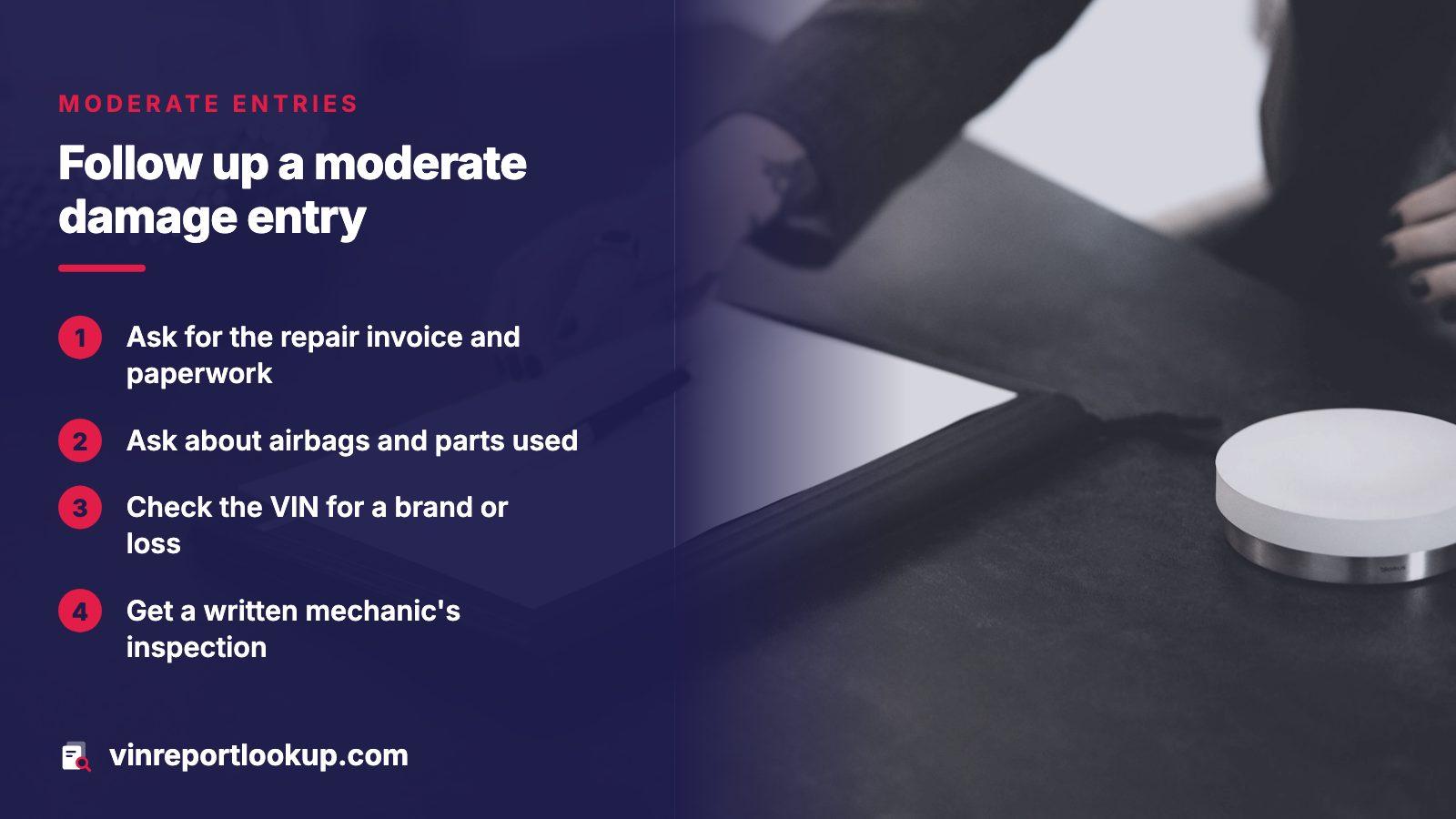
Moderate is the word that should slow you down. The steps below run in a fixed order, because each one can end the conversation cheaply before the next one costs you money.
- Ask the seller for the repair invoice, any insurance or police paperwork, and the date of the work.
- Ask whether airbags deployed and what parts the shop used.
- Check the VIN against a title-record report for a brand or a total-loss record.
- Hire an independent mechanic for an inspection and get a written report that prices every repair needed, as the FTC advises.
- Use that estimate to negotiate, or walk away if the seller will not allow the inspection.
When a second report earns its cost
The Justice Department's title-record page says consumers cannot receive the federal report from Carfax, DMVDesk or Experian, because those three serve dealerships only. Twelve providers on the same page sell to the public as well as to businesses. A Carfax damage entry and a title brand answer different questions, so a second report is worth buying when the first raises a damage entry and leaves the brand question open.
VINReportLookup is built for that second look. Type in the VIN to see the preview, which costs nothing, and pay once, only if the car survives your shortlist. Beyond the preview, the report covers brands on the title, recorded accidents and damage, and auction or salvage history, photos included. Prices for one report and for a multi-report pack sit on the pricing page, and none of it renews by itself.
Mistakes buyers make with these labels
- Reading minor as proof the car is fine, then skipping the inspection.
- Reading moderate as an automatic no, and dropping a car that an inspector could have cleared and priced.
- Assuming a report with no damage entries describes a car with no damage.
- Accepting a dealer's word that certified status makes an outside inspection pointless. The FTC says to pay for one even on a certified car.
Every one of these errors comes from treating a label as a conclusion. It is better used as a pointer to where the inspection should begin.
Where this information comes from
- eCFR: 28 CFR 25.52, definitions — The federal definitions of salvage, junk and total loss, none of which is a minor or moderate tier.
- eCFR: 28 CFR 25.55, insurance carriers — What insurers must report each month, and the model-year window the duty covers.
- eCFR: 28 CFR 25.56, junk and salvage yards — The monthly inventory that salvage and junk yards owe the title system.
- eCFR: 28 CFR 25.54, the states — How often states send titling data, brands included.
- NMVTIS: approved providers and consumer access — Source for the dealership-only note on Carfax, DMVDesk and Experian, and the providers that sell to the public.
- TxDMV: Title Check, Look Before You Buy — A state agency explaining brands and why a salvage test depends on a jurisdiction's own percentage.
- FTC: buying a used car from a dealer — Federal advice on history reports, independent inspections and written repair estimates.
Sources and photos: Facts checked against the sources above in November 2026. Photos by Everett Pachmann, Annika Wischnewsky and Leo_Visions on Unsplash; diagrams by VINReportLookup.
Keep reading
- Carfax review: is the report worth buying, and what else to compareWhat a Carfax report draws on, where it runs thin and how it compares with other ways to check a VIN.
- AutoCheck vs Carfax: which VIN report to buy, and when to buy bothHow the two best-known services differ and when buying both makes sense.
- Carfax alternatives: what each VIN report option covers and costsOther ways to check a VIN, matched to the question you still have.
- Rebuilt title inspection cost: state fees and what a buyer paysWhat to expect when a damaged car comes back with a rebuilt title.
Frequently asked questions
Is moderate damage on a Carfax report a dealbreaker?
Not automatically. It is a reason to slow down: get the repair invoice, see whether the title record carries a brand, and engage a mechanic who is not connected to the seller to inspect the car and write up the findings with a repair estimate. If the findings are clean and the price reflects the history, the car can still make sense. The FTC advises walking away to another dealer when one refuses to let someone else inspect the car.
Will a car with moderate damage always show a salvage title?
No. Salvage is a title status tied to a cost test or an insurer's total-loss decision, while a damage label is a severity word on a reported event. A car can carry a damage entry and a clean title. Only a title-record report shows which applies to the VIN in front of you.
Does minor damage mean the frame is untouched?
The word alone cannot tell you. It says how the event was rated, not which parts underneath were affected. Ask for the repair invoice, then have a mechanic examine that area with the car raised. A written inspection is the only thing that answers a structural question.
Why do two reports show different damage on the same car?
Each company gathers records from its own set of sources, so an event one received may never reach the other. The federal title record is a separate dataset again, fed by states, insurers and salvage yards. When two reports disagree, raise the gap with the seller and with your inspector instead of using it to settle the question.
Should I run a preview before buying a second report?
Yes. The VINReportLookup preview costs nothing to run, and it reveals whether any title or auction records exist for that VIN, which helps you decide if the full report is worth buying. The report itself is a single payment with no subscription.
Now check the car itself
The guide explains what to look for. The report shows what this VIN has on record.