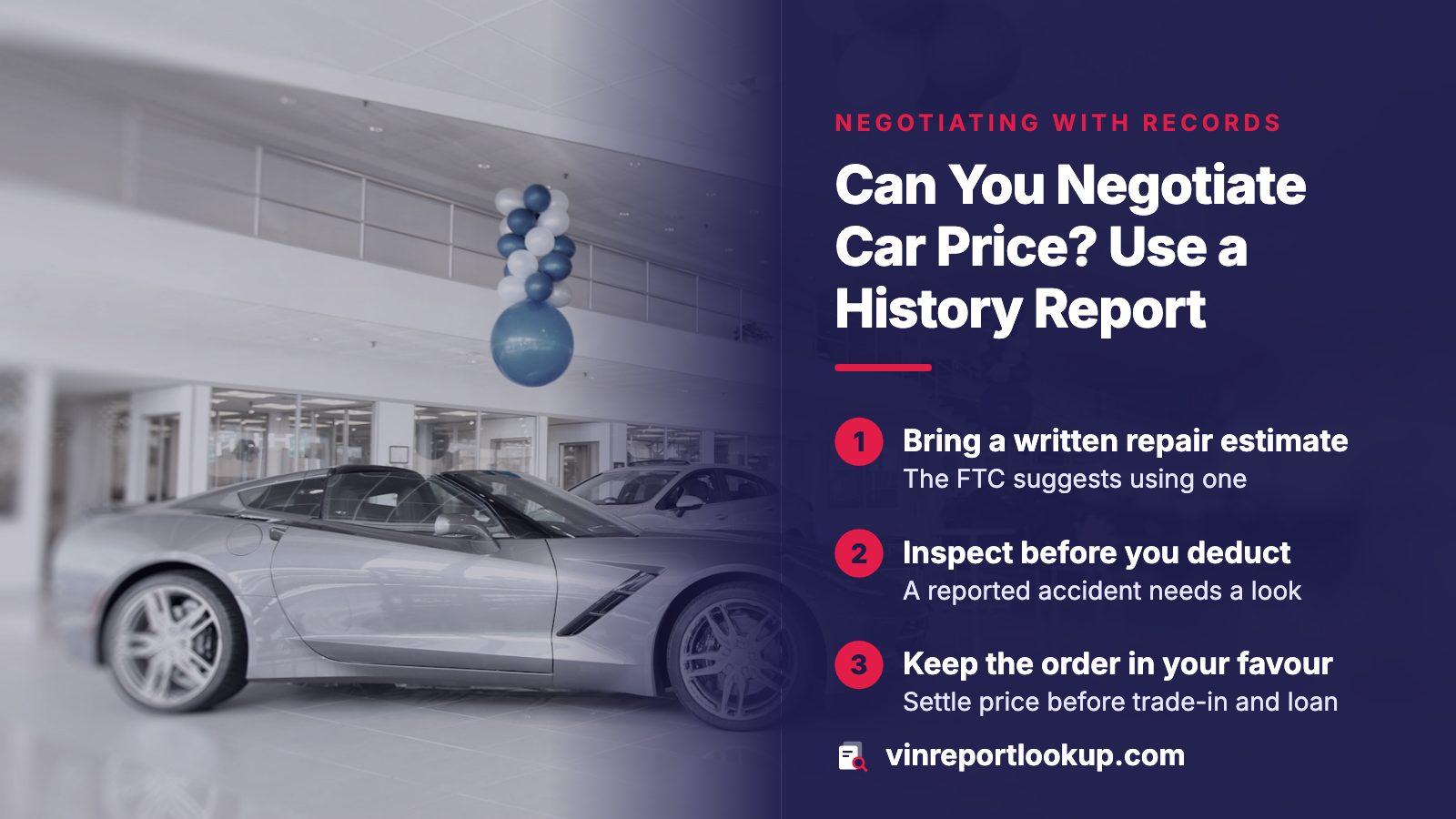
THE SHORT ANSWER
Yes. The FTC itself tells dealer shoppers to take a mechanic's written repair estimate and use it to negotiate. A history report adds a second lever: recorded accidents, title brands, odometer entries and owner counts that differ from the listing. Run it before you name a price, get the total in writing, and keep the car, trade-in, financing and add-ons as separate conversations.
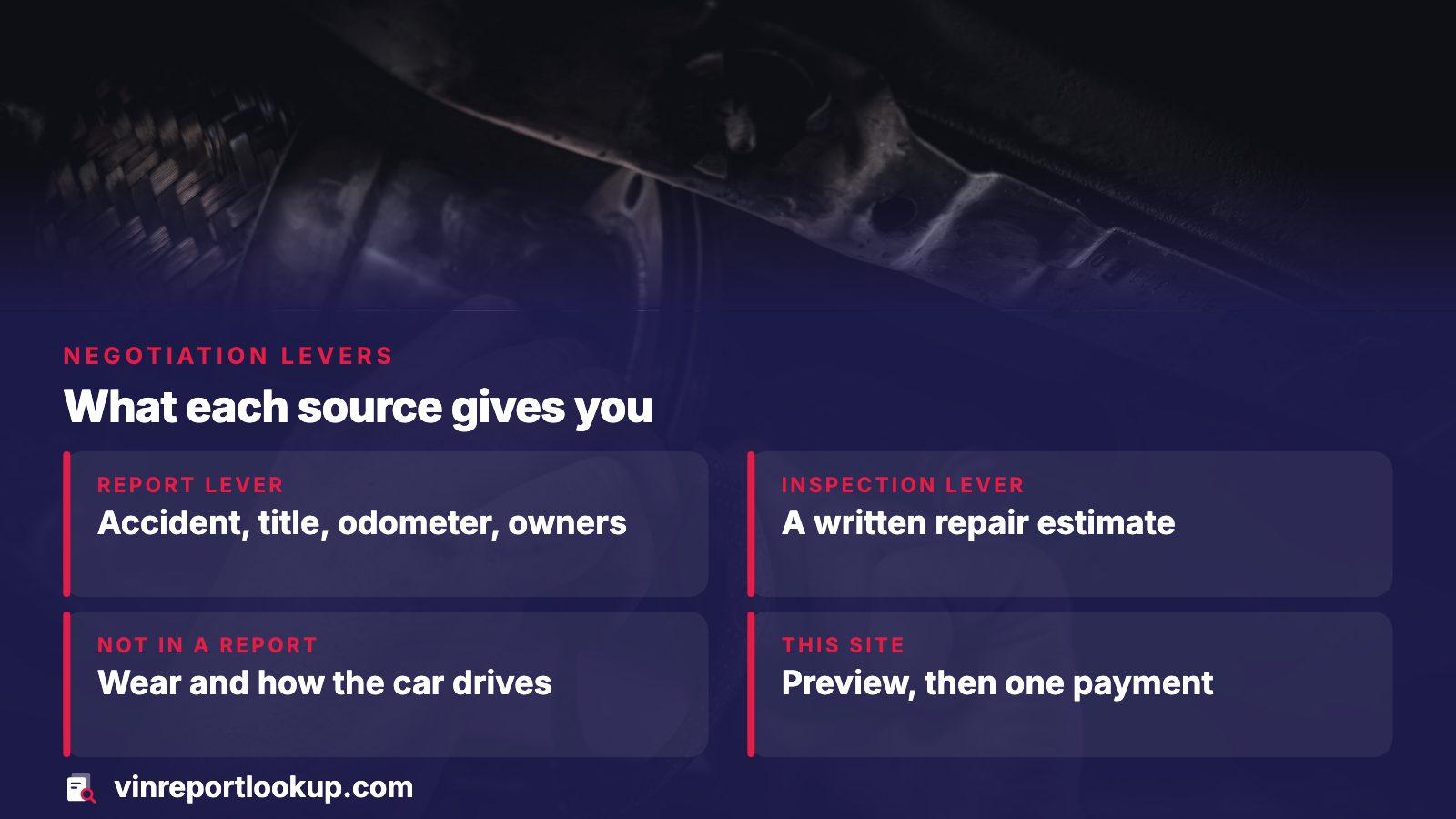
- Report lever
- Accident, title brand, odometer and owner records
- Inspection lever
- A mechanic's written repair estimate
- Not in a report
- Mechanical wear and how the car drives today
- VINReportLookup
- Free preview, then one payment, no subscription
What a report adds to the price conversation
Without paperwork, a lower offer is an opinion. The seller thinks the car is worth the number on the windshield, you think it is not, and nothing settles it. A history report moves part of that argument onto dated records that neither of you wrote. It covers the parts of a car's life a mechanic cannot see, such as where it was titled and what its odometer read a few owners ago.
It has limits from the start. A report holds only events somebody reported, and it says nothing about worn brakes or a slipping transmission. Use it as one of two documents: the report for the past, an inspection for the present.
Findings that justify a lower number
Some report entries give you something concrete to point at. This table pairs each with what it supports and a sensible next move.
| Entry on the report | What it supports | Next move |
|---|---|---|
| A recorded accident or damage event | A deduction for the repair, plus a closer look at that area | Request the invoice for the repair and book a mechanic to look at that spot |
| A title brand such as salvage or flood, or a total-loss entry | A much lower value, or no deal at all | Hold it against the ad and the seller's story before saying a number |
| An odometer reading higher than the dash shows | A mileage dispute that outranks any haggling over price | Ask for a written explanation, and stop if none arrives |
| An owner count that differs from what you were told | A correction, and a reason to doubt other claims | Put the seller's statement next to the record |
From an NHTSA owner complaint
A shopper considering a private-sale 2015 Honda Odyssey checked a history report before paying. The listing advertised 113,000 miles, while the report showed 291,000. The shopper did not buy the van and filed the mismatch with NHTSA as suspected odometer fraud.
Nothing was negotiated there, and nothing needed to be. The record settled the question before any money moved.
A reported accident: inspect first, then deduct
A listed incident does not set a price by itself. Reports say what a source recorded, not what the repair cost, so the entry only tells you where to look. Ask the seller who fixed it and what was replaced, then have an independent mechanic check that area, safety equipment included. Whatever that visit turns up becomes the number you subtract.
From an NHTSA owner complaint
A used 2016 Nissan Altima came with a report noting a minor front-end incident, no air bags deployed. Afterward the dash kept showing an air bag warning, and a dealer's service advisor said the entire module had to be replaced for $2,300. The owner doubted that was a bill to carry.
Had that quote existed before signing, it would have been a line on the negotiating table. After signing, it is only a bill.
What a clean report will not win you
A report with nothing flagged is good news, but it is not a bargaining chip. The federal title record covers only a handful of indicators, and the Justice Department's consumer page says a clean result guarantees nothing. Coverage is partial too: roughly 87% of vehicles appear in the federal database, and states define brands differently.
- Mechanical wear: the FTC says reports typically leave it out, so the inspection estimate is your tool there.
- Open recalls: NHTSA's notices for popular models say dealers perform the repair at no charge, so request that it be completed before you take the keys, not a discount.
- Flood damage in a state that does not brand it: the record may be silent.
The order that keeps the advantage with you
- Copy the VIN from the listing, or ask the dealer to send it, and read the preview before you travel.
- Pay for the full report on a finalist, not on every listing.
- Ask the dealer for a total price in writing, with fees and add-ons itemized.
- Compare the odometer, owner count and title facts with the ad and the paperwork, and flag every difference.
- Pay a mechanic to inspect the car, and ask for a written estimate that lists make, model and VIN.
- Make one offer that names your evidence, each item with a dollar amount you can defend.
With a private seller the sequence is the same minus the written total. The Buyers Guide is a dealer requirement, so there is no sheet to read, and the paper trail is whatever you collect yourself.

At the dealership: price, trade-in, financing and add-ons
A dealer can give ground on one line while taking it back on another, so keep the lines apart. Settle the car's price first, using the evidence above, then the trade-in, then financing, then extras. The FTC says extras like gap insurance or rustproofing may cost thousands and are usually optional, and that a low monthly payment often hides a longer loan at a higher rate. Compare total cost, and match the contract to the deal you reached.
From an NHTSA owner complaint
A family that bought a 2016 Dodge Charger Hellcat says the dealer skipped the report and described them as the car's second owners. A report the owner bought afterward counted them as third. The complaint also lists a rattle, a pull to one side and worn tires inside two weeks.
An owner count is a claim until a record backs it. Checking before you sign leaves you holding the argument; checking afterward leaves you in a dispute. Any promise you win belongs in writing on the Buyers Guide, which controls if it conflicts with the sales contract.
When to leave instead of negotiating
Some findings are not discounts. The Justice Department's title-record guidance treats any brand, total-loss or salvage entry as a sign the vehicle may be unsafe. Read the entry first, though: a total-loss label can follow a theft where the car stayed missing past 30 days, and it sticks even if the car turns up undamaged.
- No outside mechanic is allowed near the car.
- The dash and the record disagree on mileage and nobody can explain it in writing.
- A brand appears that the listing never mentioned.
- The dealer will not put the total price on paper.
Which report to run before you talk price
Begin with the no-charge lookups. NHTSA's recall search shows unrepaired recalls for a VIN, and NICB's VINCheck screens for flood damage, thefts never recovered and salvage declarations. The federal title record is sold by approved providers, each with its own fee. Accident detail and a fuller ownership trail come from private history reports.
VINReportLookup is built for this stage. A VIN gets you a preview at no cost; the full report is a single purchase with no plan attached, and the pricing page lists today's rates. Inside the report, the parts that move a number are the accident and damage entries, the odometer log, any title brand, and auction or salvage photos.
Where this information comes from
- FTC: Buying a Used Car From a Dealer — Written quotes, add-ons, bargaining with an inspection estimate, the Buyers Guide, as-is sales and financing.
- FTC: Used Cars — What history reports can show, the NICB and recall lookups, and the pricing guides the agency lists.
- NMVTIS: Information for consumers — What the federal title record holds, its coverage gaps and why state brand rules differ.
- NHTSA: recall notices for the 2016 Nissan Altima — Remedy wording on recall notices, which names the repair as free at dealers.
- NHTSA owner complaint 11689988 — owner experience, paraphrased
- NHTSA owner complaint 11269999 — owner experience, paraphrased
- NHTSA owner complaint 11228583 — owner experience, paraphrased
Sources and photos: Facts checked against the sources above in November 2026. Photos by Richard R, Owen Michael Grech and Martin Fennema on Unsplash; diagrams by VINReportLookup.
Keep reading
- Carfax vs inspection: what each shows and which to buy firstHow the report and the mechanic's inspection fit together before you make an offer.
- Carfax minor vs moderate damage: what each label tells a buyerHow to read a damage label before you price it into a number.
- Used car price history by VIN: what exists and what does notWhat a VIN can and cannot tell you about price, so your anchor is realistic.
- Sample reportSee the entries this page tells you to quote, laid out in a finished report.
Frequently asked questions
Can you negotiate car price at a dealership if the report is clean?
Yes. A clean report removes one argument but not the others. A mechanic's written repair estimate, listings for similar cars, add-ons you can decline and the financing terms are all still open. The report's job then is assurance that you are not paying for a hidden brand or inflated mileage.
How much lower can I offer with a history report?
No agency publishes a figure, and a report entry has no fixed dollar value. Tie the offer to costs you can show: an inspection estimate, a repair invoice, or a value range from a pricing guide such as those the FTC lists. Documents are harder to dismiss than a bare percentage.
Does an open recall justify asking for a lower price?
Usually not. The recall notices in NHTSA's data say the maker's dealers perform the repair at no charge, so the cost lands on the manufacturer, not on you. Ask for the work to be completed before delivery, and keep your price argument for problems the maker will not pay for.
What if the dealer will not let a mechanic inspect the car?
The FTC advises considering another dealer, and it adds that a certified label does not replace the independent check. That inspection produces the written estimate you bargain with, so without it you hold a record of the past and no read on the present car.
Does an as-is sticker mean the price is firm?
No. The Buyers Guide says who pays for repairs after the sale, not what the car costs. As is means later repairs are the buyer's problem, so any defect you find has to be priced in before signing, and a promise made aloud belongs in writing on the guide.
Now check the car itself
The guide explains what to look for. The report shows what this VIN has on record.