THE SHORT ANSWER
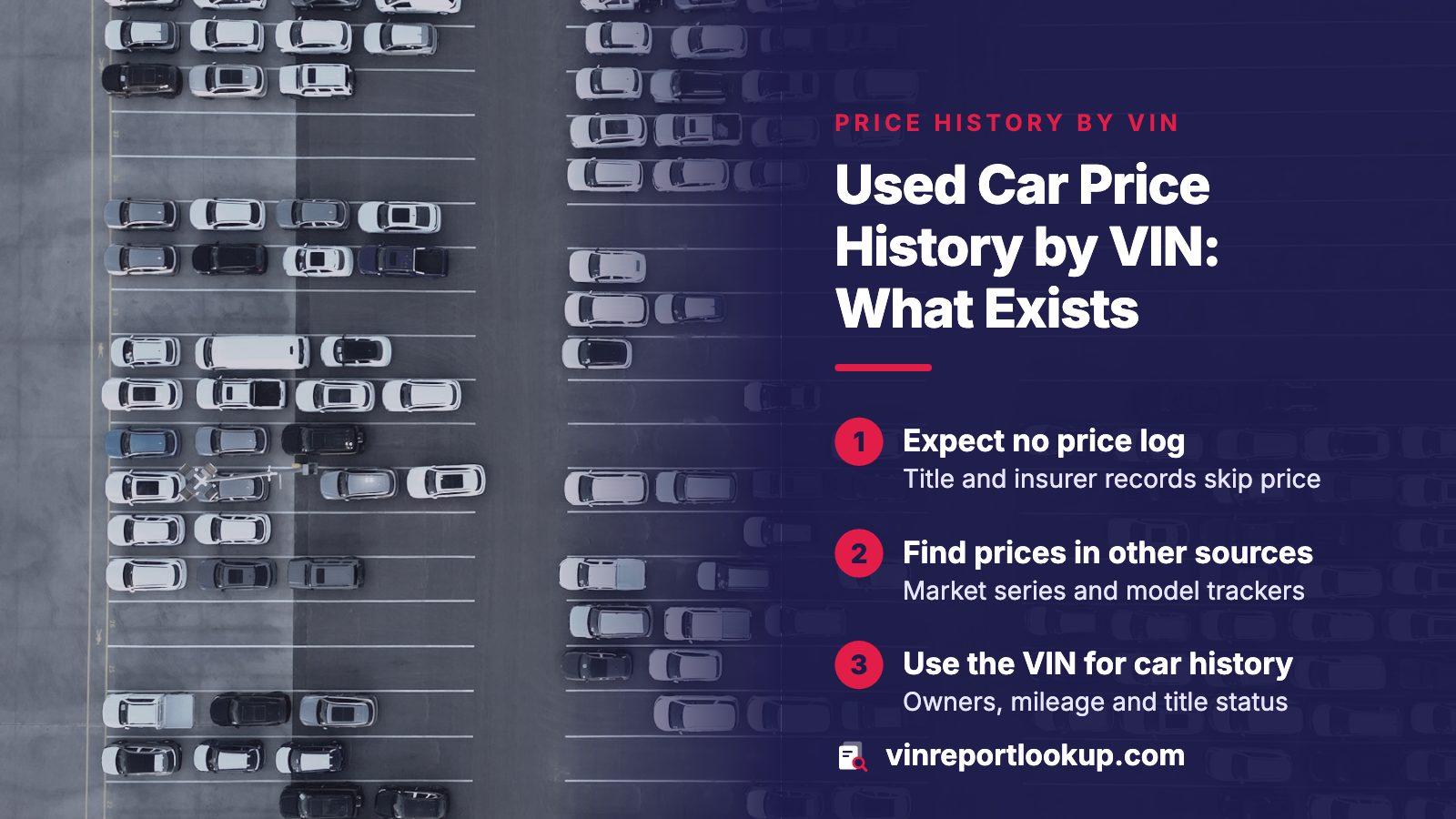
A VIN will not return a log of past asking or sale prices, because the federal title record and the reporting rules for insurers, salvage yards and auction companies leave price out. What a VIN does give you is the car's own record and a value figure to hold against the asking price. Market-wide price history comes from public indexes, and one ad's price drops come from the site that hosts it.
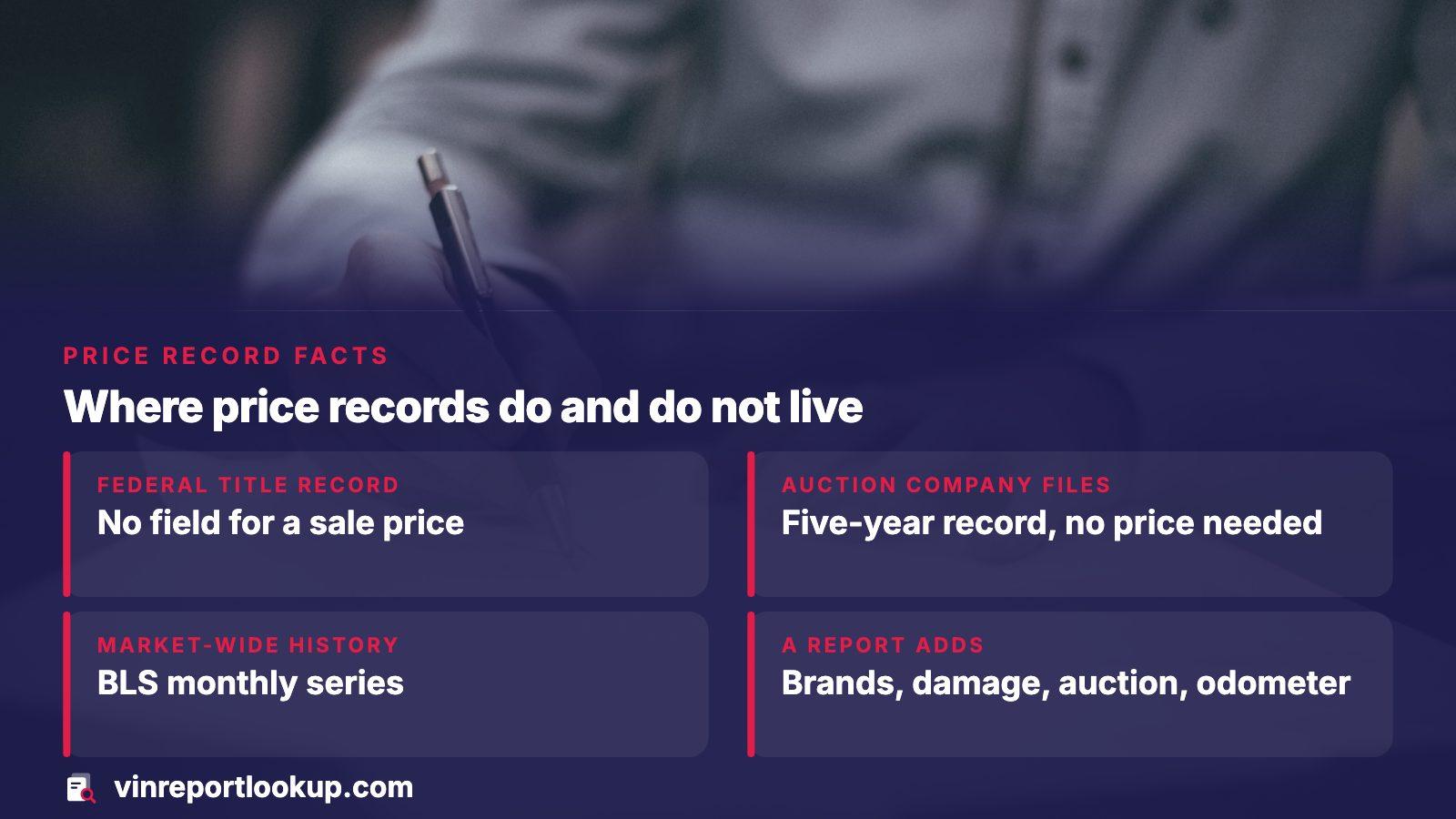
- Federal title record
- Has no field for a sale or asking price
- Auction company files
- Five-year record of owner, buyer, VIN and odometer, no price required
- Market-wide history
- BLS monthly series for used cars two to seven years old
- VINReportLookup
- Free preview, then one payment, no subscription
Why a VIN does not return a price log
Plenty of tools promise a price timeline for one VIN, but the federal record behind a VIN is thinner. The title database holds the title state, any brand, the latest odometer entry, theft status and salvage or total-loss determinations. Price is not on its list of contents.
The reporting rules agree. Under 28 CFR 25.56, a salvage yard files the VIN, the day it took the car, who handed it over and what became of it, with no sale price. Under 49 CFR 580.9, an auction company holds records for five years on each car it sells: the last owner before the sale, the buyer, the VIN and the mileage on intake. A price is missing there too.
Where each kind of price record sits
| Source | What it holds | Shows a price? |
|---|---|---|
| Federal title record | Title state, brands, odometer entry, theft, salvage and total-loss status | No |
| Auction company files | Prior owner, buyer, VIN and intake mileage, kept five years | Not required |
| A listing site | Asking-price changes on one ad, where the site publishes them | That ad only |
| Government price index | Monthly movement for used cars two to seven years old | Whole market, no single car |
| Value tool or report | A current estimate for the car's year, mileage and condition | An estimate, not a past price |
Records tied to a VIN describe events in a car's life. Records that carry prices describe one listing or the market as a whole. Neither answers what this particular car has been worth over time.
What a VIN report adds to a price decision
Price history by VIN splits into two jobs: what the car is worth now, and what happened to it that changes that number. A report handles the second job well. VINReportLookup sets a market value figure beside the entries that usually drag a price down.
- Title brands such as salvage, junk or flood. Branded cars sell for less, and a brand washed off in another state is how buyers overpay.
- Accident and damage records, which show how serious the hit was before you see the repair.
- Salvage and auction entries with photos, the nearest thing to a record of the car's worst day.
- Odometer readings from different dates, to test the mileage in the ad.
The value figure then has something to sit against: a clean record near the asking price is a different car from one with a salvage entry and the same sticker.
Market curves and trackers: price history by model
Searches for price history by model or as a graph are usually after a market curve, and the public one comes from the Bureau of Labor Statistics. Its used cars and trucks index follows vehicles two to seven years old, takes prices every month from J.D. Power valuations, and is published as a series anyone can chart. It covers the whole class, so it cannot show how one model behaved.
The seasonally adjusted national series read 186.298 in November 2025, dipped to 179.591 in June 2026, then climbed to 182.176 by September. That is the shape of the market, not of your car.
A tracker only knows the listings it has seen. Drops on one ad belong to the site hosting it, so ask the seller how long the car has been up and what it first asked.
Salvage auction price history: what the record can tell you
Salvage auctions sit among the businesses that must report to the federal title system, alongside pull-apart yards and salvage pools. What reaches the record is identity, intake date, source and next destination. Because no price is required, the federal record cannot supply a hammer price.
What an entry can give is condition. Photos taken at the sale record the damage as it stood that day, and a buyer can compare them with the car on the lot. The operator IAA says full bidding needs registration as a buyer, and its public page does not say whether final bids are posted for anyone to read.
A total-loss label is a decision, not a price
Insurers sometimes write off a stolen car that stays missing for 30 days. If it later turns up unharmed, the write-off label stays on its record, so the label alone says little about the car itself. Read it with the dates and photos.
Running the check on a specific car
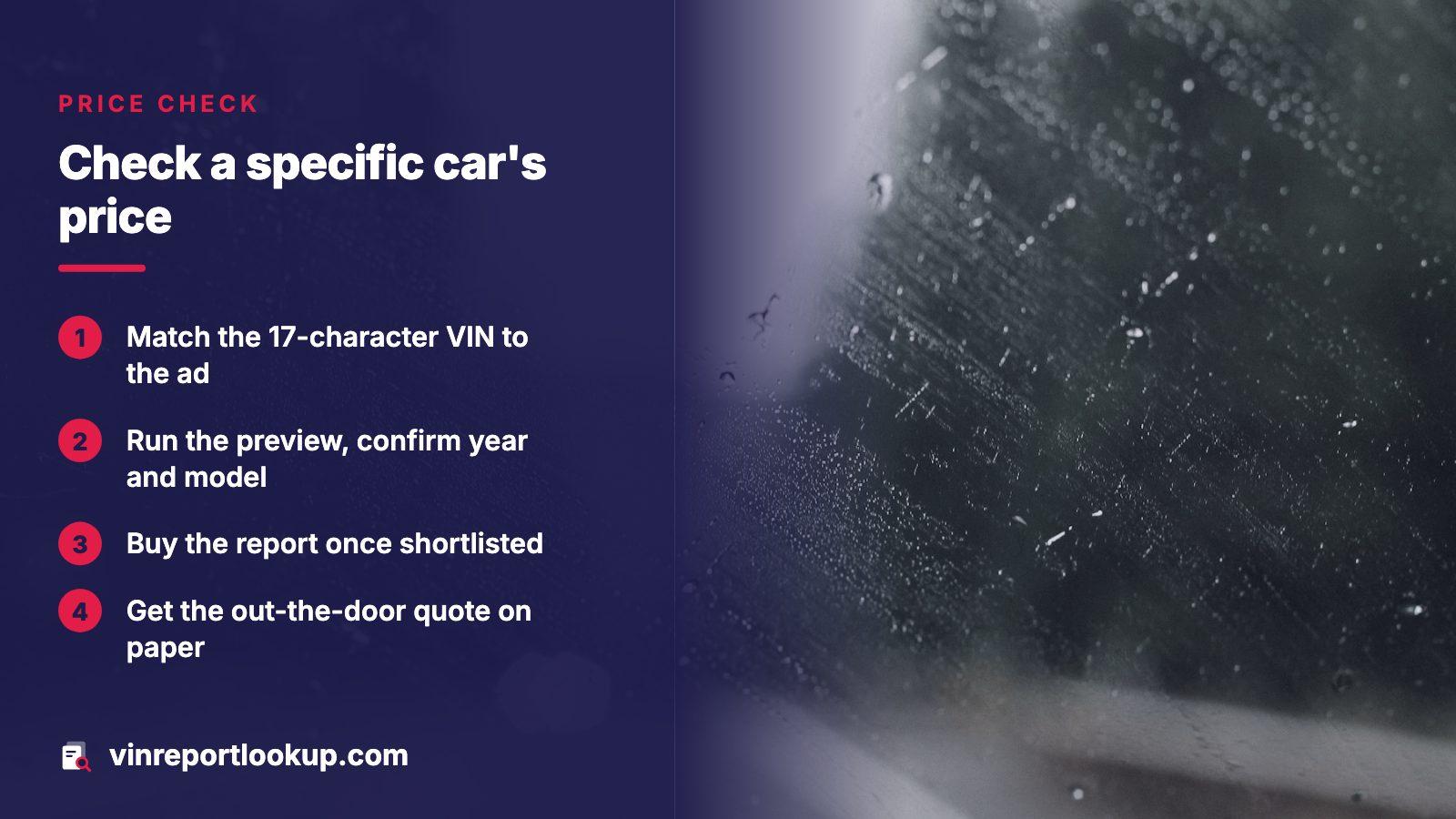
- Take the 17-character VIN from the ad and match it against the front page of the Buyers Guide, or the plate on the car. A mismatch means stop.
- Run the preview and confirm the year, make and model it returns match the ad.
- Pay for the full report once the car makes your shortlist, and go through the brand, damage, salvage and odometer entries before the value.
- Set the value figure beside the asking price and the listing's own price trail, if the site shows one.
- Get the dealer's out-the-door quote on paper and book an independent inspection before committing.
A report speaks to the record, not the drivetrain. The FTC notes that mechanical faults seldom appear in one, which is why the inspection stays on the list.
Reading the results: when the price does not add up
- An asking price far below the value figure with nothing in the record to explain it. Cheap cars usually have a reason, and it tends to sit in the brand or damage entries.
- A clean history on a car priced like a branded one. Gaps are real: the Justice Department says 87 percent of the vehicle population is in its title system and warns a search can report no salvage history for a car that has one.
- An odometer entry higher than the mileage in the ad.
- A salvage or auction entry followed by a rebuilt car offered at a clean-car price.
- A dealer who will not let an outside mechanic look the car over. The FTC says to find a different dealer.
A flag does not end a deal. The FTC suggests taking the written repair estimate from an independent inspection to the seller as a bargaining point.
Cost, and the next step
Nothing is charged for the preview. Price research ends with one charge for the full report; anyone pricing a handful of listings can take 3, 5 or 10 at once instead, and nothing bills again. Read current amounts on the pricing page on the day you buy.
For wider context, providers of the federal title record set their own fees, which the Justice Department put at $8 to $12.99 as of May 2020. That covers a title record only, not a value estimate.
Run the preview on the VIN in the ad, pay for the report on whichever cars are still in contention, then spend inspection money on the one that survives.
Where this information comes from
- NMVTIS: frequently asked questions — What a title record holds, provider-set fees, who must report salvage cars and where the record stops.
- NMVTIS: information for consumers — Coverage share, false negatives, washed brands and what a total-loss label means.
- 28 CFR 25.56: salvage yard reporting — The items a salvage yard files, which do not include a sale price.
- 49 CFR part 580: odometer disclosure and auction records — What an auction company keeps for five years and what a mileage disclosure form contains.
- FTC: Used Cars — Where the VIN appears on a dealer car, what history reports cover and why they do not replace an inspection.
- FTC: Buying a used car from a dealer — Written out-the-door prices and using an inspection estimate to negotiate.
- BLS: CPI used cars and trucks factsheet — How the federal used-car price index is built and what it covers.
Sources and photos: Facts checked against the sources above in November 2026. Photos by Iain, Cole Keister and Scott Graham on Unsplash; diagrams by VINReportLookup.
Keep reading
- PricingCurrent prices for a single report and each pack size.
- Carfax vs KBB trade-in value: which figure to trust and whyHow the value figure in a history report compares with a consumer valuation tool.
- Sample reportSee how a finished report lays out title, damage and value entries.
- Rebuilt title inspection cost: state fees and what a buyer paysWhat a rebuilt or salvage history can do to a car's price and what an inspection costs.
Frequently asked questions
Can I see a car's past sale prices from its VIN?
Not from the federal records: the title database and the salvage and auction reporting rules all leave price out. A report can show brands, damage, salvage and auction entries, odometer readings and a value estimate, but what a past buyer paid usually stays with the parties to that sale.
Is there a used car price history by model?
Not at model level from official sources. The Bureau of Labor Statistics publishes a monthly index for used cars and trucks two to seven years old, showing direction for the whole group. For one model, compare current asking prices at the same year and mileage, then cross-check with a value tool.
Does a report show what a salvage auction car sold for?
The federal rules behind salvage records ask for the VIN, intake date, source and disposition, not a price. Salvage and auction entries are most useful for condition and timing, and for any photos attached. Treat a sale price as something to ask the seller about, not something the record will confirm.
Where can I find a used car price history graph?
Chart the Bureau of Labor Statistics used cars and trucks series, which updates monthly. It reads 182.176 for September 2026 against 184.869 a year earlier, so used prices ended a little lower. That is a market view only; for your car, the VIN record and a written price matter more.
Should I buy a report before or after the inspection?
Before. A report can rule a car out for the cost of one payment, while an independent inspection is a fee you pay yourself for each car, as the FTC points out. Run the preview and report on your shortlist first, then spend inspection money on the car that is still in the running.
Now check the car itself
The guide explains what to look for. The report shows what this VIN has on record.