THE SHORT ANSWER
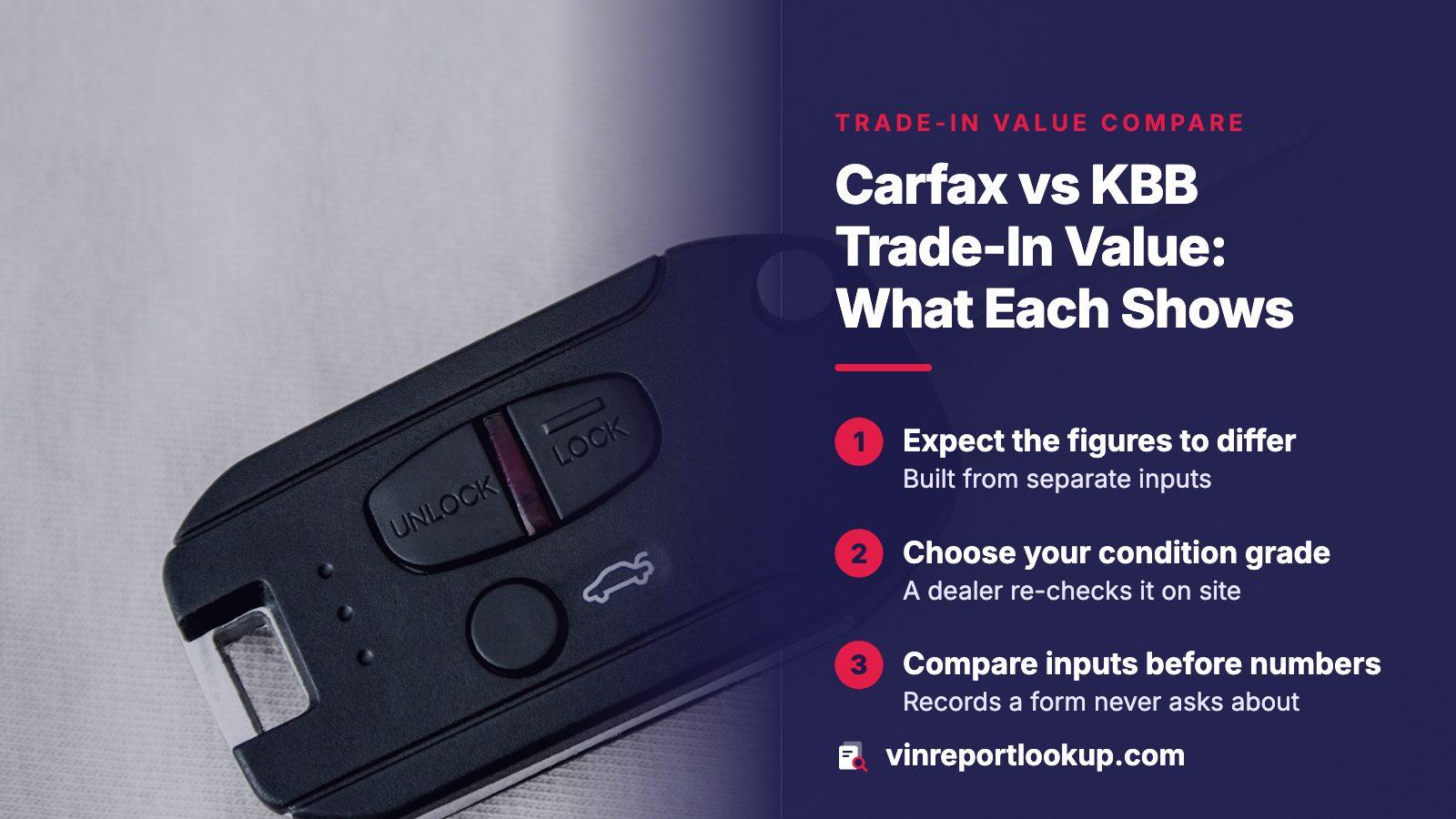
The two figures rarely match because they are built differently. Kelley Blue Book prices a car from sales and auction data, split into regions and refreshed weekly, and its Trade-In Range is the dealer-side reference. A history report is a record of one car. When a Carfax figure and a KBB figure disagree, compare the value type, the condition grade and the mileage behind each, then ask a dealer for a written offer.
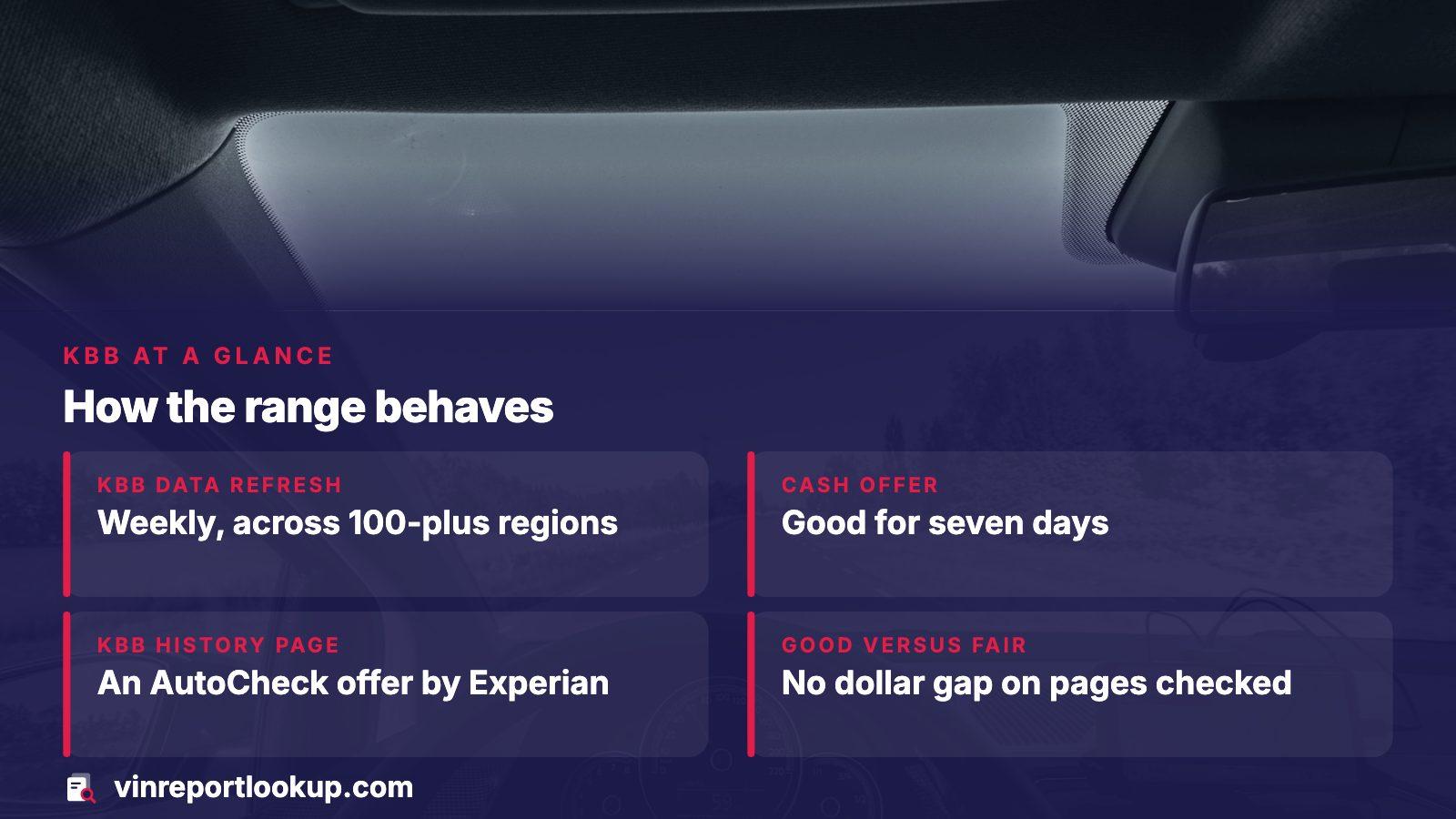
- KBB data refresh
- Weekly, across more than 100 regions
- KBB Instant Cash Offer
- Good for seven days, adjusted if the dealer's check differs
- KBB's own history report page
- An AutoCheck offer run by Experian
- Good versus fair gap
- No dollar figure on the KBB pages checked
Two names that do different jobs
Search for a trade-in figure and both names appear, which makes them look interchangeable. They are not. Kelley Blue Book is a valuation guide that turns market data into price ranges. Carfax is the name most buyers know from history reports, and the FTC lists Carfax.com among providers that sometimes add accident and repair entries. The guide estimates what cars like yours fetch; a history report describes one car.
What this page could not check
Carfax's own site refused every automated request during research, so this page does not say how a Carfax value is built or what its grades mean. Read the labels printed beside any Carfax number you hold: value type, grade, mileage and date. What follows about KBB comes from KBB's own pages, and the rest from federal agencies.
How the KBB trade-in range is put together
KBB says its figures come from real sales and auction results, then get adjusted for season and market trends. Local conditions are reflected across more than 100 regions, and the numbers refresh every week. The Trade-In Range is framed as the amount a seller should expect for the car this week. The Private Party Value is framed as a fair price when selling to an individual, and KBB's advice article calls a private sale the best way to get the most money.
Condition, mileage and options count as well, since KBB's sell page says its values factor all three in. None of the KBB pages checked for this guide gives a dollar change for any of them, though. So two people typing the same VIN can see different ranges and both be using the tool correctly.
Good versus fair: you pick the grade, a dealer re-checks it
Good and fair are condition grades chosen at the keyboard. The KBB pages checked here do not define them and show no dollar gap between neighboring grades, so treat anyone quoting a flat difference with suspicion. Any tool that shows a good value beside a fair value is pricing one car twice. KBB does explain what happens at the other end: with an Instant Cash Offer you describe the car online, a participating dealer looks at it, and the offer may be adjusted if the car differs from your description.
Grade it the way the dealer will
When you are torn between two grades, pick the lower one. An optimistic grade produces a number the first in-person look can undo, and accident or damage entries in a VIN report show where a good grade may not hold up.
Records a valuation form never asks about
A guide prices a typical car; a history report describes this one. The FTC says accidents, repairs and other damage can lower a car's value. It also lists what such a report may hold: prior owners, accidents, repair entries and any salvage declaration, with approved federal providers adding title and insurance-loss data. The inputs described on KBB's pages are vehicle details, condition, mileage and features. A title brand is not among them.
| Record in a VIN report | Check it against |
|---|---|
| Title brand such as salvage, flood or junk | Whether the figure you were shown assumed a clean title |
| Accident and damage entries | Whether the grade you picked still fits the car |
| Odometer readings | Whether the mileage you typed matches what was recorded |
| Open recalls | Whether an unrepaired recall is still open on the car you are trading |
| Market value line | A third reading to hold beside the KBB range |
When two figures disagree, check the inputs first
Before blaming either tool, line up what each was asked.
- Value type: a trade-in figure set beside a private party figure will usually look far apart.
- Grade: good against fair can explain the whole gap on its own.
- Mileage: a number typed from memory moves the result, so use the odometer reading.
- Date: KBB refreshes weekly, so last month's screenshot is out of date.
- Location: KBB adjusts across more than 100 regions, so a different market gives a different range.
If every input matches and the gap stays, the tools simply draw on different data and neither is wrong. That is when a dealer's written offer settles the question.
Turning a range into an offer you can take
- Save the KBB Trade-In Range and the Private Party Value for the grade and mileage you trust.
- Run the VIN preview and read the records, so your grade matches the car's history.
- Call several local dealerships. KBB's own advice is that some dealers are hungrier for stock than others, so one may pass on your car while another wants it.
- Treat an Instant Cash Offer as one quote among several. It stays good for seven days and can be adjusted after the dealer inspects the car.
- Get the figure in writing before you sign anything.
KBB's article says a car that is not in high demand should land close to the Kelley Blue Book value, while one in demand can bring more. A private sale usually pays more but takes longer, 1 to 3 weeks on average by KBB's count, against a same-day or next-day dealer sale.

If you still owe money on the trade
A trade-in figure means little until you set it beside the loan. The FTC's example is a car worth $15,000 with an $18,000 balance, which leaves $3,000 of negative equity. Some dealers say they will absorb it, but the FTC warns that the cost often lands in the new loan, the down payment, or both, and you pay interest on it.
The CFPB adds that the lender's payoff figure may not match your monthly statement, since interest, late fees and other charges can be added, so ask for the exact payoff. Of buyers who trade in, close to six in 10 take negative equity into the next loan, KBB's advice article reports. The FTC suggests waiting for positive equity or selling the car yourself.
Where a VINReportLookup report fits
Start with a VIN and the free preview appears before any payment is asked for. If the car stays in contention, one payment buys the full report. For a shortlist there are packs of 3, 5 or 10, and no plan renews. Check the pricing page for current amounts. The report earns its cost when you need records to back a grade or push back on a low offer: odometer readings, open recalls, damage entries and any title brand, plus a market value line to set beside the KBB range.
A report is a record, not a verdict. The FTC says no history report replaces an independent inspection, so use the records to ask sharper questions and let the inspection settle the car's actual condition.
Where this information comes from
- KBB: What's my car worth — KBB's own wording for the Trade-In Range and Private Party Value, its data sources, regions and weekly refresh.
- KBB: Sell my car and Instant Cash Offer — How the offer works, including its seven-day window, the dealer's check, adjustments and typical sale timing.
- KBB: Is now the time to buy, sell or trade in a used car — Advice on calling several dealers, expecting close to book value, and negative equity at trade-in.
- KBB: Vehicle history report page — Shows that KBB's history report page is an AutoCheck offer from Experian, where a search returns only a record count.
- FTC: Auto trade-ins and negative equity — Source for the worked loan example, what lowers a car's value, and the advice to wait or sell privately.
- FTC: Used cars — What a history report can show, the providers named, and the warning that it does not replace an inspection.
- CFPB: Trading in a car that is not paid off — Why the payoff can differ from the statement balance, and what rolling a balance into a new loan does.
Sources and photos: Facts checked against the sources above in November 2026. Photos by Shadow Photography, Alejandro Escamilla and Sander Jeurissen on Unsplash; diagrams by VINReportLookup.
Keep reading
- AutoCheck vs Carfax: which VIN report to buy, and when to buy bothKBB points its history reports at AutoCheck, so see how that report differs from Carfax.
- Used car price history by VIN: what exists and what does notPast asking prices as another way to test whether a figure fits the car.
- Carfax alternatives: what each VIN report option covers and costsOther ways to get a history report when you do not want to pay premium rates.
- Sample reportA worked sample showing each section of a full report.
Frequently asked questions
Does Carfax or KBB give the better trade-in value?
Neither figure is an offer. KBB's Trade-In Range is a market reference refreshed weekly, and a Carfax figure is one more reference whose method this page could not read. The better number is the one matching your car's true grade, mileage and records. A dealer's written quote beats both, and an Instant Cash Offer stays good for seven days.
Why is the KBB trade-in value lower than the private party value?
KBB says the private figure runs higher because the seller does the work of finding a buyer and closing the sale. A trade-in is quicker: KBB puts a dealer sale at the same day or the next, against 1 to 3 weeks on average for a private sale. The gap is what you give up for speed and convenience.
Does a KBB value account for accidents and title brands?
The KBB pages checked list condition, mileage and options as factors, and none names a title brand as an input. KBB's own history report page leads to AutoCheck, run by Experian, where a search returns only the number of records. Check the records separately, then decide how they change the grade you enter.
Is a VIN report enough to set a trade-in price?
No. The FTC says no history report replaces an independent inspection. A report tells you what was recorded, such as title status, damage entries and odometer readings. It cannot tell you what a dealer wants on the lot this week. Use it to support your grade, then collect written offers.
What should I do before trading in a car with a loan?
Ask your lender for the exact payoff, since the CFPB says it can differ from the statement balance. Then compare it with the value range at your car's real grade. If the balance exceeds what the car is worth, the FTC warns that rolling the gap into a new loan means paying interest on it.
Now check the car itself
The guide explains what to look for. The report shows what this VIN has on record.