THE SHORT ANSWER
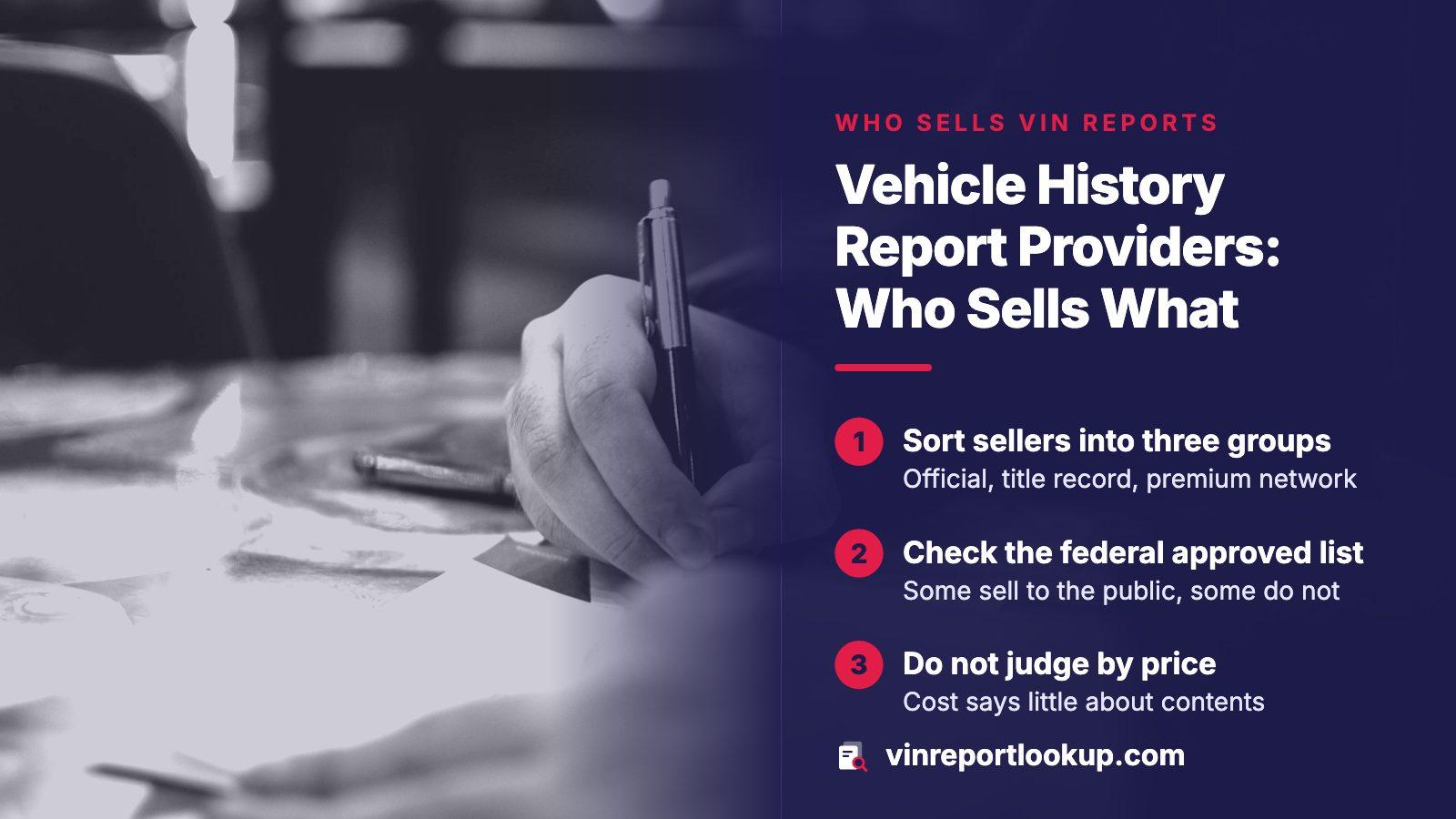
Three groups supply VIN reports. NICB's lookup costs nothing and flags flood, unrecovered theft and salvage declarations. Providers approved by the Justice Department sell concise title records: brands, odometer, total loss and salvage entries. Private databases such as Carfax and AutoCheck add records of their own. Choose by the question you need answered, and check any company that claims federal title data against the approved list.
- Approved for the public
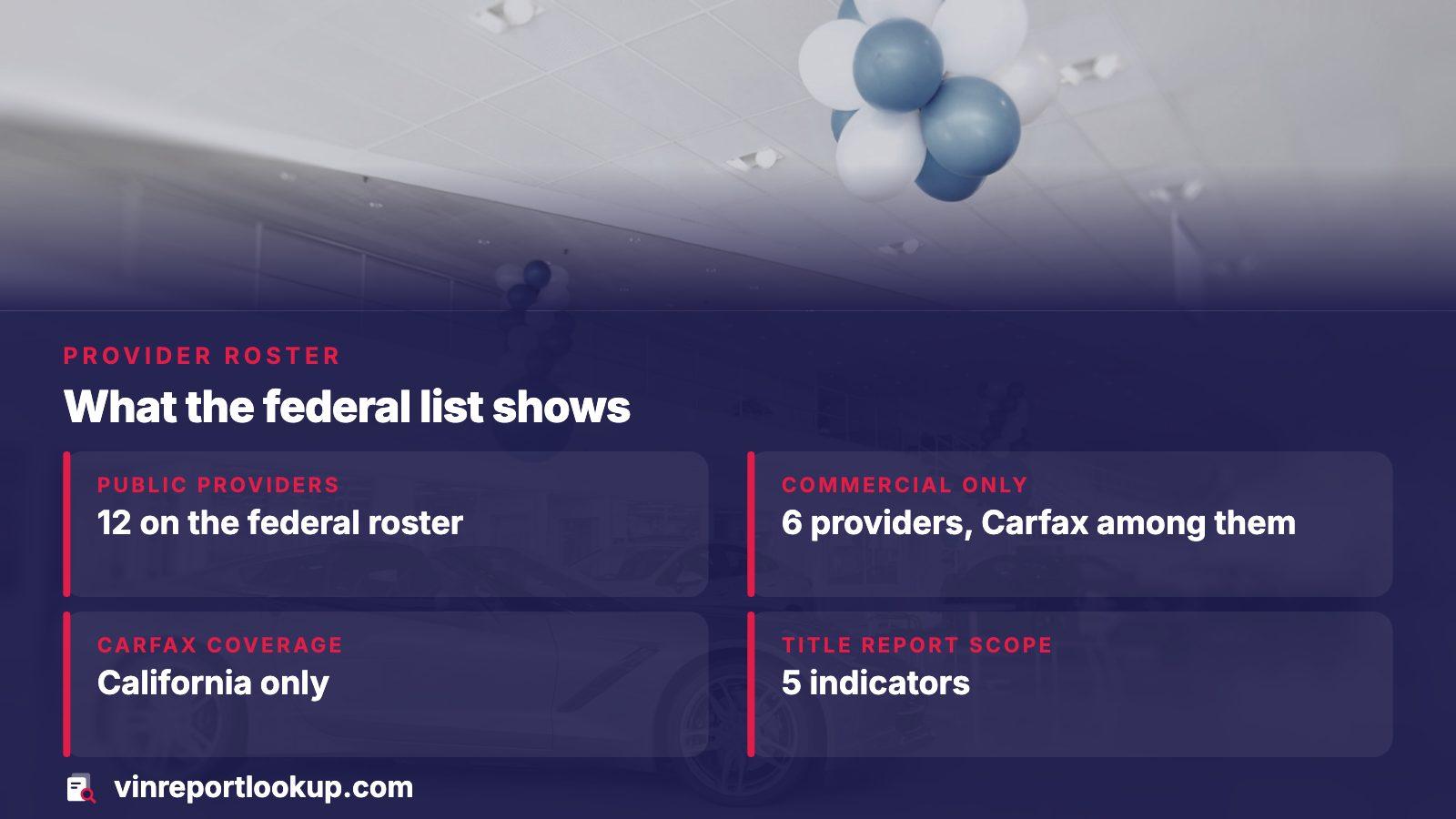
- 12 providers on the federal roster
- Commercial customers only
- 6 providers, Carfax among them (California only)
- Title report scope
- 5 indicators: title, brands, odometer, total loss, salvage
Three kinds of company stand behind a VIN report
Search for a car history report by VIN and you meet dozens of storefronts, but the records behind them come from far fewer places. Federal law requires states' titling offices, insurers, and the yards and recyclers that handle junk and salvage cars to report into the Justice Department's title system. Approved businesses resell that data. Private firms build their own databases and sell records the federal system was never meant to hold, such as repair histories and maintenance entries.
| Tier | What it supplies | What to watch |
|---|---|---|
| Free lookups | NICB flags for flood damage, stolen cars never recovered, and salvage declarations | Covers three named conditions, so treat it as a first screen |
| Approved title-data sellers | Where the car is titled, any brand labels, mileage readings, and insurer total-loss or salvage entries | Short reports, with gaps wherever a state or yard does not report |
| Private history databases | Their own records, including repair, recall and maintenance entries | Coverage and price differ by company, and the FTC endorses none of them |
What the Justice Department's approved list shows
The department publishes its roster on the vehicle history site it runs, and the older vehiclehistory.gov address now forwards there. When this page was updated in November 2026, the roster split in two. Twelve providers sell to the public and to businesses. Six more sell to commercial customers only. Five of the twelve also own extra storefronts that resell reports containing the same title data, so the brand names you meet outnumber the approved providers behind them.
The list runs alphabetically, and the department says the order implies no preference.
Carfax sits on the commercial list
Carfax is listed among the businesses that serve commercial customers only, and a note narrows that to California. The department also cautions that consumers cannot buy a federal title report from Carfax, DMVDesk or Experian. That caution concerns the federal data alone. The FTC separately names Carfax and AutoCheck as places to find reports the federal site does not sell.
What a title-record report holds, and what it skips
A report built on federal data carries five items: current title state and date, brand labels, the latest mileage entry, total-loss status and salvage status. The department calls the format intentionally concise, so a short report is normal. Anything beyond that scope, including repair histories, recall information and maintenance entries, comes from private databases.
States are only partly on board. The consumer page says more than half contribute, even though 87 percent of the country's vehicles appear in the database, with about 20 million records of salvage or total-loss cars on file. An empty result therefore does not clear a car with a bad history. Commercial vehicles can also be missing where a state tracks them in a separate agency.
A total loss is not always a wreck
An insurer can label a stolen car a total loss when it stays missing for 30 days. If the car later turns up undamaged, the label stays on its record. Read the dates and ask the seller what happened before you walk away or pay full price.
Why price is a poor guide to what you are buying
The federal system runs on user fees by law, and each provider sets its own charge. The department's FAQ says reports ranged from $8 to $12.99 as recently as May 2020. A separate buying-tips page on the same site tells readers to expect up to $4, so even official pages disagree on what a title record costs. Confirm the figure at checkout.
A higher price may or may not mean private records sit on top of the title data. Approved providers post a sample report on their sites, and the sample shows what you actually get. Compare cost per VIN, because packs and one-off charges are priced differently. VINReportLookup shows a free preview first and charges one payment for the report; the pricing page lists the options.
Checking a provider before you type in a card number
- If a company says its title data comes from the federal system, find it on the roster, either as a provider or as an affiliated storefront.
- Open the sample report. A provider with nothing to show is asking you to pay blind.
- Search the company name next to words like complaint, review or scam, which is the FTC's own advice.
- Be wary when a stranger who wants to buy your car tells you which site to use. The FTC has described fake buyers who send sellers to unfamiliar sites, some ending in .vin, to collect about $20 and card details.
- Find the support page. The department sends questions about a discrepancy to the provider, and approved providers must offer a route to the titling state.
When two reports on one VIN do not match
Mismatches are common, and the sources usually explain them. States send updates on different schedules, some as title transactions happen and others daily or after several days. Salvage and flood labels follow state rules: the same damage can earn a salvage brand in one state and escape it in another whose threshold is not met, and in some states no flood label exists. The federal system keeps every brand any state reported, so a car moved across state lines should still carry its label.
A private database may hold an entry the title data lacks, or the reverse. Take the conflict to the seller as something to explain, not a ruling. Each federal-data report includes a link for requesting the titling state's own record, which carries more detail than the report. Request that record, and book a mechanic's look at the car.
Where a VINReportLookup report fits
VINReportLookup is a preview-then-report seller, not a title agency. Start with the free preview of a VIN. If you want the full document, it is one payment with no subscription, whether you need a single report or a pack. It suits a buyer who has narrowed the list to one or two cars and wants the crash history, any brand on the title and salvage-auction photos together in one document. Treat it as the step after the free lookups, not a replacement for them.
Sequencing the checks so the paid step comes late
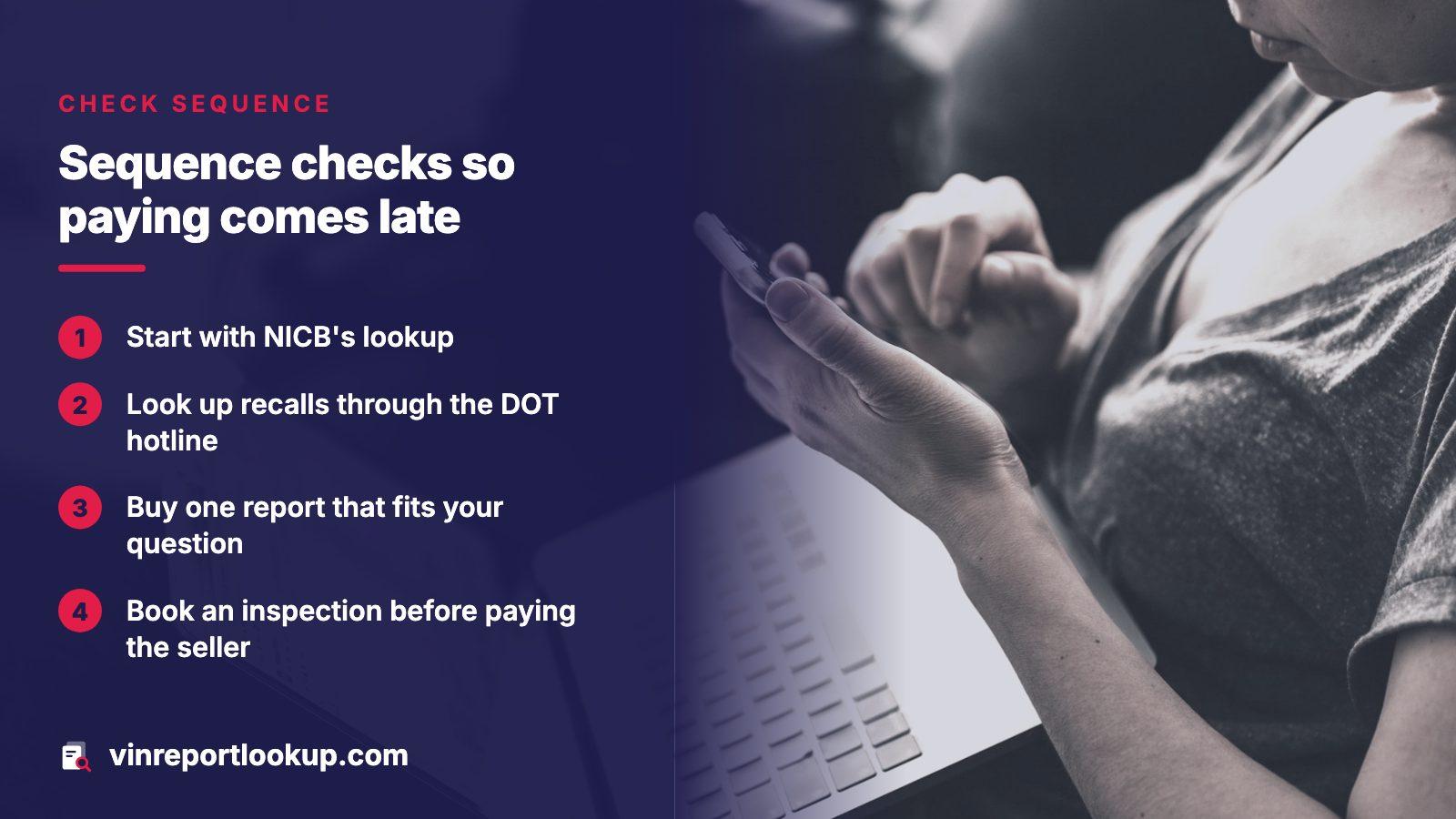
- Start with NICB's lookup, which tells you whether a VIN is tied to a flood loss, a stolen car never found, or a salvage declaration.
- Look up recall information through the Department of Transportation's safety hotline or website.
- Buy one report that fits your question: a concise title record for brands and odometer, or a fuller private report for added records.
- If anything looks odd, request the state title record that federal-data reports link to.
- Book a mechanic's independent inspection before paying the seller. The FTC and the Justice Department both advise inspecting the car whatever the report says.
Where this information comes from
- Justice Department: Approved NMVTIS data providers — the public and commercial-only rosters, affiliated storefronts and the Carfax note
- Justice Department: Understanding an NMVTIS vehicle history report — the five indicators, the data sources and what private providers add
- Justice Department: NMVTIS for consumers — state differences, coverage figures and the total-loss caveat
- Justice Department: NMVTIS frequently asked questions — fees, update timing, provider duties and gaps
- Justice Department: Used car buying tips — the lower cost figure, the NICB lookup and recall information
- FTC: Used cars — reports outside the federal list and the inspection advice
- FTC: Steering clear of vehicle history report scams — look-alike report sites and how to vet a company
Sources and photos: Facts checked against the sources above in November 2026. Photos by Owen Michael Grech, Michal Biernat and Richard R on Unsplash; diagrams by VINReportLookup.
Keep reading
- Carfax alternatives: what each VIN report option covers and costsA closer look at the options if the big-name report is not the one you want.
- Best VIN check: how to choose a report and what each one includesWhich kind of check to run first, and what a full report should contain.
- Vehicle history report cost: what each kind charges and coversHow report prices are set and what to expect at checkout.
- Sample reportSee what a finished report looks like before you pay for one.
Frequently asked questions
What are the main vehicle history report providers?
Three groups. The Justice Department approves businesses that sell title data: 12 for the public and 6 for commercial customers only. Private companies such as Carfax and AutoCheck, which the FTC names as options outside the federal list, keep databases of their own. NICB runs a free lookup for flood, theft and salvage flags.
How do I get a car history report by VIN?
Pick a provider, enter the VIN and pay its fee. For title brands and odometer entries, choose from the federal roster; for fuller records, a private database may suit better. Where a preview is offered, use it: VINReportLookup gives a free preview, then charges one payment for the report.
Are all legitimate providers on the federal list?
No. The FTC points out that not every history report is sold through the federal site, so a private database can be legitimate and still absent from it. The roster matters when a company claims its title data is federal. Then it should appear there, either directly or as an affiliated storefront.
Can I trust a free car history report by VIN?
Free lookups are real but narrow. NICB's database costs nothing and checks for flood loss, unrecovered theft and salvage. Be doubtful of any site offering a complete history for no charge. The FTC warns that report sites run by unknown operators can be used to collect card numbers and personal details from people selling cars.
Why does my history report show nothing at all?
A blank can be good news, because title reports stay concise. It can also be a gap: some states and yards do not report, and commercial vehicles may sit in a separate state system. Read an empty result as no news rather than proof, then check the state record and have a mechanic inspect the car.
Now check the car itself
The guide explains what to look for. The report shows what this VIN has on record.