THE SHORT ANSWER
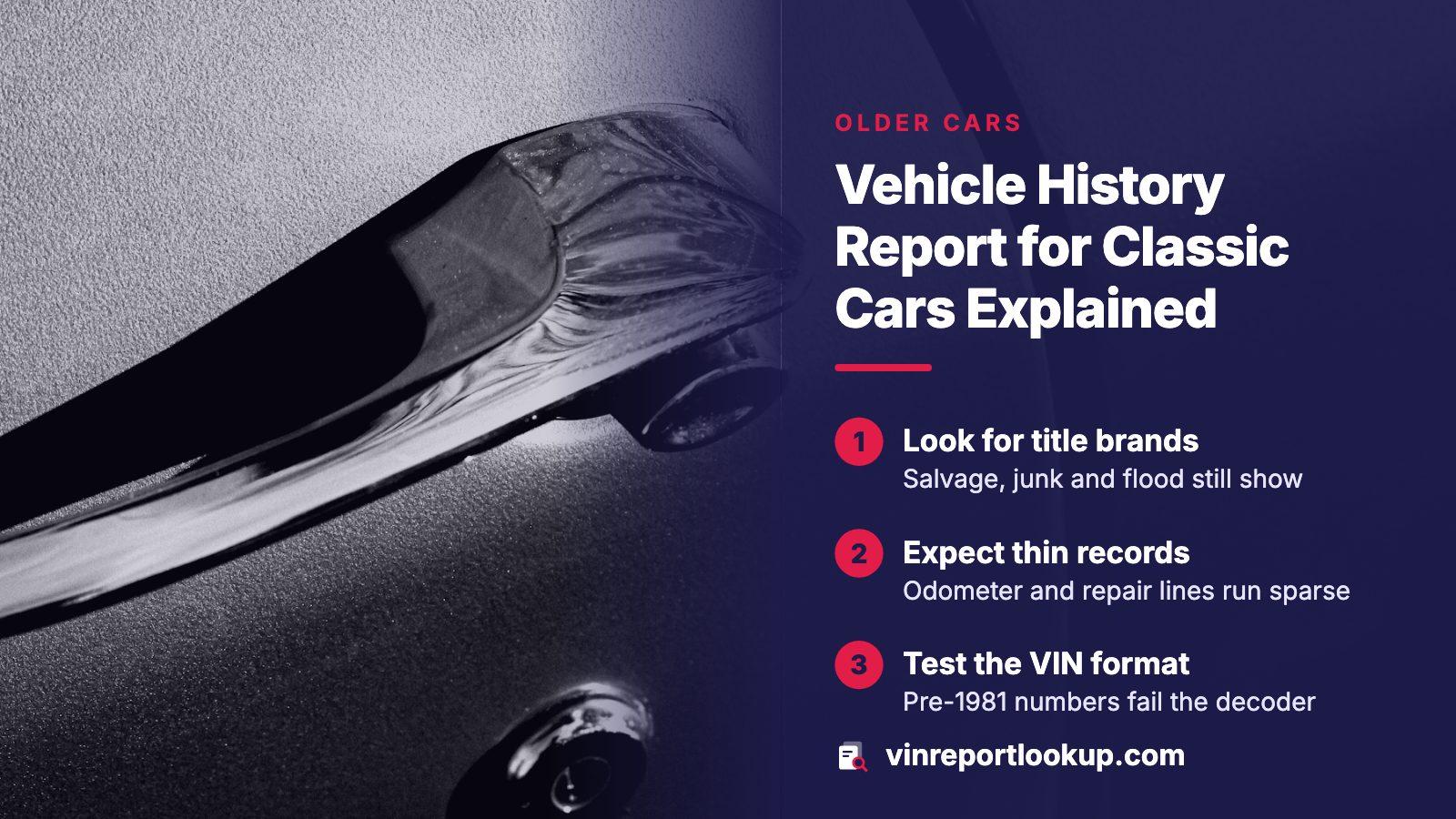
Yes, run one before you pay, as long as the car has a VIN a database can read. Expect brand, title and theft information to be the useful part. Odometer entries, accident detail and service history are often missing on older vehicles, so back the report up with an in-person inspection and the paperwork.
- Best use
- Catching a salvage, junk or flood brand before you buy
- Weak spot
- Old odometer, repair and ownership records
- VIN decoder limit
- NHTSA's decoder rejects pre-1981 numbers
- Mileage rule
- Many older cars are exempt from a federal mileage statement
What a report can still catch on a car from the sixties or seventies
Most of the value sits in the title layer. States label a car junk, salvage or flood when it has been written off, and that label travels with the car into other states. Titling offices, recyclers, scrap yards and insurers all feed the federal title system behind most reports, so a restored coupe with a flood loss in its past can still show up.
Theft is the second useful layer. Valuable old cars get stolen and cloned, and a report is one of the quick ways to see whether a number has turned up in a theft or total-loss record. None of this needs the car to be young. It needs a number that was entered into a database at some point.
A real case worth knowing
The Justice Department's consumer page cites a multistate investigation called Operation Roadrunner, where roughly 250 stolen vehicles had been cloned under swapped numbers. That kind of fraud is why you compare the stamped number with the title first.
Why the record on an older car is thinner
The federal page also admits that age can put a car outside a state's titling rules, and that each state reports its own amount of detail. It names no age, so you cannot assume a classic has a full trail. A car that sat in a barn for decades, or lived in a state that never titled it, leaves almost nothing to report.
Private providers add recall, repair and maintenance entries that the federal system is not built to hold, but those entries depend on shops and dealers that reported digitally. A 1965 car was serviced long before anyone logged work orders into a network. Treat an empty section as an unknown rather than as good news.
The VIN problem before 1981
Seventeen-character numbers are a modern standard. Older cars carry shorter, maker-specific numbers, and report systems built around the modern format may not read them. When we asked NHTSA's decoder to handle an 11-character number with model year 1967, it refused with a message about pre-1981 decode attempts and returned nothing.
- Type the number exactly as stamped, with no padding or guessing at missing characters.
- Expect a decoder or report tool to reject some pre-1981 numbers outright.
- Should a tool accept the number, compare what it decodes against the badge, body and engine on the car itself.
- A rejection is a limit of the tool, not proof that the car is fake.
Why the odometer line may be blank
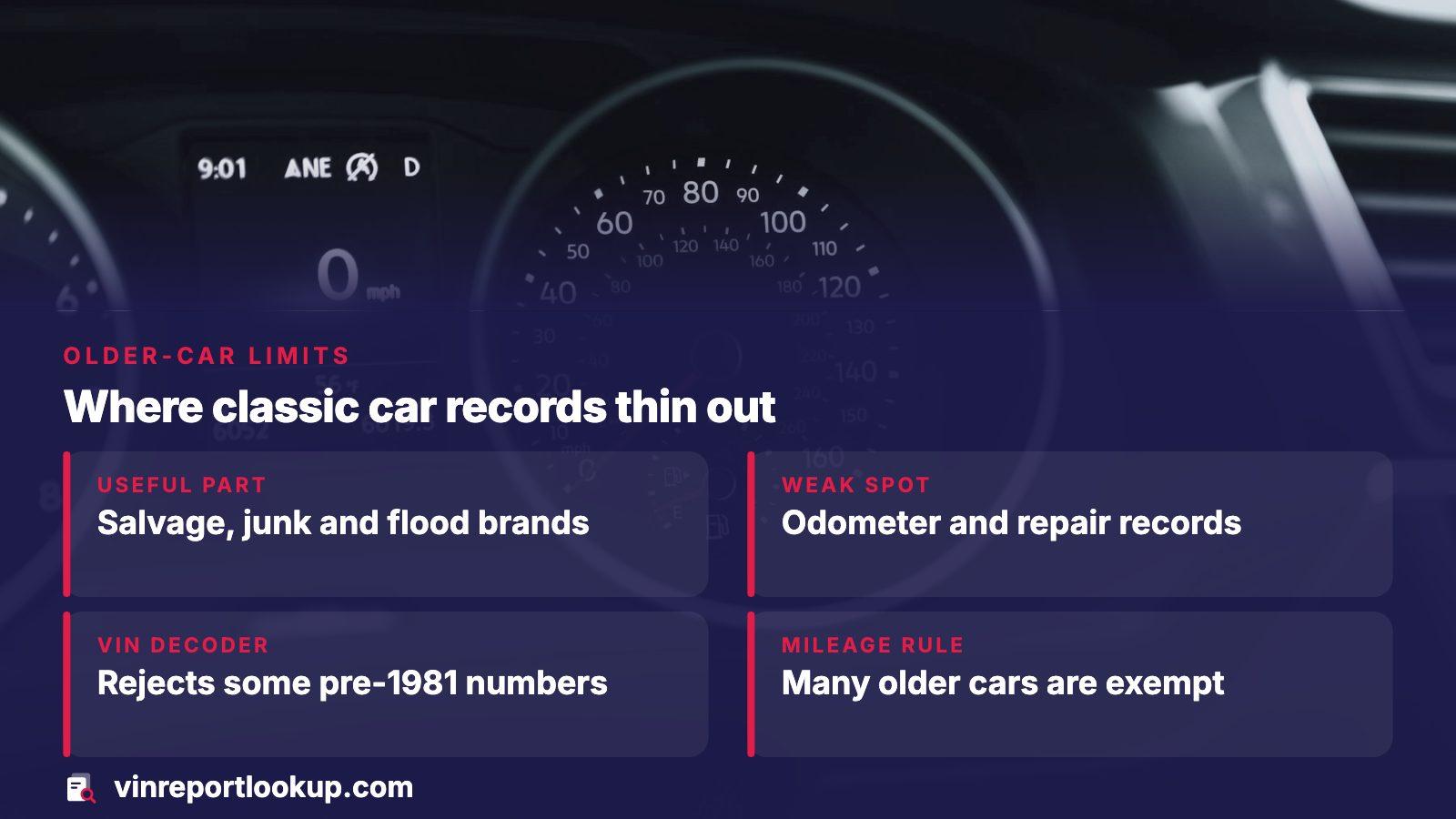
Federal odometer rules exempt several categories from a written mileage statement at sale. The clock starts on January 1 of the car's model year. Cars up to model year 2010 drop out after a decade, while newer ones take two decades. For a classic, that means the last few sales may have carried no mileage statement at all.
So a report with one stale reading, or none, is normal and not a red flag by itself. The dash number deserves the least trust of any detail on the car. Look at wear on pedals, seat and steering wheel instead, and ask for dated service records.
Recall records are patchy, not absent
NHTSA's recall data goes back several decades, but coverage varies by car. A query for the 1965 Ford Mustang returned one record: a 2019 equipment recall on aftermarket Scott Drake wheel spindles that may fail, fixed by free replacement from the parts company. A 1968 Chevrolet Camaro returned 2 records, including a 1971 campaign about a broken motor mount that lets the engine rise and tug the throttle linkage. A 1963 Corvette returned none.
| Car and year | Records in NHTSA API | What it shows |
|---|---|---|
| 1963 Chevrolet Corvette | 0 | Nothing on file, which is not the same as nothing ever wrong |
| 1965 Ford Mustang | 1 | 2019 equipment recall on replacement spindles |
| 1968 Chevrolet Camaro | 2 | Includes the 1971 motor mount campaign |
A recall written decades ago may never have been completed, and parts-company recalls attach to the car only if someone fitted those parts. Check suspension and steering work with a mechanic who knows the model.
What to add when the report runs out
The Justice Department's NMVTIS pages urge buyers to get an independent inspection alongside the report, and note that a clean result can hide gaps. On a classic that advice carries more weight, because the things that cost money are rust, replaced panels, engine swaps and non-original parts, and no database records those.
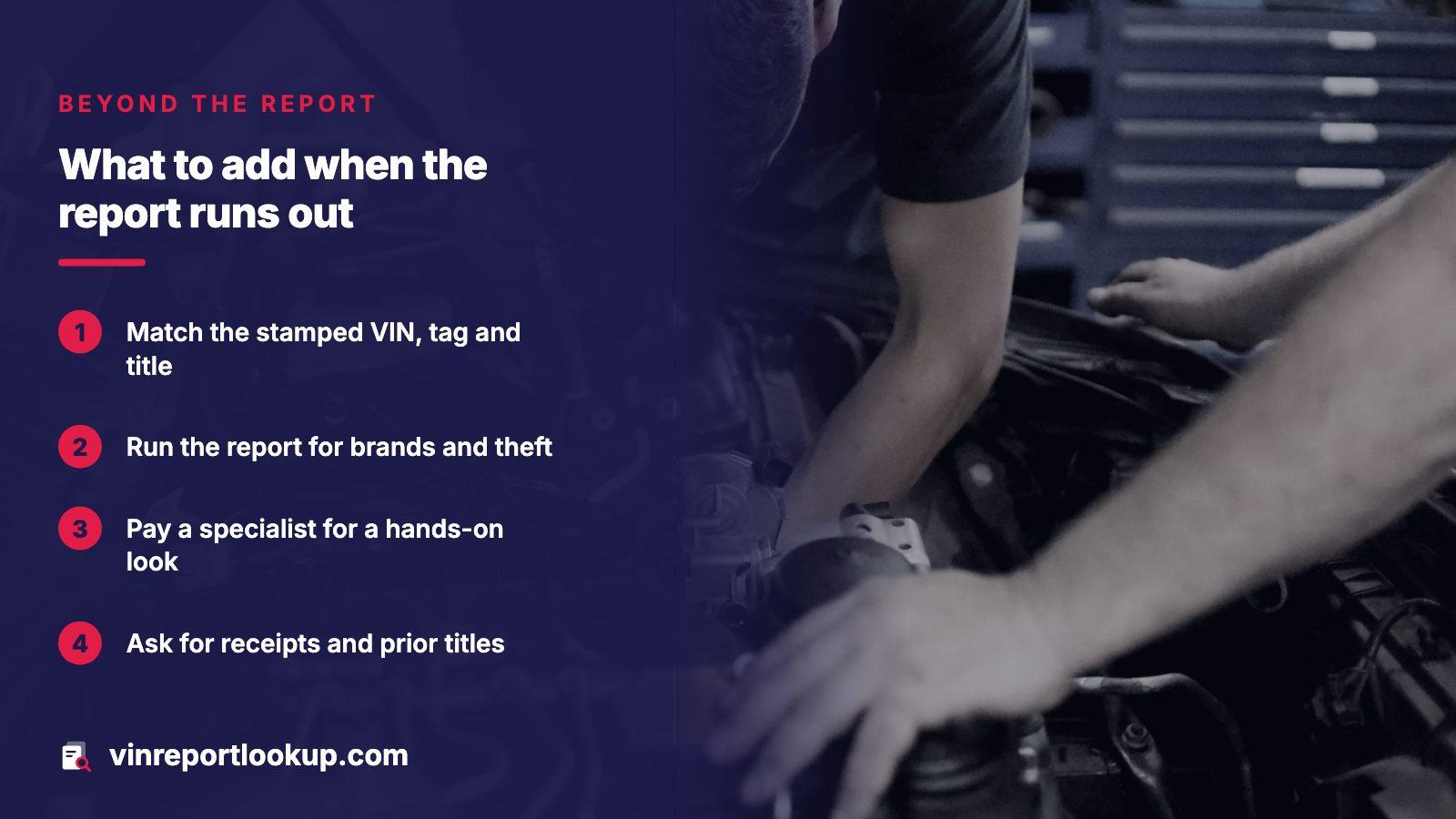
- Match the stamped VIN, any body tag and the title.
- Run the history report for brands, theft and any recorded odometer entries.
- Pay a specialist for a hands-on look at the frame, floors and drivetrain.
- Ask for photos, receipts and prior titles that show how the car was kept.
- Walk away if the paperwork and the car disagree and the seller cannot explain it.
When running the report is the right next step
Run it once you have a number you trust and a car you would seriously buy, not on every listing you scroll past. Type the number in at VINReportLookup and a teaser of the findings appears first at no charge. Only the complete report costs money, once, with nothing recurring. See the pricing page for the options.
If the preview shows a brand, a theft entry or an odometer figure that conflicts with the seller's story, that is the moment to slow down. If it shows little, you have learned the car is thinly documented, and the inspection and paperwork have to carry the decision.
How to read a sparse report
A short report on a forty-year-old car usually reflects missing data, not a clean life. Weigh what is present: any brand is serious, a theft or total-loss record needs an explanation, and a title history that jumps states deserves a question to the seller.
The federal system describes a clean report as a good thing, and its own pages stress that older vehicles may have limited or no records. Both are true at once. Use the report to rule out the big title problems, then put your money and time into verifying the car itself.
Where this information comes from
- Bureau of Justice Assistance: NMVTIS for consumers — what the title system holds and why old vehicles may have limited records
- Bureau of Justice Assistance: understanding an NMVTIS report — what the report leaves out and the advice to inspect
- eCFR: 49 CFR 580.17 odometer exemptions — age-based mileage disclosure exemptions
- NHTSA vPIC decoder API — decoder limits on pre-1981 numbers
- NHTSA recalls by vehicle: 1965 Ford Mustang — example of a record on an older car
Sources and photos: Facts checked against the sources above in November 2026. Photos by Linus Belanger, Mustafa Sheikhmouss and Nathan Dumlao on Unsplash; diagrams by VINReportLookup.
Keep reading
- Carfax vs inspection: what each shows and which to buy firstWhy a classic needs both a report and a hands-on look.
- How to read a vehicle history report before you pay for a used carReading brands and odometer entries once you have a report.
- Sample vehicle history report: what to look for before you buy oneSee the sections before you buy a report.
- Vehicle history report cost: what each kind charges and coversWhat reports cost across providers and how to avoid overpaying.
Frequently asked questions
Do classic cars have a vehicle history report?
Usually a partial one. If the car has a VIN a database can read, a report can show title brands, theft flags and any recorded odometer entries. Repair, service and ownership detail is often thin or missing on older vehicles, so treat the report as one input alongside an inspection.
Can you run a history report on a car made before 1981?
Sometimes. Pre-1981 numbers do not follow the 17-character standard, and NHTSA's decoder rejects them. Some report tools may still accept a number or return little. A rejection reflects the tool's limit, so verify the car through its title, the stamped number and an inspection.
Why does my classic car report show no mileage?
Federal rules exempt older vehicles from a written mileage statement at sale, so many classics change hands with none. The report can only show readings that someone recorded, and a blank or stale figure is common. Judge wear on the interior and ask for dated records.
Is a clean report enough to buy a classic?
No. A clean result means nothing negative was recorded, and older cars have limited records to begin with. It does not tell you about rust, replaced panels, an engine swap or non-original parts. A specialist inspection covers what no database can.
How much does a classic car report cost here?
Only the full report is paid. The teaser you see after entering the number costs nothing, and the purchase happens once with nothing recurring. Figures for a single report or a pack are on the pricing page.
Now check the car itself
The guide explains what to look for. The report shows what this VIN has on record.