THE SHORT ANSWER
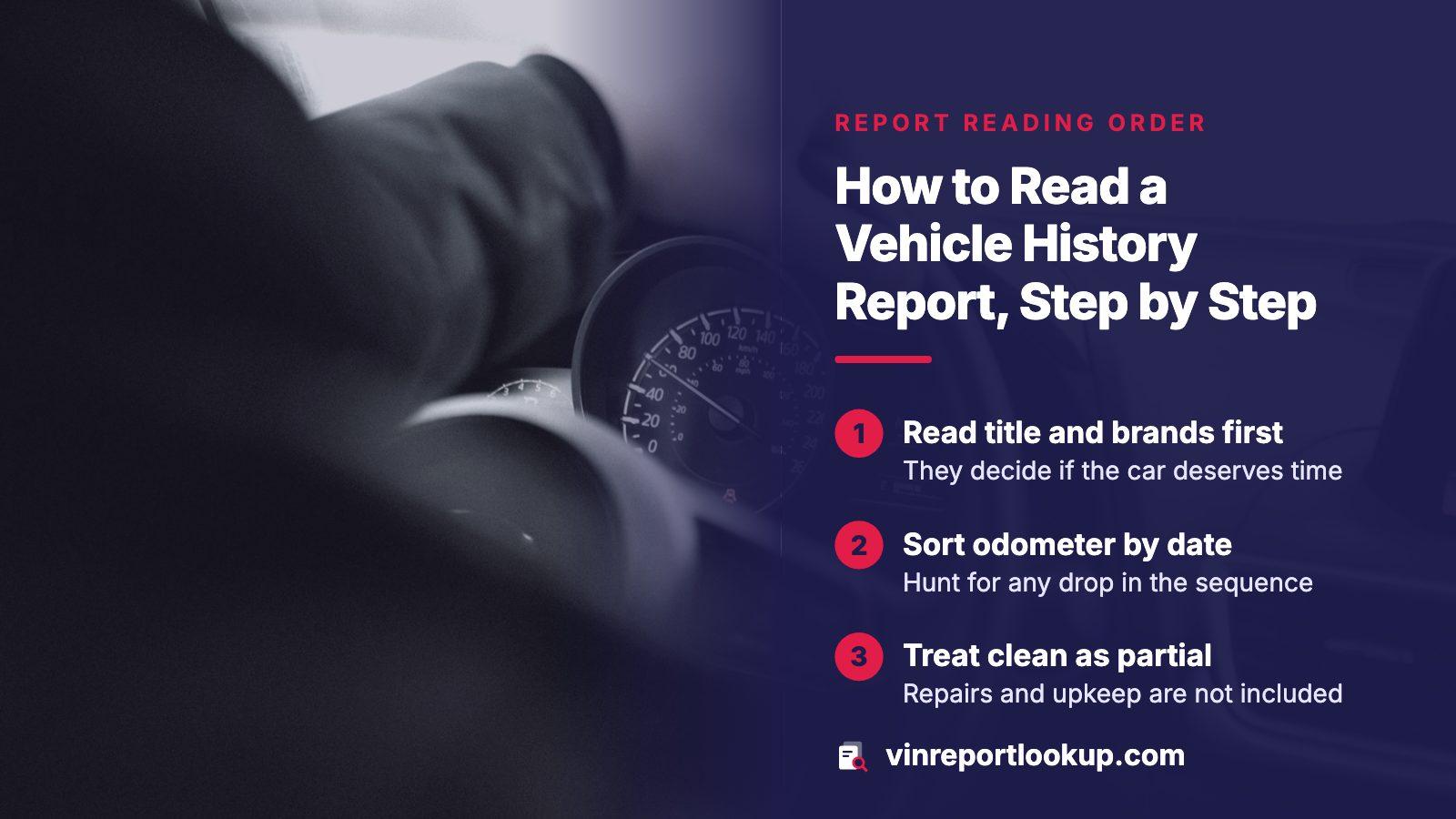
Start with the title and brand lines, because they decide whether the car is worth more of your time. Next, put the odometer readings in date order and look for any drop. Then read total loss and salvage entries, theft flags and open recalls. Treat a clean result as the absence of records, not proof of condition, and confirm with an inspection.
- Federal title record
- Five indicators: title, brands, odometer, total loss, salvage
- Coverage gap
- A search can return a false negative, since reporting is not complete
- Not in title data
- Repair history and maintenance records
The order that saves you the most time
Most people scroll a report looking for the word accident. That is the wrong first move. A title brand or a total loss entry can end the conversation in ten seconds, while an accident line often needs context before it means anything. So read in the order of how much each section can change your decision.
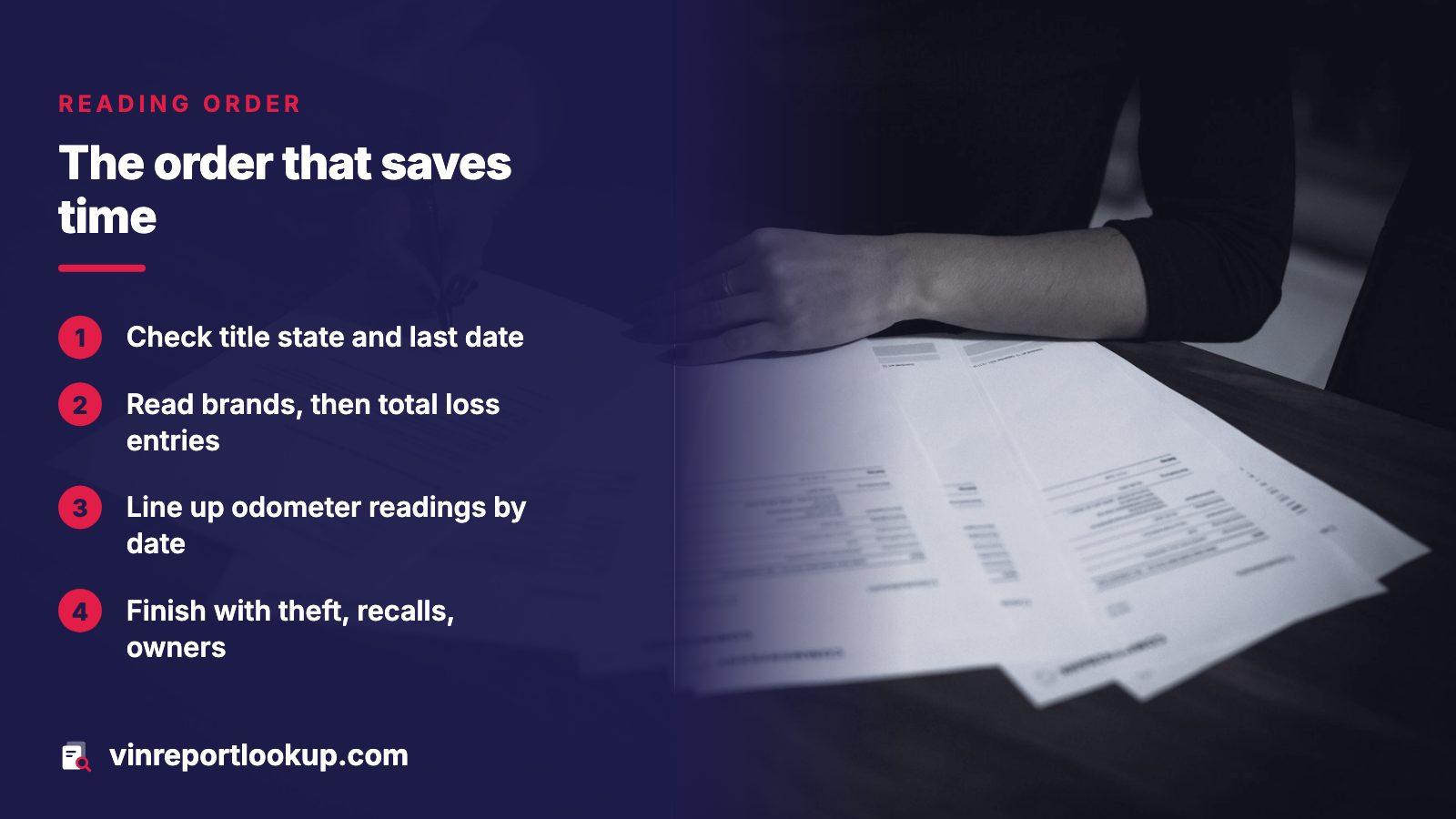
- Title state and last title date: where the car is titled and when that last changed.
- Brands: junk, salvage, flood or any other label a state attached.
- Odometer readings: every dated reading, lined up oldest to newest.
- Total loss and salvage history: insurer and yard records.
- Theft entries and open recalls.
- Ownership count, use type and the remaining details.
VINReportLookup shows a preview for a VIN before you pay, which is a reasonable way to see whether the car has any red flags worth a full read.
Title state and brands
A brand is a descriptive tag that a state titling office assigns to a vehicle to describe its status, with junk, salvage and flood being the common ones. Federal title data retains each label from every state that ever applied one, so a trip across a state line cannot scrub the record. Without that history a buyer can pay more than the car is worth or end up with one that was never properly repaired.
Check the title state against where the seller says the car lives. A car titled two states away from the seller is not automatically a problem, but it is a reason to ask why.
States do not agree on brands
Each state sets its own damage threshold and vocabulary. One wreck might be called salvage here and pass without a label next door, and certain states never use a flood label. So a missing brand on one record does not mean the car never had the damage.
Odometer readings: look for the drop
Odometer rollback is a crime that leaves the buyer overpaying and sometimes driving something unsafe. A report helps because each reading comes with a date and a source, such as a title transfer, an inspection or a service visit.
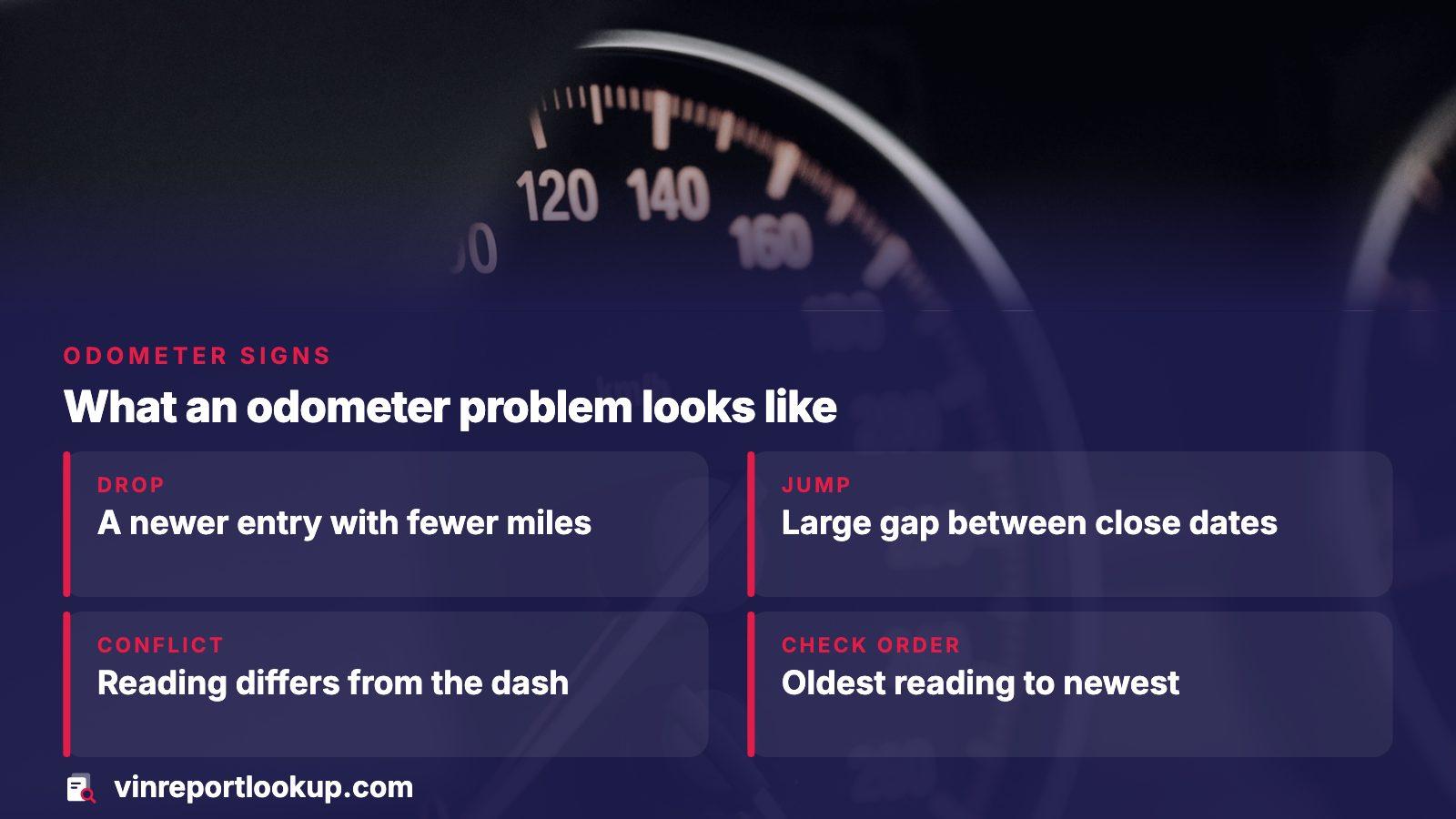
List every reading by date, earliest first. Mileage should only go up. A lower number later in the sequence needs an explanation, and so does a long gap with no readings followed by a jump that does not fit how the car was used. A single odd entry can be a typo by whoever recorded it, so look for a pattern before you accuse anyone.
- A newer entry showing fewer miles than an older one.
- Two readings close in date with a large mileage difference.
- A reading that conflicts with the number on the dash today.
Total loss and salvage entries
A total loss means an insurer decided the repair cost was not worth paying, and generally the vehicle had severe damage. A salvage entry says the car passed through a salvage yard, an auto recycler or a similar channel, or was declared salvage by an insurer. Either one is a reason to slow down, because the repairs may not have been done to a safe standard.
There is one exception worth knowing. Insurers sometimes write off a stolen car that stays missing past 30 days. When it resurfaces without damage, the write-off remains on file, and the car can be offered for sale in sound condition. So read the dates and the circumstances, not just the label.
What a clean report really tells you
A clean title record is a good result. Nothing branded, totaled or salvaged was found in the sources. It does not mean nothing ever happened. Reporting to the federal system is not complete: the system covers about 87 percent of vehicles, yet fewer than all states feed it, so a lookup may say nothing about damage that did happen.
| What you see | What it supports | What it does not prove |
|---|---|---|
| No brands | No state recorded one | That damage was never repaired quietly |
| No salvage entry | No yard or insurer reported one | That every reporter is in the system |
| Steady odometer | Readings rise in order | That the mileage today is accurate |
| Few owners | Fewer title transfers | That the car was maintained |
Federal data also has timing lag. Some states send records as titles are issued; others batch them daily or take several days.
What a report does not contain
Title data was built to catch fraud and theft, not to describe a car's mechanical condition. It carries no repair history, and private providers add other items such as recall information and maintenance data from their own sources.
The federal buying checklist therefore adds a mechanic's look, a drive over varied roads, a review of the owner's maintenance records and a conversation with the previous owner. Think of the report as a way to find the questions, and the inspection as how you answer them.
Recalls are a good example of a separate check. NHTSA publishes open recall data by make, model and model year, and a recall search by VIN costs nothing, so run it even when the report shows no problem.
When a line looks wrong, go to the source
A report summarizes. The state's own title record holds more than the federal system passes along, and reports from approved providers are supposed to include a way to reach the state that titled the car. If a brand, a date or a mileage looks off, request the full state record before you argue with the seller or walk away.
For a mistake in the report itself, contact the company that sold it to you. They are the ones who can correct their own output.
A quick sanity routine
Compare the VIN printed on the report with the one on the car and on the paperwork. Then compare the title state, the owner's story and the odometer. Any two that disagree are worth a direct question.
Putting it together before you buy
Run the VIN, read the title and brand lines first, line up the odometer dates, then read total loss and salvage entries. Check recalls separately and book an inspection if the car is still a candidate. When you are weighing several cars, a multi-report pack can cost less per vehicle than buying them one at a time, and the exact prices are on the pricing page.
VINReportLookup is a one-time purchase after a free preview, with no subscription to cancel later. Use the preview to decide which cars deserve a full report.
Where this information comes from
- DOJ Vehicle History: reading an NMVTIS report — what the five indicators are, and why an empty result is welcome
- DOJ Vehicle History: for consumers — state brand differences, false negatives and the total loss exception
- DOJ Vehicle History: FAQ — what title reports omit and how data timing varies
- DOJ Vehicle History: used car buying tips — mechanic, test drive and records checklist
Sources and photos: Facts checked against the sources above in November 2026. Photos by Miles Loewen, Dimitri Karastelev and CHUTTERSNAP on Unsplash; diagrams by VINReportLookup.
Keep reading
- Sample reportSee how the sections described here look on a finished report.
- Carfax vs inspection: what each shows and which to buy firstDecide what each check can and cannot tell you.
- Carfax vs NMVTIS: what each report shows and which to buyCompare commercial reports with the federal title record.
- Carfax minor vs moderate damage: what each label tells a buyerInterpret damage severity entries once you find one.
Frequently asked questions
What should I look at first on a vehicle history report?
Look at the title state and any brands, because a junk, salvage or flood label can rule out a car immediately. After that, check the odometer sequence and any total loss or salvage entry. Accident lines and ownership counts matter, but they rarely decide the purchase by themselves.
Is a car safe if its history report is clean?
No. It means the sources the report draws on had nothing to report. Some damage never reaches an insurer or a state record, and reporting is incomplete. Add a shop inspection and a road test before you hand over money.
How can I tell whether the mileage was tampered with?
Line up every dated reading and look for a lower number appearing later, or a mileage jump that does not match the dates. Then hold the newest figure up against the dashboard. A report can flag the pattern, but a mechanic can confirm wear that fits the mileage.
Why does the report show a total loss on a car that looks fine?
A total loss label is an insurer's decision, not an inspection result. It can follow severe damage, but a stolen car that stays missing for a long enough period can also get it. Ask the seller for the claim details and the repair paperwork.
Where can I find recall information for a car?
NHTSA publishes open recalls, and its VIN search costs nothing. Some private reports include recall data too, but checking the federal source directly takes a minute and confirms whether a fix is still pending on that specific vehicle.
Now check the car itself
The guide explains what to look for. The report shows what this VIN has on record.