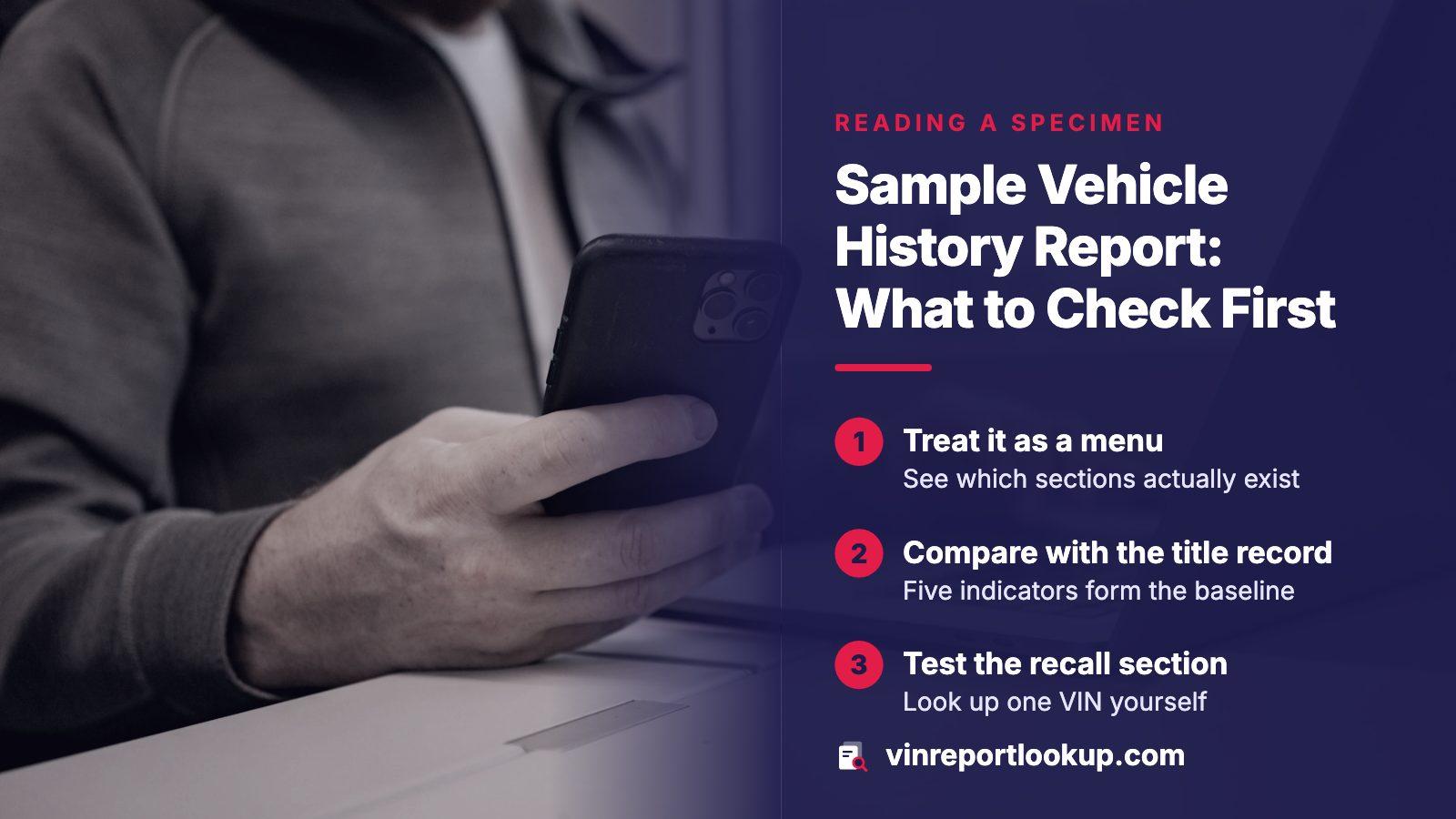
THE SHORT ANSWER
Treat a sample as a menu. Look at which sections exist, how clearly a brand or damage entry is worded, and whether each record says where it came from. A sample cannot tell you whether a particular car is clean. Only a report run on that car's VIN can, so compare samples first and pay for one report afterwards.
- Federal title report
- Five indicators only
- Government price guide
- Up to $4 for a title report
- Extras
- Repairs and recalls come from private data
What a sample can and cannot prove
Shoppers comparing report sellers often start by hunting for a specimen, and that is a sensible instinct. A specimen lets you see the order of sections, the wording of warnings and how much empty space a clean car produces. It does not prove that the seller has good data, because the specimen is chosen by the seller. A glossy example with a dozen colorful entries says little about what your own vehicle will return.
So read a sample for design and honesty of labels, never for reassurance. If an entry is vague, such as a damage line with no date or source, expect the same vagueness on your report.
The government title report is the baseline to compare against
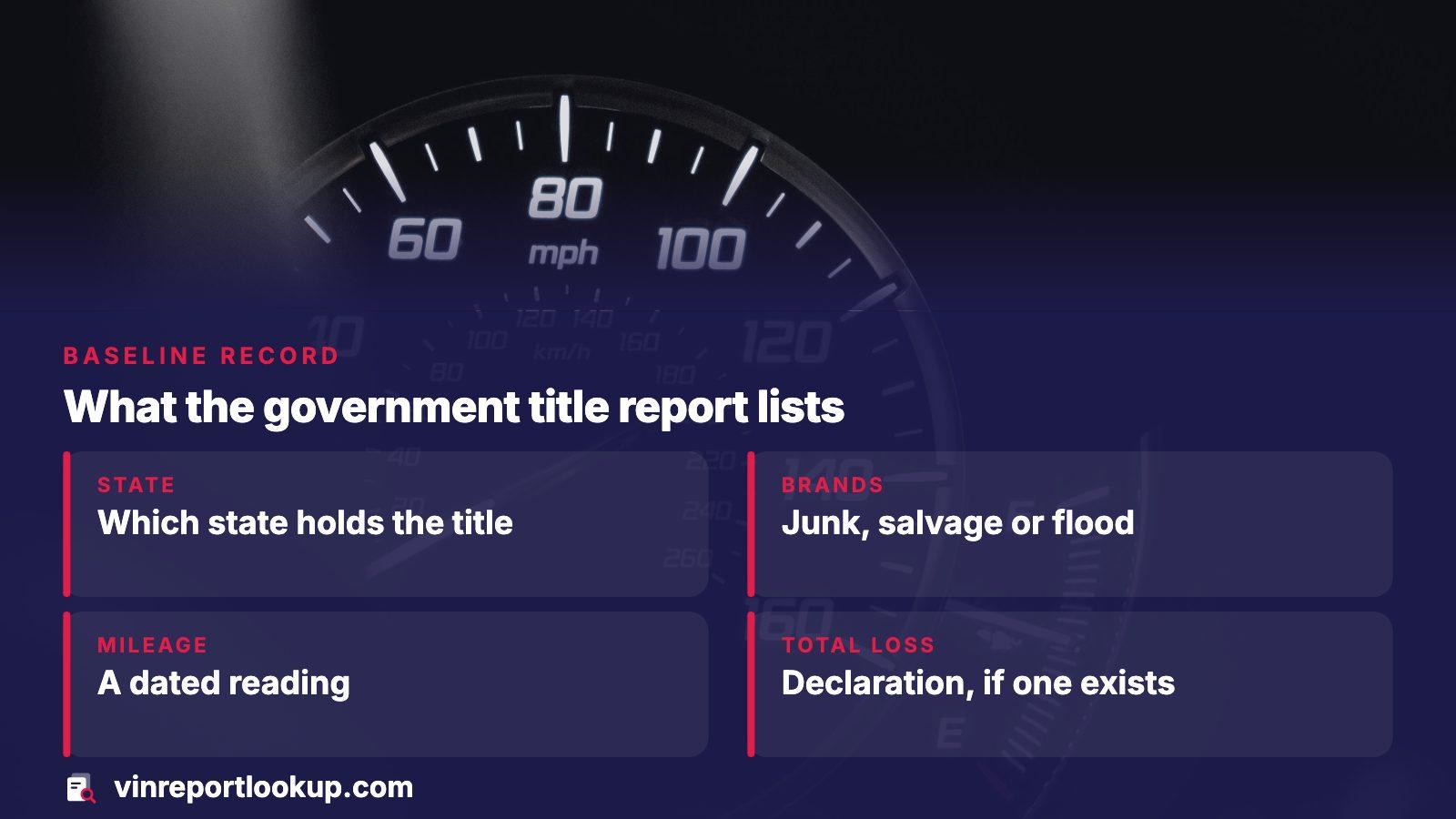
The Justice Department runs a vehicle history site that spells out what a federal title report should hold, and the list is short. Think of it as five questions: which state holds the title and since when, whether any state branded the car, what the mileage was, whether an insurer wrote it off, and whether it passed through salvage. The answers come from titling offices, junk and salvage yards, recyclers and insurers, all of which federal law compels to report.
- Which state holds the title, and since when
- Brands any state applied, such as junk, salvage or flood
- Mileage recorded at a dated event
- A total loss declaration, if one exists
- Any trip through a salvage yard
A specimen should cover at least that ground. Pretty graphics that skip brands or write-offs leave out the part that protects your money.
Why a clean report looks thin
Buyers sometimes open their first report and feel cheated because it has so little on it. The federal site addresses this directly: a clean title report is a good outcome, and the report is deliberately short compared with fuller private reports. Empty rows mean no brand, no total loss and no salvage entry reached the system.
Read the blanks as an answer
No entry under brands is a result, not a missing page. What it cannot tell you is whether an accident was ever reported anywhere, since minor repairs paid in cash often reach no database at all.
The sections to read first in any specimen
| Section | What to look for in the sample | Red flag |
|---|---|---|
| Title and brands | Dates, states and the exact brand wording | A brand with no date or state |
| Odometer | Readings at separate dates | Mileage that drops or stalls |
| Damage and loss | Whether a source is named | Severity words with no detail |
| Salvage and auction | Photos or sale records, if the seller claims them | A promise of photos with none shown |
| Recalls | Whether entries come from maker campaigns | No campaign identifiers |
Start with the first row. A brand is the single entry most likely to change what you offer, and the wording should be exact enough to look up.
Testing the recall section yourself
Recalls are the one section you can audit without paying anyone. NHTSA publishes each campaign with a number, the date the report was received, the affected component, a summary, the consequence and the remedy. If a specimen lists a recall, it should be traceable to a campaign record like that. A line that says only that recalls exist, with no identifier, is weaker than it looks.
NHTSA's VIN decoder gives you a second cross-check: the make, model and year printed on a specimen should agree with what the decoder says for that VIN.
What fuller reports add to the title record
According to the federal site, private companies sell material the title system was never built to hold: service and repair entries, recall notices and upkeep data. That is the honest gap between a short title report and a longer one. More lines are useful only when each one is sourced, and the specimen is where you can judge that.
Also check scope. Some familiar names sell to dealers alone. On the government's provider roster, Carfax, DMVDesk and Experian are marked as unavailable to individual shoppers for title reports, and Carfax's title data is limited to business customers in one state. Before paying anyone, confirm they appear on the roster for public buyers.
A report plus an inspection beats either one alone
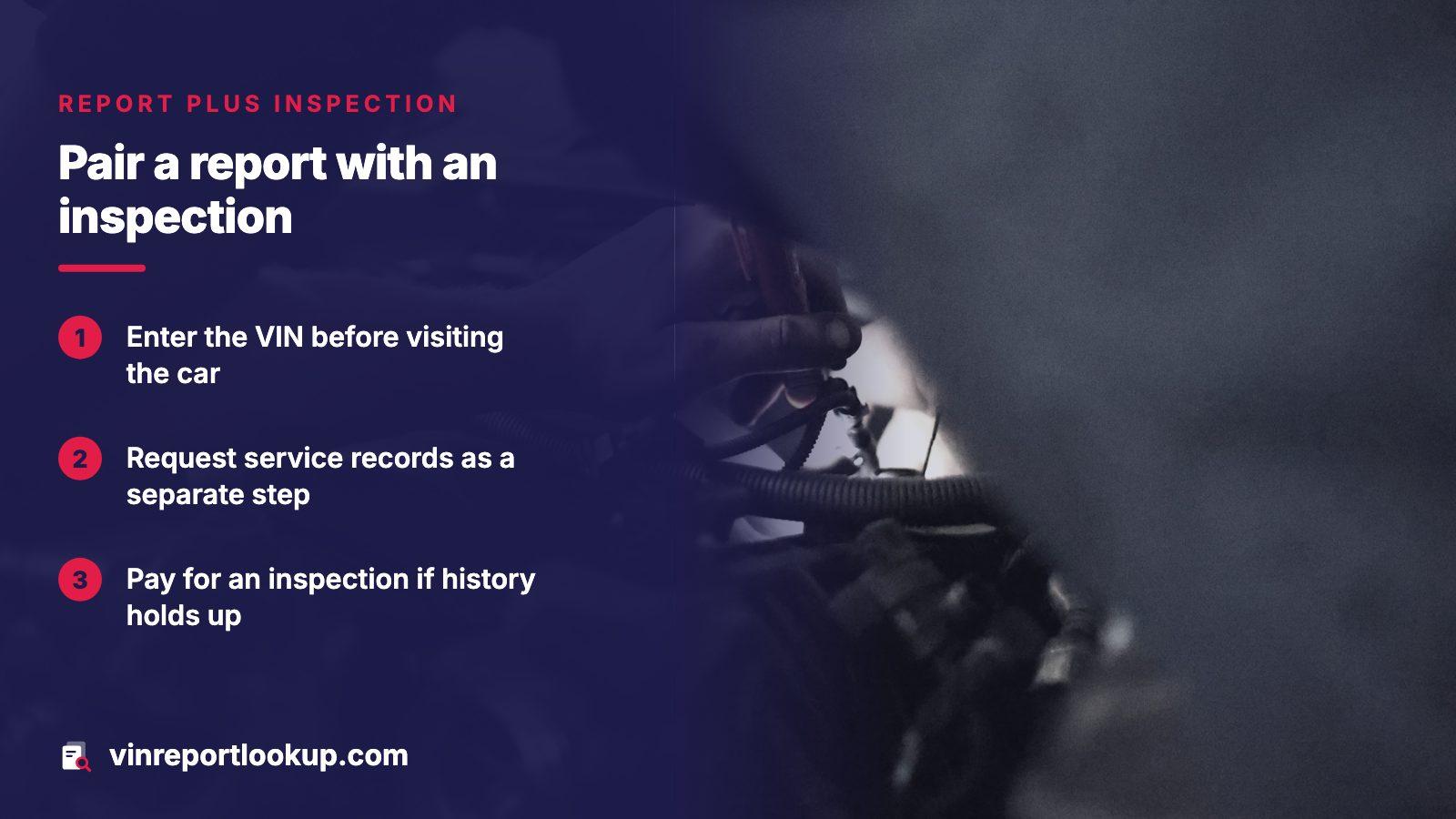
The federal buying checklist starts with a mechanic's inspection, adds a varied test drive, then a history check, service records and a conversation with the earlier owner. The report fills one slot. Its job is the paper trail. The mechanic's job is the car in the driveway as it sits now. A specimen replaces neither.
- Enter the VIN first, ahead of any trip to see the car
- Request service records from the seller as its own step
- Pay for an inspection only when the history holds up
When to stop reading samples and run the VIN
Once you know which sections you care about, a specimen has done its job. Our site gives you a free preview first, so you can see what a VIN returns before paying, and then a one-time purchase for the full report, with no subscription. Pricing sits on the pricing page.
If the preview shows a title brand, total loss or salvage entry, read the full report before you negotiate. If it looks clean, the report still earns its cost when the seller is a stranger and the car is far away.
Where this information comes from
- VehicleHistory.gov: Understanding an NMVTIS Vehicle History Report — the five indicators, why a clean report is short, and data sources
- VehicleHistory.gov: Used Car Buying Tips — the checklist order and the price guide for title reports
- VehicleHistory.gov: Approved NMVTIS Data Providers — which sellers serve the public and which serve dealers only
- NHTSA recalls API — the fields a recall record carries, for auditing a report's recall line
Sources and photos: Facts checked against the sources above in November 2026. Photos by Anastasiia Nelen, Mustafa Sheikhmouss and NATHAN MULLET on Unsplash; diagrams by VINReportLookup.
Keep reading
- How to read a vehicle history report before you pay for a used carGo section by section through a real report once you have one.
- Vehicle history report providers: who sells VIN reports and how they differSee who sells VIN reports and how the sellers differ.
- Carfax vs NMVTIS: what each report shows and which to buyCompare a private report with the federal title record.
- Carfax vs inspection: what each shows and which to buy firstDecide what a mechanic can catch that a report cannot.
Frequently asked questions
Is there a free sample of a vehicle history report?
Many sellers publish a specimen, and the government points readers to approved providers' own sites for NMVTIS samples. Our site shows a free preview on your own VIN, which is more useful than a specimen because it reflects your car. The full report afterward is a paid, one-time purchase.
Does a sample show real vehicle data?
Usually it shows one chosen vehicle, picked to display as many sections as possible. Treat it as a layout demo. It tells you nothing about whether any other car has a brand, odometer problem or salvage record.
Why does my report look empty?
A federal title report covers just five indicators and is short on purpose. Blank rows mean no brand, write-off or salvage entry reached the system. Fuller private reports add repair and maintenance lines, but a short report on a clean car is normal.
What should every sample include?
Look for the title state with a date, any brands, a mileage reading, and write-off and salvage entries. A specimen that omits brands or total loss skips what protects you most. Extra sections are welcome when each one names its source.
Can I check a car's recalls without buying a report?
Yes. NHTSA publishes campaign records by make, model and year. A report's recall line should match them, so that free lookup is a good cross-check on any seller's specimen.
Now check the car itself
The guide explains what to look for. The report shows what this VIN has on record.