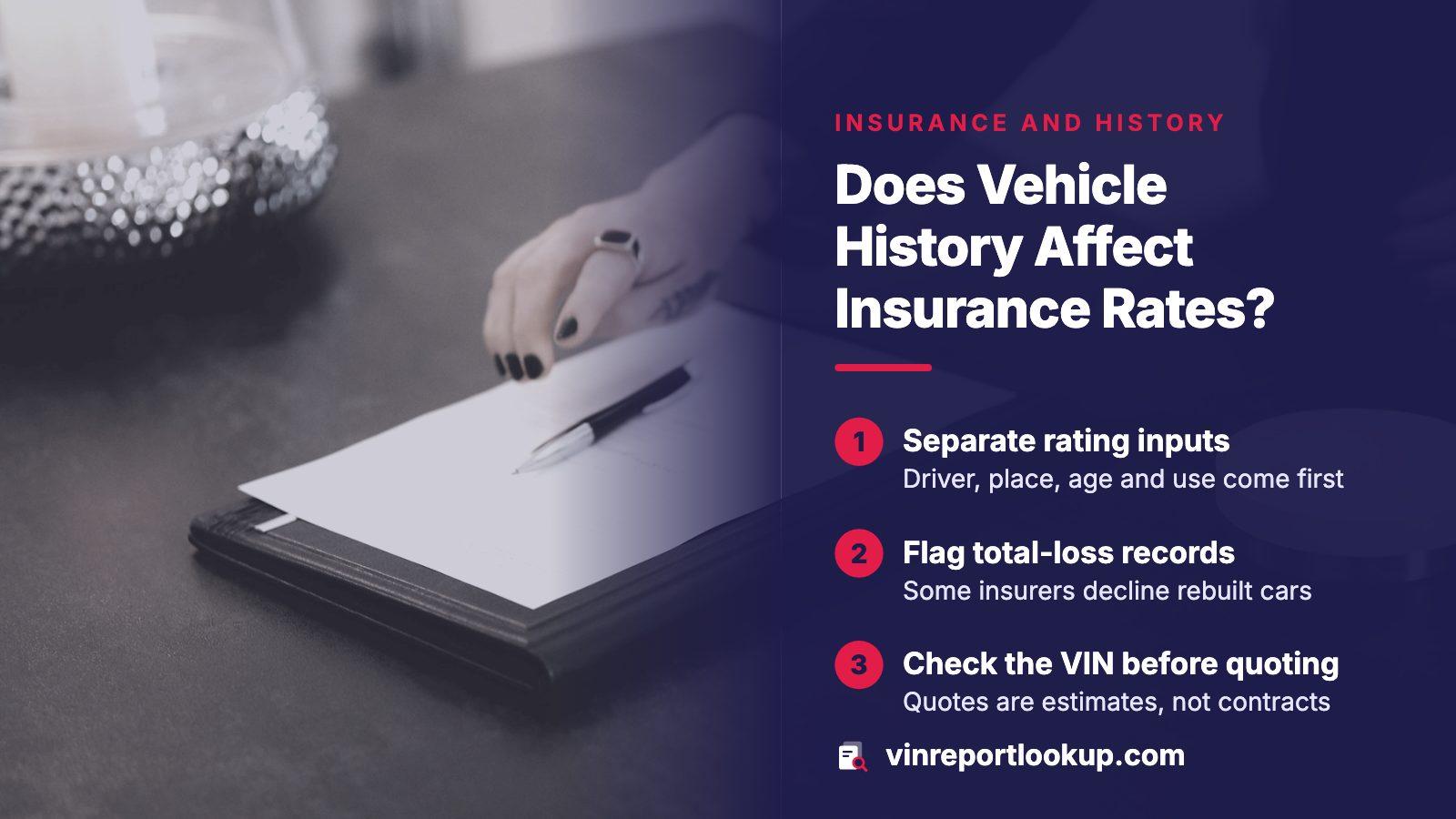
THE SHORT ANSWER
A clean-title car with a few owners and a minor fender bender rarely changes your quote on its own. A salvage, rebuilt or total loss record does matter: some insurers decline rebuilt cars, and the car is worth less if it is ever totaled. Run the VIN, read the title section first, then get quotes with the exact VIN so the price you see is the price you pay.
- Common rating inputs
- Driving record, location, age, prior coverage, use, model
- Where history bites
- Salvage, rebuilt and total loss records
- Quotes
- An estimate, not a firm price or contract
- Preview
- Free preview now, one payment later if you want the report
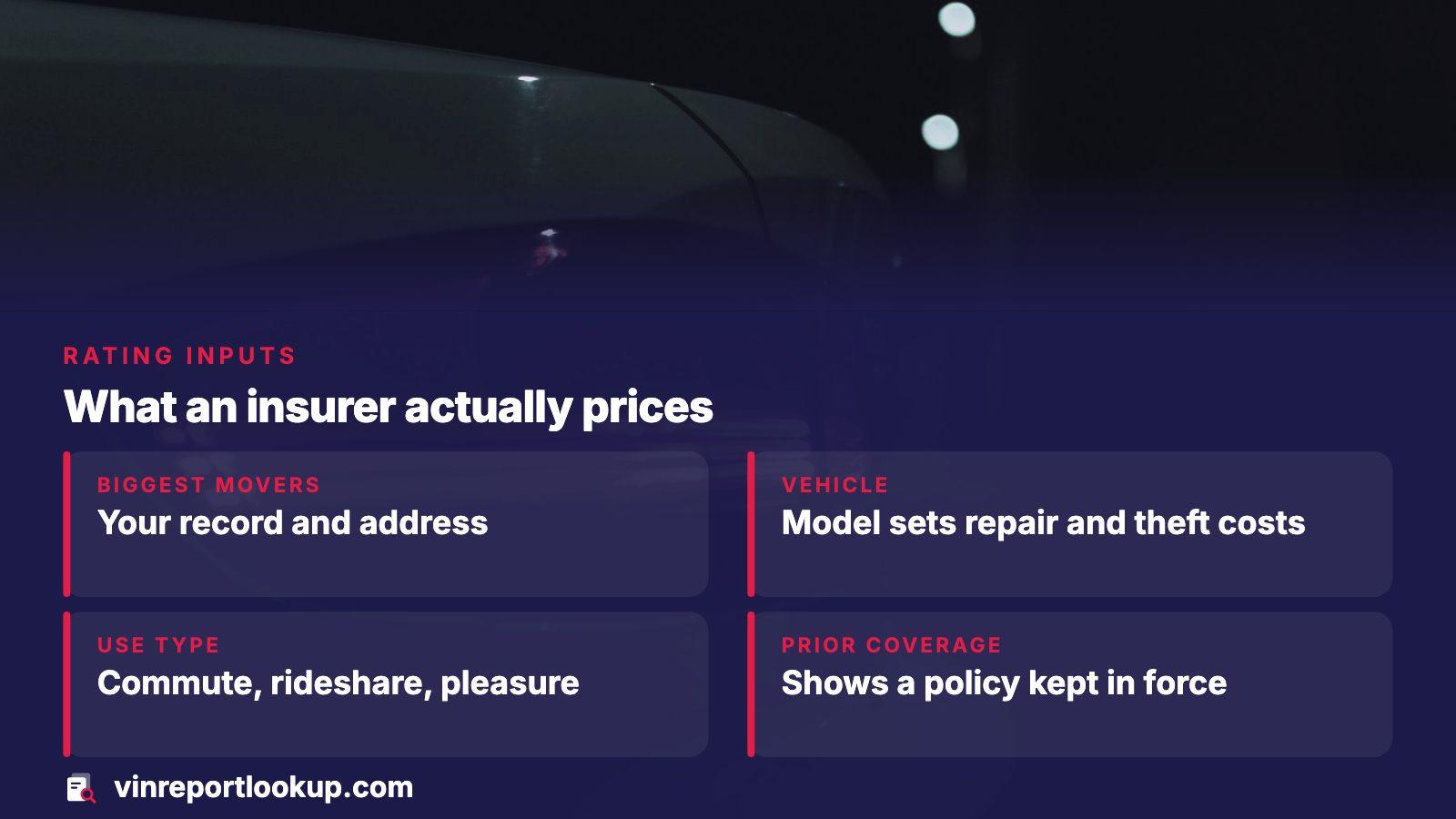
What an insurer actually prices
A premium is built in two passes, according to a Utah consumer page prepared with the NAIC. First the company screens the application and slots you into a pool of comparable drivers. Then it attaches a price to that pool. The inputs it names are tickets and crashes on your record, your ZIP code, age, marital status, any earlier policy, what the car is used for, and which model it is.
Look at what that list leaves out. Previous owner counts and a car's years in a salt-belt state go unmentioned. They affect resale value and wear, and they matter to a buyer, but regulators do not present them as the normal drivers of a premium.
- Your own record and address move the price most.
- The model sets repair and theft cost assumptions.
- Use type (commute, rideshare, pleasure) changes the rate.
- Prior coverage shows you have kept a policy in force.
The records that do change the answer
A few entries cut straight into insurability. A salvage or rebuilt brand, an insurer's total loss entry, flood damage and a theft record each tell an underwriter the car has already cost someone serious money. Texas DMV guidance says insurers frequently turn away rebuilt cars and advises calling your agent first. It also says such a car sells for far less than the same model with an unbranded title.
The lower value shows up at claim time. If a rebuilt car is totaled again, the payout tracks its discounted worth, so some owners buy thinner coverage on it.
| Record on the report | Likely effect on insurance |
|---|---|
| Clean title, no loss records | Normal underwriting, rated on you and the model |
| Salvage brand | Coverage may be hard to place until it is rebuilt and retitled |
| Rebuilt brand | Some insurers decline; others limit coverage or value |
| Total loss without a brand | Ask the agent whether it changes the offer |
| Theft or flood record | Expect questions and possibly an inspection |
Reading a total loss record without panic
NMVTIS, the federal title database, is fed by motor vehicle agencies, scrapyards, auto recyclers and carriers. A brand a state applies never drops out of the record. Insurer total loss calls are reported too, though the Justice Department warns they do not always signal a wreck. A stolen car nobody finds within a month can be marked as a loss by its insurer, and the mark survives if the car reappears untouched.
So read the reporting entity and the date, then ask the seller what happened. A theft total loss and a frame-bending collision look alike in one line of a table and mean very different things for the car.
False negatives exist
The Justice Department says 87 percent of vehicles are covered by NMVTIS, and a search can show no junk or salvage history only because a reporter has not filed yet. A clean line lowers the odds of trouble without removing them, so an inspection stays on the list.
Past claims versus the car's own history
People mix up two records here. A history report follows the car by VIN, while a screening report follows you. The Consumer Financial Protection Bureau lists insurers among the buyers of consumer reports from specialty reporting firms, and says any such firm must hand over your file on request and investigate disputes at no charge under the Fair Credit Reporting Act.
North Carolina's insurance department adds two points. Points cannot be assessed for a collision where you were blameless. A company may still decline to renew collision and other-than-collision coverage when you fall short of its criteria, and many weigh how often you claim, even when blame lies elsewhere. If an old claim of your own is the reason you are shopping, request that file before quoting so an error does not follow you around.
Check the VIN before you ask for a quote
Order matters. A VIN run first tells you whether this is a routine quote or a special case, and it gives every agent the same exact description. Utah's page says to supply identical details to each company, so the quotes line up.
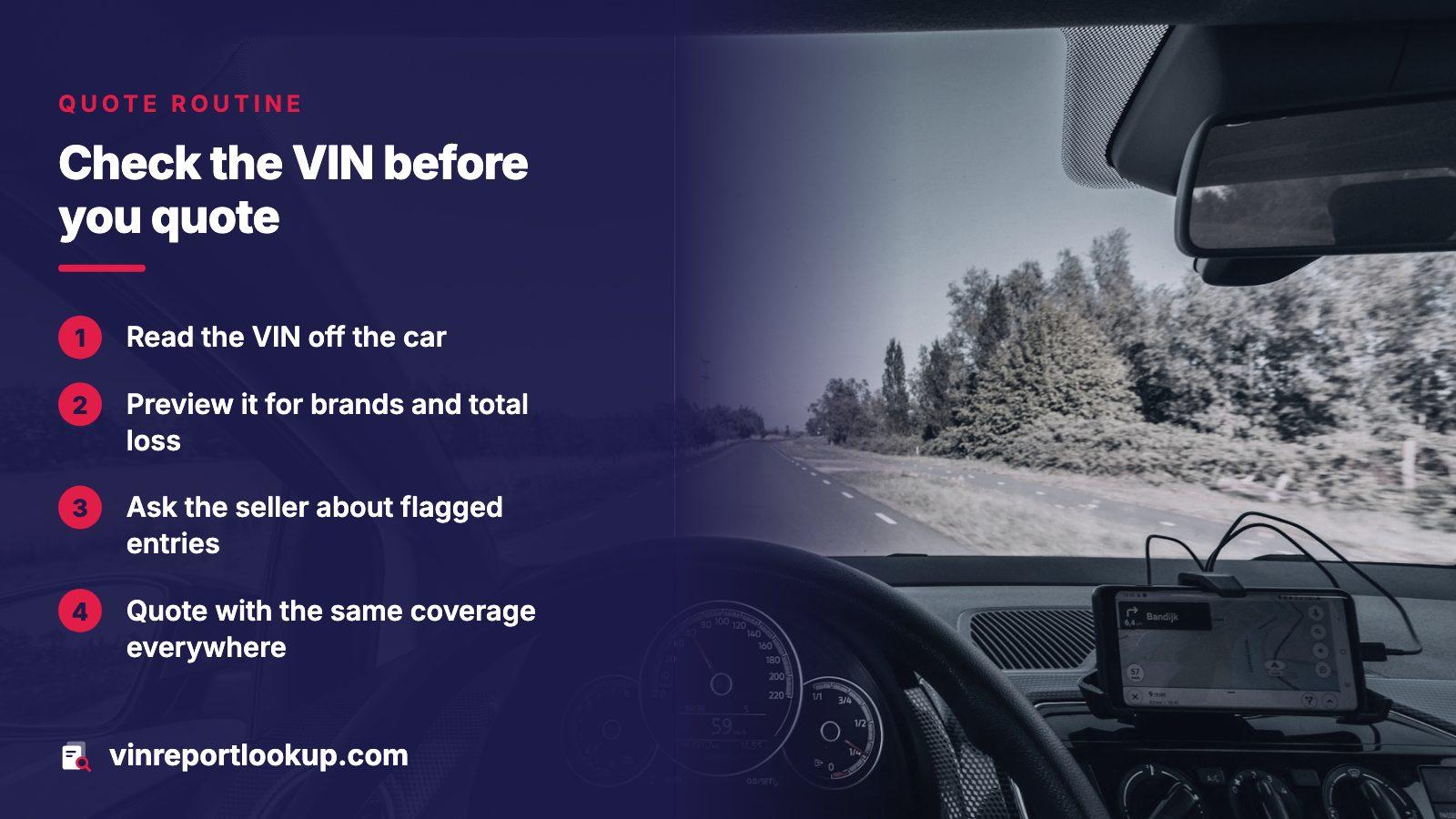
- Read the VIN off the windshield-corner plate or the driver-door sticker, and match it to the title paperwork.
- Run the free preview on VINReportLookup to see whether brands or loss records exist.
- Open the title and insurance sections of the full report if the preview shows anything.
- Ask the seller about every flagged entry before you bargain.
- Quote with the VIN, the use type and the same coverage on every request.
A problem found after the sale is yours. Found before, it gives you bargaining room or a reason to leave.
Where the VINReportLookup report fits
VINReportLookup opens with a free preview showing whether the car has records worth reading. If it does, you pay once for the full report, nothing renews, and the cost sits on the pricing page. For this question the useful parts are the title brand history, insurance loss and salvage entries, odometer readings, and any theft or flood note. Accident detail helps you judge repairs, though the report is a record of what was reported, not an engineer's opinion.
Treat it as the first filter. A report that comes back clean tells you quoting should be routine. One that shows a rebuilt brand tells you to phone the agent before you phone the seller back.
After you buy: telling your insurer
Owning a car does not insure it. In North Carolina, a vehicle joins an existing policy automatically only when you notify the company within 30 days. Rules and policies differ elsewhere, so bind coverage before you drive away.
Flood deserves its own question. Both North Carolina and Utah place water damage under the optional other-than-collision coverage. If the report hints at flooding, confirm what your policy would pay before you rely on it.
What a report cannot tell your agent
Reports record events. They cannot read brake pads or check frame alignment. Texas suggests asking about a rebuilt car how severe the damage was, which shop fixed it, whether the frame was straightened properly and whether an outside mechanic approved the work. Those questions suit any flagged car.
- Book your own mechanic for a look at the car before you commit.
- Ask for the repair invoices behind any old claim.
- Get a written estimate if the car needs work.
- Pair the inspection with the VIN report; neither replaces the other.
Where this information comes from
- Utah Insurance Department: buying auto insurance, ten points — The underwriting and rating steps, common rating factors and why quotes need identical inputs.
- North Carolina DOI: FAQs about auto insurance — Fault and points, nonrenewal criteria, the notice window for a new car and flood coverage.
- NMVTIS: consumer information — Who reports title and loss data, how total loss labels work and the coverage gaps.
- Texas DMV: rebuilt vehicles — Insurance denial risk, lower value and questions to ask about a rebuilt car.
- CFPB: consumer reporting companies — Insurer use of consumer reports and your right to a copy and a dispute.
Sources and photos: Facts checked against the sources above in November 2026. Photos by Annika Wischnewsky, Sander Jeurissen and Johnathan Kaufman on Unsplash; diagrams by VINReportLookup.
Keep reading
- Vehicle history report cost: what each kind charges and coversWhat a history report costs across providers before you buy one.
- Carfax vs inspection: what each shows and which to buy firstWhy the report and a mechanic's inspection answer different questions.
- How to read a vehicle history report before you pay for a used carA walk through the sections that matter, title first.
- Can you negotiate car price at a dealership? Using a history reportTurning a flagged entry into a lower price.
Frequently asked questions
Will an accident on the car's history raise my premium?
Not as a standard rating factor. Regulators point to your driving record, location, age and the model you drive. Damage records weigh more on value and on how an insurer treats a branded car, so share the report with your agent and quote by VIN.
Can I get insurance on a rebuilt-title car?
Sometimes, though Texas DMV guidance says insurers often refuse them, so ask an agent before buying. Expect questions about the repairs, and a payout below a clean-title car's if it is totaled.
Does a total loss record mean the car was wrecked?
Not always. A stolen car still missing after a month can be marked a loss by its insurer, and the mark sticks if it turns up undamaged. Read the date and the reporting company, then ask the seller.
Is a quote the price I will pay?
No. North Carolina's insurance department treats a quote as an estimate, not a firm price or contract, and an agent's wrong figure must be fixed by a corrected bill or a refund. Accurate vehicle and driver details keep the number close.
Should I check the VIN before or after getting quotes?
Before. VINReportLookup's free preview shows whether brands or loss records exist, so you know whether to expect a routine quote. Then give each company the same VIN, use and coverage.
Now check the car itself
The guide explains what to look for. The report shows what this VIN has on record.