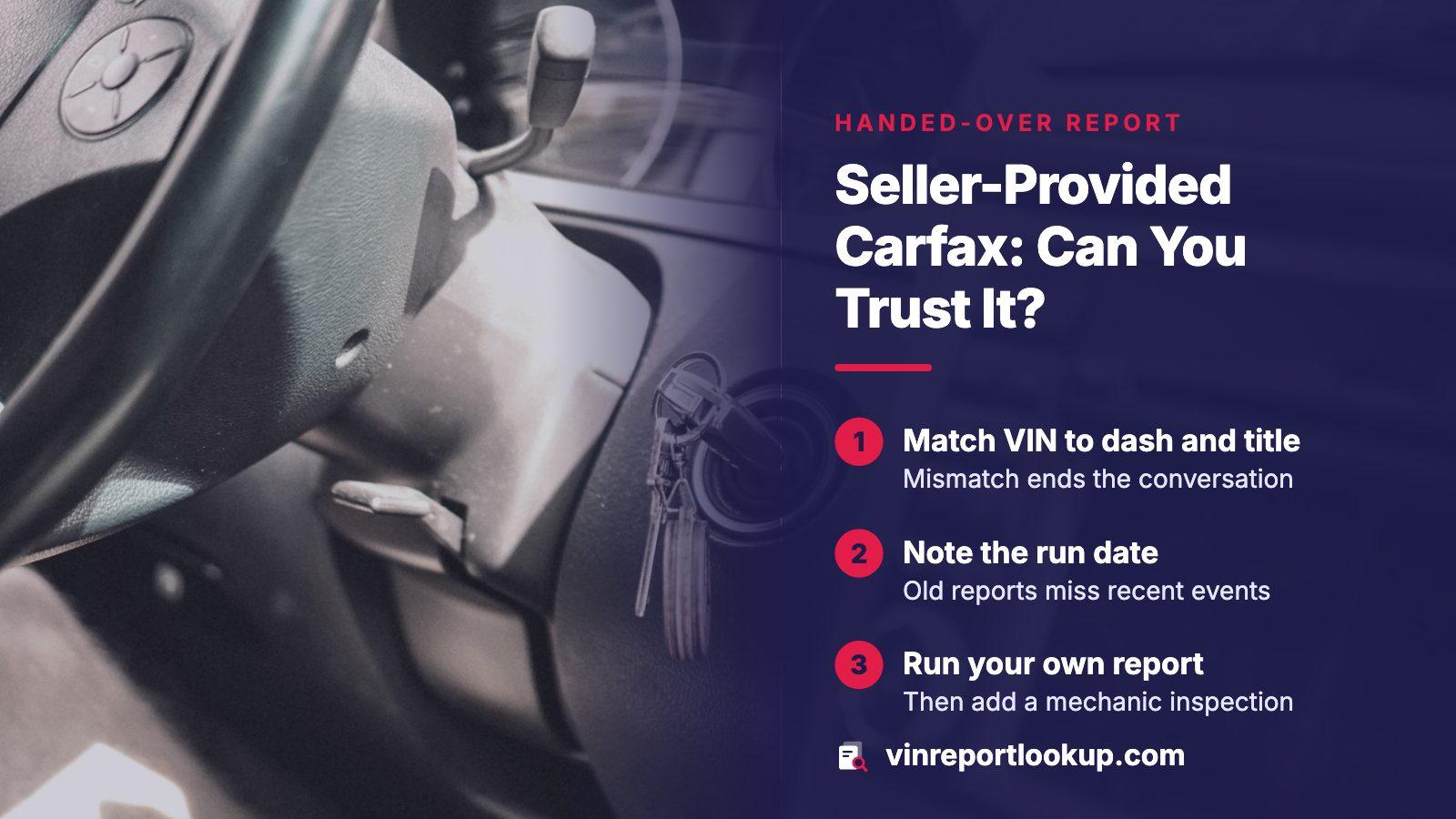
THE SHORT ANSWER
Treat a seller-provided Carfax as unverified until you check it. Confirm the VIN on the report matches the car's dash and title, note the date it was run, and compare its odometer and title entries against a report you order yourself. A fresh report costs a sliver of what the car does.
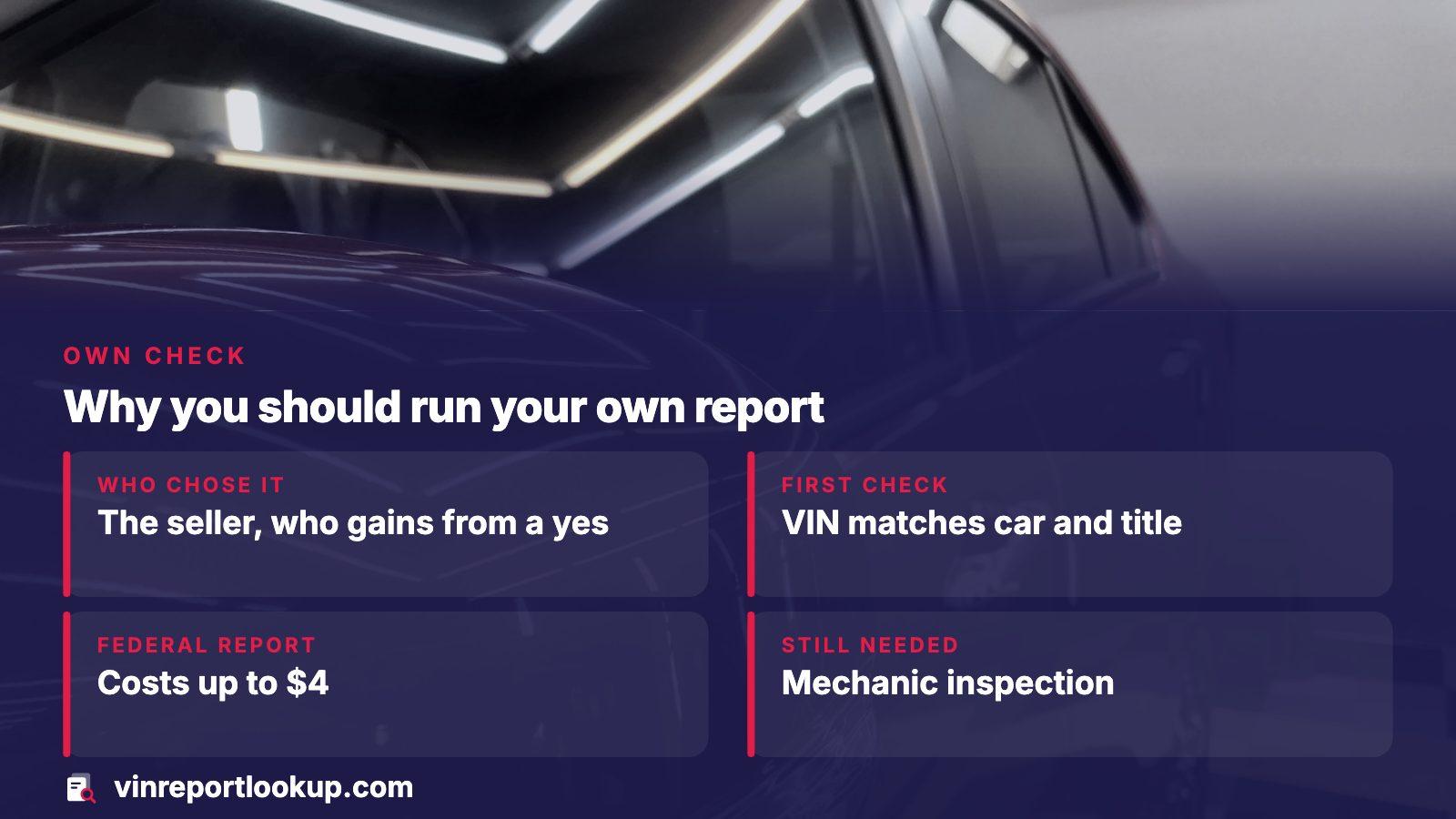
- Who chose the report
- The seller, who profits if you say yes
- First check
- VIN on the page equals VIN on the car and title
- Federal title data
- NMVTIS reports cost up to $4
- Still required
- An independent mechanic inspection
Why the source of the paper matters
A report is only as honest as the chain of custody behind it. When a dealer or private seller gives you a printout or a PDF, you did not choose which report, which VIN or which day it was pulled. Most sellers who share a report do so in good faith, because the car really is clean and the paper helps close the sale. A few do not, and the format of a handout is easy to alter or to swap for a different car's record.
That is not a reason to wave the report away. It is a reason to treat it the way a lender treats a pay stub: useful evidence that still gets confirmed against something you pulled yourself.
Step one: make the VIN match the car
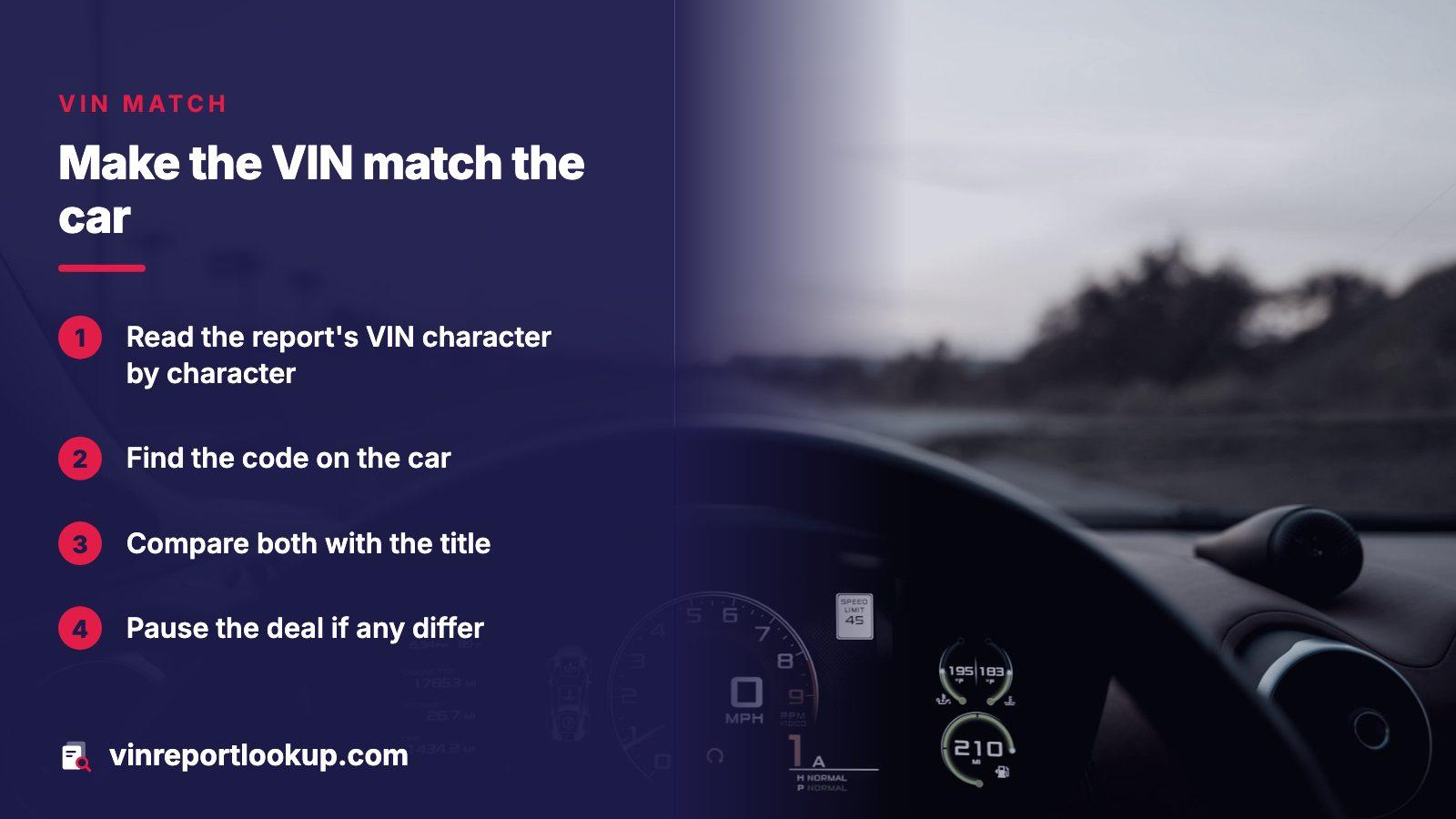
Each line of a report hangs off a single 17-character code. When that code belongs to some other car, nothing else on the page applies to yours. Start with the code printed on the report. Then hunt for it on the car: the dash plate, the door-frame label. Last, set it beside the title or registration.
- Read the VIN printed on the report, character by character.
- Find that code on the car itself, in both places it is stamped.
- Compare both with the title or registration, not with a photo the seller texted.
- Walk away or pause the deal if any one of them differs, even by a single character.
A mismatch can be an innocent typo on a pasted document. It can also mean the paper describes a cleaner twin. You do not need to guess which; you only need the numbers to agree.
What a handout can leave out
Even an authentic report has gaps you cannot see from the paper alone. Timing is the biggest one. A record run three months ago will not show a title change, a claim or an odometer entry made last week. A cropped page can drop the section where a brand or a total loss would appear. And a report built from one provider's data may not carry the same entries another provider holds.
| Weak spot | What to do about it |
|---|---|
| Old run date | Ask for a fresh pull, or run your own today |
| Missing pages or cropped sections | Ask for the full document, every page |
| Single provider's data | Compare against a second source such as federal title records |
| Edited or retyped file | Prefer a link or login the seller does not control |
| Different VIN | Stop and match the car first |
None of these are accusations. They are the reasons a careful buyer wants a second read that the seller never touched.
Spotless paper, unknown car
History reports record events that someone reported: titles, brands, insurance losses, salvage sales, odometer readings. The federal title system says plainly that it leaves out repair history, recall data and maintenance records, which come from private providers. A car can have an unreported fender repair, a worn transmission or a deferred service and still show nothing on paper.
What the paper cannot tell you
A report says what was recorded about the car's past. It cannot say whether the brakes are worn, whether the frame was repaired well, or whether the engine leaks. Only an inspection answers those.
The Federal Trade Commission's Buyers Guide, which dealers who sell more than five used cars a year must display, tells shoppers to get a vehicle history report and also to ask for an independent mechanic's inspection. Both, not either.
Run your own report from the VIN
Buying your own report takes the seller out of the loop. The VIN you key in comes from the car itself, the pull date is visible, and no one has trimmed the pages. Here, a free preview shows whether records turn up for the number. The full report is bought once, nothing recurs, and the pricing page shows what is on offer.
Then compare the two documents. The odometer entries should climb in a sensible line. The title history should name the same states. Any brand, total loss or salvage entry in your report that is missing from the seller's copy is the most important finding of the whole exercise.
Add a federal title check
One more source is worth a few dollars. The NMVTIS is a national title database fed by state titling agencies, plus salvage yards, junkyards, recyclers and insurers, all of which federal law obliges to submit records. A report from an approved provider lists where the title stands and its latest change date, brand entries, the odometer figure, and total-loss and salvage events. Its own consumer page says reports cost up to $4.
The brevity is deliberate, which makes it a quick sanity test next to the seller's longer document. If the federal record shows a brand that the seller's paper does not, get the seller's explanation before you continue.
Red flags in how the seller behaves
Paper problems often arrive with behavior problems. Watch for these:
- Reluctance to let you read the VIN off the car yourself.
- Pressure to decide today because another buyer is coming.
- A report sent as an image or screenshot rather than a link or full file.
- Refusal to allow a mechanic inspection at your expense.
- Promises made out loud that the seller will not put in writing.
The Buyers Guide itself cautions that spoken promises are tough to hold anyone to. A seller who is confident in the car will usually welcome the extra check; one who resists it has told you something.
A simple order of operations
- Take the seller's report as a lead and note its run date.
- Match the VIN across the report, dash, door label and title.
- Type the VIN into this site and read the preview. Upgrade to the full report only for a car that is still a contender.
- Cross-check with a federal title report.
- Request service records, or phone the garage that handled the bulk of the repairs.
- Book an outside mechanic's inspection before any payment changes hands.
Federal buying tips add a test drive over varied roads, plus a call to the main repair shop if the owner kept no records. Each step is cheaper than inheriting someone else's hidden brand.
Where this information comes from
- NMVTIS: Understanding a vehicle history report — What the federal title record contains, where its data comes from, and what it leaves out.
- NMVTIS: Used car buying tips — Inspection, test drive and records advice, plus the stated report cost.
- FTC: Dealer's guide to the Used Car Rule — The Buyers Guide and its advice to get a history report and an independent inspection.
Sources and photos: Facts checked against the sources above in November 2026. Photos by tim, Dennis Eusebio and Clarence Tioh on Unsplash; diagrams by VINReportLookup.
Keep reading
- Carfax vs inspection: what each shows and which to buy firstWhy you need both a report and a mechanic, and what each one finds.
- Carfax vs NMVTIS: what each report shows and which to buyHow the short federal record differs from a commercial report.
- Best VIN check: how to choose a report and what each one includesPick a second report to cross-check the seller's copy.
- Carfax alternatives: what each VIN report option covers and costsOther report options if you want a second source.
Frequently asked questions
Is a Carfax from the dealer reliable?
It is usually authentic, but you did not pick the date, the pages or the VIN. Match the VIN to the car, check how recent it is, and compare it with a report you run yourself. Reliable enough to start a conversation, not to close a deal.
Can a seller fake a vehicle history report?
A file that is only an image or PDF can be edited or swapped for another car's record. That is why a link you can open yourself, or your own report from the VIN, is stronger evidence than a handout.
My report shows a salvage brand and the seller's does not. Now what?
Raise it with the seller, and ask when their copy was run. Compare the VIN on the two documents. Without a clear explanation, assume the brand is real: walk away, or have a mechanic examine the car first.
Is an inspection still needed when the report looks fine?
Yes, because a report lists recorded events rather than how the car is today. The FTC's Buyers Guide lists a history report and a mechanic's inspection as two separate pieces of advice.
How much does it cost to double-check a report?
Federal title reports are listed at up to $4 on the DOJ-run consumer page. Here the preview comes first and costs nothing; the pricing page covers what follows.
Now check the car itself
The guide explains what to look for. The report shows what this VIN has on record.