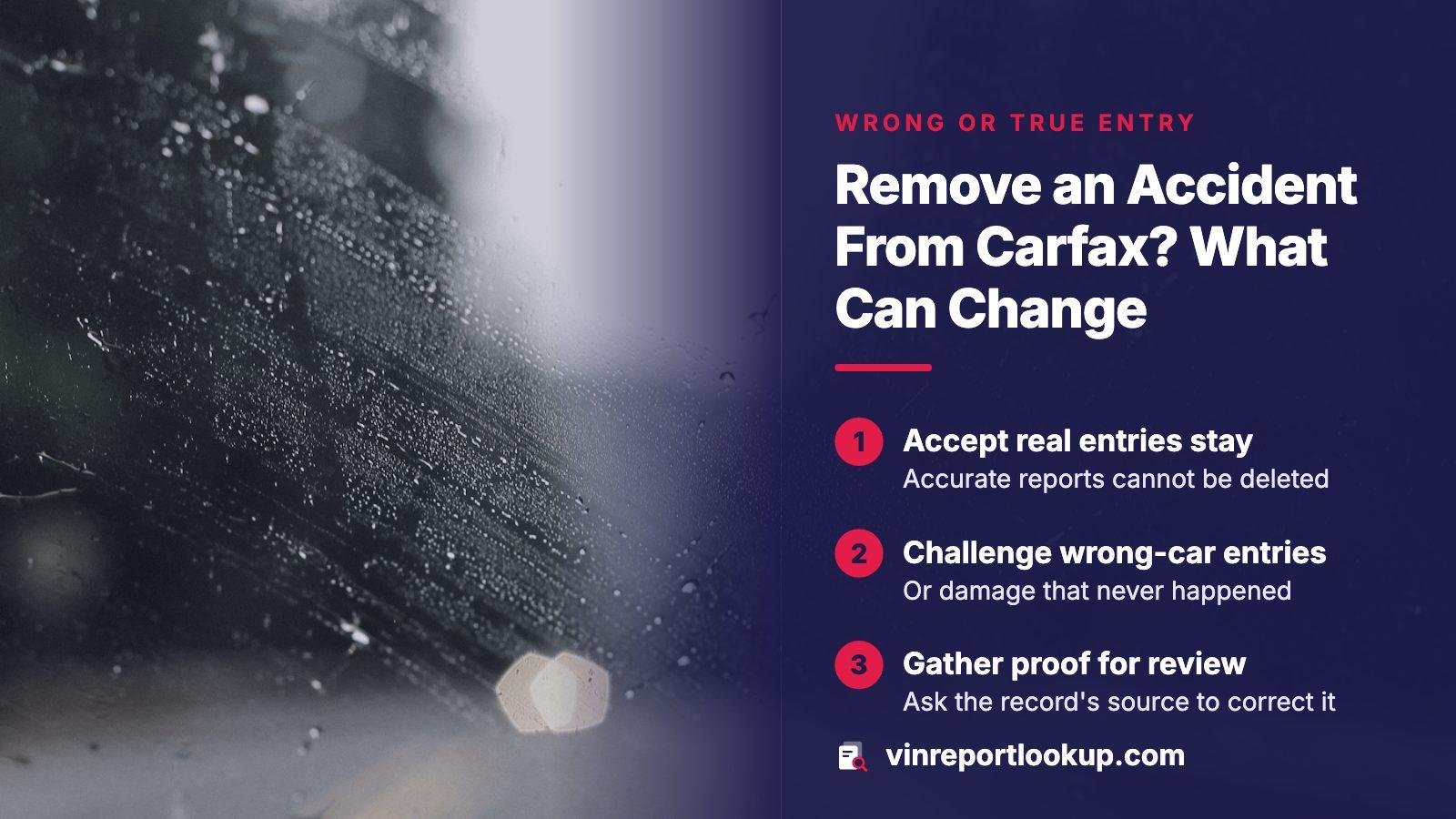
THE SHORT ANSWER
No one can delete a real, correctly reported accident from a history report. If the entry is about a different car or describes damage that never happened, ask the report company to review it and go to the source of the record, such as the insurer, the shop or the state title office. Carfax's own help pages would not open for me, so its exact steps are not covered here. As a buyer, treat an entry that disappears from a listing as a reason to look harder.
- Real, accurate entry
- Stays; there is nothing to correct
- Wrong entry
- Raise it with the report provider and the record's source
- Federal title data
- Provider support is the stated route for disputes
- Carfax's own steps
- Not confirmed here; its help pages blocked access
Why a true accident entry stays on the report
A history report is a collection of what other businesses told a database. An insurer reports a claim, a salvage yard reports a disposal, a state office records a brand on a title. The report company repeats those records; it does not decide whether a crash happened. So there is no setting, fee or favor that erases a record that is accurate.
That matters most to sellers who ask this question hoping to sell a car cleanly. Any outfit offering to scrub a true entry for money is promising something the data flow cannot deliver. From the buyer's side, the same logic is reassuring: the system is built so that a convenient edit is not available to whoever happens to own the car.
When an entry is wrong, and what counts as wrong
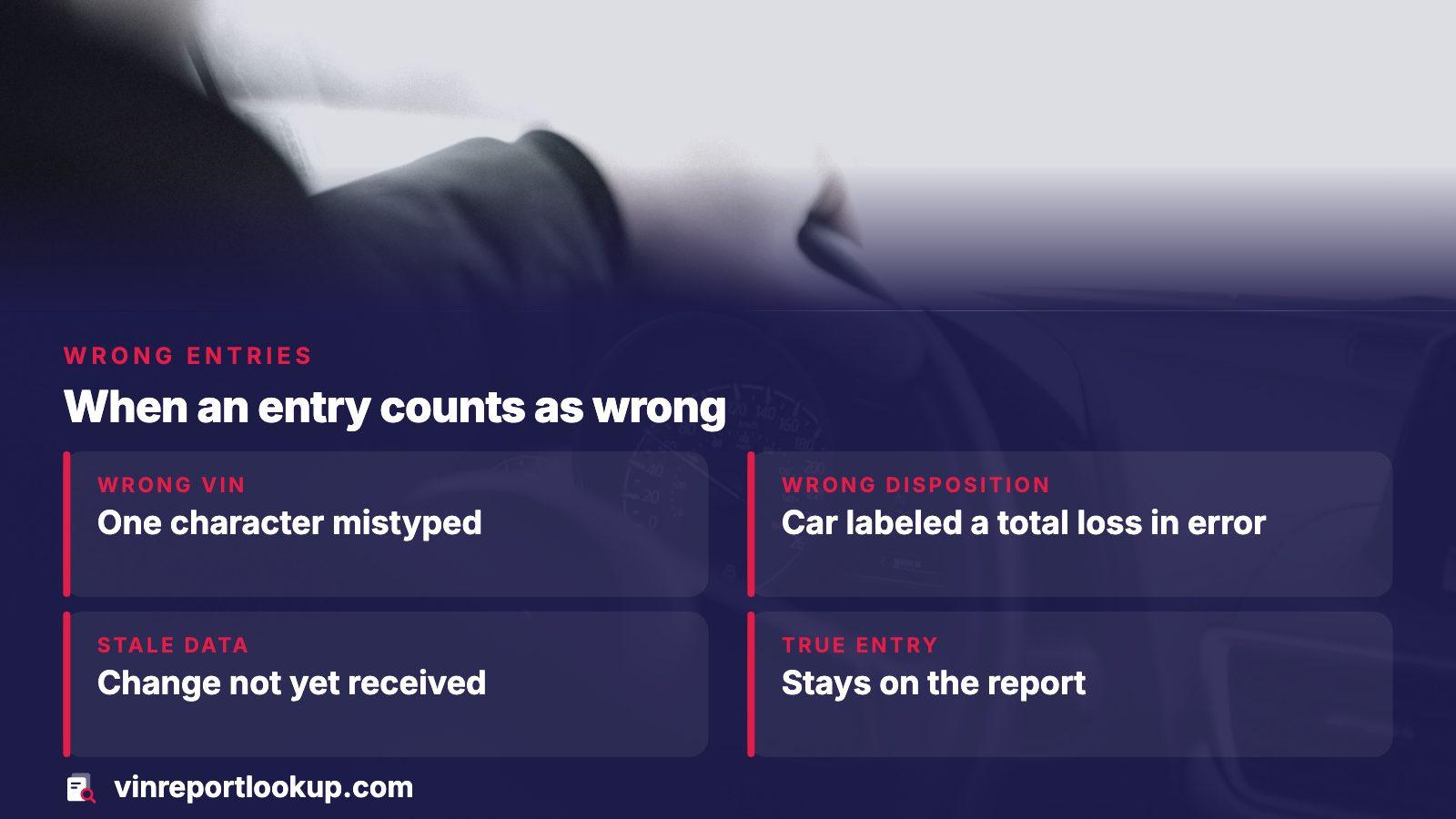
Wrong is narrower than unwelcome. An entry is wrong when it sits on the wrong VIN, when the date or the vehicle does not match the paperwork, or when a record describes an event the car never went through. A minor parking-lot claim that you consider trivial is still a correct record.
- Wrong VIN: one character typed incorrectly at a shop or yard can attach someone else's crash to your car.
- Wrong disposition: a car labeled a total loss that was in fact repaired and kept on the road is an arguable point, not an error, since a write-off label can sit on a car that was later repaired and driven.
- Stale data: a recent change may simply not have reached the database yet.
Sort your complaint into one of these before you contact anyone. A clear, documented mismatch gets a hearing; a plea to hide a true event does not.
Fixing it at the source of the record
The Justice Department, which runs the national title database behind many reports, describes the correction route in two parts. A consumer who sees a discrepancy contacts the provider that sold the report, and each provider lists customer support on its site. The business that originally filed a record sends the correction to the consolidator that took in the original, following the amendment steps of its reporting service.
Put plainly, you cannot rewrite a record yourself, but the business that created it can. Start by asking who that was: the body shop, the insurer, the salvage yard or the state titling office. Then ask that party to amend what it filed, and ask the report provider to refresh the entry once it has.
What the federal system does not do
The government site gives no separate appeals desk for individual car owners. It points people to the report provider, and to the titling state for the full title record.
What to gather before you ask for a review
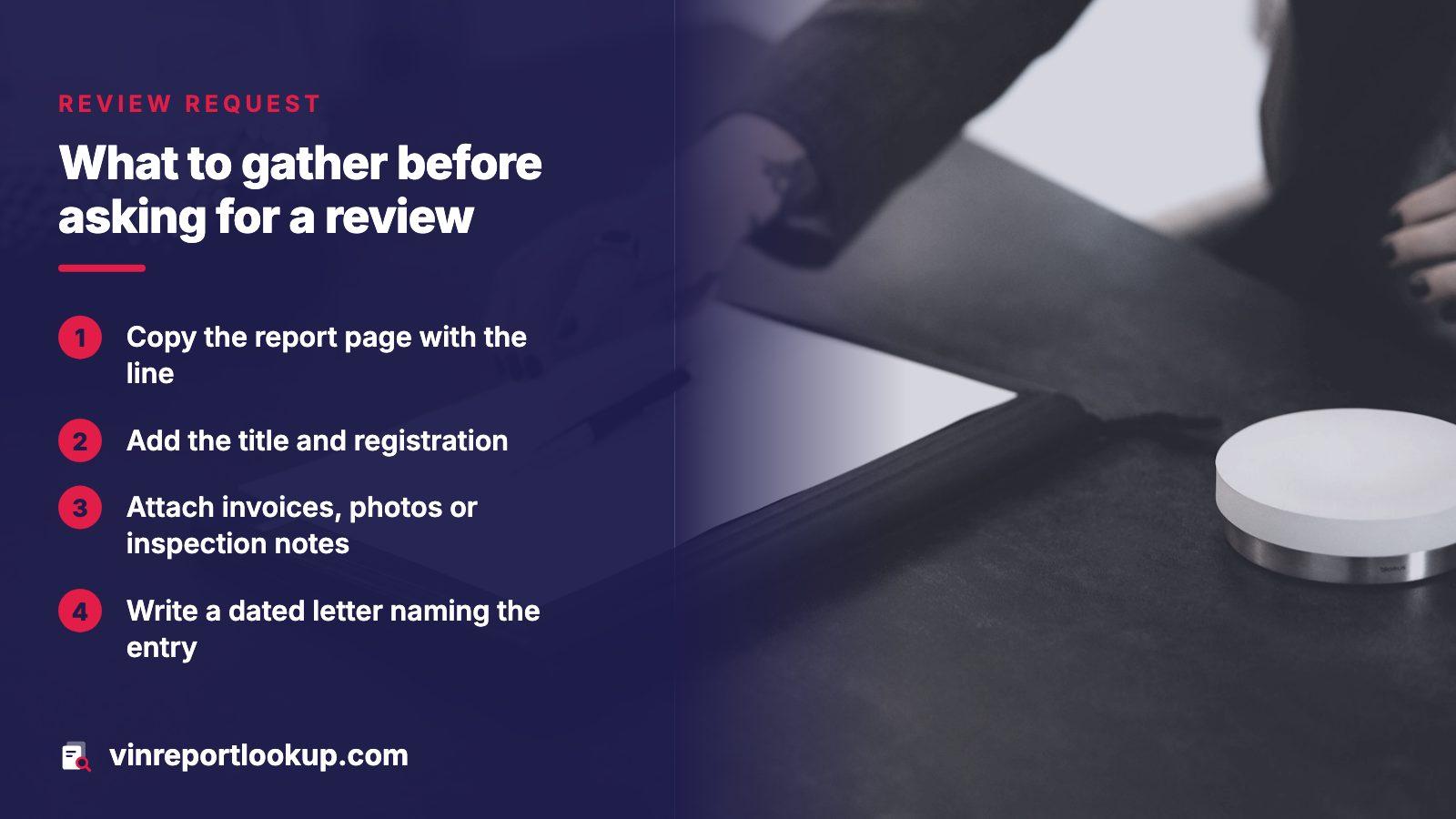
A request with paperwork moves faster than a request with a complaint. Build a small file first, then send the same packet to the report provider and to the business that filed the record.
- A copy of the report page showing the disputed line, with its date and source label if one is shown.
- The title and registration, so the VIN you quote can be checked character by character.
- Repair invoices, an inspection write-up or photos that show what the car actually went through.
- The insurer's claim paperwork, if a claim was involved, including how it was closed.
- A short, dated letter that names the single entry you say is wrong and what the correct fact is.
Keep every reply. If the first answer does not settle it, the file is what you take to the titling state's office, which holds the full title record that a short report only summarizes.
What I could not confirm about Carfax's own process
This guide would be stronger with Carfax's published steps, but its help pages refused to open for me, and two other official sites blocked the same request. I will not guess at a form name, a contact address or a turnaround time, and you should be wary of any page that states them without showing where they came from.
What you can rely on is the structure documented by the federal title system: report providers handle questions about their reports, and original filers correct original records. Before you write to anyone, open the provider's own help section and use the route it lists today.
If you are buying: what a vanished entry should tell you
Shoppers meet this question from the other direction. A listing's report shows no crash, yet the paint looks uneven or the panel gaps differ side to side. Silence in a report reflects what nobody filed, which is a weaker claim than no damage. Government guidance says buyers should not lean on a single report and should look at the state's full title record as well.
Ask the seller directly
Find out if an insurer ever paid on it, and whether any body work was paid for privately. Ask for the shop's invoices. A seller who has nothing to hide usually has a folder of them.
A mismatch between a seller's story and a second source is the signal worth acting on. Brands also vary by state, so a car moved across state lines can look different on paper from one state to the next.
Cross-checking a report you cannot edit
Because no single report is the final word, use more than one lens. NICB runs a free VIN lookup that shows theft, salvage and flood reports its member insurers filed, though it is not a full history and a clear result proves little. The federal title system adds brand, odometer and total loss data for a small fee. Maintenance records come from the owner, the dealer or the shop.
| Source | What it adds | Limit |
|---|---|---|
| NICB VINCheck | Theft, salvage and flood flags filed by insurers | Not a full history |
| Federal title system | Brand, odometer and total loss records | Short on purpose; provider support handles disputes |
| Shop and owner records | Repairs that never reached a database | Only as honest as the paperwork |
| Independent inspection | Physical evidence of repair | Costs money, needs a mechanic |
Where a VIN report helps next
Weighing a specific car right now? Enter its VIN for a preview, which costs nothing, to see whether records exist worth a closer look. The full report is billed once, and the pricing page spells out the packs.
Use it as one input. An independent mechanic's written inspection, with repair estimates, gives you both a safety check and a number to negotiate with. A report tells you what was recorded; the inspection tells you what is under the paint.
Where this information comes from
- Justice Department NMVTIS: frequently asked questions — who handles a disputed record and how filers amend theirs
- Justice Department NMVTIS: for consumers — where the data comes from and why states differ on brands
- Justice Department NMVTIS: used car buying tips — inspection, maintenance records and asking the previous owner
- FTC: Buying a used car — what history reports leave out and why a mechanic's inspection matters
- NICB VINCheck — free theft and salvage lookup, and its stated limits
Sources and photos: Facts checked against the sources above in November 2026. Photos by Cole Keister, Annika Wischnewsky and Miles Loewen on Unsplash; diagrams by VINReportLookup.
Keep reading
- How to dispute a Carfax report: what to do when a record looks wrongThe step-by-step side of challenging an entry you believe is wrong.
- Does Carfax show all accidents? What a history report can missWhy some crashes never reach a report in the first place.
- How accurate is Carfax, and what to check before you payHow much weight to put on a report's contents.
- Carfax vs inspection: what each shows and which to buy firstWhat a mechanic finds that no database can.
Frequently asked questions
Can a dealer or seller get an accident taken off a Carfax?
Only if the entry is wrong. A seller can ask the provider and the original filer to review a mismatched record, but nobody can have a correctly reported crash deleted. If a seller says otherwise, ask to see the corrected report with your own eyes before you pay.
Who fixes an accident record that has the wrong VIN?
The business that filed it. Government guidance says filers amend records through their reporting service, while consumers contact the provider that sold the report. Bring the title and invoices so the VIN can be compared character by character.
Does repairing the car clear the accident from its history?
No. Repair changes the car, not the record of the event. A brand or loss label also stays tied to the vehicle, and states use different standards, so the same car can look different on paper depending on where it was titled.
The report shows nothing, yet I suspect the car was hit. Now what?
Trust the evidence in front of you. An empty report reflects only what was filed. Ask for repair invoices, check the state title record, and pay a mechanic for a written inspection before agreeing on a price.
Is there a free way to see more than one record?
Partly. NICB offers a no-charge lookup of theft, salvage and flood reports filed by member insurers, and it adds that coming back clear proves little about the rest of the past. Our own preview costs nothing too, while the complete report is billed once.
Now check the car itself
The guide explains what to look for. The report shows what this VIN has on record.