THE SHORT ANSWER
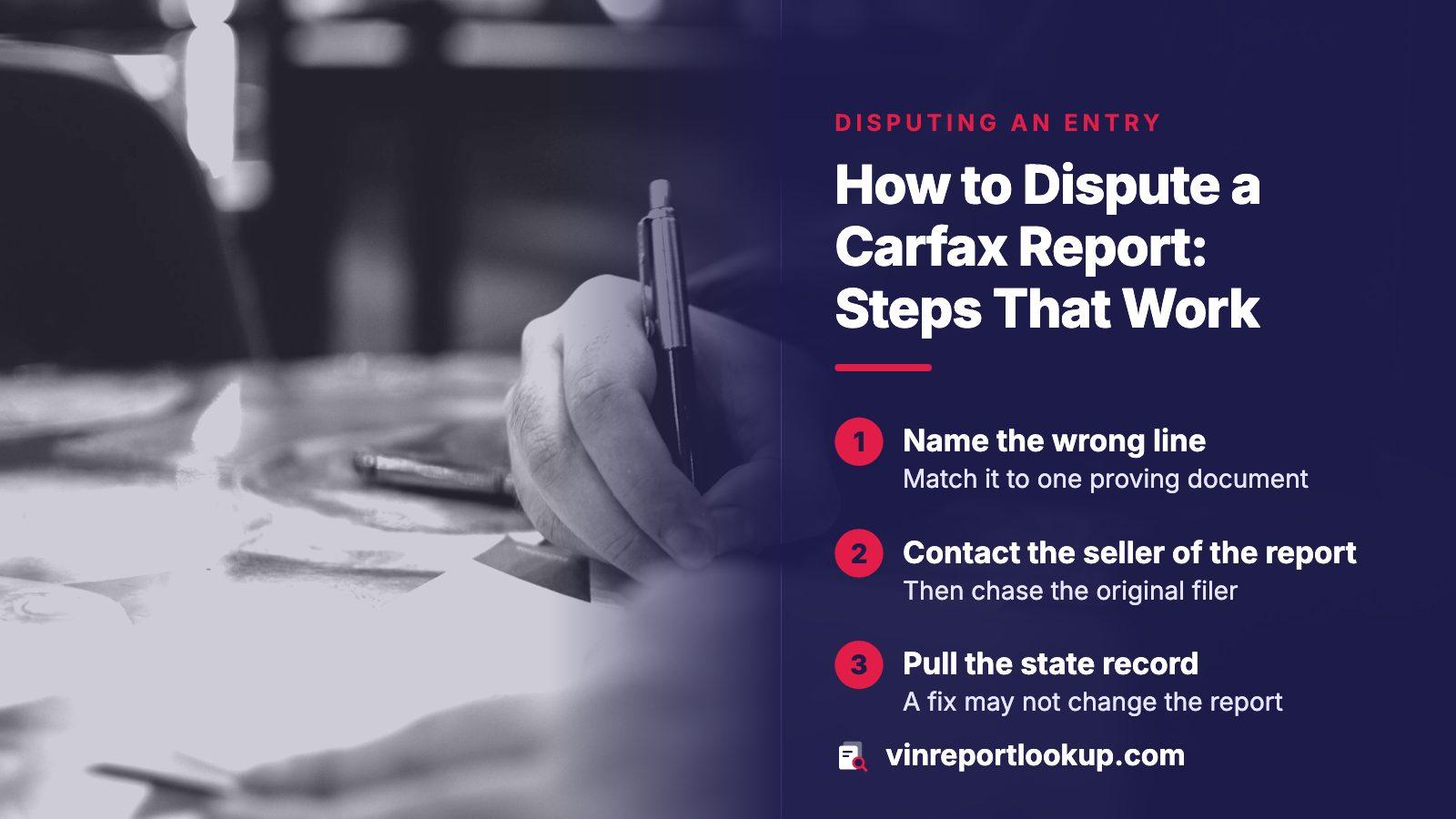
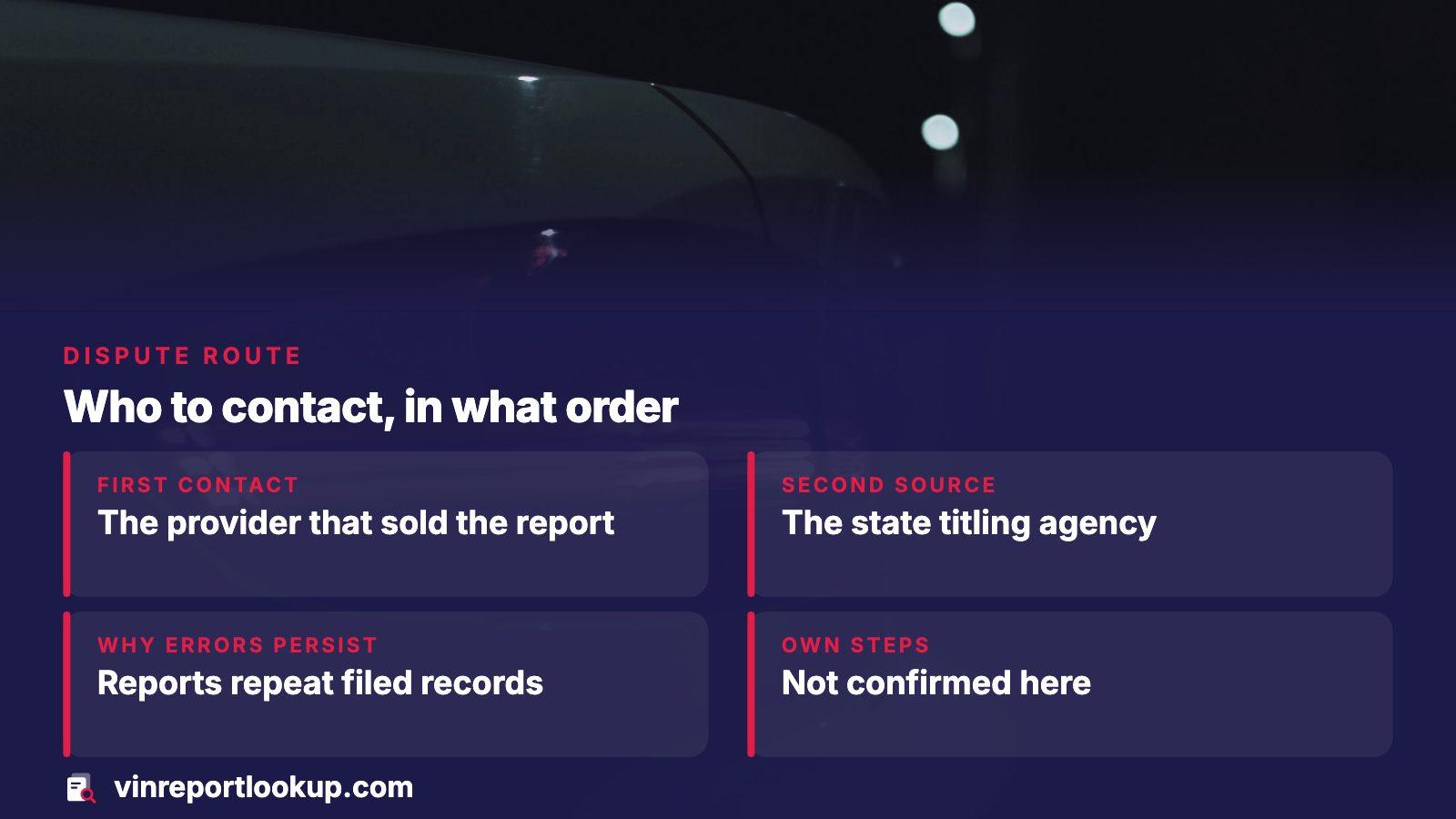
Start by naming the single line you think is wrong and the document that proves it: a repair invoice, a title copy, an insurer letter. Contact the provider that sold you the report, since the Justice Department tells buyers to do exactly that for a discrepancy. Ask the state titling agency for its own record too. A report is built from other parties' filings, so the lasting fix often sits with the reporter.
- First contact
- The provider that sold you the report
- Second source
- The state titling agency's own record
- Why errors persist
- Reports repeat what independent reporters filed
- Not covered here
- Carfax's own form, steps and timing, which we could not read
Decide what kind of wrong you are dealing with
Before writing to anyone, sort the problem into one of three piles. The first is a plain error: the wrong VIN got attached, an odometer reading was typed with a digit swapped, or an accident belongs to a different car. The second is a record that is accurate but misleading, such as a total loss label on a vehicle that was repaired and driven for years. The third is a disagreement about severity, where you believe damage was cosmetic and the entry makes it sound worse.
Each pile gets a different response. A true error can usually be corrected once the right party sees proof. A misleading label usually stays, because it correctly reflects what an insurer or state decided, so your job becomes explaining it to the next buyer. Severity disputes rarely change anything on the report, and you are better off documenting the repair.
Build the paper file first
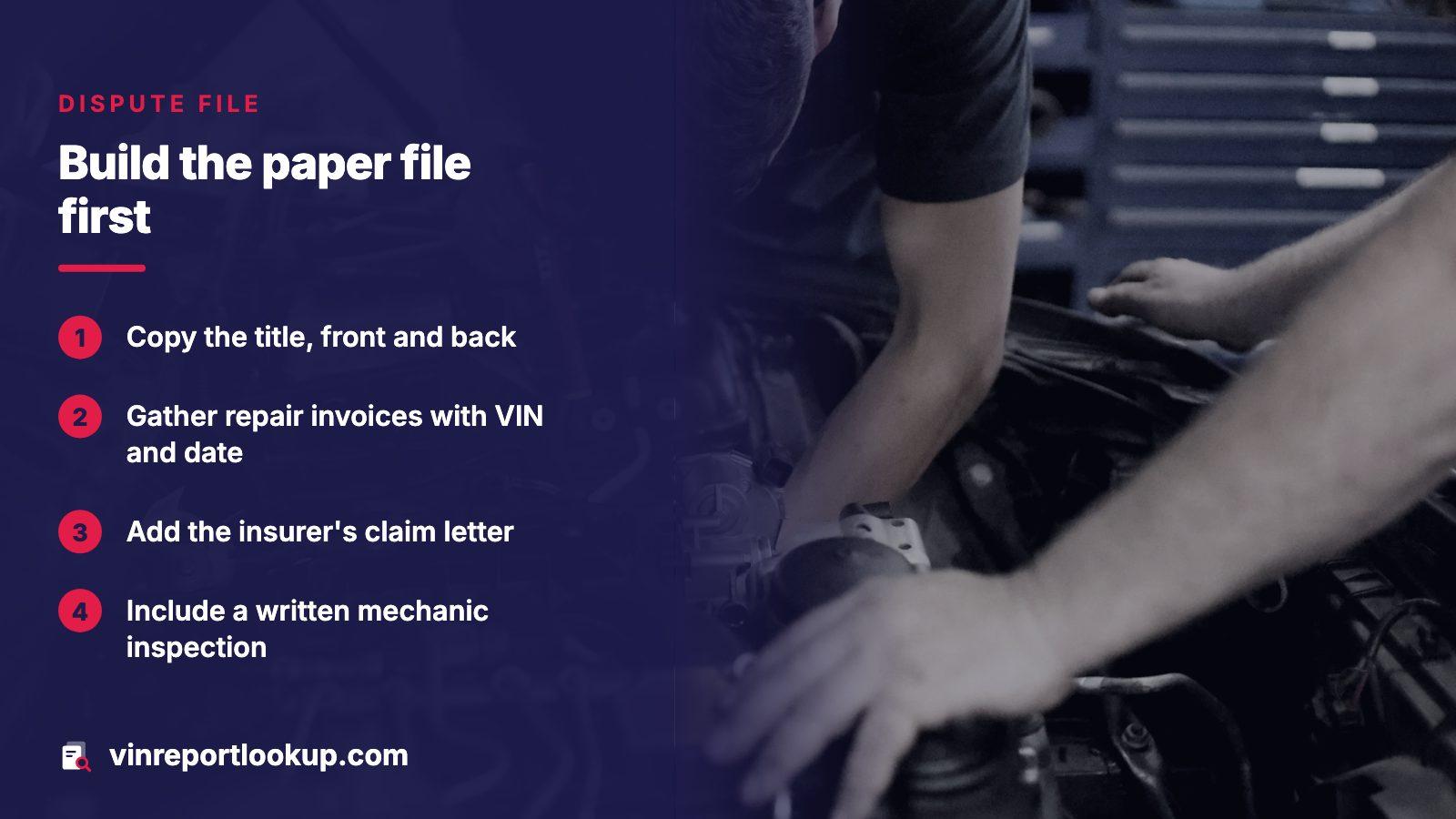
Nobody fixes a record on your say-so. Gather proof that ties to the same VIN, and keep copies, since originals tend to get lost in the back and forth.
- A copy of the title, front and back, showing the brand status and odometer disclosure
- Repair invoices with the shop name, date, mileage and VIN
- An insurer's settlement or claim letter if the entry comes from a claim
- Photos from before and after any repair, with dates
- A written inspection from an independent mechanic if the dispute is about damage
Add a short cover note naming the report section, the date of the entry and what you say is correct. One page that a clerk can act on beats a long story.
Contact the company that sold you the report
For a mismatch in a record, the Justice Department's NMVTIS FAQ sends buyers back to the company they paid, via the customer support listed on that company's site. The advice is aimed at NMVTIS records, yet it makes sense as step one with any private report.
We tried to read Carfax's own help pages for its dispute steps and were refused with an access error, so we cannot tell you its form name, address, documents it asks for or how long it takes. Look on its support pages, or ask in writing and keep the reply. Do not rely on a phone call alone.
What we could not confirm
Carfax's own dispute procedure, any fee, any turnaround time and any guarantee about the outcome. Treat anything you read elsewhere about those points as unverified until it appears on Carfax's pages or in a reply from Carfax.
Chase the record back to whoever filed it
A history report is a summary. Insurers, salvage yards, recyclers and state titling agencies send their records in, and the Justice Department notes these sources do not use one uniform way of describing a vehicle's condition. If the entry is wrong at the source, a provider can only repeat it.
That changes who you should write to. If an insurer declared a total loss, the claim file is the insurer's. If a state applied a brand, the state's title record is what counts. Reporting entities correct their own submissions through the data consolidator that accepted them, and salvage and junk yards must send an update when the final disposition differs from what they first reported. Consumers cannot make those filings, but a letter to the filer, with your proof attached, can prompt one.
Pull the state's title record
The federal data page says the full title record sits with the state motor vehicle titling agency, and that the report you bought may leave out detail the state holds. Ask your state agency how to request that record for the VIN in question. Fees and forms vary, so check the agency's own page rather than a forum post.
This record is useful two ways. If it matches your documents and the private report does not, you have a clean exhibit for your dispute. If it matches the private report, you learn early that the problem is real and the fix is a title matter, not a report matter.
| If the mismatch is in | Best first stop | Backup evidence |
|---|---|---|
| Brand or title status | State titling agency | Title copy, state record |
| Total loss or salvage entry | The insurer or salvage yard that filed it | Claim letter, repair invoices |
| Odometer reading | The state record and the shop that logged it | Invoices showing mileage and date |
| Anything else on the report | Report provider's support | Your cover note and proof |
Why a corrected entry may still not change
Timing is one reason. According to the Justice Department, state feeds arrive at uneven speeds, anywhere from instant to a day or several days, so a correction can lag behind. Different standards are another: each state writes its own brand rules, so a label applied by one state can be absent from another's records.
The label itself can also be technically right. The Justice Department stresses that a total loss label is not proof the car was wrecked beyond use or has no value, which is exactly why owners feel wronged by it. If the car was repaired well, the better move may be to keep the paper trail and hand it to buyers, because the entry will probably stay on the record.
Reading a dispute from the other side
A buyer who finds an entry you are contesting should see your documents, not just hear your word. Invoices with dates, mileage and a shop name carry weight. A promise that the report is wrong does not.
If you are the buyer, do not wait for the dispute
Maybe the seller says the report is wrong and wants you to ignore it. Disputes can drag on, and you should not pay while one is open. Pull a second report from a different source and compare line by line. A record that shows on both is far less likely to be a clerical slip.
Federal consumer guidance says to hire your own mechanic even if the dealer labels the car certified, get the findings in writing with cost estimates, and bring those numbers to the price discussion. Should a dealer say no to an outside inspection, that guidance suggests shopping elsewhere. A seller with nothing to hide has little reason to refuse.
Where a VIN preview fits
When you cannot tell whether the entry you are fighting over is real, a second view helps. Enter the VIN on our home page for the free preview, then decide whether the full report is worth a one-time payment, with prices on the pricing page. Compare its title brands, damage and odometer records against the report in dispute.
Keep expectations realistic. Two reports built from different feeds may disagree, and a disagreement is a reason to dig, not proof that either side is right. The Justice Department cautions that a lookup can come back falsely clean when reporters have not filed, and private databases can have holes of the same kind.
Where this information comes from
- Bureau of Justice Assistance: NMVTIS frequently asked questions — Where the advice to contact the report seller, the state agency route and the reporter correction process come from.
- Bureau of Justice Assistance: NMVTIS for consumers — Independent reporting sources, state brand differences and the caution on total loss labels.
- Bureau of Justice Assistance: understanding an NMVTIS vehicle history report — What the record covers and the push for an independent inspection.
- FTC: buying a used car — Inspection advice and what a history report typically leaves out.
Sources and photos: Facts checked against the sources above in November 2026. Photos by Owen Michael Grech, Mustafa Sheikhmouss and Johnathan Kaufman on Unsplash; diagrams by VINReportLookup.
Keep reading
- Can you remove an accident from a Carfax report? What can and cannot changeWhat can and cannot be taken off a record once an accident is filed.
- How accurate is Carfax, and what to check before you payWhy reports have gaps and where the data comes from.
- Does Carfax show all accidents? What a history report can missWhat never reaches a report in the first place.
- Carfax vs inspection: what each shows and which to buy firstWhich questions a mechanic answers that a report cannot.
Frequently asked questions
Can I dispute a Carfax report for free?
We could not read Carfax's own pages, so we cannot say whether it charges anything or what its steps are. Check its support section and ask in writing. If you bought a report, start with that support route, because the Justice Department directs buyers with a discrepancy to the provider that sold the report.
Who can actually change a wrong entry?
Usually the party that filed it. Insurers, salvage yards, recyclers and state titling agencies send records in, and reporting entities correct theirs through the consolidator that accepted them. A provider can review its own report, but if the source stays wrong, the report may keep repeating it.
What if the report says total loss but the car was repaired?
The label may still be correct. The Justice Department stresses that a total loss label is not proof the car was wrecked beyond use or has no value. Keep repair invoices, photos and any inspection report so the next buyer can see what was done, since the entry itself will likely remain.
Should I buy a car while a dispute is open?
Better not to. Get a second report, request the state title record, and book an outside mechanic who will put findings and costs in writing. If a dealer blocks that visit, federal guidance says to walk to a different lot. The result of the dispute can change later; the car's condition today is what you are paying for.
Does a clean report prove nothing went wrong?
No. The Justice Department warns that an empty salvage result may just mean nobody filed, and private databases can share that weakness. A history report also typically leaves out mechanical problems, so an inspection still matters.
Now check the car itself
The guide explains what to look for. The report shows what this VIN has on record.