THE SHORT ANSWER
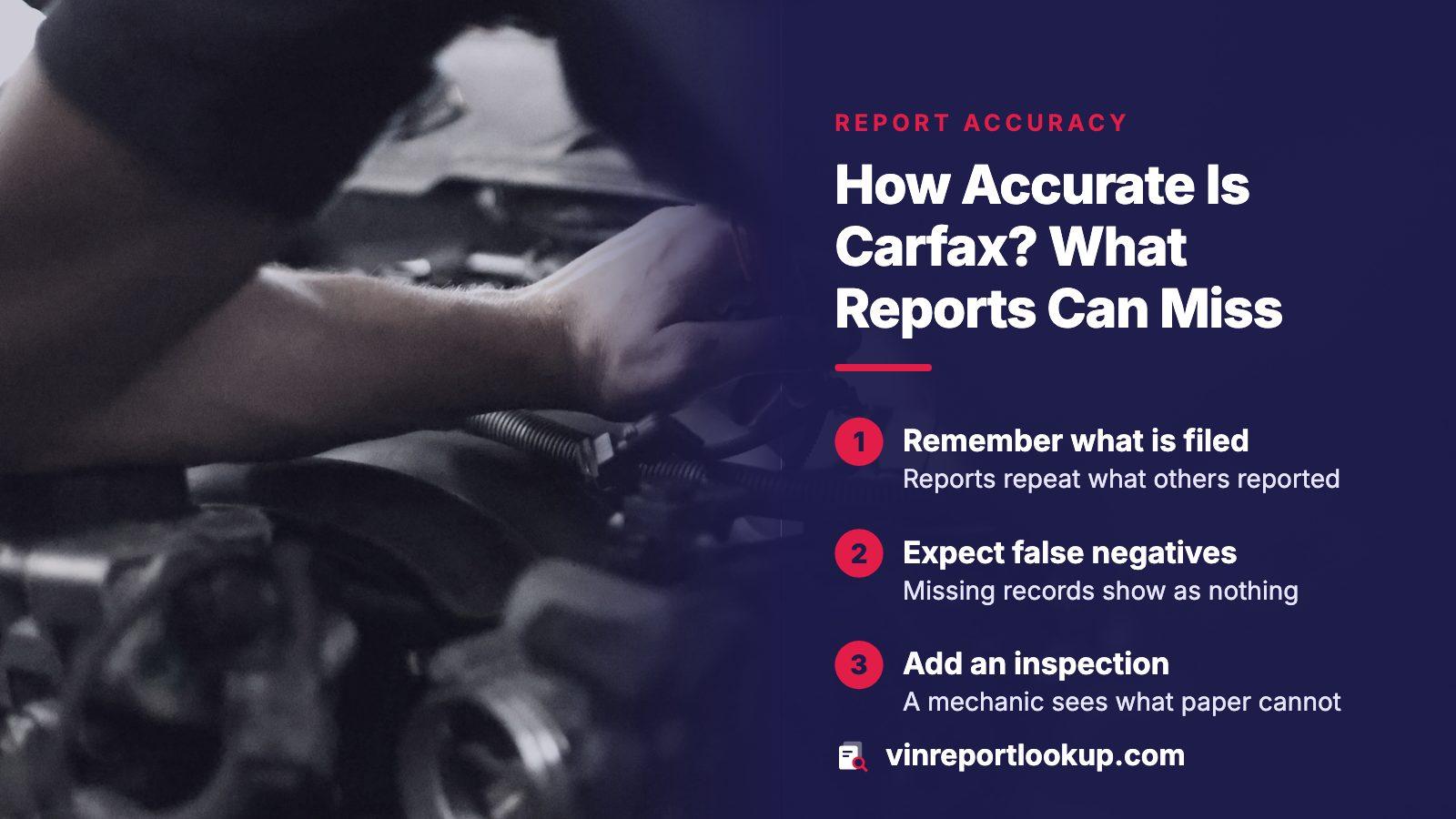
Carfax can only report what was filed about a car, and the Justice Department cautions that any history database may wrongly show nothing under salvage when a record never arrived. Accuracy therefore depends on whether the event was reported, in which state, and how that state labels it. Treat a clean report as one input, then add a second VIN source and an independent inspection.
- Accuracy rate
- None published by the agencies read for this guide
- Known gap
- Unreported events produce false negatives
- Federal title data
- Covers 87 percent of U.S. vehicles
- Not a substitute for
- An independent inspection
What accuracy means for a history report
A history report is a collection of records, not an examination of the car. So the useful question is rarely whether a line is typed correctly. It is whether the event ever reached the database at all. A fender-bender paid for in cash, a repair at a shop that sends nothing anywhere, or a car that changed hands privately may leave no entry for any provider to show.
That is why a report can be accurate about everything it lists and still miss something that happened. Think of it as a ledger that only holds what someone filed.
This guide uses only what the Justice Department and the FTC publish. Carfax's own site refused the request, so claims Carfax makes about its data are left out rather than guessed.
What the Justice Department says about gaps
The federal title system, NMVTIS, is the best-documented source here, and its consumer page is blunt about limits. Federal law requires certain businesses to report, but until all of them do, a search may wrongly show an empty salvage history. Private databases, the page adds, have holes of the same kind.
| Limit | What it means for you |
|---|---|
| Reporting is not complete | Only some states report, so a missing record is not proof of a clean past |
| Sources define things differently | A yard stay never forces a state to stamp the title |
| Labels can mislead | A total loss tag can follow a stolen car that was later found undamaged |
| Age rules differ | Some states do not title older vehicles, so records may never exist |
The agency adds a general warning: study how these quirks work before leaning on a report, whoever sells it.
Where a clean report can still be wrong
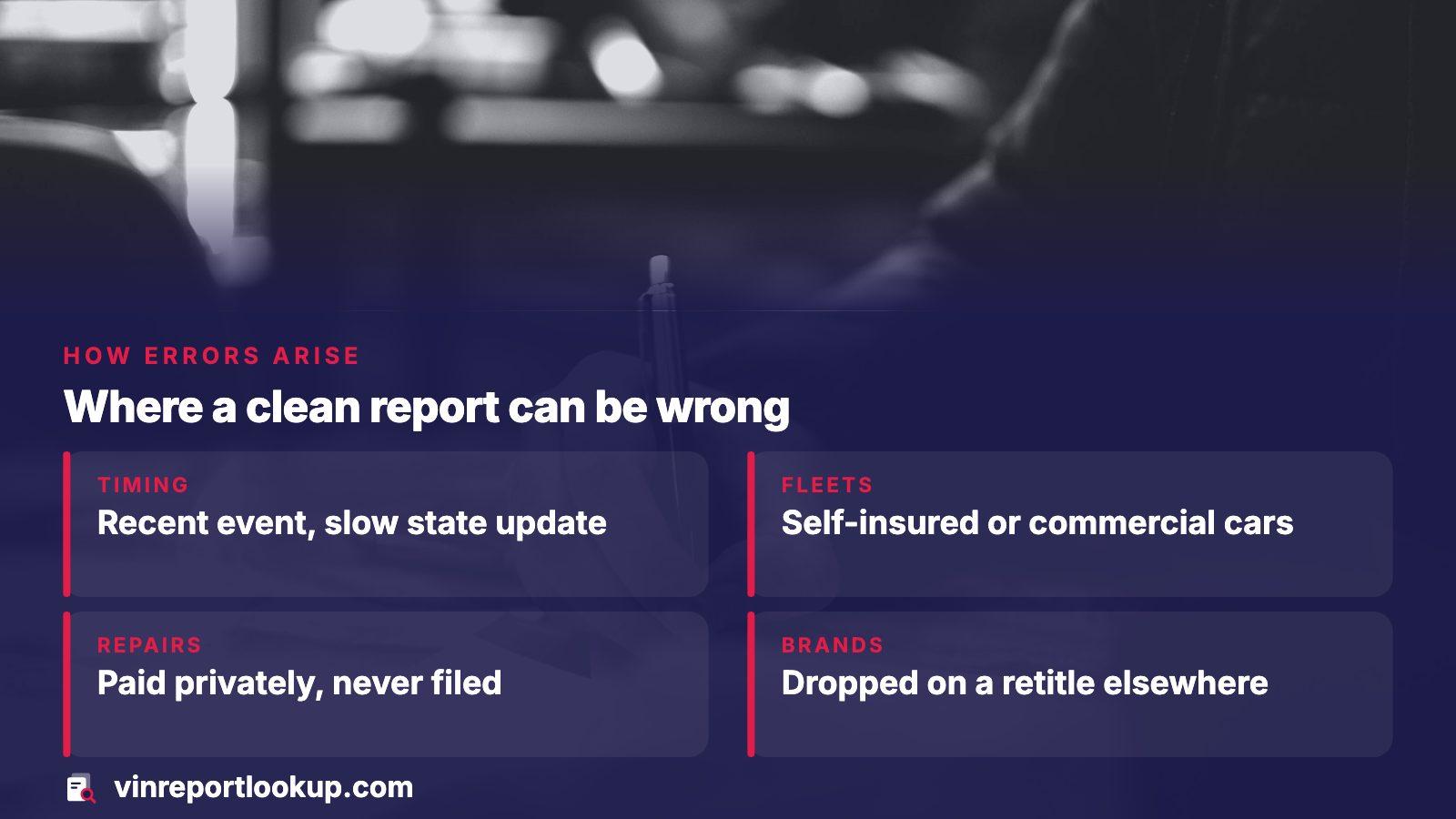
Three patterns explain most surprises. The first is timing: some states push updates in real time, while others send theirs daily or take several days, so a very recent event can lag. The second is scope. Companies that insure their own fleets owe no reports, and commercial vehicles missing from a state's core title files may not appear.
The third is brand washing, where retitling in a state that skips checking the origin leaves the brand off the paper title. The federal system keeps every reported brand, which is why a title check by VIN can show what the paper title hides.
- Recent event, slow state update
- Self-insured fleet or commercial vehicle
- Repair paid privately, never filed
- Brand dropped on a retitle elsewhere
Accurate entries that still read wrongly
Some of the worst misreadings come from entries that are correct. A total loss label, per the Justice Department, does not mean the car was destroyed. Insurers can apply it to a stolen car still missing after a month, and it sticks even if the vehicle is found in fine condition.
The reverse also holds. A car that sat in a salvage yard need not carry a salvage brand, because state law decides whether to apply one. So the same history can look harsher or milder depending on which state handled it.
Read the entry, then the state
When you see a brand or a total loss line, find out which state or insurer made the call. The same event can be labeled differently elsewhere, so request the seller's documents on it.
What no report can tell you
The FTC says these reports can reveal accidents and flood damage, yet they rarely cover mechanical faults. It adds that an independent inspection still has to happen. The FTC article does not rate any report's accuracy, and it names Carfax, AutoCheck and Vinaudit only as providers that sometimes add accident and repair detail while endorsing none.
So the engine, the brakes and a repaired frame that was never reported all sit outside the paper trail. A mechanic you pay to look at the car covers that gap, and the written estimate becomes a bargaining tool.
- Wear on parts and fluids
- Repairs done off the books
- Damage that no insurer or state recorded
A second look that costs little
Since each source has its own blind spots, two sources beat one. The FTC points to NHTSA for open safety recalls and to NICB's VINCheck for flood, thefts with no recovery, and salvage determinations, all searchable by VIN. Those are separate lookups run by the VIN, and both are free from their operators.
A third angle is the title record itself. Only a slice of a state's title file lives in the federal system, and buyers are encouraged to request the state's own.
VINReportLookup fits as the step after those: enter the VIN for a free preview, and if you are still interested, one payment buys the full report with title brands, odometer readings and damage entries in one place. Nothing renews, and see the pricing page for what is on offer.
A short routine for any car you are considering
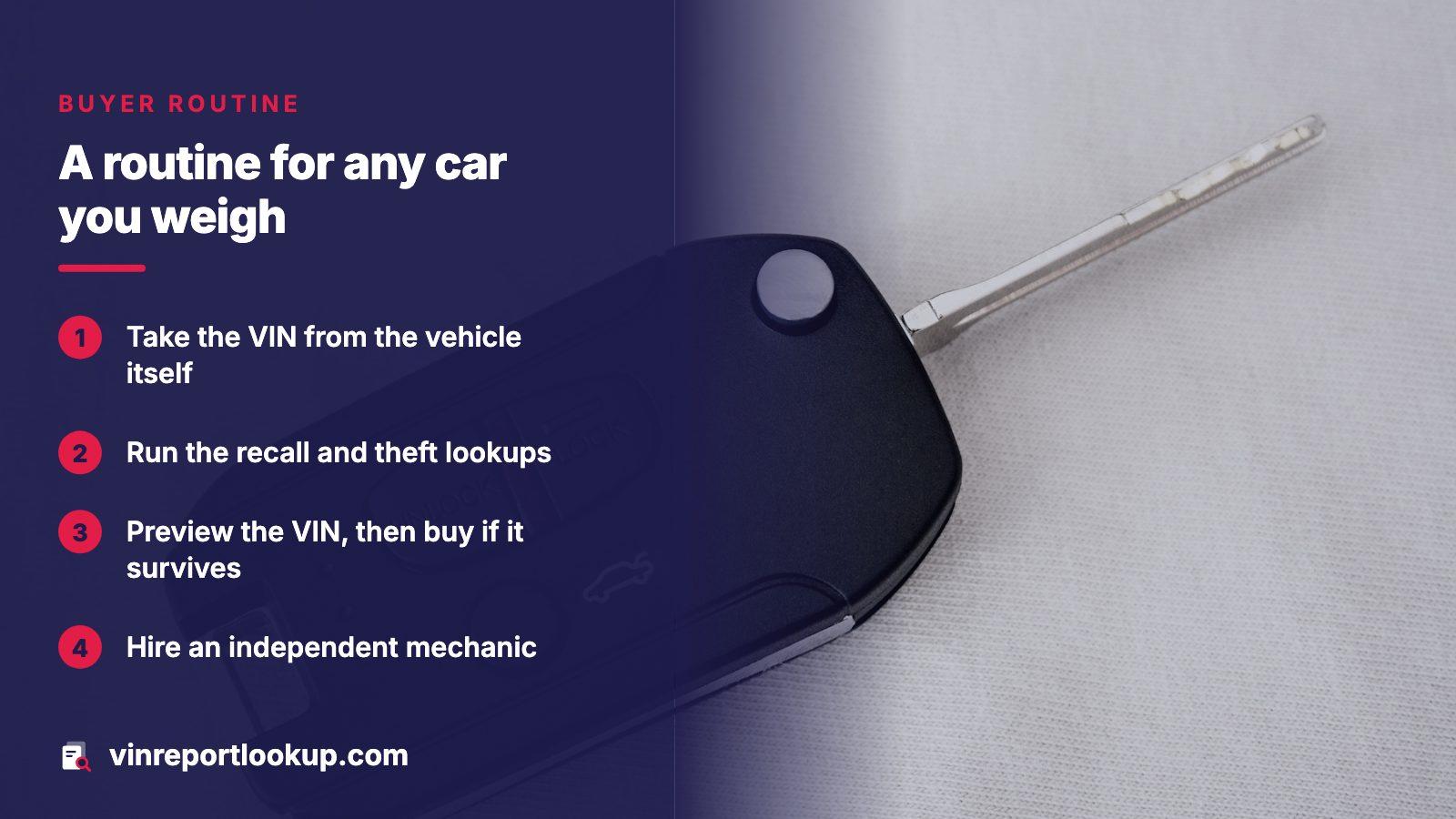
- Take the VIN from the vehicle itself and check it against the seller's papers.
- Run the free recall and theft or salvage lookups from NHTSA and NICB.
- Run a VIN preview, then a full report if the car survives that.
- Ask the seller about every brand, total loss or odometer line.
- Hire an independent mechanic and ask for the findings in writing.
If the sources disagree, do not average them. Find out why. A brand in one place and nothing in another usually means one source saw an event the other never got.
So can you trust it
Trust it for what it lists, and doubt it for what it does not. A listed accident or brand is a reason to dig deeper before you buy. A blank is only a lack of records.
No agency read for this guide publishes a figure that ranks Carfax or any other provider on accuracy, so be wary of anyone who quotes one. Judge each report by whether you can verify its entries elsewhere.
Where this information comes from
- Bureau of Justice Assistance: NMVTIS for consumers — False negatives, uneven state reporting, total loss labels and brand washing.
- Bureau of Justice Assistance: Understanding an NMVTIS report — The five federal indicators and what private providers add.
- Bureau of Justice Assistance: NMVTIS FAQ — Update timing and who is exempt from reporting.
- FTC: Buying a used car — Reports do not show mechanical problems and do not replace an inspection.
- FTC: Used cars — Where to check recalls and flood or salvage declarations.
Sources and photos: Facts checked against the sources above in November 2026. Photos by Mustafa Sheikhmouss, Shadow Photography and Owen Michael Grech on Unsplash; diagrams by VINReportLookup.
Keep reading
- Does Carfax show all accidents? What a history report can missThe accident side of the same question.
- Carfax vs NMVTIS: what each report shows and which to buyHow the federal title record differs from a private report.
- Carfax vs inspection: what each shows and which to buy firstWhat a mechanic finds that a report cannot.
- How to read a vehicle history report before you pay for a used carReading each entry once you have a report.
Frequently asked questions
Is Carfax always right?
No history provider can be, because a report only reflects events someone filed. The Justice Department cautions that any database can wrongly show no salvage record when the filing never arrived. Verify entries with a second VIN source and an inspection.
Does a clean Carfax mean no accidents?
It means no accident reached the data that provider holds. Repairs paid privately or events in states or sources that did not report can leave nothing to show. Use it as a good sign, then confirm with a mechanic.
Is there an official accuracy percentage for Carfax?
None appeared in the federal pages read for this guide, and Carfax's own site would not open. Any exact percentage you see should come with a named, checkable source before you rely on it.
Can a total loss entry be wrong?
The entry can be correct and still mislead. A stolen car still missing after a month can get that label, and the tag stays if it is found undamaged. Ask what caused the label.
What should I check besides a history report?
Open recalls through NHTSA, flood, theft and salvage flags through NICB, the state title record, and a paid independent inspection. Together they cover gaps any one report leaves.
Now check the car itself
The guide explains what to look for. The report shows what this VIN has on record.