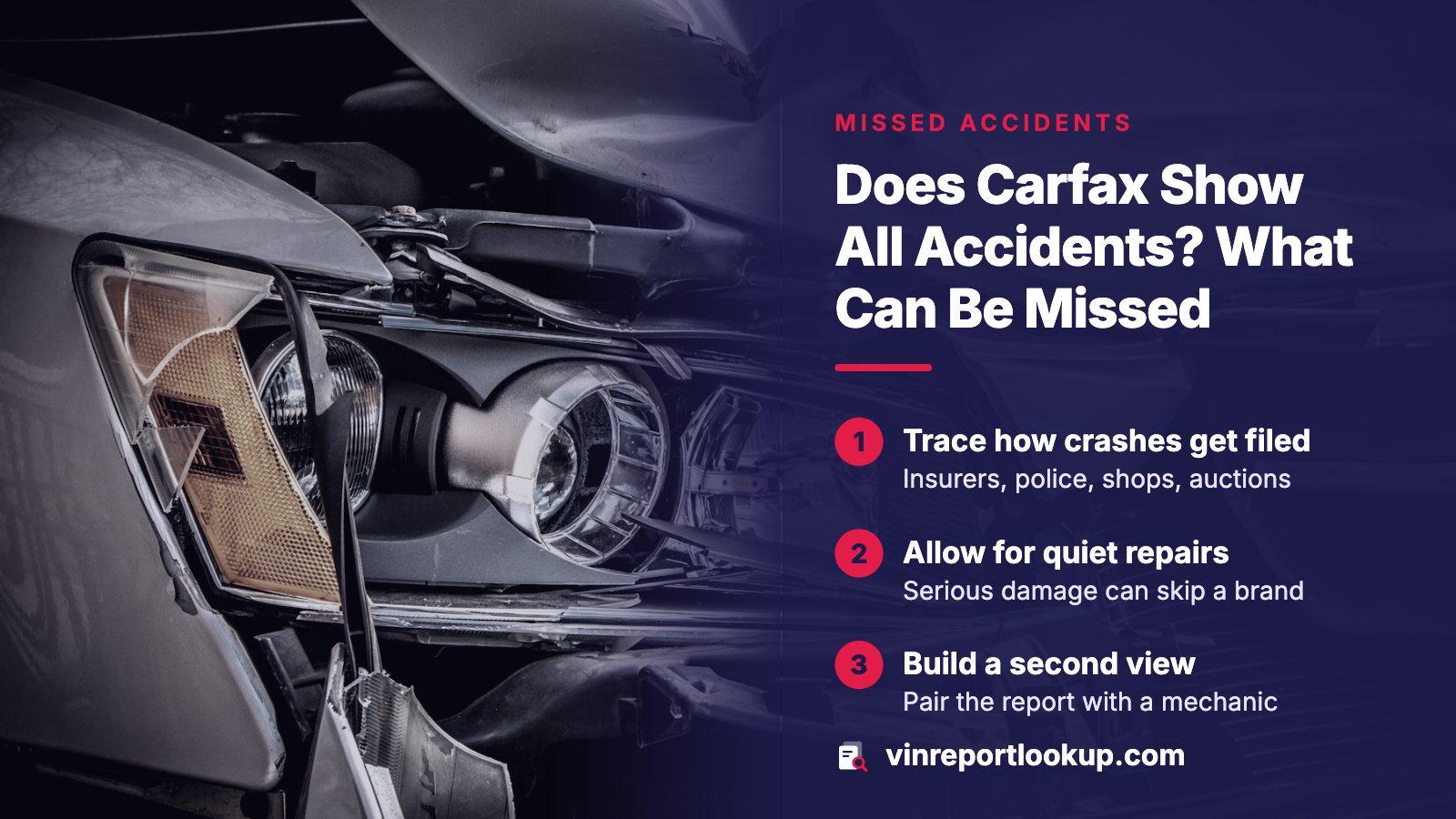
THE SHORT ANSWER
Carfax does not show every accident, and neither does any other provider. A crash appears only if an insurer, police agency, shop, auction or state title office passed it along. Damage paid for privately, or repaired without paperwork, can leave no trace. Treat a clean report as one useful signal, then add a second source and an independent inspection.
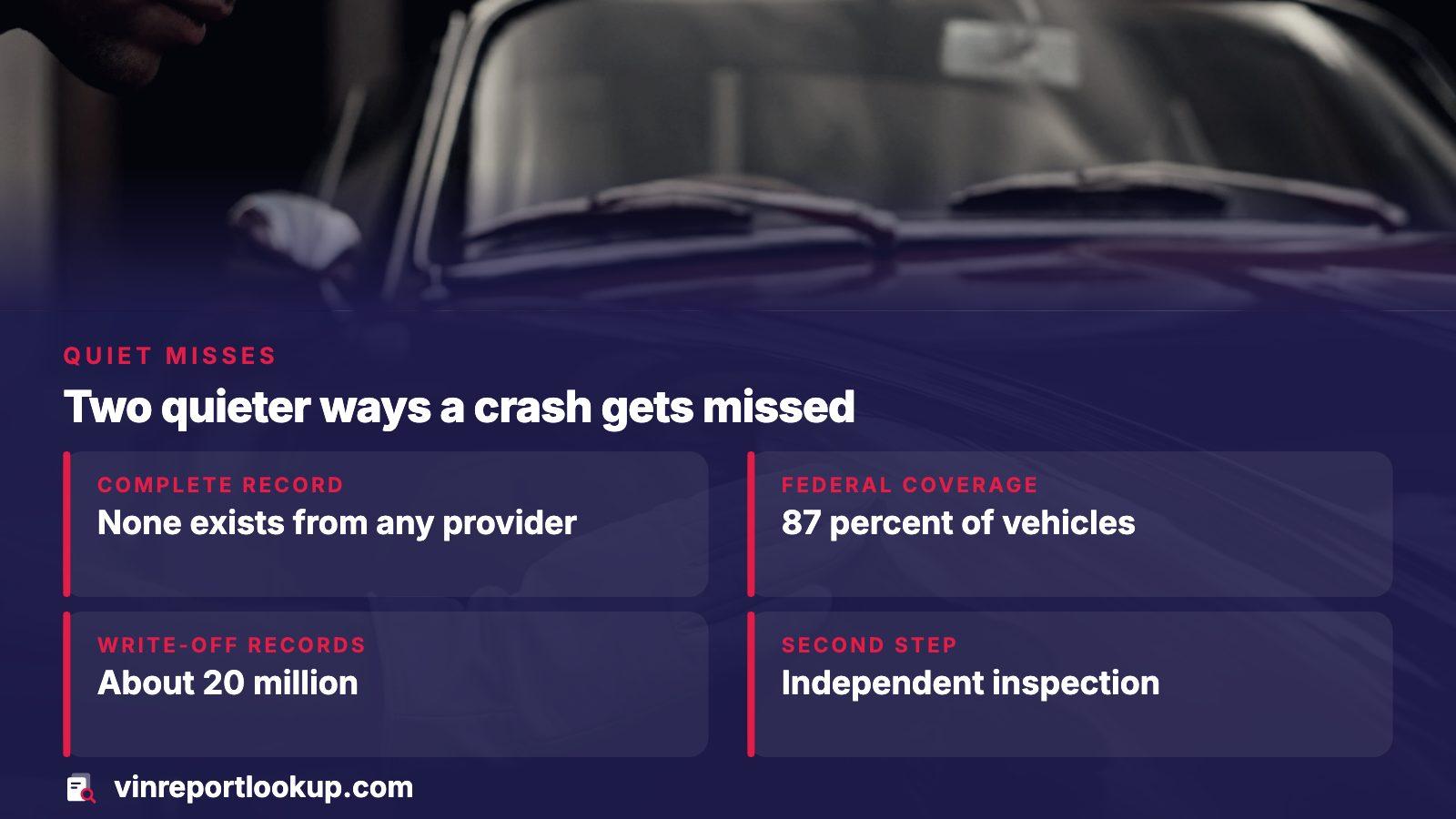
- Complete accident record
- None exists, from any provider
- Federal title data
- Holds 87 percent of U.S. vehicles
- Salvage and total loss records
- About 20 million in the federal system
- Best second step
- Independent mechanic inspection
The honest answer for a buyer
Shoppers often treat a report as a verdict. It is closer to a filing cabinet. Each drawer holds what a particular source chose to send in, and an accident only lands in the cabinet if one of those sources saw it and reported it.
That means two cars with identical clean reports can have very different pasts. One really was never hit. The other was struck in a parking lot, fixed for cash at a small body shop, and sold privately. Nothing on paper separates them, which is why a report should shape your questions rather than end them.
This guide does not quote any Carfax statistic, since none could be read from Carfax itself. Where it states a limit, the source is a government page you can open yourself.
How a crash becomes a record at all
A history database is fed by outside parties. The Justice Department names four kinds of contributor to its title system: motor vehicle offices, insurers, scrapyards and recyclers. Private providers add other feeds on top, but the principle holds. No feed, no entry.
| Event | Likely to leave a record? |
|---|---|
| Insured crash ending in a total loss | Yes, through the insurer and the salvage chain |
| Crash that earned a state brand on the title | Yes, in the state's title file |
| Minor scrape fixed out of pocket | Often no |
| Repair at a shop that shares nothing | Often no |
| Private sale after an unreported hit | Often no |
The pattern is simple. The costlier and more official the event, the more likely it was reported.
What the Justice Department admits about gaps
Roughly 87 percent of U.S. vehicles sit in the federal title system, but fewer than all states feed it fully. Its consumer page cautions that a lookup can return a false negative, such as an empty salvage line, when a record never came in. Commercial databases, it says, can be patchy in the same way.
States also disagree on what counts. One may brand a damaged car as salvage while another does not, because damage under its legal dollar threshold does not qualify. Time spent at a scrapyard is no guarantee of a brand on the title either.
A warning that applies to every provider
The agency urges buyers to study these quirks before leaning on any report, from any seller. The gap comes from how vehicle data is collected, not from one company.
Why a serious repair can leave no brand
A title brand is the loudest signal a report can carry, and it depends on state law. Because thresholds differ, a vehicle that one state would have branded can pass through another with a normal title. Structural repair, a replaced door, welded rails: none of that is required to show up as an entry.
The reverse mistake happens too. A write-off label is not always about a wreck. If a stolen car stays gone for 30 days, its insurer may declare it lost, and that tag remains after the car is found without a scratch. So an entry deserves a question about the details, not just a glance at the heading.
Timing and scope: two quieter ways to miss one
Recent events can lag. Certain states push updates as events occur; others batch them daily or take several days. A crash from last week may not be visible yet.
Scope matters as well. Organizations that insure their own fleets have no duty to report, and some commercial vehicles never enter a state's main title database. A former rental, delivery van or company car can therefore carry a thinner record than a privately owned sedan.
- Ask whether the car served as a fleet or company vehicle
- Note the date of the latest entry against today's date
- Check where the car was titled, since states record different things
Build a second view of the same car
Since each source sees a slice, combine slices. The free NICB VINCheck covers theft not recovered and salvage or flood declarations from participating insurers, though the bureau stresses that it is not a full report and that a clean answer promises nothing. A federal title check adds brand history and odometer data.
A VIN report from this site puts crash and damage records next to odometer readings and salvage or auction entries. You see a preview first at no charge, then decide on the full report, which is bought once and never renews. Amounts are listed on the pricing page. Use it as a cross-check, not a replacement for the other steps.
If one source shows damage and another shows none, do not average them. Take the disagreement to the seller and ask for repair invoices.
Let a mechanic look where records cannot
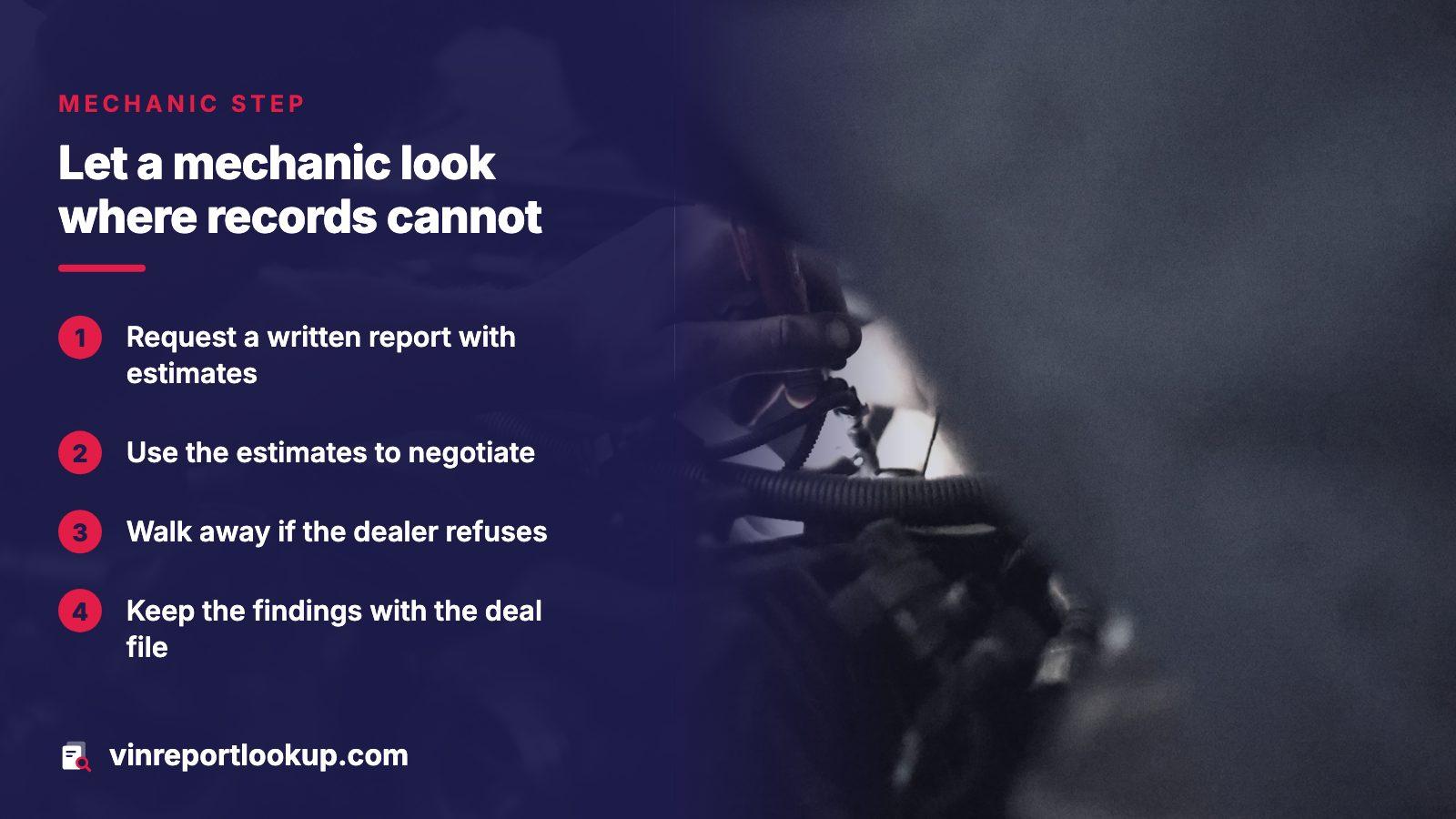
Per the FTC, these reports can name crashes and floods yet normally say little about mechanical trouble, and they cannot replace an outside mechanic's inspection. A lift and a trained eye catch things databases never see: paint thickness that varies across panels, mismatched fasteners, bent frame sections, uneven gaps.
- Request a written report with repair estimates, plus the make, model and VIN
- Use the estimates to negotiate the price
- If a dealer says no to an outside inspection, buy from someone else
NHTSA adds a specific point for crashes where air bags went off: have a reputable independent mechanic or a dealership inspect the air bags.
How to read a clean report without over-trusting it
A clean result still helps. It rules out the well-documented disasters: a branded title, a reported total loss, a flagged odometer problem. That removes the worst surprises. What it cannot do is prove that nothing happened.
Questions worth asking the seller
Has the car ever been repainted? Were any body panels replaced? Is there paperwork from any shop? An honest seller answers easily, and a vague answer is information too.
Combine the answers with what you see in person. Mismatched paint under bright light, a trunk floor with ripples, or overspray on rubber seals all point to work the report never mentioned.
Where this information comes from
- Justice Department NMVTIS: for consumers — report gaps, state differences, who supplies data, coverage figures
- Justice Department NMVTIS: frequently asked questions — self-insured fleets and update timing
- FTC: buying a used car — what reports leave out and why to get an inspection
- NICB: VINCheck — free theft, salvage and flood lookup and its limits
- NHTSA: consumer alert on used cars and air bags — air bag inspection after a crash
Sources and photos: Facts checked against the sources above in November 2026. Photos by Clark Van Der Beken, Mustafa Sheikhmouss and Mohamed Gado on Unsplash; diagrams by VINReportLookup.
Keep reading
- How accurate is Carfax, and what to check before you payA wider look at what history data gets wrong
- Carfax vs NMVTIS: what each report shows and which to buyHow the federal title record compares with a private report
- Carfax vs inspection: what each shows and which to buy firstWhat a mechanic finds that records cannot
- Vehicle history report providers: who sells VIN reports and how they differWho sells reports and where their data comes from
Frequently asked questions
Why would an accident be missing from a Carfax report?
Most often because nobody reported it. Cash repairs, private sales and shops that send no data leave nothing to collect. Timing can also hide a recent crash, since some states update only daily or within days. A missing entry means no record was received, not that nothing happened.
Does a clean report prove the car never crashed?
No. It means no reporting source sent an entry the provider could match to that VIN. That still rules out many serious problems, such as a branded title, but a minor or privately fixed hit can sit behind a clean page. Pair it with an inspection.
Can a state title hide a salvage history?
Sometimes. States set their own damage thresholds and labels, so the same damaged car may wear a brand in one state and none in the next. The federal title system keeps every brand reported, which is why a VIN title check can show history that the paper title leaves out.
Is running a second report worth it?
Usually, when the car matters to you. Different providers draw on different feeds, so one can hold an entry the other lacks. If both agree, you gain confidence. If they disagree, you learned something before paying the seller.
What should I do if a report shows an accident the seller denies?
Ask for repair invoices and the date and place of the work, then have an independent mechanic inspect the area. Be aware that labels can mislead: a total loss entry can follow a stolen car later found undamaged. Details decide whether to negotiate or walk away.
Now check the car itself
The guide explains what to look for. The report shows what this VIN has on record.