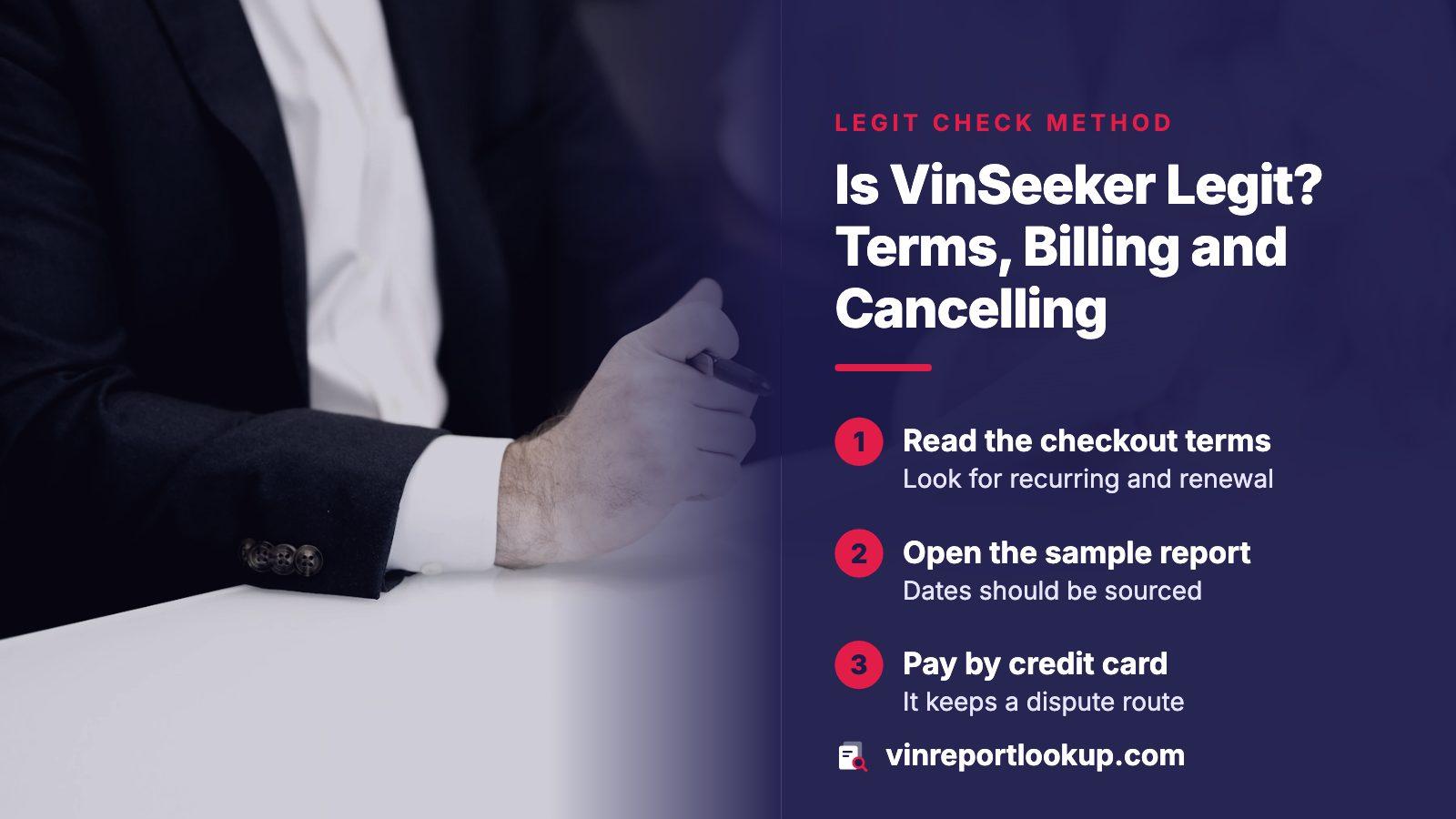
THE SHORT ANSWER
We found no sign that VinSeeker is a sham: it publishes a street address, support contacts, a public sample report, terms and a cancellation guide. We also found no price, no named data supplier and no independent rating we could use. Its terms point to recurring billing, so read the checkout screen before paying, and keep the cancellation steps handy. Whether it suits you depends on the checkout, not on a verdict from us.
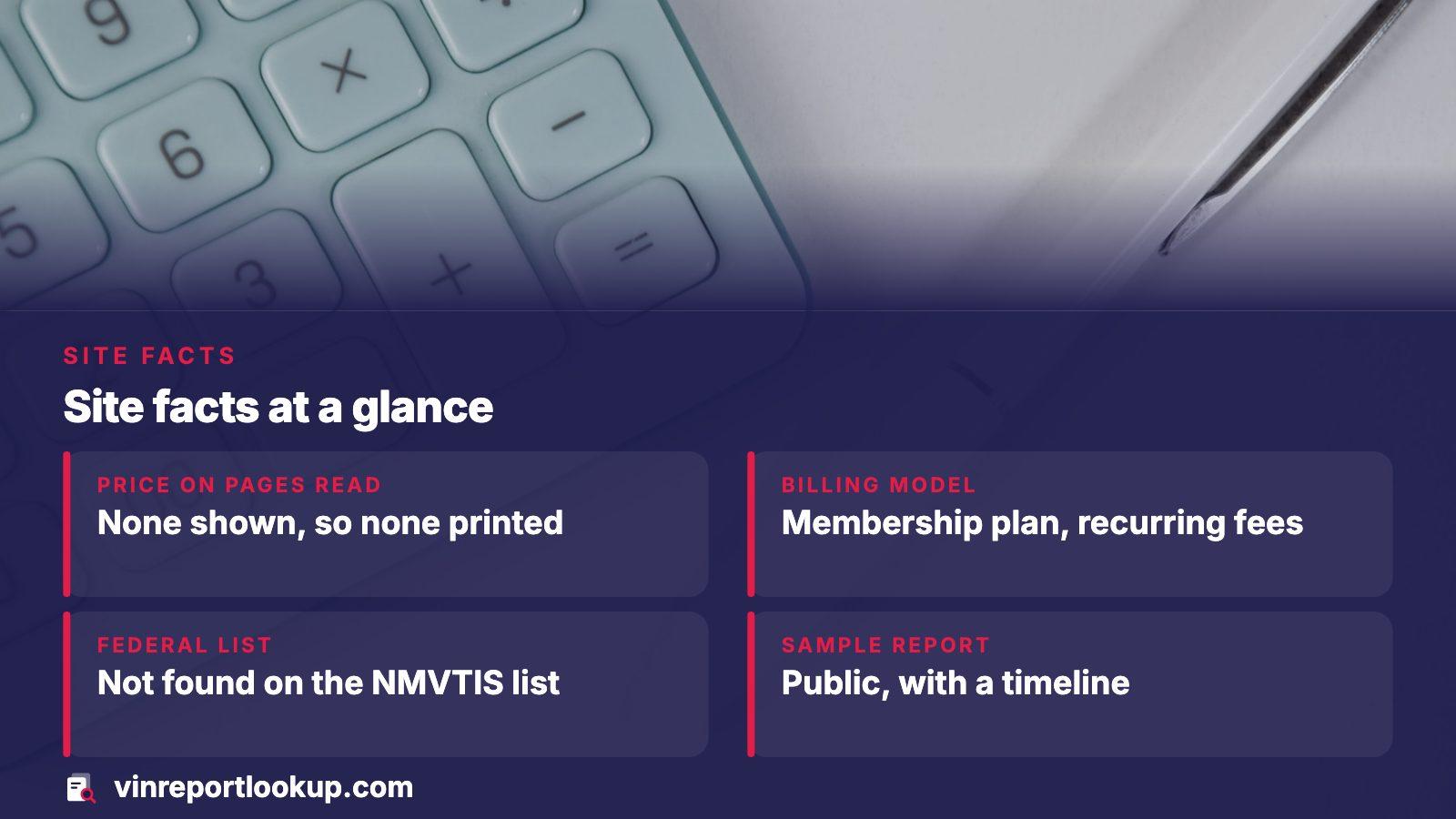
- Price on pages we read
- None shown, so we print none
- Billing model
- Terms refer to a membership plan and recurring fees
- Failed-payment fee
- $0.97 per unsuccessful attempt, per its terms
- Named on the NMVTIS list
- Not found on the Justice Department page
What a legit check can and cannot settle
Searches for a site's name plus the word legit usually hide two questions. One is whether the business exists and delivers a report. The other is whether the money leaves your card the way you expect. We read the company's own pages for the first and its terms for the second, and we skipped review sites, forums and star ratings, because none of those can be traced to a source we can verify.
That limits what we can say. We can describe what VinSeeker publishes. We cannot tell you how accurate its reports are on your car, how its support team behaves, or what a typical customer ends up paying. Where a fact was missing, the notes below say so instead of guessing.
What VinSeeker's home page and sample report show
The home page offers two search boxes, one for a VIN and one for a plate with a state, and claims more than 30 sources behind the result. Down in the footer sit a Miami street address, an email for support and a toll-free number. A public sample report for a 2016 Hyundai Tucson is open to anyone with the link, which is more than many report sites offer.
- Accident entries with a damage-zone diagram and airbag flags.
- Title, owner and lien events laid out as a timeline, each tagged by where it came from, such as a motor vehicle department or an auction.
- Charted odometer readings, open recalls, specs and a computed vehicle score.
- Customer quotes on the home page, which are marketing copy and not independent reviews.
A sample proves the layout, not the accuracy of the report you will buy. Judge it the way you would judge any report: does the timeline make sense, and do the odometer readings climb in order?
The billing terms are the part to read slowly
The home page, the sample report and the terms page all lack a stated price. The terms say fees are disclosed on the website, but they also describe a membership plan and recurring fees, and they reserve the right to alter what you pay, how often you pay and how many reports the plan includes. That is the language of a subscription, and the company's own blog has a guide to cancelling one.
Failed payments
If a charge fails, the terms let the company retry the debit repeatedly and add $0.97 for each unsuccessful attempt. A card that is near its limit, or a bank that blocks the first charge, can therefore cost extra.
None of this is unusual for a paid service, and none of it proves bad intent. It does mean the purchase may not end when the report loads. Look at the checkout screen for the charge today, the charge later and the renewal date before you enter a card.
Cancelling and asking for money back
The company's cancellation guide, dated July 26, 2026, names three routes. You can use the account dashboard after a one-time code arrives by email, call the number in your order confirmation, or email support with your order ID and the details of how you paid. Cancelling stops future renewals. It does not return a payment already taken.
| Step | What the pages say |
|---|---|
| Stop renewals | Dashboard, phone or email; keep the order confirmation email |
| Ask for a refund | Call support; requests are weighed one at a time, usually one refund per subscription |
| Card refund timing | Can take up to thirty days to appear on a statement |
| Before a bank dispute | The guide asks you to contact support first, saying a dispute can slow a direct refund |
The terms also say that cancelling does not erase amounts already billed, for the period you are already in.
What we could not confirm
- The price of a report or plan, and what a first charge turns into later.
- Where the title and brand data comes from. The pages we opened do not name a supplier.
- Whether the business is an approved provider of federal title data. We looked for it by name on the Justice Department list and found nothing, yet a company may buy records from a listed firm, so a missing name settles little.
- Whether the plate search works in every state, or how reliable a VIN found from a plate is.
The terms also state that the company is a technology platform that does not create the underlying data and does not guarantee its accuracy, with its own liability capped at $50.00. That is standard fine print for the category, but it tells you where responsibility sits if a report misses something.
What you agree to besides the report
One clause deserves a second read. Handing over contact details, in the terms' reading, also signs you up for messages from partner firms, a group that may cover marketing companies, advertising agencies and data aggregators. To stop those, you contact each third party yourself.
The Federal Trade Commission has warned about report sites that exist to collect card and contact details, and suggests searching a company's name with words like complaint or scam before paying. Treat your phone number and email as part of the price, and use an address you can discard if you would rather not hear from partners.
A five-minute test for any report site
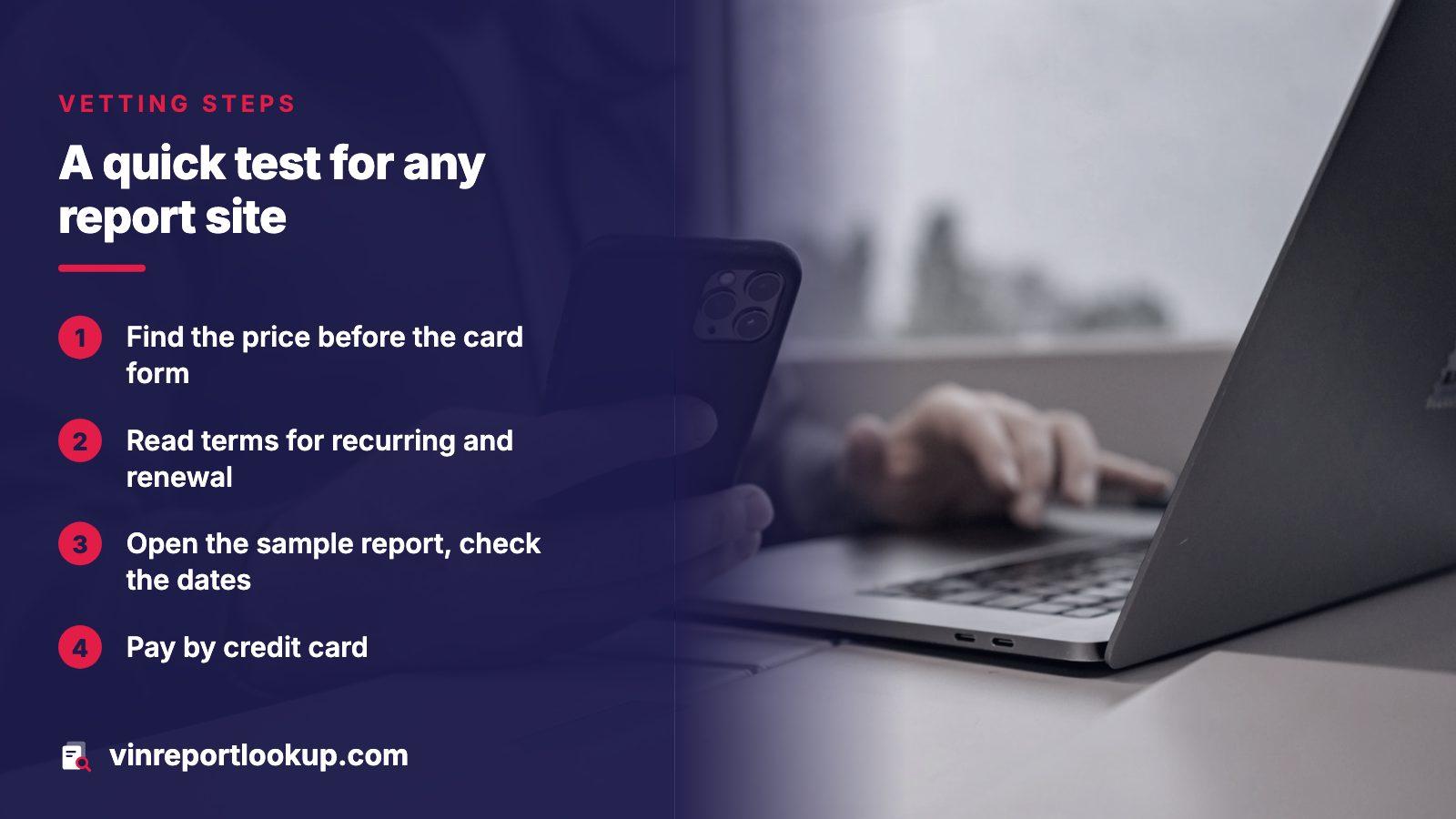
- Find the price on the page before the card form. If you cannot, treat that as an answer.
- Read the terms for the words recurring, membership and renewal.
- Open the sample report and check that the timeline is dated, sourced and consistent.
- Pay by credit card, not a transfer, gift card or payment app. The FTC says a card gives you a route to dispute the charge.
- Write down the cancellation steps at once, and set a calendar reminder.
The same test works on us, and our pricing page is open to read before you start.
How a one-payment report differs
VINReportLookup is built differently. Type the VIN, look at the preview at no charge, and decide from there. Buying is a single payment for one report, or a bundle of 3, 5 or 10 if you are shopping several cars. Nothing renews, so there is no cancellation to remember. Current prices are on our pricing page.
The report itself includes title brands, crash and damage entries, odometer data, auction photos and open recalls. That suits a one-car purchase better than a plan does. When you compare services, put what each charges today beside what it charges next month.
What to do before you pay anyone
Whatever site you pick, read the VIN off the car, read it again on the paperwork, and make sure the characters agree. A VIN that a plate search hands back deserves the same comparison before you rely on it.
Government pages can answer part of the question without a card. The federal title system says its reports show title state, odometer data, theft, brands and salvage history, and that such reports hold no repair history. Its approved-provider list is the place to start if title data matters most to you. Whatever report you buy, an independent inspection can still find damage no database recorded.
Where this information comes from
- VinSeeker: Terms of Service — Fees, plan language, failed-payment fee, cancellation, refunds, marketing consent and the liability cap.
- VinSeeker: how to cancel — The three cancellation routes and the note on refunds and disputes.
- VinSeeker: home page — What the site advertises, its contact details and the lack of a stated price.
- Justice Department NMVTIS: approved providers — The list we checked for the company name.
- Justice Department NMVTIS: FAQ — What a federal title report contains and what it leaves out.
- FTC: What to do if you were scammed — How to ask a card issuer or payment app to reverse a charge.
Sources and photos: Facts checked against the sources above in November 2026. Photos by Carrie Allen www.carrieallen.com, Anastasiia Nelen and Sasun Bughdaryan on Unsplash; diagrams by VINReportLookup.
Keep reading
- Vehicle history report scams: how to spot a fake report seller before you payThe FTC's warning about report sites, and how the pattern works.
- Car history report subscription: when a plan pays and when to skip itHow report subscriptions renew and how to stop one.
- Best VIN check: how to choose a report and what each one includesHow to choose a report once you know what to compare.
- Carfax vs inspection: what each shows and which to buy firstWhat a report cannot see and an inspector can.
Frequently asked questions
Is VinSeeker a scam?
We found no evidence of that on its own pages: it lists an address, support contacts, a sample report and terms. We also could not verify its price, data supplier or independent ratings, so we neither vouch for it nor accuse it. Read the checkout screen and terms before paying.
Does VinSeeker charge a subscription?
Its terms describe a membership plan, recurring fees and changes to billing frequency, and its blog explains how to cancel a subscription. We did not run a checkout, so we cannot say what any given purchase renews into. The checkout screen should state it.
How do I cancel VinSeeker?
Per its blog, log in with your order email and a one-time code, then use the billing section. You can also call the number in your order confirmation or email support with your order ID. Cancelling stops renewals but does not refund a charge already taken.
Can I get a refund from VinSeeker?
The terms say to call support, that requests are decided case by case, and that a person normally gets one refund per subscription. Its blog asks you to contact support before opening a bank dispute. If support does not resolve it, your card issuer is the next step.
Is VinSeeker an approved NMVTIS provider?
We searched the Justice Department's approved-provider page for it and found no match. That alone does not show it uses no federal data, because a business can buy records from a listed firm. Its pages never say where the title records originate.
Now check the car itself
The guide explains what to look for. The report shows what this VIN has on record.