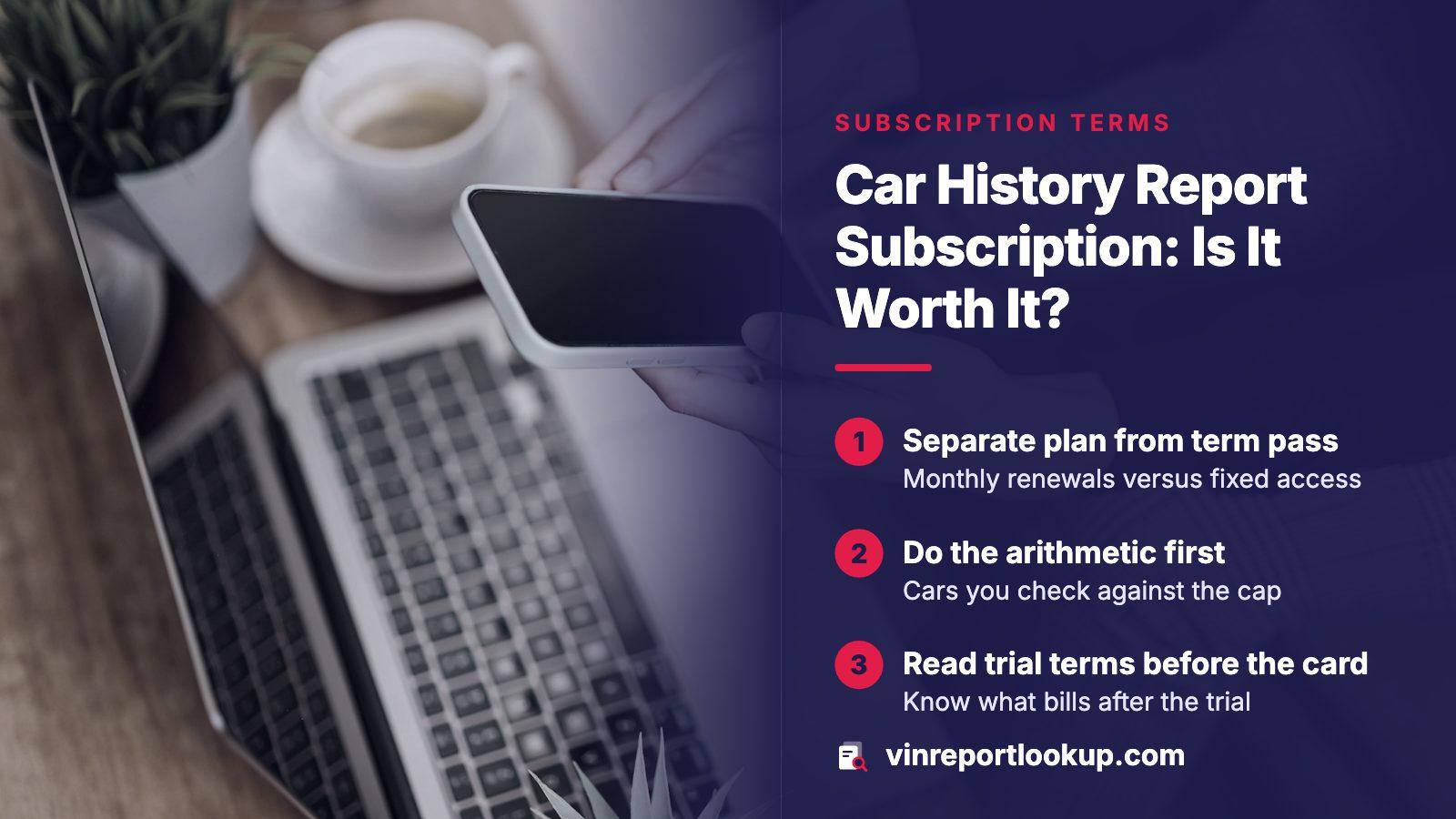
THE SHORT ANSWER
Unlimited vehicle history reports exist, but the word is looser than it sounds. One provider's monthly plan caps use at 50 reports and renews every 30 days, while another sells a term pass that does not renew by itself. A plan can win if you will check a dozen cars in a week. For an ordinary shortlist, a one-time report or pack from VINReportLookup, bought after a free preview, avoids renewal risk.
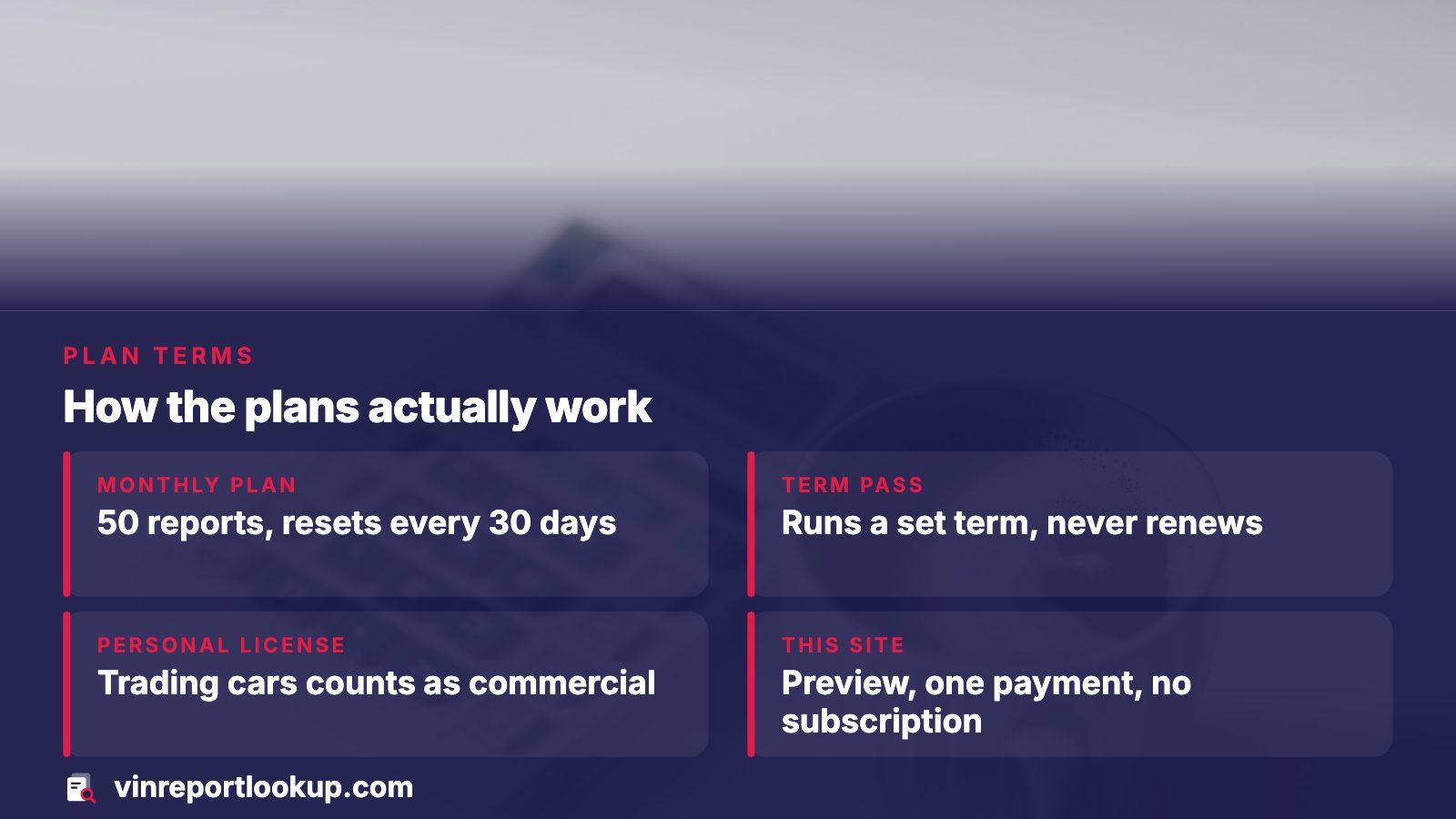
- Monthly plan
- Bumper's page states 50 reports per month, resetting every 30 days with no rollover
- Term pass
- AutoCheck's multiple-report access runs for a set term and does not renew itself
- Personal license
- AutoCheck's consumer terms treat buying and selling cars beyond your own as commercial use
- VINReportLookup
- A preview comes first, then one payment; no subscription exists
Three different products wear the word subscription
Sellers use one word for several arrangements, and they behave differently once the card is charged. Sort the offer in front of you before you compare any prices. The notes on other companies come from their own pages, read in November 2026, and plans change, so treat the checkout screen as the final word.
| Arrangement | How the money moves | What to confirm |
|---|---|---|
| Term pass (AutoCheck's multiple-report plan) | One payment opens access for a fixed term, and you can run a report on every car that catches your eye during it. The company says it never renews on its own. | How long the term lasts, and what happens to saved reports afterward |
| Monthly membership (Bumper) | The card is billed at the start of each 30-day period, and the report allowance resets with it. | The monthly cap, the rate after any trial, and the cancel route |
| Prepaid pack (VINReportLookup) | One payment buys report credits that stay valid for 12 months. There is nothing to cancel. | How many credits you get and how long they last |
| Single report | One payment for one VIN. | Whether the checkout total is the entire charge |
Do the arithmetic before you hand over a card
A plan beats a one-off purchase only when three things line up: you will run many VINs, you will run them close together, and you will stop the billing straight after. Take the first period's total, divide it by the cars you will really check, and set the result beside the per-report cost of a pack.
Used-car searches narrow quickly: ten listings might shrink to three worth a visit and one worth buying. A plan built for 50 lookups mostly pays for capacity that sits unused, while a pack covers the few cars that reach the shortlist.
One company, two starting prices
When this page was written, Bumper's common-questions page showed $19.99 per 30-day period, or $12.99 per period on a three-period plan costing $38.97 up front. Its home page said plans start at $27.99 per month. Neither gave a trial length. Treat prices on a web page as a hint and the checkout total as the contract.
Where unlimited stops being unlimited
The search phrase promises no ceiling, and the fine print usually installs one. Bumper's report page offers 50 reports per month, and its questions page adds that the allowance resets every 30 days and unused reports do not carry over. AutoCheck's pages state no count but limit time: access lasts for the subscription term, and it sells that term before you have a VIN, so you can type numbers in on a dealer lot.
Time limits bite once you stop paying. AutoCheck keeps lapsed histories locked until you reactivate, and Bumper asks for reactivation before an old report will open. If a particular car matters, save a PDF while access is live. Bumper says its reports can be downloaded in that format.
A consumer plan is a personal license, not a dealer account
If you want unlimited lookups so you can buy cars and resell them, read the license first. AutoCheck's consumer terms limit its site to personal, non-commercial evaluation. They define commercial use to include buying or selling vehicles beyond your own, and they send dealers and other businesses to a separate commercial subscription.
The same terms bar you from sharing your login, and from passing a report to anyone except in connection with your own personal purchase or sale. If the company decides an account was used commercially, it may close it without refunding prepaid fees and bill its standard per-report fee for the reports involved.
Read the trial terms before the card field
Trials are where recurring charges begin. Bumper's home page describes a lower-cost trial that rolls into the standard recurring rate unless you cancel, yet it prints neither the trial length nor that rate. The FTC's advice on trials is blunt: find the terms first, and if the cancel route is unclear, walk away.
- Find the price that follows the trial and the date it starts. If neither is stated, stop.
- Clear any box that arrives ticked.
- Locate the cancel route before paying. A subscription bought through an app store ends only in Apple's or Google's settings; uninstalling the app leaves the billing running.
- Set a reminder for the cancel date at the moment you sign up.
- Keep a copy of the cancel request, then watch the next statement.
What a bigger allowance will not fix
More lookups buy more lookups, not better data. Bumper tells buyers not to rely only on its records to judge whether a car was in an accident, and AutoCheck says its report may not show every accident.
Justice Department figures point the same way: roughly 87 percent of U.S. vehicles appear in the federal title system, not every state supplies data (the page says more than half do), and a gap in reporting can return a reassuring blank. Run the report on cars that are close to a purchase, read it for brands, odometer entries and accident or auction records, then check the state's own title record and book a mechanic. Forty lookups do not make any single car better documented.
Thin the list with checks that cost nothing
Before you pay for anything, cut the list with lookups that carry no charge. They never replace a report, but they remove cars you would otherwise pay to research.
| Check | What you learn | What goes missing |
|---|---|---|
| NHTSA recall lookup | Open recalls on that exact VIN. Up to 100 VINs can go in one search. | Repaired recalls, non-safety campaigns, and recalls over 15 years old unless the maker has extended them |
| NICB VINCheck | Theft, salvage and flood records from participating insurers, limited to five searches per 24 hours from one IP address | Anything those insurers never reported, and a clean result is no guarantee |
| VINReportLookup preview | Counts of what is on file for a VIN, such as open recalls and title or auction entries | The records themselves, which sit behind the purchase |
Buying for a shortlist on VINReportLookup
VINReportLookup is built the other way round from a plan. Enter a VIN, read the preview, and pay only for the cars that earn it. One report covers one VIN. A pack of 3, 5 or 10 prepays credits for a longer list, usable on any vehicles for 12 months. Nothing renews, no trial converts, and the card is not stored. An unlocked report stays in your account with no time limit.
What you receive is the part that decides a purchase: damage and accident entries, title brands, odometer history, salvage auction photos where they exist, and a market value to hold against the asking price. Amounts live on the pricing page; the sample report lets you inspect a finished one first.
- Screen the list with the NHTSA and NICB lookups.
- Preview each remaining VIN.
- Buy reports for the one to three cars you plan to see.
- Save the PDFs, then pay a mechanic to inspect the winner.

Where this information comes from
- FTC: Getting in and out of free trials and auto-renewals — The checks to make before signing up, how to cancel, and what to do if a charge arrives afterward.
- Justice Department NMVTIS: for consumers — Coverage of the federal title system, why a search can look clean, and the pointer to the state title record.
- NHTSA: Check for recalls — The recall lookup by VIN, what it shows and omits, and the limit of 100 VINs per search.
- NICB: VINCheck — A theft, salvage and flood screen with a daily search limit, plus the group's own caution about clean results.
- AutoCheck: Frequently asked questions — How multiple-report access works, that it does not renew itself, and what happens to histories when it lapses.
- AutoCheck: Consumer terms and conditions — The personal-use limit and the definition of commercial use.
- Bumper: Common questions — Plan prices as shown on that page, the 30-day cycle, the report allowance and the ways to cancel.
Sources and photos: Facts checked against the sources above in November 2026. Photos by Jakub Żerdzicki, Owen Michael Grech and Ben Wicks on Unsplash; diagrams by VINReportLookup.
Keep reading
- PricingThe current amounts, from one report up to the largest pack.
- Vehicle history report cost: what each kind charges and coversWhy history report prices spread so widely and what drives them.
- Bumper VIN check cost: what the plan bills and cheaper ways to check a carHow one monthly provider charges, renews and cancels.
- Sample reportA worked report, to see what a purchase returns.
Frequently asked questions
Is there a truly unlimited vehicle history report plan?
Not in the sense of no limits at all. Bumper's report page promises 50 reports per month, and AutoCheck's multiple-report access runs for a fixed term. Both suit a burst of shopping rather than open-ended use, and both say their data can miss records.
How do I cancel a car history report subscription?
Use the route the company's own pages name. Bumper lists account settings, chat, phone, email and a contact form. Keep a copy of the request. Should a charge appear anyway, raise a dispute with your card issuer and tell the FTC.
Can I get a refund if I forget to cancel?
Bumper's billing page says refunds go through support, are decided case by case, and may take up to 10 days to reach your bank. Apple and Google refund their own charges. Since a refund is never guaranteed, a reminder costs less than a dispute.
Is a subscription cheaper than buying reports one at a time?
Only if you use enough of it. A lapsed plan can also lock reports you already ran, while VINReportLookup keeps an unlocked report in your account with no time limit. For two or three cars, buying once usually wins.
What will a history report subscription not tell me?
It cannot change what the data sources hold. The federal title record leaves out repair history, and a state that has not reported can leave a car looking clean by default. Pair any report with a mechanic's inspection of the car itself.
Now check the car itself
The guide explains what to look for. The report shows what this VIN has on record.