THE SHORT ANSWER
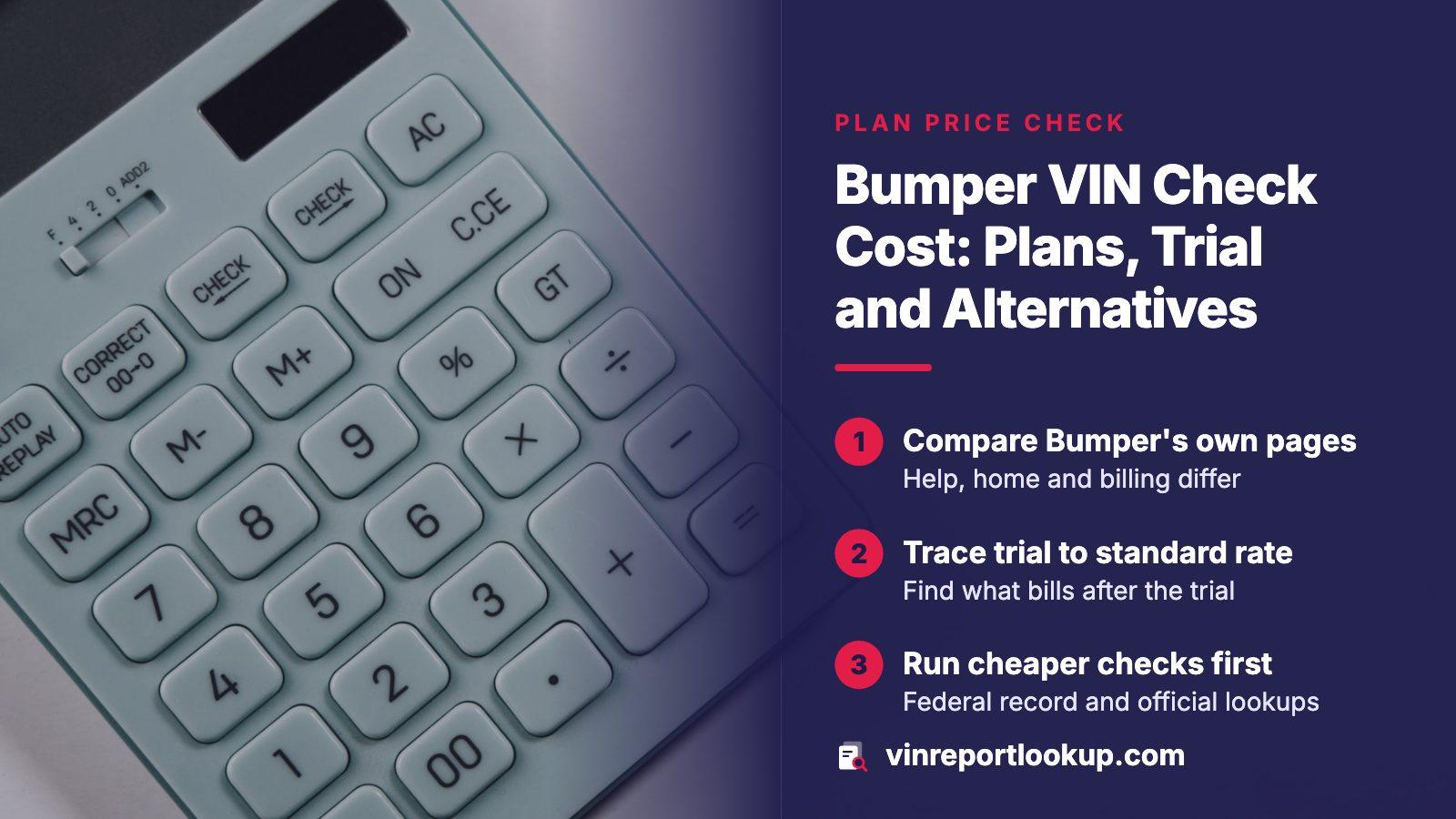
A Bumper check is paid. Its help page lists $19.99 per 30-day period, or $12.99 per period on a three-period plan billed as $38.97 in total. The homepage says plans start at $27.99 a month, and the billing page prints no amounts at all. Read the order screen, note the renewal date the day you sign up, and cancel on time.
- Bumper help page
- Says the site is not free; paid plans bill every 30 days
- Prices on its pages
- $27.99, $19.99, $12.99, or no figure, depending on the page
- Federal title record
- Up to $4 per report, per the Justice Department
- One-time route
- Free preview, then one payment; nothing renews
Bumper's pages give several answers on price
Bumper does not print a single price. It prints several, on different pages, and two of its pages print none. The table sets down what each page said when this guide was written, next to the Justice Department's figure for a bare federal title report.
| Page | What it says about cost |
|---|---|
| Bumper homepage | Plans start at $27.99 per month, with a lower-cost trial for a limited time |
| Bumper help page | $19.99 per 30-day period, or $12.99 per period on a three-period plan billed as $38.97 in total |
| Bumper billing page | No dollar amounts, only a note that deals and pricing options vary |
| Bumper report page | No dollar amounts, only a claim that rivals charge per report |
| Justice Department buying tips | A federal title report runs up to $4, the department says |
The help page also states that Bumper.com is not free, which settles the first question. Bumper does not explain why its homepage figure differs from its help-page figures, so treat the amount on the final order screen as the one that applies.
From the trial charge to the standard rate
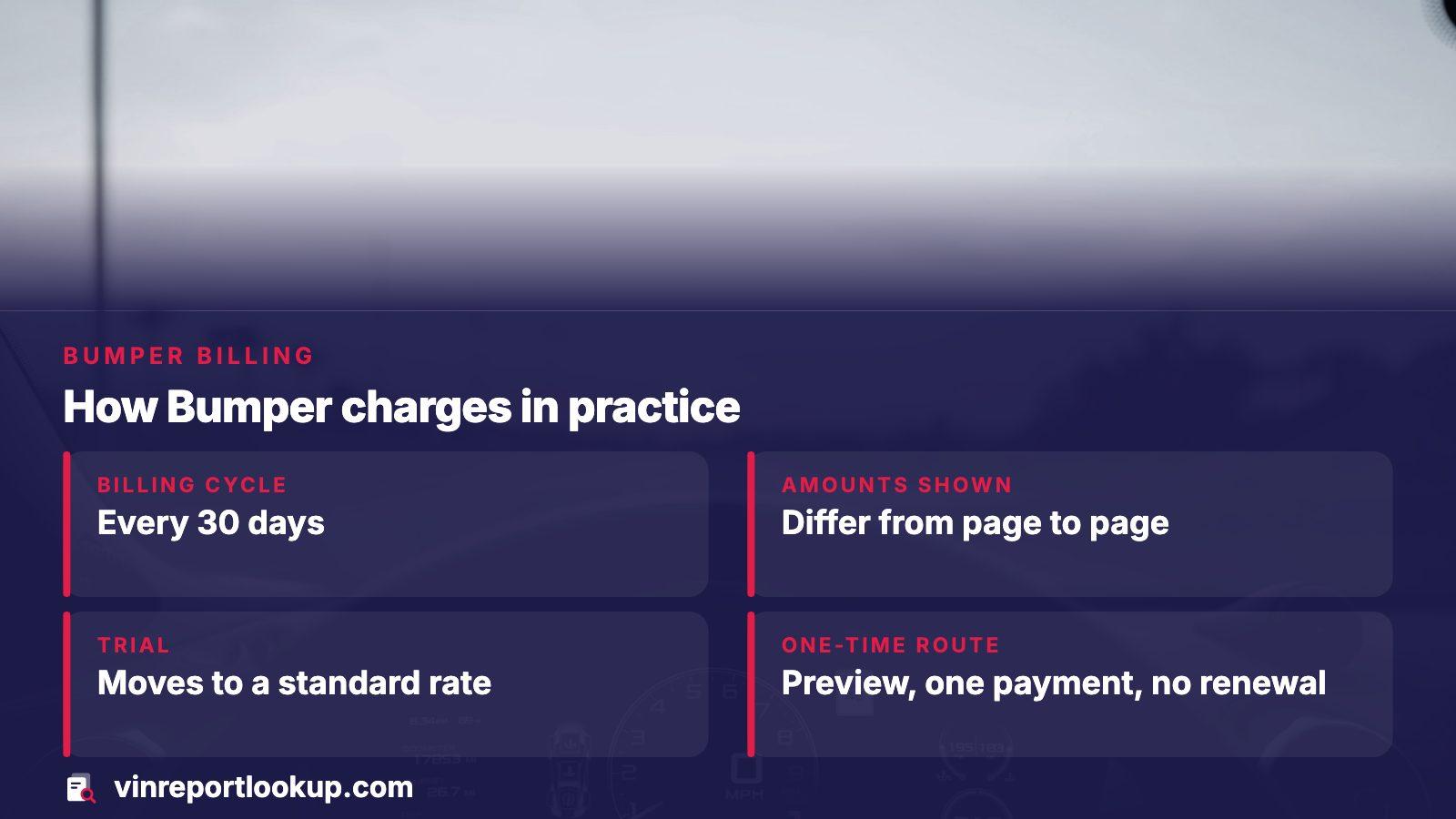
The homepage presents the trial as a lower-priced introduction that lasts a limited time. It gives neither the trial price nor its length. It adds that once the trial ends, the membership carries on at the standard recurring rate unless you cancel, and it does not print that rate either.
So the first charge tells you little about the second. The FTC's advice on trial offers fits well: find the terms before you sign up, including how long the trial runs and how to cancel, and skip the offer if you cannot find or understand them. The same page says to confirm that a renewal costs what you expected.
Two things to write down
Before you enter a card, note the day the trial ends and the rate that follows. If the checkout screen shows neither, take that as your answer and leave.
What a monthly allowance means when you have one car
Bumper's help page says plans renew every 30 days, with the charge landing as each new period opens, and that reports you do not use are lost instead of carrying over. Its report page says a subscription includes 50 reports per month, while the help page says only that the number is limited. Either way, you are buying room for many cars.
The help page mentions one-time searches without a price and suggests signing up, running a single report, then canceling so billing stops. The billing page adds that once a plan lapses you must reactivate it to open old reports, so save what you need before you cancel.
- One car: most of a plan's allowance goes unused, so compare it with a single payment.
- A few cars over a couple of weeks: a plan and a pack can both fit, so price the two against each other.
- A long list checked in one sitting: a plan with a fixed end date suits the volume.
What the money buys on top of a $4 title record
The Justice Department's roster puts Bumper.com in the group of title-record sellers that serve the public, and its tips say to expect a fee of up to $4. That record is narrow: the title, an odometer figure and some damage history. A plan priced well above it has to be paying for whatever Bumper layers on top.
Bumper's own pages name those layers: accident entries gathered from 44 state-level agencies, but only where local data has been digitized, plus market value estimates, recall notices, photos and sales history. Its report page also tells buyers to look elsewhere before deciding a car was never crashed, and says it cannot guarantee that its data is complete or accurate.
Checks that cost little or nothing, in the order to run them
- Search the VIN in the free NICB database. The Justice Department says it holds flood damage and other information, and Bumper's report page points to it for theft claims.
- Look up open recalls through the Department of Transportation's hotline or website, the route the Justice Department's tips name.
- Buy a federal title record if title and odometer are all you need. The Justice Department's approved list links out to each provider's own site, where the fee is set.
- Pay for a longer report only after those come back, and only for a car still on your list.
- Hire a mechanic. The Justice Department's tips strongly encourage an independent inspection before you buy.
The no-renewal route: preview first, then one payment
VINReportLookup runs the opposite way from a monthly plan. You type in the VIN and a free preview shows which kinds of record exist, well before a payment page appears. If the car merits a closer look, one payment buys a single report, or a larger set of three, five or ten reports when your shortlist runs long. No renewal follows, so there is no cancellation date to guard. Current amounts sit on the pricing page.
| Question | Monthly plan | Preview, then one payment |
|---|---|---|
| How you pay | Recurring, every 30 days | A single payment |
| How many reports | A limited number per period | One report, or a set of three, five or ten |
| If you stop shopping | You must cancel or billing continues | Nothing to cancel |
The report centers on a car's legal and damage record: title brands, accident and auction entries with photos, odometer readings and open recalls. It is not a service log, so shop visits on one particular car have to come from the seller or the repair shop.
If you do subscribe, stop it on your terms
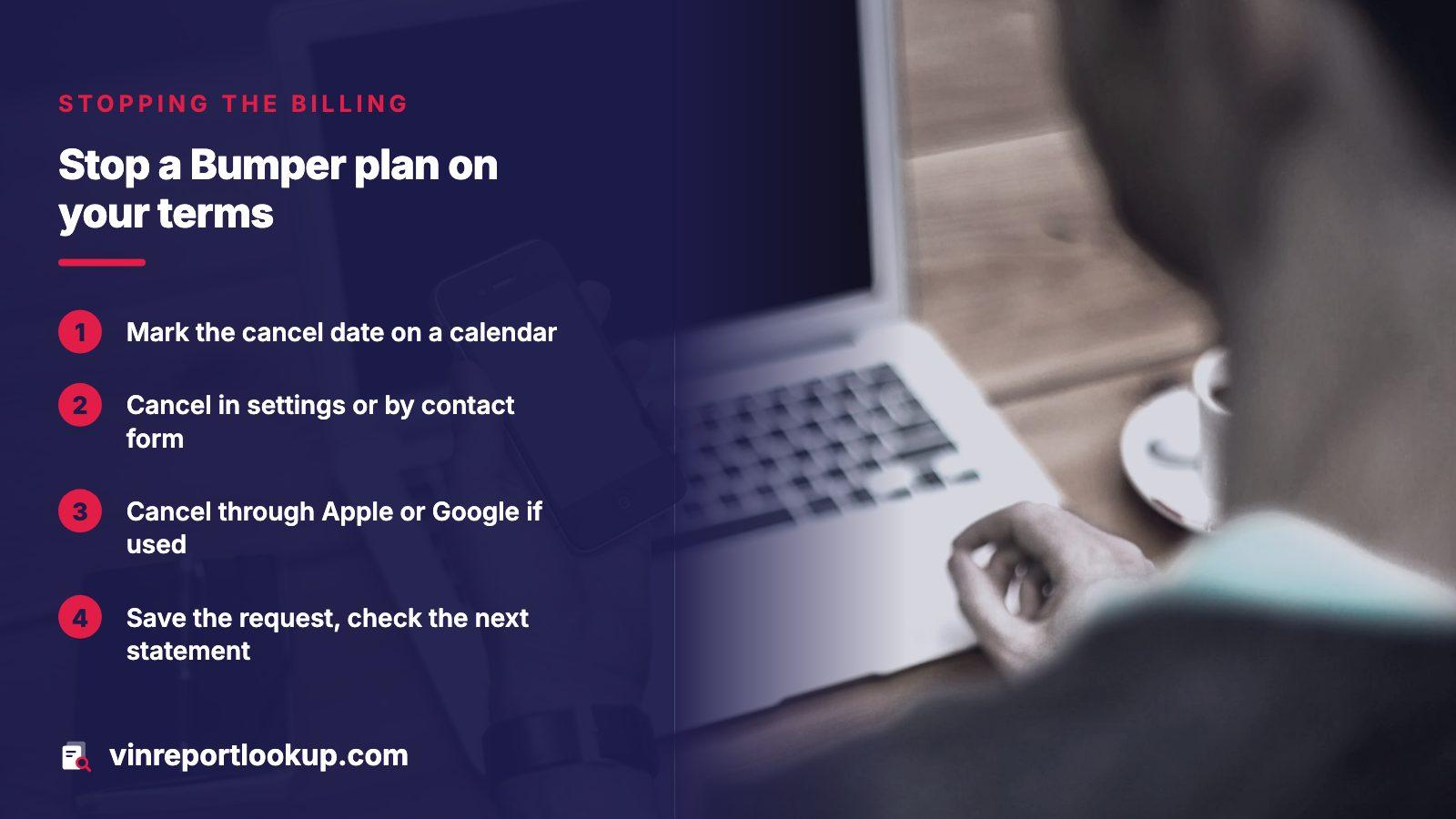
- Mark the cancellation date on a calendar the day you sign up, as the FTC suggests.
- Cancel in account settings, or use the contact form, chat, email or phone. The phone line asks for a 9-digit membership ID, and the form takes either that ID or your sign-up email.
- If you bought through Apple or Google, cancel there. Deleting the app does not stop billing.
- Save your cancellation request, then check the next statement.
If a charge lands after you canceled
The FTC says to dispute it with your card company, file a chargeback promptly if no refund comes, and tell both ReportFraud.ftc.gov and your state attorney general. Bumper's billing page says refunds are handled case by case, and a bank can take up to 10 days to post one.
Before you pay the seller
Whatever report you buy, it holds only what was reported. Bumper's report page says its data is limited to what is available and urges buyers to do their own due diligence, so a quiet result is not proof of a sound car. Slow down for a salvage brand, a write-off line, or an odometer reading that drops between entries. The Justice Department's tips add two more steps: ask the owner, a dealer or the repair shop for maintenance records, and book an independent inspection before the money moves.
Where this information comes from
- Bumper: common questions — per-period plan prices, renewal, report limits and ways to cancel, in Bumper's words
- Bumper: homepage — the starting monthly figure and the trial-to-standard-rate wording
- Bumper: billing — the price caveat, app-store subscriptions and refund handling
- Bumper: vehicle history report — the 50-report allowance, named data sources and disclaimers
- Justice Department: NMVTIS approved providers — where Bumper.com sits among providers that sell to the public
- Justice Department: NMVTIS buying tips — the up-to-$4 title report, the free NICB database and inspection advice
- FTC: free trials and auto-renewals — reading terms, calendar reminders and disputing charges after canceling
Sources and photos: Facts checked against the sources above in November 2026. Photos by Sasun Bughdaryan, Alejandro Escamilla and Dennis Eusebio on Unsplash; diagrams by VINReportLookup.
Keep reading
- Carfax vs Bumper: which VIN report to buy for one used carHow Bumper's billing compares with another well-known report, and who sells the federal title record
- BeenVerified VIN check cost: what the plan bills and what to compareThe affiliate the federal list shows beside Bumper, and what to read in its plan terms
- Vehicle history report cost: what each kind charges and coversPrice bands for every kind of report, and where a one-time purchase sits
- Cheap Carfax: legitimate ways to pay less for a vehicle history reportLegitimate ways to pay less for a report, from no cost to a full one
Frequently asked questions
Does a Bumper VIN check cost money?
Yes. Bumper's help page says the site is not free, and its plans bill every 30 days. A trial gives cheaper access for a limited time, then the standard rate applies unless you cancel. Its report page points to the NICB tool for basic theft checks and adds that a complete history costs money.
Is there a free Bumper trial?
The homepage describes a lower-cost trial, not a free one, and it shows neither the trial price nor its length. Read both on the checkout screen. For a no-cost first step, the Justice Department's tips point to the NICB database, which can be searched by VIN.
Can I buy just one Bumper report?
The help page says one-time searches exist but prints no price for them. It also suggests joining, running one report and canceling so billing stops. Check the amount on the order screen, and keep a copy of your cancellation request, as the FTC advises for any subscription.
Why does Bumper show different prices on different pages?
The homepage gives a starting monthly figure, the help page gives per-period rates for two plan lengths, and the billing page says deals vary. Bumper does not say why the numbers differ, so the order screen on the day you buy is the amount to rely on.
Is a federal title record cheaper than a Bumper plan?
The Justice Department tells buyers to expect up to $4 for a federal title report, and Bumper.com is one of the listed providers that sells it to the public. That record covers title, odometer and certain damage history, so it answers fewer questions than a full report does.
Now check the car itself
The guide explains what to look for. The report shows what this VIN has on record.