THE SHORT ANSWER
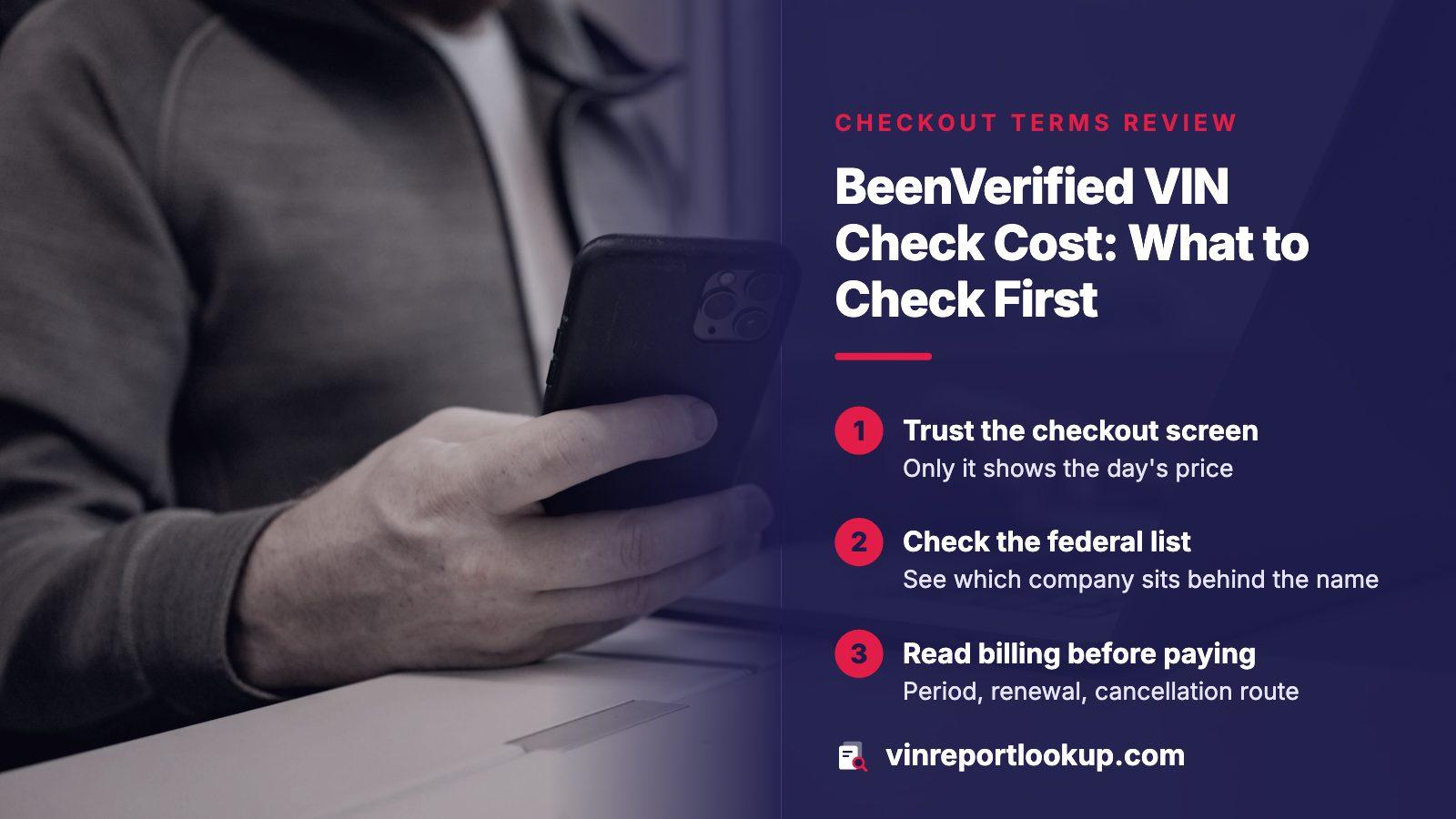
A BeenVerified VIN check costs whatever its checkout screen shows on the day you buy, and the billing structure matters more than the number. The Justice Department lists BeenVerified.com as an affiliate of Bumper.com, and Bumper's help pages describe a plan billed every 30 days with a monthly report limit. Confirm the renewal and cancellation terms first. For one car, a free preview followed by a single payment avoids renewals altogether.
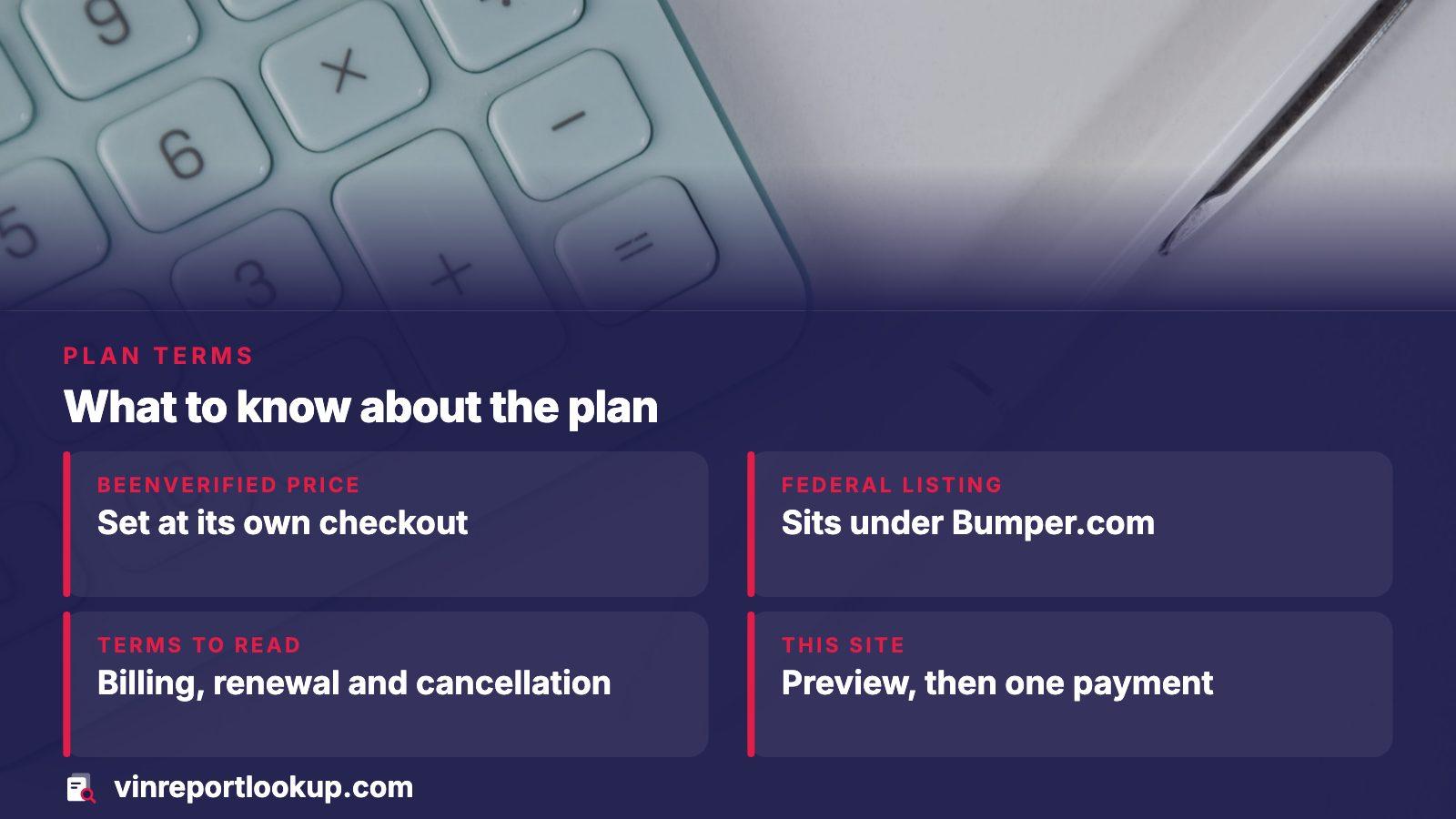
- BeenVerified price
- Set at its checkout, not printed here
- Federal listing
- BeenVerified.com sits under Bumper.com
- Terms to read
- Billing period, renewal, cancellation route
- VINReportLookup
- Free preview, then one payment, no subscription
Why only the checkout screen gives a reliable price
Nobody outside BeenVerified can state today's price with authority, and that includes this page. Reviews and forum posts quote the figure from the week they were written, and a promotional first charge can look nothing like the second one. The Justice Department's own pages show how fast a number goes stale, because they answer the question of what a federal title record costs in two different ways.
| Justice Department page | What it says about price |
|---|---|
| Used-car buying tips | Expect to pay up to $4 per federal title report |
| Frequently asked questions | Fees varied by provider, from $8 to $12.99 per report as recently as May 2020 |
| Approved-provider list | No prices at all; the banner lines beside providers are their own marketing |
Take any price on a third-party page as a hint. The amount on the final order screen is the one that binds you.
What the federal list says about BeenVerified.com
The Justice Department keeps a list of approved sellers of federal title records. It has 12 serving the public and businesses, and 6 serving businesses only. BeenVerified.com has no primary entry of its own. It appears as an affiliated site beneath Bumper.com, which sits in the group open to consumers.
Costs differ by provider, and the department's FAQ explains why: the system is paid for by user fees rather than federal money, so every report is fee for service. The list also carries a warning for shoppers. Consumers cannot get these records from Carfax, DMVDesk or Experian, which supply dealers only.
What a recurring plan looks like in a provider's help pages
BeenVerified's own plan terms are not reproduced here, so the closest public evidence is the help page of the provider it is listed under. Those are Bumper's terms, not BeenVerified's, and they work best as questions to put to any checkout screen.
- Billing recurs in 30-day periods, with a lower per-period rate offered on a multi-period plan.
- The report allowance resets every 30 days, and reports left over do not carry forward.
- A search by year, make and model leaves out accident, salvage and theft records, so it answers less than a full VIN search.
- Cancelling goes through email, a contact form, chat or phone, and a request may ask for a 9-digit membership ID.
- One-time searches are mentioned, though the page shows no price for them.
A plan like this can suit a month of heavy shopping. For a single car, the unused days and the unused allowance are the cost that never appears on the first screen.
Six things to read before you pay for any report
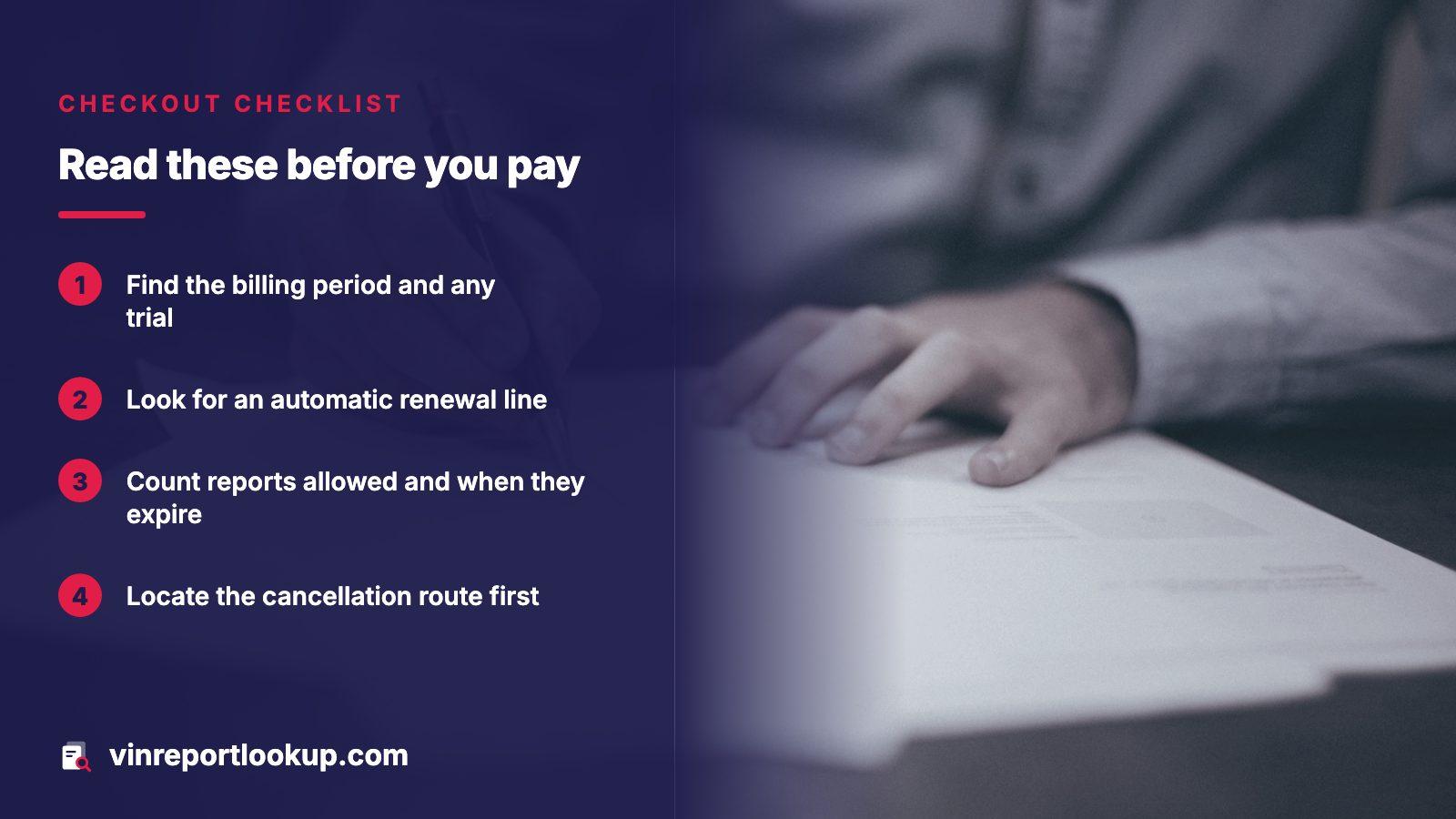
- Find the billing period, and check whether the first charge is a trial or promotional rate that rises later.
- Look for a line saying the plan renews on its own, and note the date it would.
- Count how many reports the plan allows and whether leftovers expire.
- Locate the cancellation route before you type a card number. The FTC advises walking away when the route is unclear.
- Screenshot the terms and keep the confirmation email.
- Put the cancellation deadline on a calendar.
If a charge arrives after you cancelled
Keep your cancellation request and dispute the charge with your card company right away, then follow up in writing. A written billing-error dispute has to reach the card issuer within 60 days of the first bill that shows the error. The issuer must acknowledge it within 30 days and settle it within 90. Send copies of your paperwork, never originals.
What a federal title record shows, and what it skips
Whatever brand sits on the checkout page, the federal layer is narrow by design. The Justice Department describes five indicators. Two concern the title itself: the state where it currently sits with its latest date, and any brand carried over from other states, such as salvage, junk or flood. Two flag severe loss: a total loss record and a salvage record. The fifth is the odometer reading. Sources are state titling agencies, salvage and junk yards, recyclers and insurers.
Repair histories, recall information and maintenance data are outside it, and the FAQ adds that some states or vehicles may not have reported yet. A record with nothing on it is called clean. The consumer page warns that gaps can produce a false clean, so a quiet report is a good sign and not proof.
Public searches to run before any plan
Two public sources deserve ten minutes before you pay anyone. The Justice Department's buying tips point to a database from the National Insurance Crime Bureau that is free to search by VIN and includes flood damage. For recalls, NHTSA publishes each campaign with a summary, the consequence and the remedy, which tells you what the defect is and what the fix involves.
Neither replaces a history report, and a report does not replace a mechanic. The department urges an independent inspection before purchase, with a test drive that includes a hill, a highway stretch and stop-and-go traffic. Ask the seller for maintenance records as well, since service history is not among the federal indicators.
How a single VINReportLookup report is priced
VINReportLookup runs the other way from a plan. You enter the VIN and see a free preview first, which shows whether the car has records worth reading. If it does, you pay once for one report, or once for a pack of 3, 5 or 10 when you are comparing several cars. Nothing renews, and the pricing page carries the current amounts.
| What you want to know | Federal title record | Full report here |
|---|---|---|
| Brand history and odometer | Yes, among its five indicators | Included |
| How the car was damaged | Not one of the five indicators | Accident and damage records |
| Auction photos | Not one of the five indicators | Included where auction records exist |
| Open recalls | Left to other sources, per the Justice Department | Included |
| How you pay | Fee set by each provider | One payment, no renewal |
The extra rows matter because they answer what a title record cannot, such as how a car was damaged and whether a recall is still open.
Matching the spend to the stage of your search
- One car, ready to buy: run the preview, read what it flags, and buy a single report if the car has a history worth paying to see.
- A shortlist of several: a pack of 3, 5 or 10 covers the whole list in one payment, and nothing lapses if you buy early.
- A month of nonstop searching: a recurring plan can fit, provided you set the cancellation date the day you sign up.
- Still deciding whether to look at the car: the free NICB database and NHTSA's public recall records can rule a car out first.
Whichever route you take, the report is one input. A mechanic you chose settles questions no database can.
Where this information comes from
- Justice Department NMVTIS: approved data providers — The two-group provider list, BeenVerified.com's place under Bumper.com, and the note on dealer-only vendors.
- Justice Department NMVTIS: understanding a vehicle history report — The five indicators a federal title record is meant to carry and what private reports add.
- Justice Department NMVTIS: frequently asked questions — Why fees vary by provider, the May 2020 fee range and the gaps in reported data.
- Justice Department NMVTIS: used car buying tips — The per-report price figure on that page, the NICB database pointer and the inspection advice.
- FTC: free trials, auto-renewals and negative option subscriptions — What to read before signing up, how to cancel and where to report trouble.
- FTC: disputing credit card charges — The written-dispute timeline for a billing error.
- Bumper: common questions — The provider's own description of 30-day billing, report limits and cancelling.
Sources and photos: Facts checked against the sources above in November 2026. Photos by Anastasiia Nelen, Scott Graham and Sasun Bughdaryan on Unsplash; diagrams by VINReportLookup.
Keep reading
- Vehicle history report cost: what each kind charges and coversThe cost question across every kind of report, not one brand.
- Carfax vs Bumper: which VIN report to buy for one used carBumper, the provider BeenVerified.com is listed under, set against Carfax.
- Carfax alternatives: what each VIN report option covers and costsOther ways to check a VIN, matched to the question still open.
- Best VIN check: how to choose a report and what each one includesHow to pick a report by what you still need answered.
Frequently asked questions
How much does a BeenVerified VIN check cost?
The amount on BeenVerified's checkout screen on the day you buy is the only figure that counts, and this page quotes none because plans and promotions change. Before paying, find the billing period, whether the plan renews on its own, and how to cancel. Those three terms decide what you actually spend over a month.
Does the federal government list BeenVerified as a VIN report provider?
The Justice Department's provider page lists BeenVerified.com as an affiliated site under Bumper.com, which is approved for public and commercial customers. It has no separate primary entry there. Open the page itself on the day you buy, because a list like this can change.
How do I stop a charge for a report I only needed once?
Follow the company's cancellation steps, keep a copy of your request, and watch your statement. If a charge still lands, dispute it with your card company at once and follow up in writing. The FTC also asks people to report cancellation trouble at ReportFraud.ftc.gov and to their state attorney general.
What is the cheapest way to check a single car?
Start with the free NICB database and NHTSA's public recall records, and rule out cars that fail them. For the finalists, run the preview and buy one report rather than joining a plan. That way a single purchase covers the one car you are serious about.
Will a VIN report catch every problem with a used car?
No. A federal title record has five indicators and leaves out repair and maintenance data, and some states or vehicles may not have reported yet. A clean result is useful but not proof. The Justice Department encourages an independent inspection alongside any report.
Now check the car itself
The guide explains what to look for. The report shows what this VIN has on record.