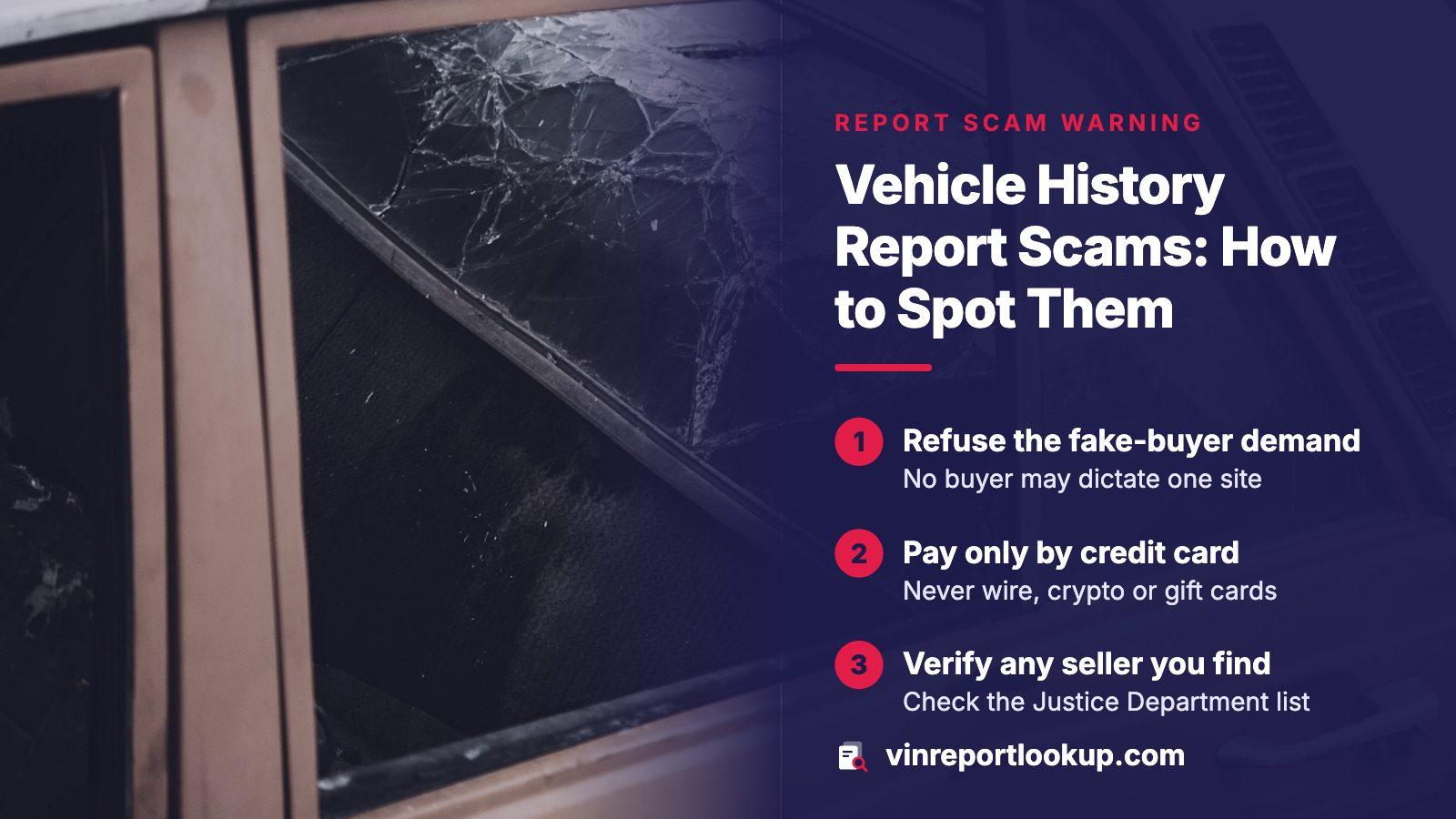
THE SHORT ANSWER
The best-documented version targets sellers. A supposed buyer says a report must come from one named site, you pay roughly $20 with a card, and the buyer goes quiet. Refuse that demand, pay only by credit card, choose a seller from the Justice Department's approved roster, and run the VIN yourself rather than trusting a PDF another person supplies.
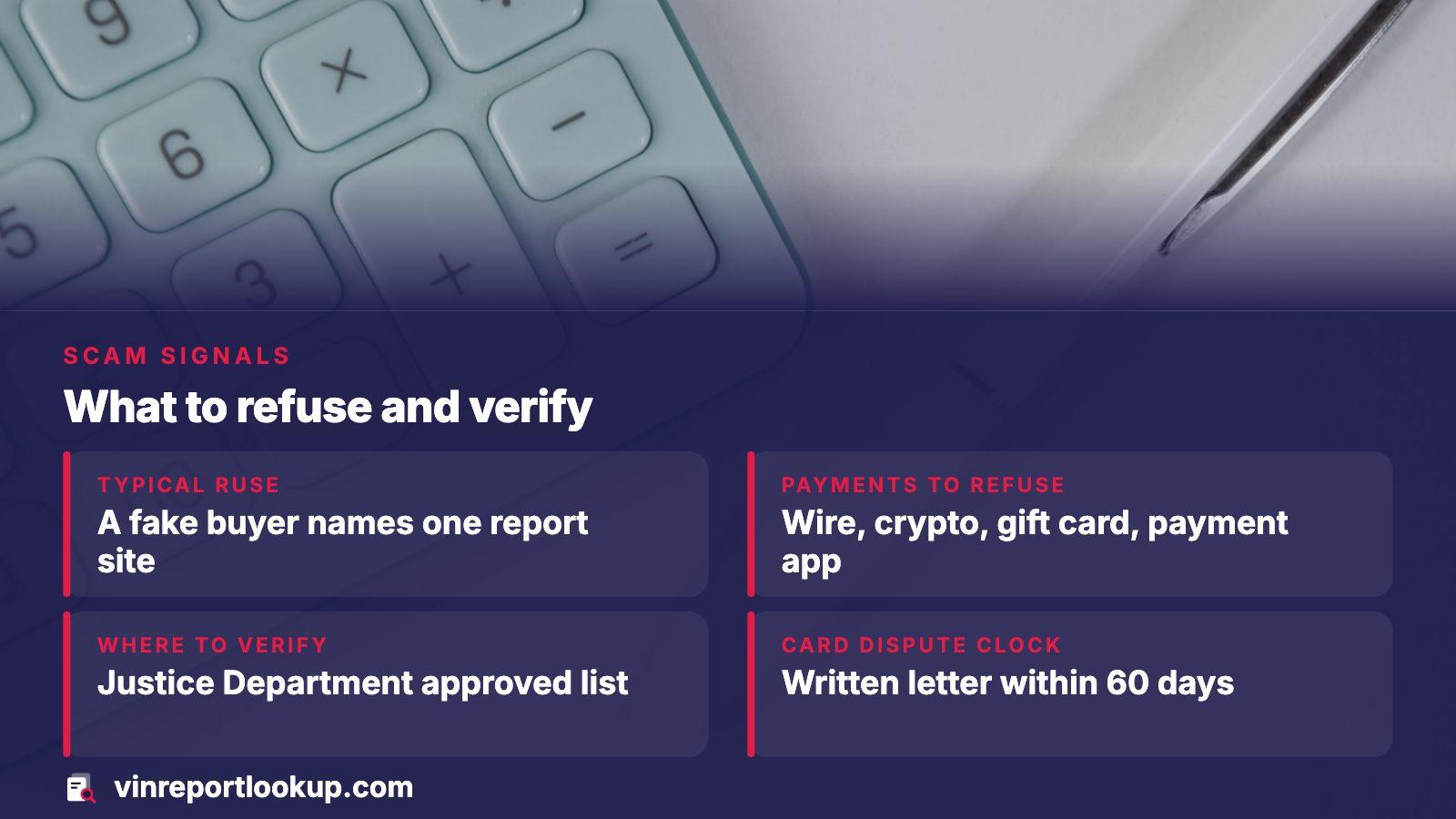
- Typical ruse
- A fake buyer names one report site; about $20 on a card, then silence
- Payments to refuse
- Bank transfer, wire, cryptocurrency, payment app, gift card
- Where to verify
- The Justice Department's list of approved title-data providers
- Card dispute clock
- Written letter within 60 days of the first bill with the error
Two different scams hide behind one phrase
Searches for car history report scams mix two problems that fail in different places.
- The fake buyer: someone answers your for-sale ad, says a report is required before a visit, and names the one site where it must be bought. You are the target and the fee is the bait.
- The lookalike seller: a site posing as a history service that collects a card number and returns a thin or copied document. A buyer shopping for a report is the target.
The FTC has documented the first. For the second we found reader accounts but no official count, so its frequency is unknown.
The fake-buyer ruse, step by step
The FTC's October 2018 alert describes the pattern. A caller or texter claims to want your car but asks for a history report first, from a particular website. You enter some details, pay about $20 by credit card, pass the report along, and never hear from the buyer again.
Sellers who opened those sites were redirected to addresses ending in .vin, an ending created with wine sites in mind (vin is French for wine) and unrelated to vehicle numbers. The FTC adds that you may have no way to learn who runs such a site. It could be gathering card details, or acting as a lead generator that sells what you type.
From a seller on the FTC alert page
A seller with a car on Craigslist was first asked for a personal email address, then told a lender required a report from one named site. The site wanted a card number and security code and offered no PayPal option. That gap raised suspicion, and the seller then found the FTC warning.
A serious buyer can run a VIN without your help, so insisting on one site says more about the sender than the car.
Payment methods that should end the conversation
In July 2026 the FTC listed ways of paying that mark a scam when a stranger insists on them: wires, bank transfers, cryptocurrency, gift cards and payment apps. Its figures put the largest reported losses, above $4 billion in total, on bank transfers and cryptocurrency, since scammers choose routes where money is hard to recover.
For a report purchase that means a plain rule: use a credit card, which the FTC says offers more protections and lets you dispute a charge, and leave any seller who accepts one method only.
From a seller on the FTC alert page
One seller wrote that the ruse climbed a rung once the report was paid for: the supposed buyer then pressed for a co-signed loan, or for someone who would co-sign. The seller reported all of it and left the warning for other readers.
Paying the fee was the way into the next request, so a loan, co-signer or transfer after a report purchase is the moment to stop.
How to confirm a report seller is real
A badge on a seller's own pages proves nothing. Evidence from outside the site carries more weight.
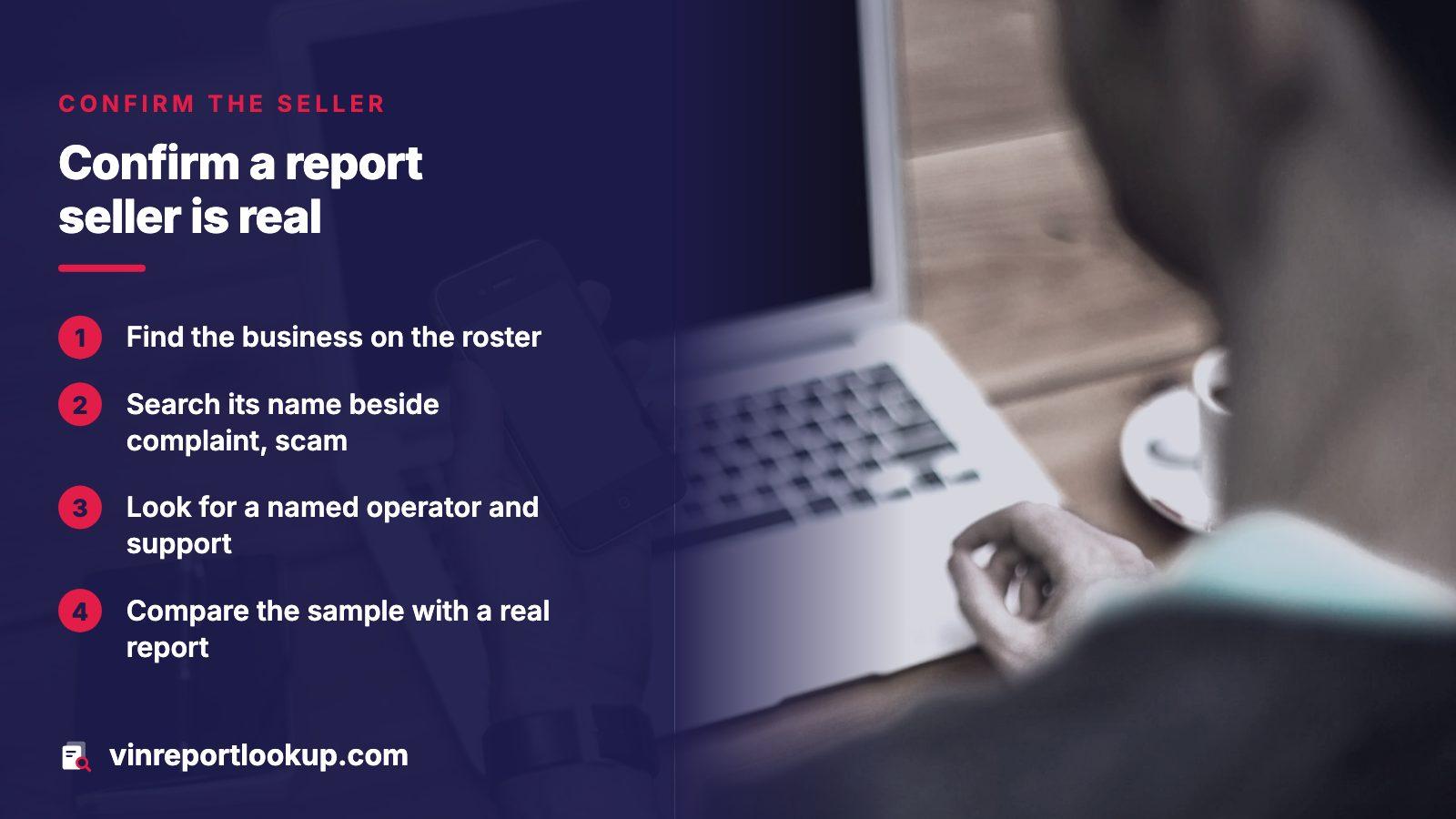
- Find the business on the Justice Department's vehiclehistory.gov roster, or the parent company that owns the site. The roster splits public-facing providers from commercial-only ones and states no preference among them.
- Search the company name beside complaint, review, rating and scam, as the FTC suggests.
- Look for a named operator and working support. The Justice Department sends report questions to the issuing provider's customer support, so one has to exist.
- Compare the sample report with a real one before paying.
From a reader on the FTC alert page
A reader who received a text with a link ended up at a seller charging $14.99 for its report. In the reader's view the sample had been lifted from a free site, and referral codes in the link suggested the sender earned a share of each sale.
A seller absent from the roster is not automatically fake, since reports with accident and repair entries come from other sources too. It does owe you an answer on where its title data comes from.
What each check covers and what it skips
A fake seller hides in the gap between what a report promises and what any single source can deliver. Knowing the limits makes a thin product easy to spot.
| Check | Reveals | Misses |
|---|---|---|
| NICB VINCheck (no cost; five lookups per IP address in 24 hours) | Stolen, salvage and flood flags reported by participating insurers | Police records and non-participating insurers; a mistyped VIN can miss a match |
| Report from an approved NMVTIS provider (fee set by the provider) | Title state and date, latest odometer reading, brands, theft, salvage and total-loss history | Repair history; some states update daily or after several days |
| Fuller report from another provider | May add accident and repair entries, according to the FTC | Gaps remain; none replaces a mechanic's inspection |
Price is a weak test. The Justice Department's FAQ gave a range of $8 to $12.99 per report as of May 2020, a dated figure, so check the provider's own page for today's amount and ask what the product contains.
When someone else hands you the report
A report you did not order yourself is a claim, not a check. Compare the VIN on the page with the number on the car, note the run date, then enter the VIN in a source you picked. No official page we read says how often altered reports circulate, so the test is practical: if the document and your search disagree, the seller has explaining to do.
A clean result proves little too. The Justice Department warns that a title search may wrongly show nothing, such as no salvage entry, until every required reporter is filing; more than half of states report, and private databases share those gaps. NICB likewise says a clean lookup cannot guarantee a car's past. A mechanic's inspection covers what paper cannot.
If you already paid
Speed matters most. The FTC says to contact the company that moved your money right away, tell it the payment was fraud, and ask whether it can stop or reverse it. The five methods above are the hardest to claw back, which is why scammers ask for them.
A credit card gives you extra routes. The Fair Credit Billing Act lets you dispute a charge for something not delivered as agreed. Write to the issuer's billing-inquiry address so the letter arrives within 60 days of the first bill showing the error. The issuer must acknowledge it in writing within 30 days and resolve it within 90, and you may withhold the disputed amount meanwhile. Report the site at ReportFraud.ftc.gov too.
Where a VINReportLookup report fits
None of this argues against buying a report. The FTC's own alert points buyers to the Justice Department's provider list, so the real questions are who you pay and how. VINReportLookup starts with a free preview: enter the VIN, see what is on file, and decide whether the car deserves a purchase.
Payment is one transaction, a single report or a bundle for a longer shortlist, with no subscription and nothing that renews. The pricing page shows current amounts. Pay by card, keep the receipt, and read the report beside a mechanic's inspection, not instead of one.
Where this information comes from
- FTC: Steering clear of vehicle history report scams — the fake-buyer ruse, the .vin redirect, and the reader comments below the alert (seller experiences, paraphrased)
- FTC: A way to spot scams, how someone asks you to pay — the five payment methods that signal a scam and what to do after paying
- FTC: Using credit cards and disputing charges — how a written billing dispute works and its deadlines
- Justice Department NMVTIS: approved providers — who may sell title-data reports to the public
- Justice Department NMVTIS: frequently asked questions — what a title report contains, how current it is, and who handles disputes
- Justice Department NMVTIS: for consumers — why a search can miss a brand and how states differ
- NICB: VINCheck — limits of the insurer-record lookup
Sources and photos: Facts checked against the sources above in November 2026. Photos by Abolfazl Ranjbar, Alejandro Escamilla and Sasun Bughdaryan on Unsplash; diagrams by VINReportLookup.
Keep reading
- Is a cheap Carfax report legit? What to check before you payPayment routes and dispute windows when a cut-price report is on offer.
- Vehicle history report providers: who sells VIN reports and how they differWho sells reports and what each provider's data includes.
- Sample reportWhat a full report looks like before you pay for one.
- Vehicle history report cost: what each kind charges and coversWhat reports cost and why quoted prices differ.
Frequently asked questions
Are vehicle history report scams common?
The FTC called the fake-buyer ruse new in 2018, and reader comments on its alert run into 2020. The pages we read publish no count of cases, so today's frequency is unknown. Any buyer insisting on one named site is a warning sign.
Is a car history report itself a scam?
No. A report is a normal step before buying. The scam is the setup around it: a stranger naming the site, a card-only checkout from an unknown operator, or a payment you cannot reverse.
Why would a buyer ask me to purchase a report?
A real buyer can enter your VIN themselves. The FTC says to ask why and think twice, since a site you have never heard of may harvest card numbers or resell your details. Offering to show the car in person is a fair reply.
How can I tell if a history report site is legitimate?
Check the Justice Department roster, search the company with words like complaint or scam, look for a named operator and a support contact, and pay by credit card. A seller outside the roster may still be real but should say where its data comes from.
What should I do if I paid a fake report site?
Contact whoever moved the money straight away, call it fraud and ask for a reversal. For a credit card, a written dispute must reach the issuer within 60 days of the first bill showing the error. Then report the site at ReportFraud.ftc.gov.
Now check the car itself
The guide explains what to look for. The report shows what this VIN has on record.