THE SHORT ANSWER
Sometimes the PDF is genuine, but a listing cannot prove it, and no official page we opened vouches for any resale route. Judge a cheap report by what happens if it turns out wrong. Pay inside Etsy's checkout, by PayPal goods and services, or by credit card, never by friends and family, gift card or wire. Then match the VIN and run date to the car, and treat a seller who pushes one payment method as a warning.
- Etsy cases
- Checkout orders only; off-platform deals are excluded
- PayPal windows
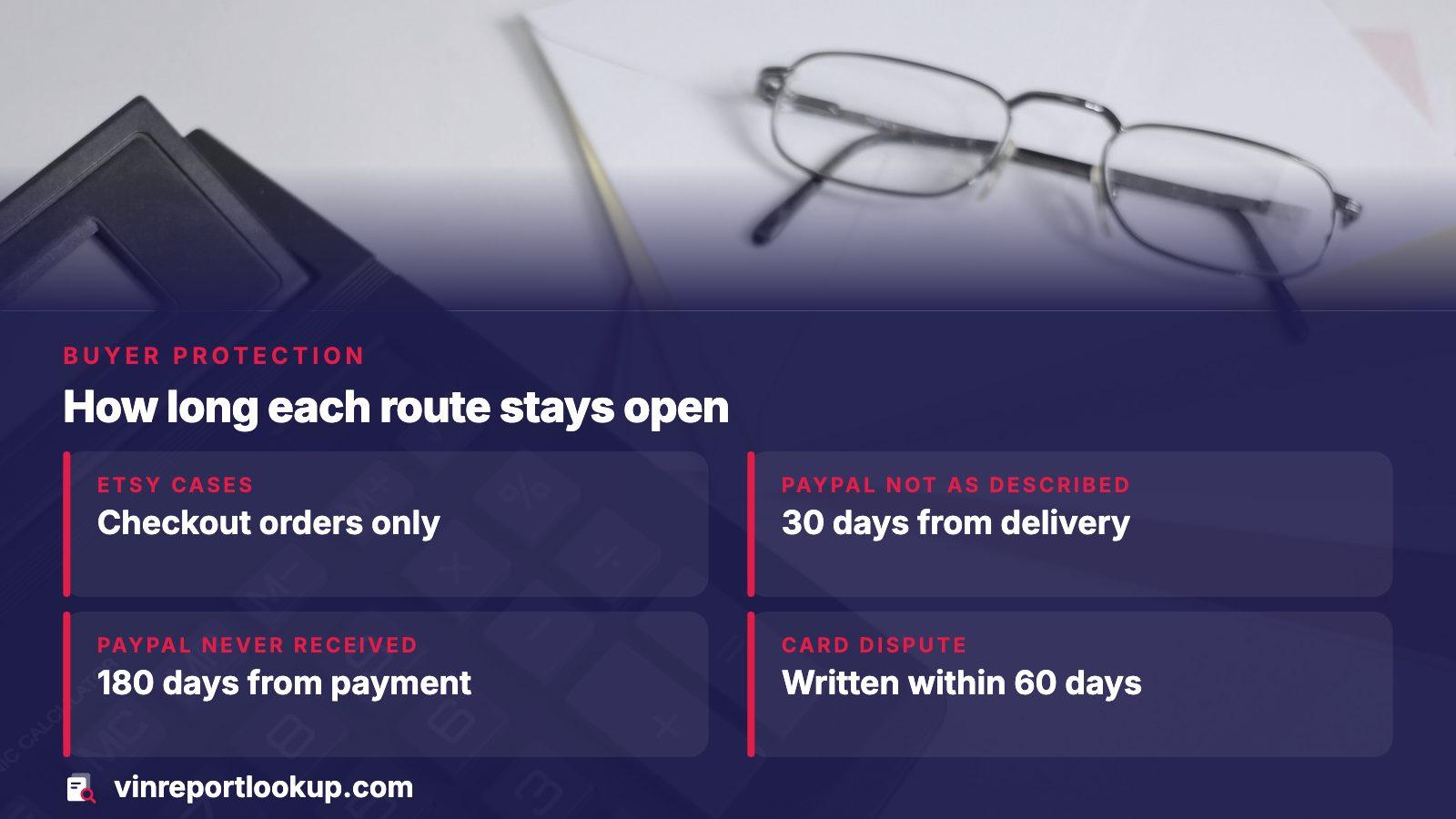
- 30 days from delivery if not as described; 180 days from payment if never received
- Card dispute
- A 60-day clock for the written dispute
- VINReportLookup
- Free preview, then one payment, no subscription
Three things "legit" can mean for a cut-price report
A listing that promises a cheap Carfax is selling one of three different products, and each fails in its own way.
- A genuine report for your VIN from a source you cannot see. It may be accurate, but nobody is on hand to explain it.
- A document for another car, or one run long ago, that looks right at a glance.
- A look-alike page that wants a card number, delivers little, or sells your contact details.
None of the government pages we read mention history reports resold by listing or private message. Carfax's own site refused every connection we tried, so we cannot say what its terms allow when a report changes hands. The payment route and the paperwork can be tested, though.
The report-site scam the FTC documented
In October 2018 the FTC warned about a ruse used on private car sellers. A supposed buyer asks for a history report from one named website, about $20 on a card, then goes silent. The site bounced visitors to addresses ending in .vin, a suffix meant for wine sites that has nothing to do with vehicle numbers.
That ruse targets sellers, yet a cheap-report shop can use the same machinery on buyers: a page dressed up as automotive, a card form and no named operator. The FTC says such sites may collect card numbers or act as lead generators that resell your details.
Two questions the FTC suggests
When anyone insists on one particular site, ask why. Then search the company's name beside words like complaint, review, rating or scam. For an unknown operator, that search is the only background check you get.
Buying through Etsy: what the marketplace does and does not back
Etsy's buyer policy says you are purchasing from an independent seller, not from Etsy, and that Etsy neither pre-screens items nor endorses what a listing claims. Its prohibited-items page bars counterfeit and unauthorized goods but never mentions history reports, so a report listing is neither approved nor banned by name.
- The order must go through Etsy's own checkout. Deals made elsewhere, Standalone PayPal included, fall outside the case system, and messages may not be used to arrange them.
- Contact the seller first and allow 48 hours before opening a case.
- Covered problems include an item that never arrives and one that does not match its listing, such as something sold as authentic that is not.
- Refunds through Etsy are available for 180 days after the transaction.
Etsy also states that it decides eligibility at its own discretion and that buyers have no legal claim under the program. It may ask for documentation, so keep the PDF and a screenshot of the listing as you found it.
Paying with PayPal: goods and services, never friends and family
PayPal's Purchase Protection covers an item that never arrives and one that is significantly not as described, a category that includes goods advertised as authentic that are not. Personal payments are excluded, and that includes the friends-and-family option.
| Situation | PayPal's stated limit |
|---|---|
| Item never received | Inside 180 days after you pay |
| Significantly not as described | 30 days after delivery, or 180 days after payment if that comes first |
| Turning a dispute into a claim | Within 20 days of opening it, or PayPal closes it |
| Paid as friends and family | Outside Purchase Protection |
Downloads and reports are not named on PayPal's ineligible list, yet PayPal says it alone decides each claim, and a seller's proof of delivery defeats a never-received claim. A PDF that arrived counts as delivered, so your argument would be that it covers the wrong car.
The card route, and why it makes the stronger fallback
The FTC advises paying by credit card whenever possible, because a card lets you dispute a charge. For goods not delivered as agreed, your letter has to arrive at the card company inside 60 days of the first bill showing the charge. The issuer then has 30 days to acknowledge and 90 to resolve, and you may hold back the disputed amount meanwhile.
PayPal's own page leans the same way: a card chargeback can reach further than its program, though you pick one route and cannot run both. Gift cards, wires and crypto rarely offer anything comparable, and the FTC lists bank transfers, payment apps and those three as the ways scammers insist on. A seller who accepts only one of them is raising a red flag.
Keep the paper trail
Save the listing, the seller's messages, the PDF and the date you paid. Every route above runs on a deadline, and Etsy may ask for documentation.
Vetting a report once it lands in your inbox
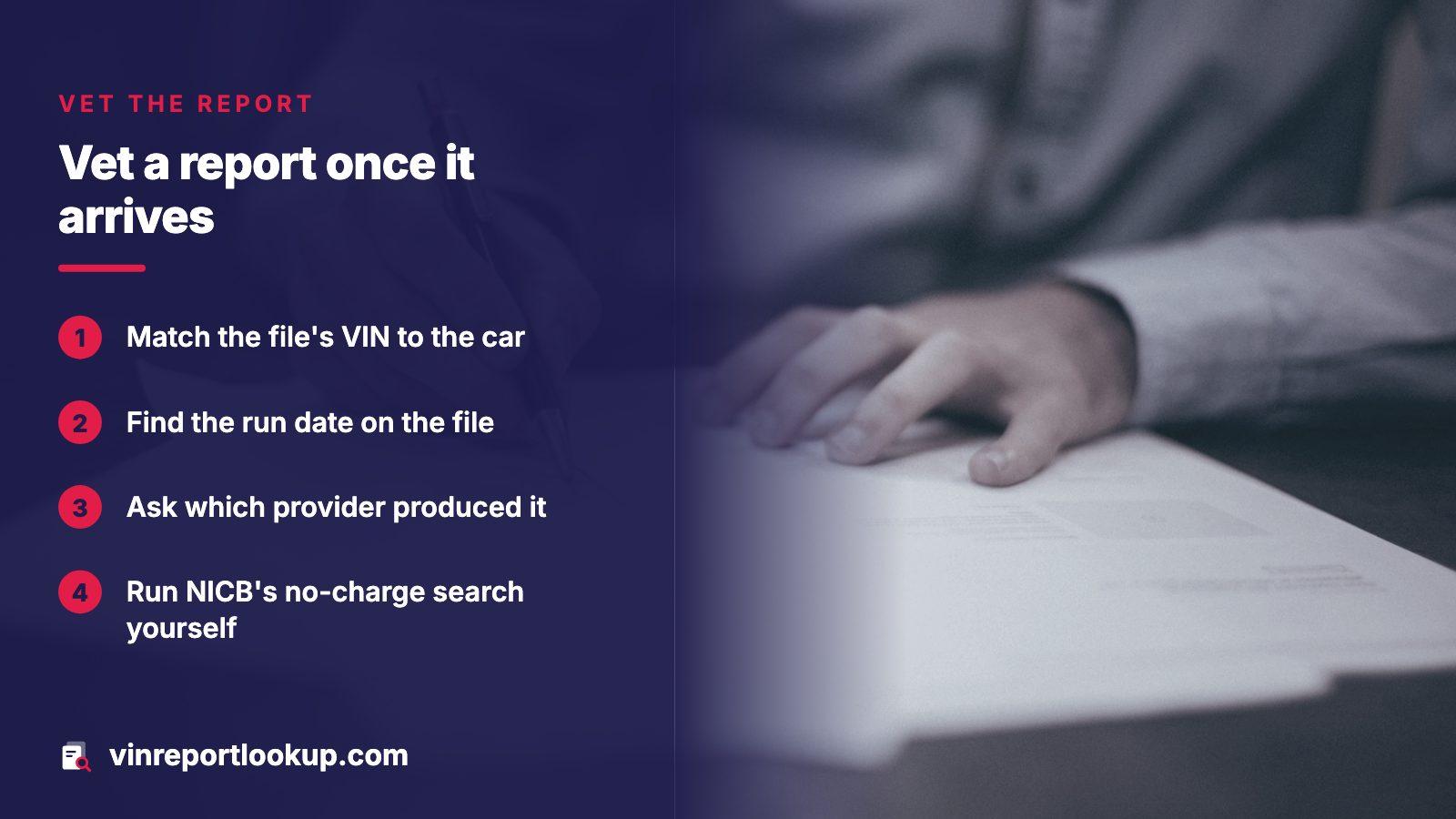
- Check the VIN printed on the file against the car itself, one character at a time. A single wrong character yields a report on some other vehicle.
- Find the run date. Title data lags, since each state reports on its own schedule, so an older file is stale on arrival.
- Ask which provider produced it. Whichever provider issued a report is the one that handles queries about it, and a seller who cannot name one leaves you with nobody to ask.
- Run the VIN through NICB's no-charge search for theft, salvage and flood records. If it shows something the PDF left out, stop and find out why.
- Do not read a clean result as a guarantee. NICB says it promises nothing, and the Justice Department says gaps in state reporting can produce a false all-clear.
Lower-cost checks from sources you can name
| Lookup | Run by | Cost | Gap |
|---|---|---|---|
| VINCheck | NICB, an insurance-fraud non-profit | No charge, five searches per 24 hours per IP address | Participating insurers only; no police records |
| Title record | Approved providers on the Justice Department's list | Set by each provider; $8 to $12.99 as of May 2020 | No repair history; not real time |
Order matters more than the fee. NICB's search takes seconds and costs nothing, so it can screen every car on your list. A title record costs money per VIN, which makes it better spent on cars you plan to view. Whatever you buy, ask which provider's data sits behind it.
Where a report with a free preview fits instead
Wanting a lower price is reasonable, and cost per report matters when several cars are in play. VINReportLookup is set up for that comparison: type in a VIN, and the free preview shows what is on file for that car. You pay only if it stays on your shortlist.
Payment happens once per purchase, either one report or bundles of 3, 5 or 10 when the search runs long, and nothing renews. The report shows title brands, damage and odometer entries and auction photos, so you hold something concrete against whatever a stranger's PDF claims. The pricing page lists current amounts.
Where this information comes from
- FTC: Steering clear of vehicle history report scams — The pay-for-a-named-report scheme, the .vin redirect and the advice to ask why.
- FTC: A way to spot scams, how someone asks you to pay — The payment methods scammers insist on and the advice to pay by credit card.
- FTC: Disputing credit card charges — The 60-day written dispute and the issuer's 30 and 90 day duties.
- Justice Department NMVTIS: frequently asked questions — Fees quoted for title records, what they omit and who answers questions about a report.
- Etsy: Buyer Policy — What Etsy does not guarantee and the conditions of its case system.
- PayPal: Purchase Protection Program — Claim types, exclusions, time limits and the card-dispute alternative.
- NICB: VINCheck — The no-charge theft, salvage and flood search and its stated limits.
Sources and photos: Facts checked against the sources above in November 2026. Photos by Alejandro Escamilla, Scott Graham and Cht Gsml on Unsplash; diagrams by VINReportLookup.
Keep reading
- Cheap Carfax: legitimate ways to pay less for a vehicle history reportThe full ladder of lower-cost checks, from no-charge lookups upward.
- Carfax alternatives: what each VIN report option covers and costsOther report options matched to the question you need answered.
- Sample reportA worked example of what a full report shows before you pay.
- PricingWhat one report or a pack costs today.
Frequently asked questions
Is a cheap Carfax report legit?
It can be genuine, but nothing in a listing proves it, and no official page we read vouches for resold reports. Treat legitimacy as something you test: pay by a route with dispute rights, match the VIN and run date to the car, and ask who produced the data.
Are cheap Carfax reports on Etsy legit?
Etsy says it does not pre-screen items or endorse listings, and its prohibited-items page does not mention history reports. Its case system covers an item not as described, but only for orders paid through Etsy's checkout, and Etsy judges each case at its own discretion.
Is it safe to pay for a cheap Carfax with PayPal?
Safer as goods and services than as friends and family, which Purchase Protection excludes. You have 30 days from delivery to dispute a report that is not as described, and 180 days from payment for one never received. A card dispute is a separate route, and PayPal says you cannot run both at once.
What can I do if the report is wrong or for another car?
Message the seller first, since Etsy, PayPal and card issuers all expect that. Then open the marketplace case or PayPal dispute inside its window, or dispute the charge with your card company. A resale seller may not be able to name the provider that produced the data.
Is there a cheaper way to check a car than a resold Carfax?
Yes, in layers. NICB's VINCheck costs nothing and screens insurer records for theft, salvage and flood, though only from participating insurers. An approved provider's title record was quoted at $8 to $12.99 in May 2020. Neither is a full history, so a report with a free preview comes next for cars still on your list.
Now check the car itself
The guide explains what to look for. The report shows what this VIN has on record.