THE SHORT ANSWER
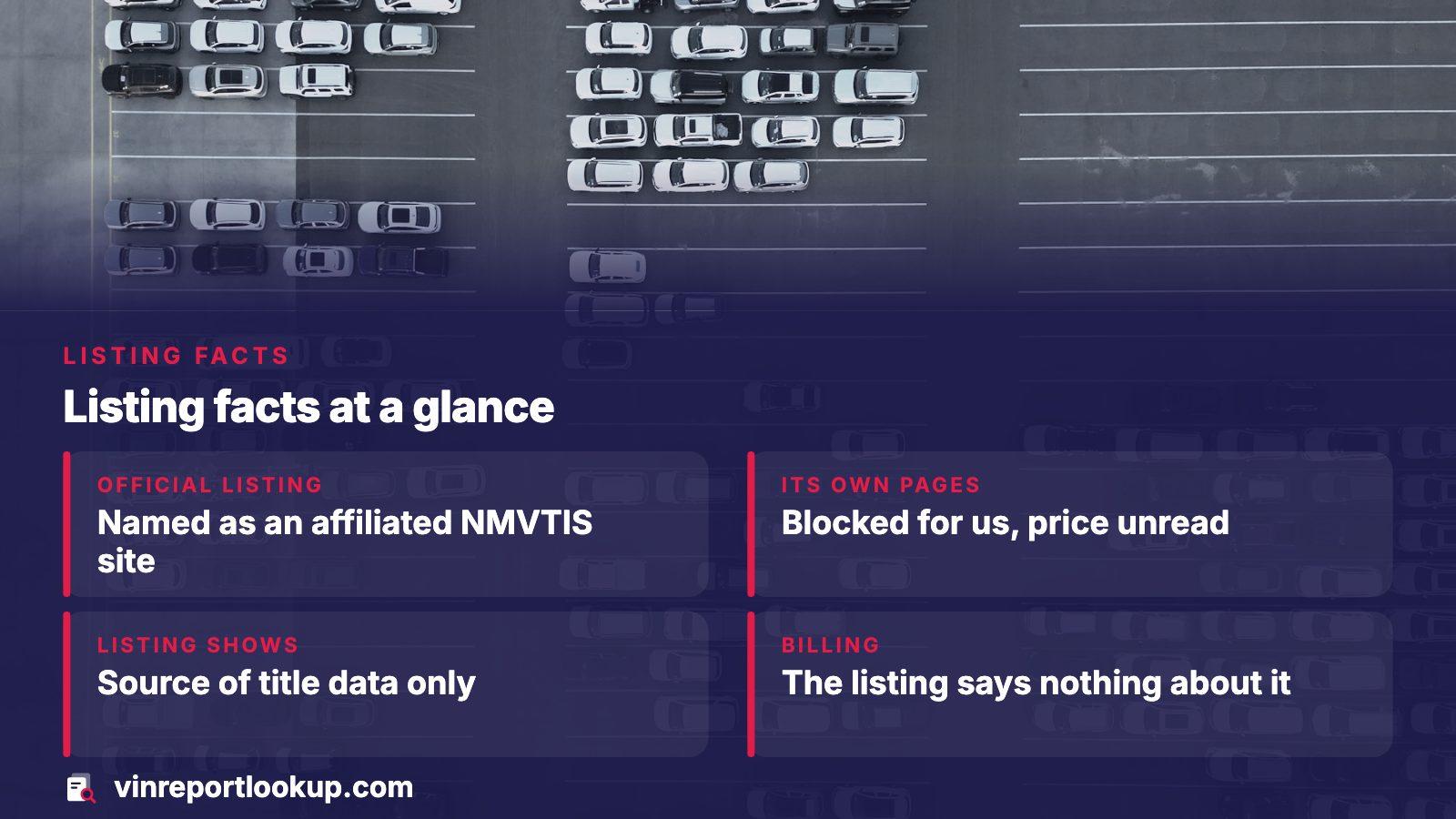
On the one point an official page can settle, yes: the Justice Department lists Vininspect.com as a site owned by an approved NMVTIS provider. What we could not read is VinInspect's price, billing terms, refund rules or report layout, since its pages returned a block screen. So we cannot call it a scam or praise it. Read its checkout terms yourself before paying.
- Official listing
- Named on the Justice Department's NMVTIS provider page as an affiliated site
- Its own pages
- Blocked for us, so price and terms are unread
- What the listing shows
- Source of title data, nothing about billing or service
- VINReportLookup
- Free preview, then one payment, no subscription
What we could read, and what we could not
We tried the VinInspect home page and its pricing address with a plain request, then once more in a normal browser window. Each time the site answered with a security screen and no content. We did not try to get around it, so this page carries nothing from VinInspect itself: no price, no sample report, no terms of service.
We also read no customer reviews, forum threads or star ratings. Those are easy to fake, and the FTC itself advises searching a company's name beside words like complaint or scam and weighing what you find yourself. What follows rests on government pages we opened directly.
Why this matters to you
Any verdict on VinInspect that quotes its price or refund policy, written by someone who never reached its pages, is guessing. Open the checkout and terms on your own screen before you enter a card.
The one official fact: a Justice Department listing
The Justice Department runs the page that names businesses approved to sell reports drawn from NMVTIS, the national title system. Beneath the approved provider EpicVin.com, the department lists two further web properties of that same company, VinGurus.com and Vininspect.com, and notes that their reports draw on NMVTIS records.
Put plainly, VinInspect appears as an affiliate of an approved business, not as a stand-alone entry. The page orders everything alphabetically and says it shows no preference among them. Clicking any entry takes you off the government site to the vendor's own.
What that listing proves, and what it leaves open
| The listing tells you | The listing does not tell you |
|---|---|
| Title-record data can come through an approved route | What a report costs or how it is billed |
| The site is tied to an approved provider by name | Whether you are enrolled in a plan after paying |
| The department has not left it off its public page | How quickly support answers or refunds |
| Where to confirm this yourself | Whether the report adds accident or service records |
In short, the listing speaks to where the title data originates. Whether you will be treated fairly at checkout is a separate question that only the site's own pages can answer.
What an NMVTIS-based report holds
The department's FAQ describes the contents plainly. You get the current and earlier state of title, the date a title was issued, the latest odometer figure, any theft history, any brand and when it was applied, plus salvage history, total-loss labels among it.
- Repair history is not part of the federal record.
- States report on different schedules: some as titles change, others daily or within a few days.
- An empty result may simply mean no participating state reported anything.
The FTC adds that reports from other providers sometimes carry extra items, such as accident and repair history. Ask any service which of those it includes and where it gets them.
A checkout test you can run on any report site
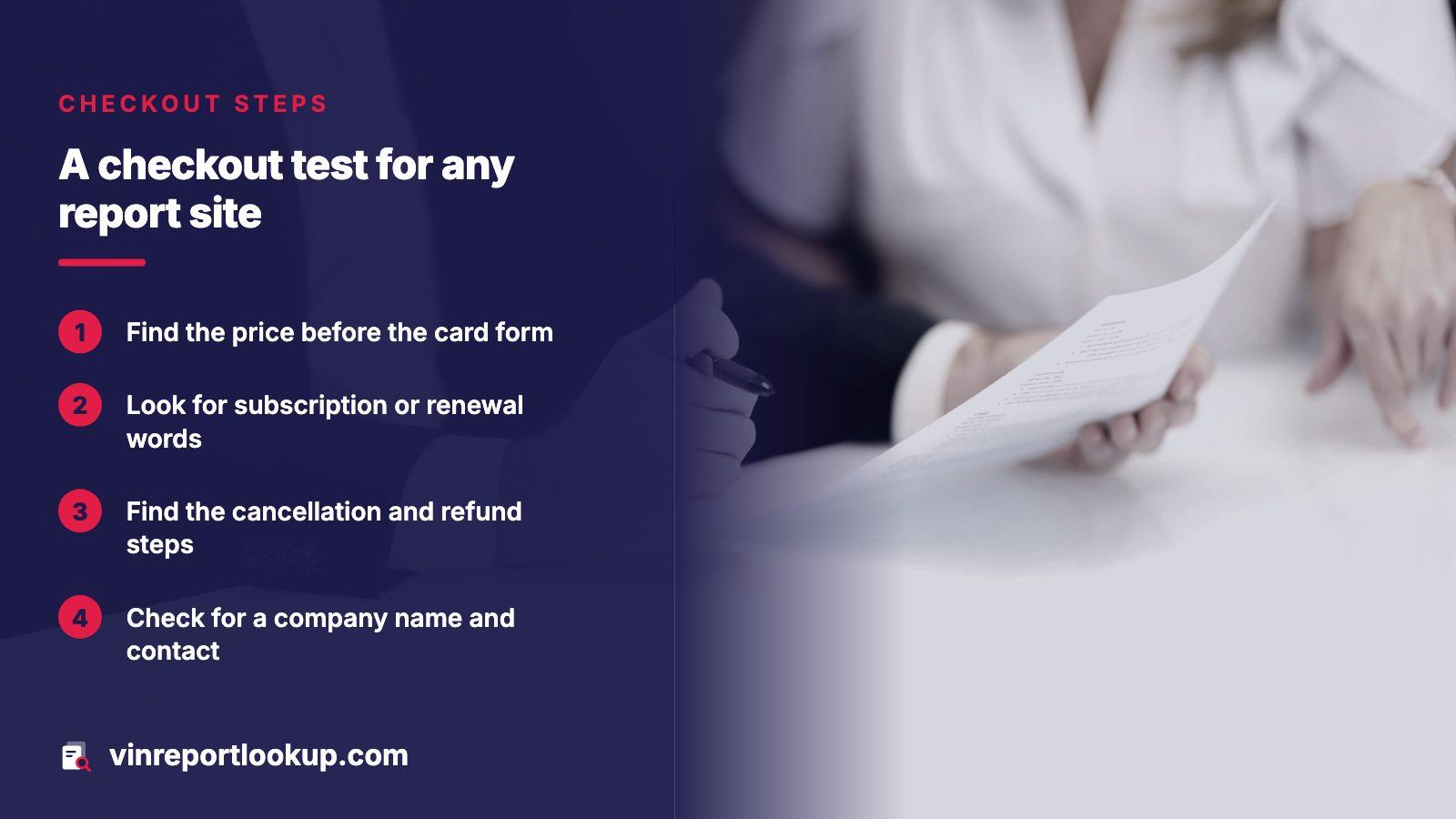
Because the listing cannot speak for billing, apply a short test before paying anyone, VinInspect included.
- Find the price on the page before the card form, not after it.
- Look for the words subscription, membership, recurring or renewal in the terms.
- Find the cancellation and refund steps and note who you must contact.
- Check for a company name, address and working contact method.
- Pay by credit card, so a billing-error dispute stays available.
If any of these is missing or buried, treat that as the answer to your question, whatever any listing says.
If a charge turns out different from what you expected
The FTC's credit card guidance sets the steps. Send a letter to the card issuer's billing-inquiry address, not the one for payments, describing the mistake along with your name and account details. It has to arrive within 60 days of the first statement that carried the error.
The issuer must acknowledge the dispute in writing within 30 days and settle it within 90, and you may hold back the disputed amount while it investigates. Certified mail with a return receipt gives you proof of delivery. Send copies of receipts, never originals.
Signs to walk away, for any site
The FTC's 2018 alert described a ruse aimed at people selling cars: a stranger tells the seller to purchase a report at one particular website, which may exist to harvest card details or sell your information to advertisers. The same warning fits buyers.
- Someone else picks the site and presses you to use it today.
- The domain ends in an unrelated suffix such as .vin.
- No price appears until your details are entered.
- You cannot tell who runs the business.
Starting from the Justice Department list avoids most of these, since you choose the vendor rather than being steered to one.
Running a check here instead
VINReportLookup works the other way around: type the VIN and see the free preview first, so you learn what turns up on the car before spending anything. If you want the full report, it is a single payment, with no plan to cancel afterward. Current options are on the pricing page.
Whichever service you choose, pair the report with a mechanic's inspection. A record search cannot see damage that was never reported to anyone.
Where this information comes from
- Justice Department: Approved NMVTIS data providers — Where Vininspect.com appears, as a site owned by an approved provider.
- Justice Department: NMVTIS frequently asked questions — What an NMVTIS report contains and how states report.
- FTC: Steering clear of vehicle history report scams — The named-site ruse, the .vin domain and the advice to search a company's name.
- FTC: Using credit cards and disputing charges — The written dispute steps and their deadlines.
Sources and photos: Facts checked against the sources above in November 2026. Photos by Bence Balla-Schottner, Carrie Allen www.carrieallen.com and Iain on Unsplash; diagrams by VINReportLookup.
Keep reading
- Is VinSeeker legit? What its own pages show and what they leave outAnother report site checked the same way, including what its billing terms say.
- Vehicle history report scams: how to spot a fake report seller before you payHow report-related scams work and how to spot them.
- Vehicle history report providers: who sells VIN reports and how they differA side-by-side look at the companies that sell reports.
- Carfax vs NMVTIS: what each report shows and which to buyWhat the federal title record covers compared with a commercial report.
Frequently asked questions
Is VinInspect legit?
The Justice Department's NMVTIS page lists Vininspect.com as a site owned by an approved provider, which speaks to its title-data source. We could not open VinInspect's own pages, so we cannot vouch for its pricing, billing or refund handling. Read its terms before you pay.
Are VinInspect reviews reliable?
We read none, so we cannot rate them. Reviews on any site can be written or edited by the seller. The FTC suggests searching the company name beside words like complaint, rating or scam, then comparing several sources instead of trusting one score.
Does an NMVTIS listing mean a site is safe to pay?
No. The listing covers where title records come from. It says nothing about how a site charges, whether it enrolls you in a plan or how it handles refunds. Judge those from the checkout page and terms, and pay by credit card.
How do I find approved report providers myself?
Use vehiclehistory.gov or the Justice Department's provider page, which lists approved businesses alphabetically and shows affiliated sites beneath each one. Picking a link there sends you to the vendor's own site, where you still need to read the price and terms.
What if a report site charged me more than I expected?
Contact the site first, then write to your card issuer's billing-inquiry address. The FTC says the letter must arrive within 60 days of the first bill showing the error. The issuer must reply in writing within 30 days.
Now check the car itself
The guide explains what to look for. The report shows what this VIN has on record.