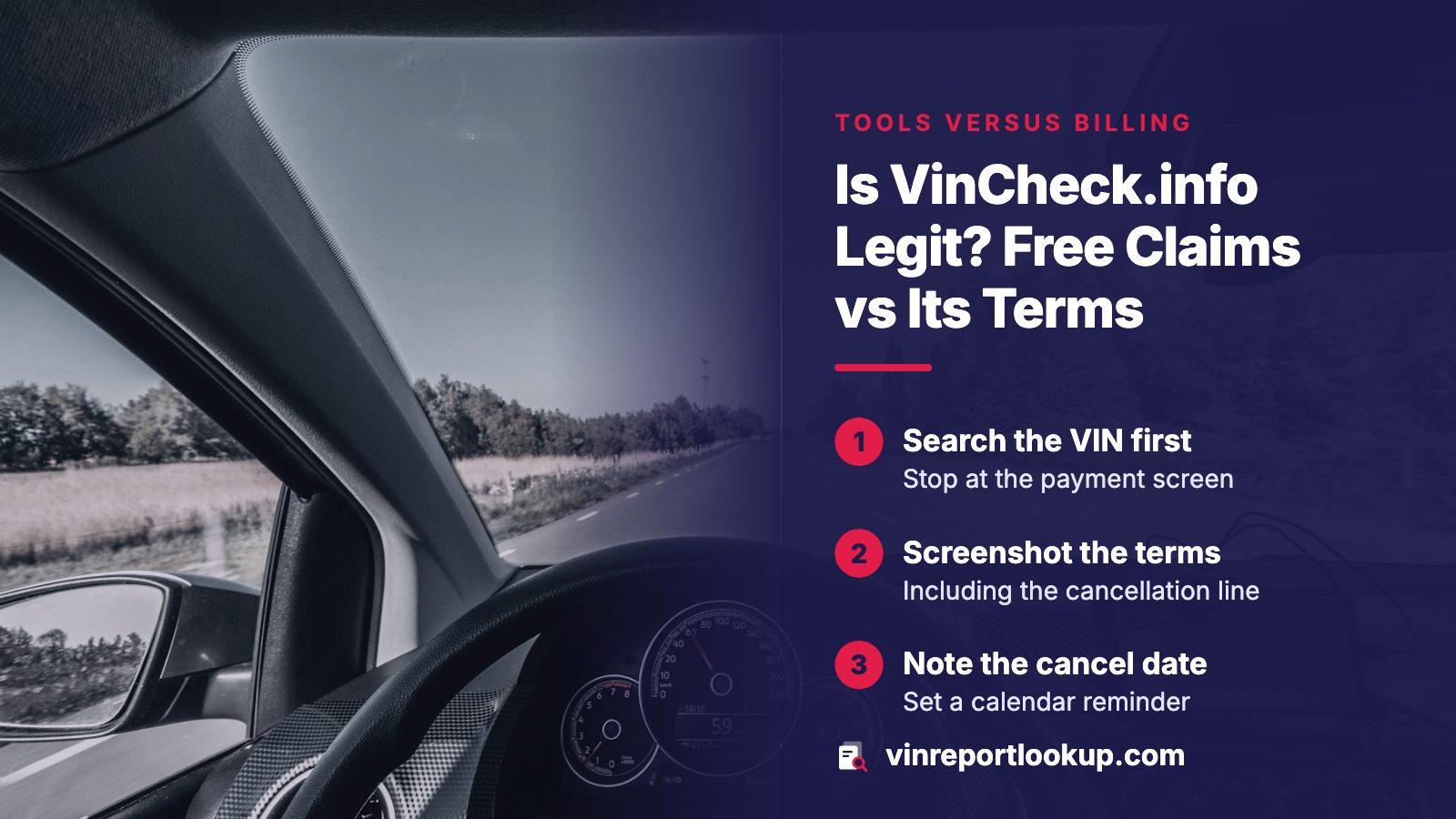
THE SHORT ANSWER
VinCheck.info is a working site with a federal tie we could verify: the Justice Department lists it among websites owned by an approved NMVTIS data provider. We found no price anywhere, no review we could trust, and terms that describe monthly billing with no refunds on processed fees. Treat the free label as covering the lookup tools only, and read the checkout screen before entering a card.
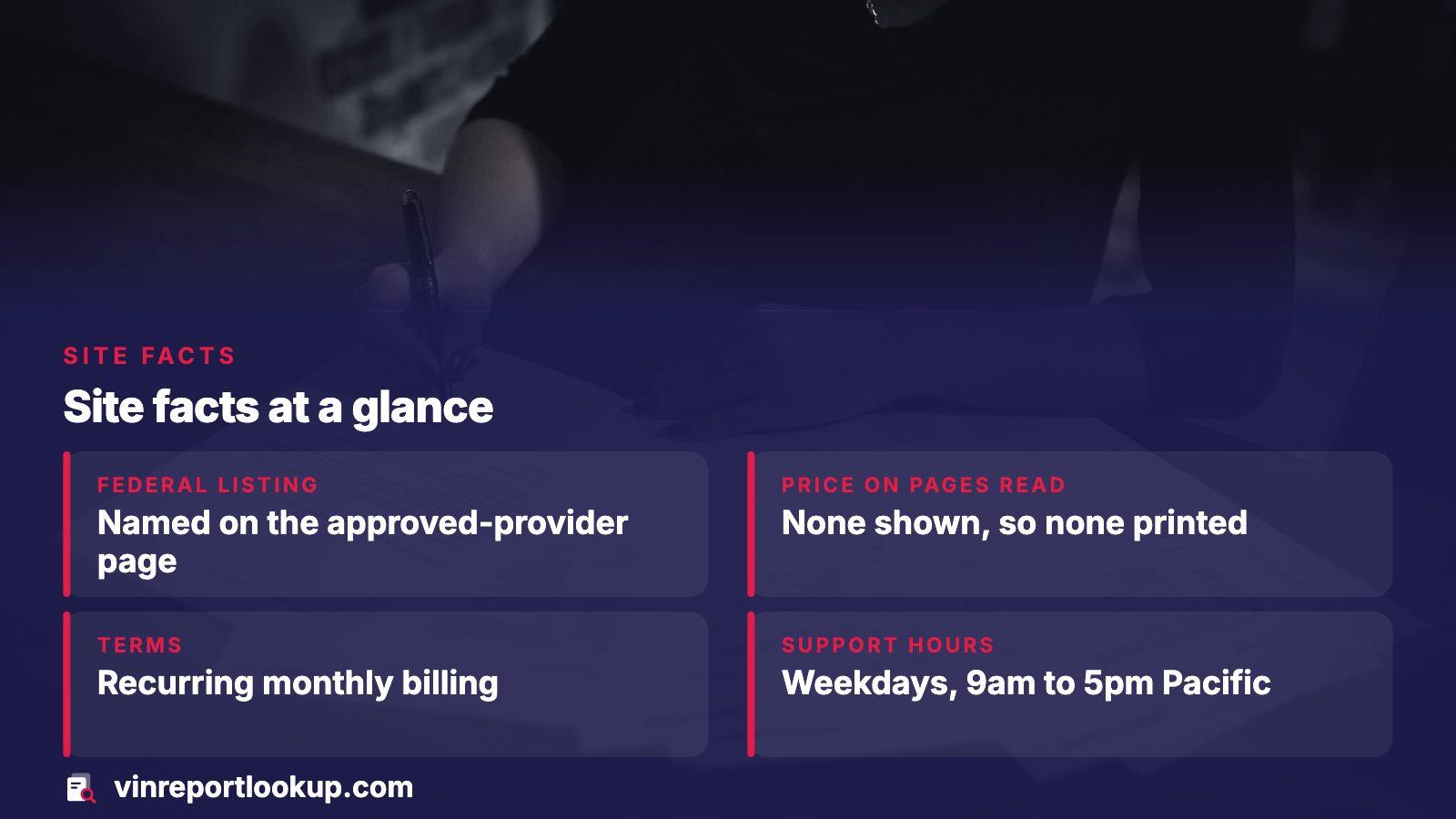
- Federal listing
- Named on the Justice Department approved-provider page
- Price on pages we read
- None shown, so we print none
- Terms
- Recurring monthly billing, cancel by email or form
- Support hours
- Weekdays, 9am to 5pm Pacific
Two questions hiding inside the word legit
When someone types a site's name plus legit, they usually want two answers. Does the business exist and hand over a real report? And will the charge on the card match what they thought they agreed to? We tried to answer both from primary pages: the site's own home, about and terms pages, and the federal list of approved title-data sellers.
We did not read star ratings, forum posts or complaint boards, because none of them can be traced back to a person we could verify. We also did not run a search or open a checkout, so we cannot describe what a buyer sees after typing a VIN. That limit shapes everything below.
The one claim we could check against a government page
The site's badge says approved NMVTIS data provider, and its about page says the title access runs through VinAudit. That sounds like marketing until you open the Justice Department's page of approved providers. Under VinAudit, the department lists additional websites owned by that provider that sell reports with NMVTIS information, and VinCheck.info is one of them.
So the name is real in the narrow sense that matters: a federally approved provider stands behind the title portion. The same page says it ranks nobody and shows no preference among providers, so the listing is a floor, not an endorsement.
What the listing does not tell you
It says nothing about price, billing terms, support quality or how complete the non-title parts of a report are. Those you have to judge from the checkout screen and the terms.
Free on the front, monthly on the back
The home page leads with free VIN check, free plate lookup and free vehicle history, and says its tools cover all 50 states. The about page explains the model: advertising pays the bills, which keeps core searches open without a paid subscription. If that were the whole story, there would be little to worry about.
The terms add a second layer. A subscription section says plan fees recur every month until you stop them. To stop, you email customer service or send the contact form, and the stop only bites once your paid month runs out. Money already collected stays collected. We found no page that names a plan, shows a price or says which parts of a report sit behind it.
- Free label: applies to the lookup tools the about page calls supported core searches.
- Paid layer: described only in the terms, with no price on any page we read.
- Exit route: an email or a form, effective at cycle end, with no refund of processed charges.
What the site says about itself, and what it leaves out
The about page is unusually candid in places. It says the site is privately run, is not a government body or an insurer, and is not connected to the insurance industry's theft database, whose name it resembles. It also warns that coverage varies and that a missing record does not prove an event never happened.
The contact page, by contrast, offers a form and weekday support hours, 9am to 5pm Pacific, and no street address or phone number. Plenty of honest small sites work that way. It does mean that if a charge goes wrong, your first move is a written message, and your fallback is the card issuer.
What the federal-style part of a report actually covers
Federal guidance calls a title report brief by design. It boils a car down to five signals: the latest titling, a brand like flood or salvage, a single mileage figure, an insurer's write-off and a salvage-yard record. Insurance carriers and scrap or salvage operators are legally obliged to send data into the system, which is why those last two signals carry weight.
| Item | What a clean result means | What it cannot prove |
|---|---|---|
| Brand history | No state has branded the car | That it was never wrecked |
| Total loss and salvage | No insurer or yard reported one | That repairs were done well |
| Odometer | The last title reading is on file | That today's dash number is honest |
| Title state | Which state titled it last, and when | That the seller holds the title |
Officials call a clean result good news, yet they also urge buyers to add an independent inspection. A report from any seller, this one included, is a screen, not a clearance.
How to pay for any report without being surprised
- Search the VIN first and stop at the screen that asks for payment.
- Find the price, the billing interval and whether it renews, on that screen, not on the home page.
- Screenshot the terms you agree to, including the cancellation line.
- Pay with a card you can dispute, and note the cancel date in your calendar before you buy.
- Confirm the VIN on the car matches the VIN you searched, character by character.
If the checkout shows a one-time price for one report, you have your answer. If it shows a trial that converts to a monthly plan, you can still buy, but cancel the same day if you only need a single check.

If you want one purchase and no renewal
Here you type the VIN and get a no-charge preview of what the report holds before any payment. The report itself is a single payment for one vehicle, or a pack if you are comparing several cars, with no subscription to cancel. Prices are on the pricing page, and we do not repeat them here.
Whichever seller you pick, the logic holds. Run the VIN on a car you are serious about, not on every listing, and spend the money after a test drive and before you hand over a deposit.
Where this information comes from
- Justice Department NMVTIS: approved data providers — The listing that names VinCheck.info under the provider that owns it.
- Justice Department NMVTIS: understanding a report — The five items a title report covers and who must report.
- VinCheck.info: about us — Its own account of ownership, the free model and coverage limits.
- VinCheck.info: terms of website use — The subscription, cancellation and refund wording.
Sources and photos: Facts checked against the sources above in November 2026. Photos by Sander Jeurissen, Jakub Żerdzicki and Dimitri Karastelev on Unsplash; diagrams by VINReportLookup.
Keep reading
- Car history report subscription: when a plan pays and when to skip itHow report subscriptions renew and how to stop one.
- Vehicle history report scams: how to spot a fake report seller before you payWarning signs on report sites and what to do after a bad charge.
- Best VIN check: how to choose a report and what each one includesHow to compare reports once you know your budget.
- Carfax vs inspection: what each shows and which to buy firstWhat a report cannot see and a mechanic can.
Frequently asked questions
Is vincheck.info a scam?
We found nothing on its pages that marks it as one. The Justice Department lists it among sites owned by an approved title-data provider. We also found no price and no review we could trust, so we neither vouch for it nor accuse it. Read the checkout and terms first.
Is vincheck.info really free?
Its home page and about page say the core lookup tools are free and funded by advertising. Its terms separately describe a monthly plan. We could not see where one ends and the other begins, so check the screen that asks for a card before you enter one.
How do I cancel a VinCheck.info subscription?
Its terms say to email customer service or use the contact form. The stop applies after your paid month finishes, you get a confirmation email, and charges already taken are not returned. Send the request well ahead of renewal and keep a copy.
Is VinCheck.info the same as NICB's VINCheck?
No. Its about page disclaims any ownership, tie or endorsement involving the National Insurance Crime Bureau, an insurance-industry nonprofit. The names look alike, but they are separate services, so do not assume the theft and flood coverage of one carries over to the other.
Can a title report replace an inspection?
No. Federal guidance pairs a report with an independent inspection. A report shows what was reported, such as brands and total losses. It cannot see unreported damage, worn parts or a poor repair, which a mechanic can find in an hour.
Now check the car itself
The guide explains what to look for. The report shows what this VIN has on record.