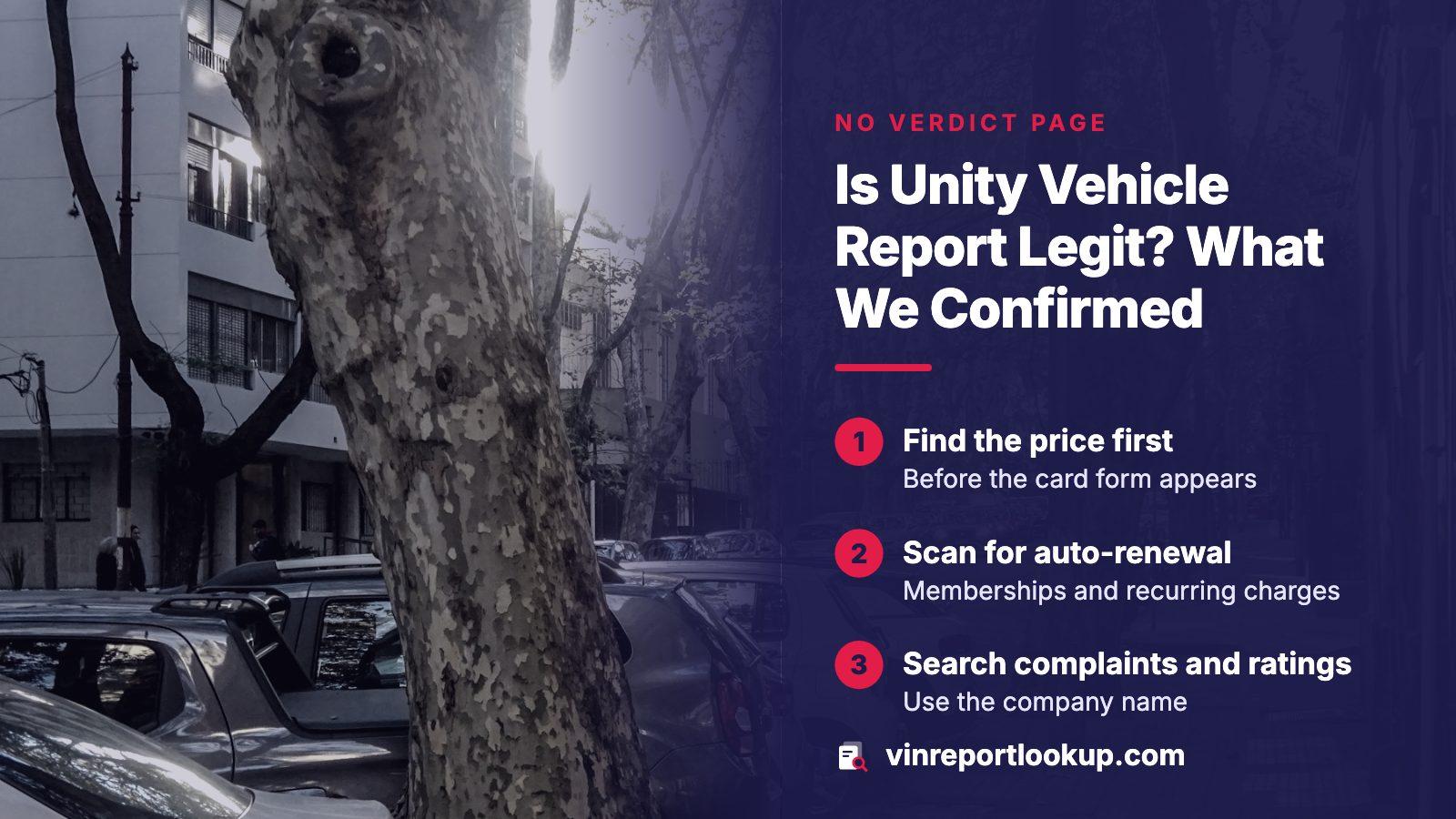
THE SHORT ANSWER
No verdict is possible from what we could read. The company's site failed to load on our end, so we have no price, terms or sample to describe. The federal list of approved NMVTIS sellers does not include the name, though that alone proves little. Before paying any report site, find the price, read the refund wording, and consider running a VIN report from a seller you can verify.
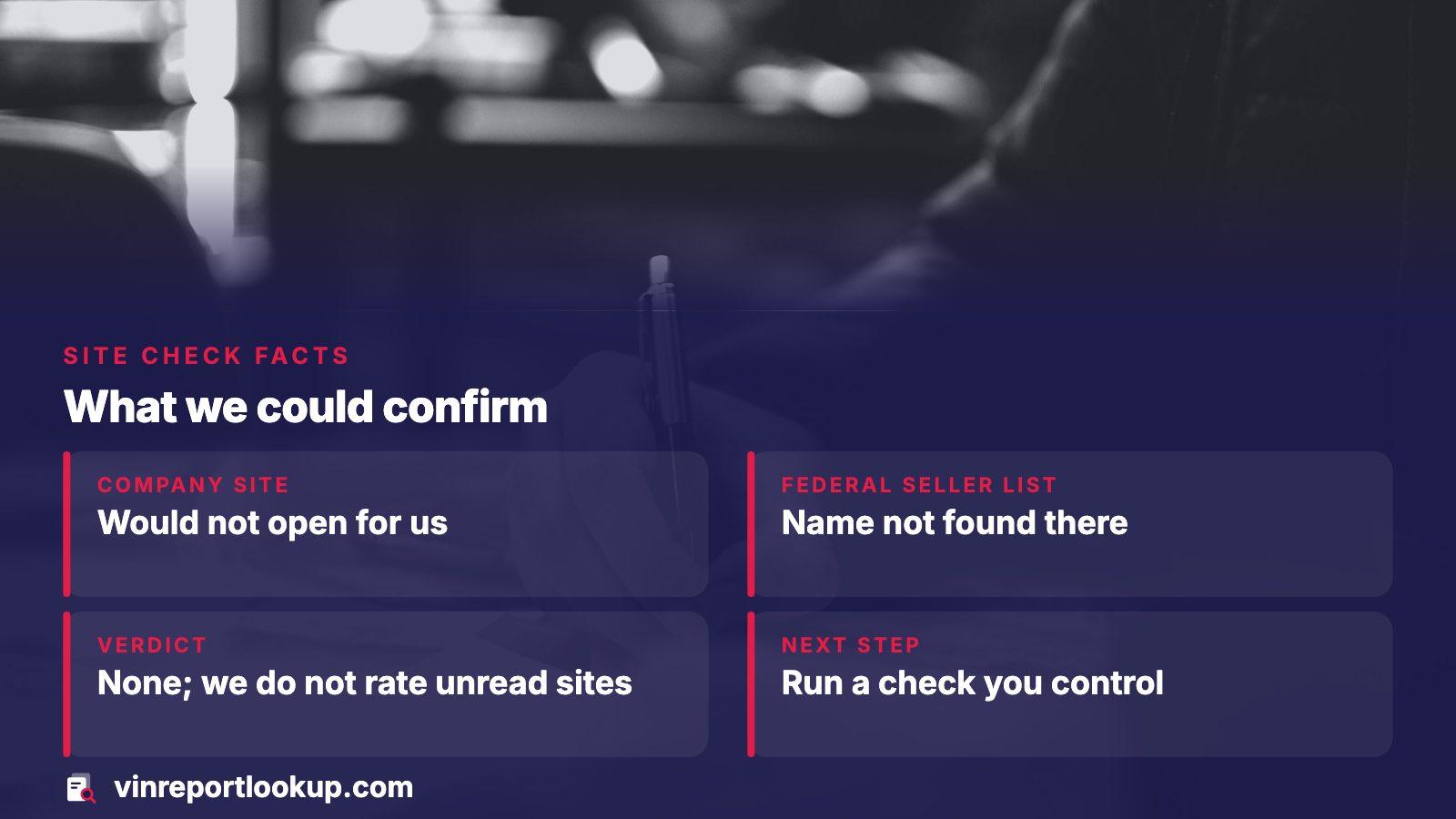
- Company site
- Would not open for us, so nothing from it is quoted
- Federal approved-seller list
- Name not found on the Justice Department page
- Typical NMVTIS fee range
- $8 to $12.99 per report, as of May 2020
- Verdict
- None; we do not rate what we could not read
Why this page gives no verdict
People who search for a site's name beside the word legit usually want one of two answers. Either the company will deliver a report, or the card will be charged for something unexpected. Answering either takes the company's own pages: its price, its terms, its sample report. When we tried to open the Unity Vehicle Report address, it failed to load, through plain requests and through a browser window alike.
So we have nothing to quote from the company. We did not substitute review sites or forum posts, since we had no way to trace any of them back to a first-hand source. A page that guessed would be less useful to you than one that says plainly where the evidence stops.
What the Justice Department's seller list shows
The federal title database behind many history reports, NMVTIS, is overseen by the Department of Justice, which publishes a page of approved sellers. We ran a text search of that page for the word Unity. Nothing came back, whether as a lead provider or as a site attached to one.
A missing name is weak evidence
A report site might license records from a listed firm and never appear there under its own name, so a blank result cannot show that federal data is unused. It also does not prove the site does. Treat it as a question to put to the company, not as an answer.
The same page notes that Carfax, DMVDesk and Experian give NMVTIS data to dealerships only, so consumers should not expect a retail NMVTIS report from them.
What a title-data report can and cannot tell you
The Justice Department's own questions page lists what the national records hold. Anything beyond that list has to come from other sources, which a report site would need to name.
| In federal title records | Not in them |
|---|---|
| Current and previous state of title | Repair history |
| Title issue date | Service visits |
| Latest odometer data | Anything a state has not yet sent |
| Theft history, brands and the date applied | Personal details about owners |
| Salvage history, including total-loss designations |
States also report on different schedules. A few states pass records along as each title transaction occurs; the rest batch them daily or take several days, so a fresh event may not show yet.
The scam pattern the FTC has warned about
In October 2018 the Federal Trade Commission described a trick aimed at people selling a car online. A caller or texter posing as a buyer wants proof of the car's past, and names the one site to get it from. The owner pays roughly $20 on a card, passes the document along, and hears nothing more. The FTC noted that those pages bounced visitors to .vin web addresses.
We are not saying Unity Vehicle Report does this, and we found nothing tying it to that scheme. The point is the general rule the FTC drew: if someone you have not met insists on a specific site, ask why. You may not know who runs it, and the site may exist to collect card details or to gather contact data that gets sold to marketers.
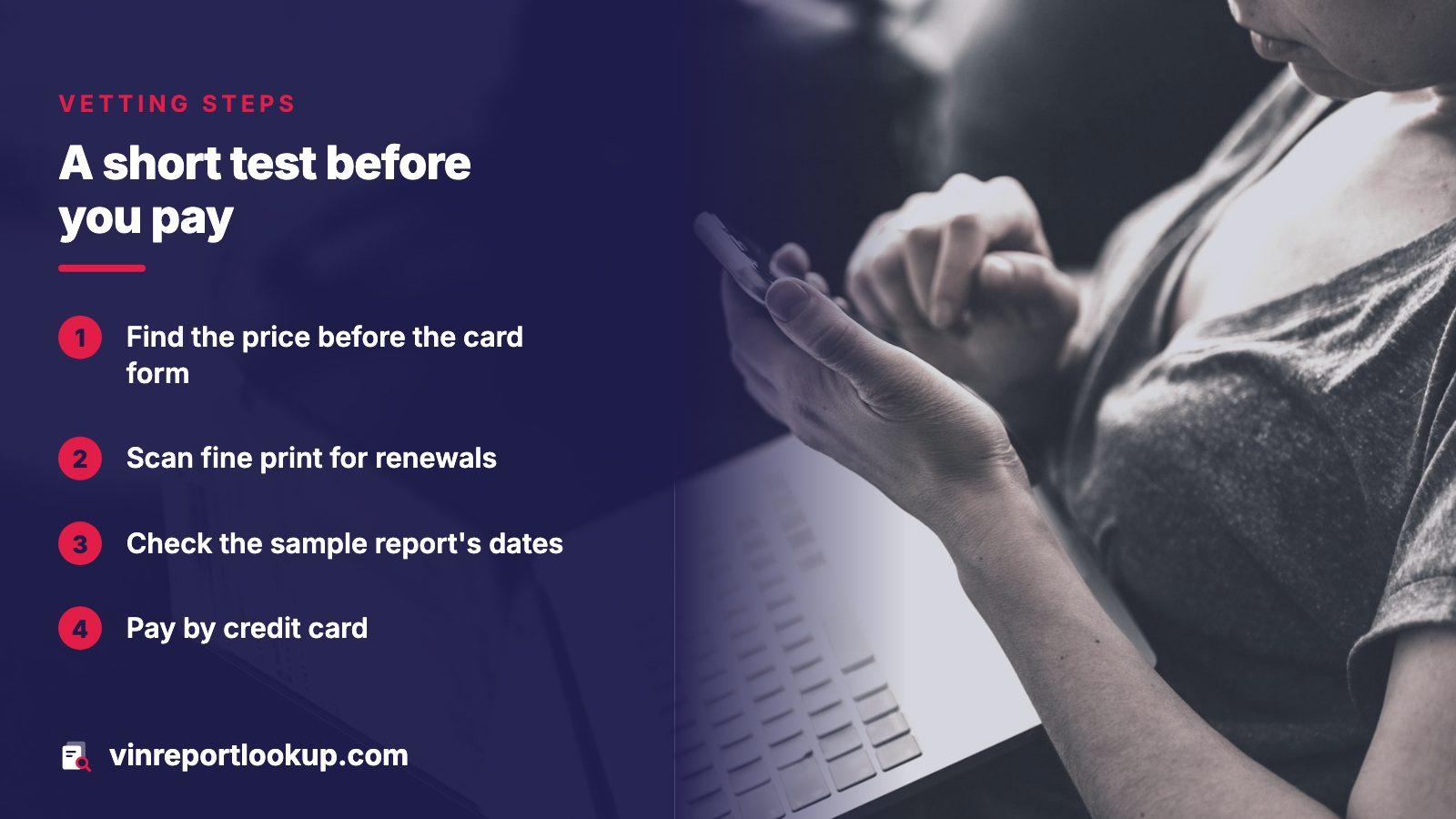
A short test before you pay any report site
- Find the price on a page you can read before the card form appears.
- Scan the fine print for recurring charges, memberships and auto-renewal.
- Look for a real sample report and check that its dates and odometer readings make sense.
- Check whether the site names an approved NMVTIS seller, then confirm the name on the federal page yourself.
- Pay by credit card, so a dispute route exists, and save the confirmation email.
- Search the company name with the words complaint, review, rating or scam, as the FTC suggests.
A site that fails the first step has already told you something. One that passes all six is still not guaranteed accurate, but you will have traded a guess for evidence.
If a buyer or seller points you to this site
Sellers sometimes get a message asking them to buy a report from a named site before a viewing. Buyers sometimes get a link from a seller who has already printed one. In both cases the report came from someone with an interest in the sale, which is a reason to run your own.
Copy the VIN off the vehicle, order the check on your own, and compare it with what the other person gave you. If the two disagree on title brands or mileage, ask the other party to explain before any money moves. A willing seller will not mind a second look; a pushy one is worth noting.
Running a check you control
On VINReportLookup you enter the 17-character VIN and see a free preview of what turns up. Buying the full report is one payment with nothing recurring. Amounts sit on the pricing page. The preview is the only part that costs nothing.
The federal fee range quoted above, $8 to $12.99 as of May 2020, covers title records alone. A fuller report may add sources beyond them, so compare what each seller lists, not just the number. If you are close to buying, book an independent inspection too, which the Justice Department also recommends because title data has no repair history.
What we could not confirm
- What the company charges, and whether a purchase renews.
- Its refund and cancellation terms.
- What its reports contain and where the data comes from.
- Who operates it, and whether it claims approved-seller status.
- Any independent rating or complaint record.
If you have the company's own pages open in front of you, those five items are the ones to read first. If you cannot find the price or the terms, that gap is your answer.
Where this information comes from
- Justice Department: approved NMVTIS data providers — the seller list we searched for the name, and the dealer-only note
- Justice Department: NMVTIS frequently asked questions — what title records hold, fee range, update timing and inspection advice
- FTC: Steering clear of vehicle history report scams — the seller-targeted report scam and the advice to search a company name
Sources and photos: Facts checked against the sources above in November 2026. Photos by Nikolai Kolosov, Michal Biernat and Owen Michael Grech on Unsplash; diagrams by VINReportLookup.
Keep reading
- Is VinSeeker legit? What its own pages show and what they leave outAnother report site read through its own pages and terms.
- Vehicle history report scams: how to spot a fake report seller before you payMore on the patterns that target buyers and sellers.
- Vehicle history report providers: who sells VIN reports and how they differHow the main report sellers differ in what they offer.
- Carfax vs NMVTIS: what each report shows and which to buyWhat federal title records add and leave out.
Frequently asked questions
Is Unity Vehicle Report legit?
We cannot say. The company's website did not open for us, so we read none of its pages. We can say that its name is not on the Justice Department's approved-seller page, which proves little by itself. Judge it by the price, terms and sample you can see before paying.
Does Unity Vehicle Report show up on the NMVTIS approved list?
Not on the version of the Justice Department page we read in November 2026. We searched for the name and found none. A company can still resell data bought from a listed provider, so ask the company which provider it uses, then check that name on the federal page.
A buyer told me to get a report from a specific site. Should I?
Ask why first. The FTC has warned about a scheme in which a supposed buyer sends a seller to a particular site, the seller pays about $20, and the buyer disappears. You can offer to run your own check, or to share a report from a seller you picked.
How can I tell if a report site is approved to sell federal title data?
Open the Justice Department's vehicle history page yourself and read the list of approved providers. Do not rely on a badge on the site's own page. Some providers also own extra websites, and the federal page lists those beneath the main provider.
What if I already paid a site I now doubt?
Contact the company first with your order details, then your card issuer if the charge looks wrong. Keep the confirmation email and a screenshot of the checkout. The FTC advises searching a company's name with complaint or scam before paying, which is easier to do before the charge.
Now check the car itself
The guide explains what to look for. The report shows what this VIN has on record.