THE SHORT ANSWER
Pick carVertical when the car may have been registered abroad, or when you want a refund route for a report that comes back empty. Pick AutoCheck when the car was made for the US or Canada and you care about auction records and its 1 to 100 Score. AutoCheck's single report was listed at $29.99 and carVertical's at $34.99 when we read both pages. Prices change, so confirm before paying.
- AutoCheck single report
- $29.99, with 21 days of data updates
- carVertical single report
- $34.99, cheaper per report in bundles
- Market limit
- AutoCheck covers US and Canadian-market vehicles only
- Return route
- carVertical returns empty reports automatically
Two reports built around different questions
These two reports start from opposite ends. AutoCheck is Experian's product and leans on dealers, auctions and state motor vehicle departments, with a tidy score on top. carVertical is a European-born service that sells itself on breadth: its US page talks about insurance, police and registration data from dozens of countries.
Neither one is a superset of the other. The useful question is which gaps matter for the vehicle on the lot: a decade-old pickup that never left Ohio and a grey-market hatchback shipped from Europe need different reports.
Start with the car's history, not the logo
Know the car's original market and you know which report has a head start. If the seller cannot say, that doubt is itself a reason to look at carVertical's wider reach.
What each one costs, and what the plan looks like
Both sell one-time purchases, per their own pages. The figures below were shown on each site when we read them, so treat them as a snapshot.
| Option | AutoCheck | carVertical |
|---|---|---|
| One report | $29.99, data updates for 21 days | $34.99 |
| Larger purchase | 5 reports for 21 days at $59.99 | 2 reports at $49.98 total, 3 reports at $59.97 total |
| Renewal | None; AutoCheck says it bills only if you choose to renew | Reports are spent from your account, no recurring charge stated on the pricing page |
| Search by | VIN or US license plate | VIN |
AutoCheck's five-report pack is time-boxed, which suits a weekend of lot visits. carVertical's bundles drop the cost per car and are advertised as saving up to 40%, which suits a longer shortlist.
Where the records come from
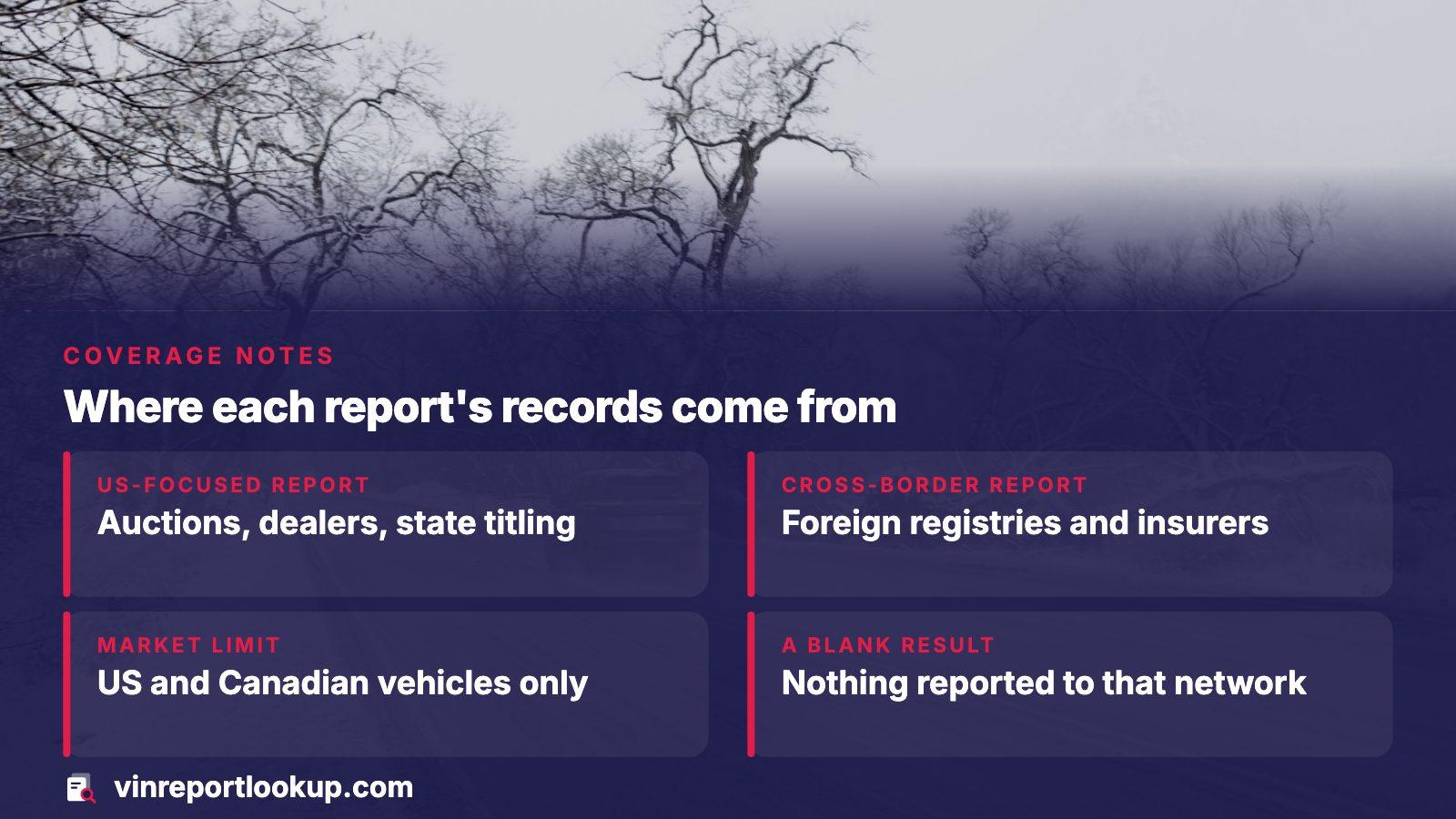
AutoCheck lists state DMVs, auctions, Canadian agencies, consumer protection bodies and dealers as inputs. Its business page adds data from 95% of US auction houses plus tens of thousands of accident sources. That is a dense North American net.
carVertical describes 1000+ databases across 48 countries, including registries, insurers and police. Its pages also advertise a Timeline of dated records, market price and past pictures where they exist. We found no breakdown of how many sources hold records for a typical US car, so expect the breadth to pay off mostly when a car crossed a border.
- AutoCheck: strongest on US auctions, dealers and state titling
- carVertical: strongest where a foreign registry or insurer holds a record
- Both: a missing record means nothing was reported to that network, not that nothing happened
Imported and grey-market cars
This is the clearest split. AutoCheck's FAQ says it reports only on vehicles manufactured for the US and Canadian markets, so a car built for another market should not be expected to return much.
An import arrives with its past mostly invisible to domestic databases. Mileage in a foreign registry, or damage logged by a foreign insurer, can matter more than anything filed here. There, carVertical's multi-country reach is a real reason to pay.
Even then, hold the result loosely: finding nothing abroad has not cleared the car. Pair it with an inspection and ask for the import paperwork.
Auction records, the Score and what a summary hides
AutoCheck's differentiator is a number. Its Score, scaled 1 to 100, estimates whether the car will still be on the road in 5 years, and only means something beside the Score Range for similar cars. The company's example: an 84 against a peer range of 76 to 81 beats its group, while an 89 against 90 to 95 falls short of its group.
Accidents, brands, odometer trouble, frame or water damage, theft and taxi use all pull it down, as do age, class and owner count. It summarizes the records; it does not replace them.
Read the lines, then the number
A good Score on a car with a salvage entry in the body of the report is not a clean car. Facts about this vehicle outrank a peer-group estimate every time.
carVertical showed no equivalent score on the pages we read; you read its damage, mileage and timeline entries yourself.
The federal title record and who can sell it to you
The Justice Department's NMVTIS program gathers five indicators, among them brands, odometer readings and salvage history, from sources the law requires to report: state title offices, insurers and scrap or recycling businesses. Its approved-provider list for the public includes CarVertical.com.
The same page carries a notice that private buyers cannot receive NMVTIS reports through Experian, which sits behind AutoCheck, or through two other named firms, because those supply dealerships only. That does not make an AutoCheck report worthless; it means the government title feed is not what you are buying there.
If a federally sourced brand check matters, read the roster rather than a sales banner.
Refunds, returns and buyback promises
The two companies protect you in different ways. carVertical's return policy handles reports that come back empty or wrong. A report with no history in the odometer, damage or timeline sections goes back to your balance automatically and stays usable for 6 months from purchase. Otherwise you can email support within 30 days of generating the report, citing errors or a report that never arrived.
AutoCheck's protection is a buyback, and it is narrow. It covers a missed state-reported title brand, such as salvage, flood or rebuilt, and pays up to 110% of a published retail value plus up to $500 in accessories. You register within 90 days of buying the car, and it does not cover accidents, insurance losses or rollback reported by commercial sources.
- carVertical: protects the report purchase
- AutoCheck: protects the car purchase, for one category of record
- Neither one replaces an inspection by a mechanic you trust
A quick way to decide before you pay
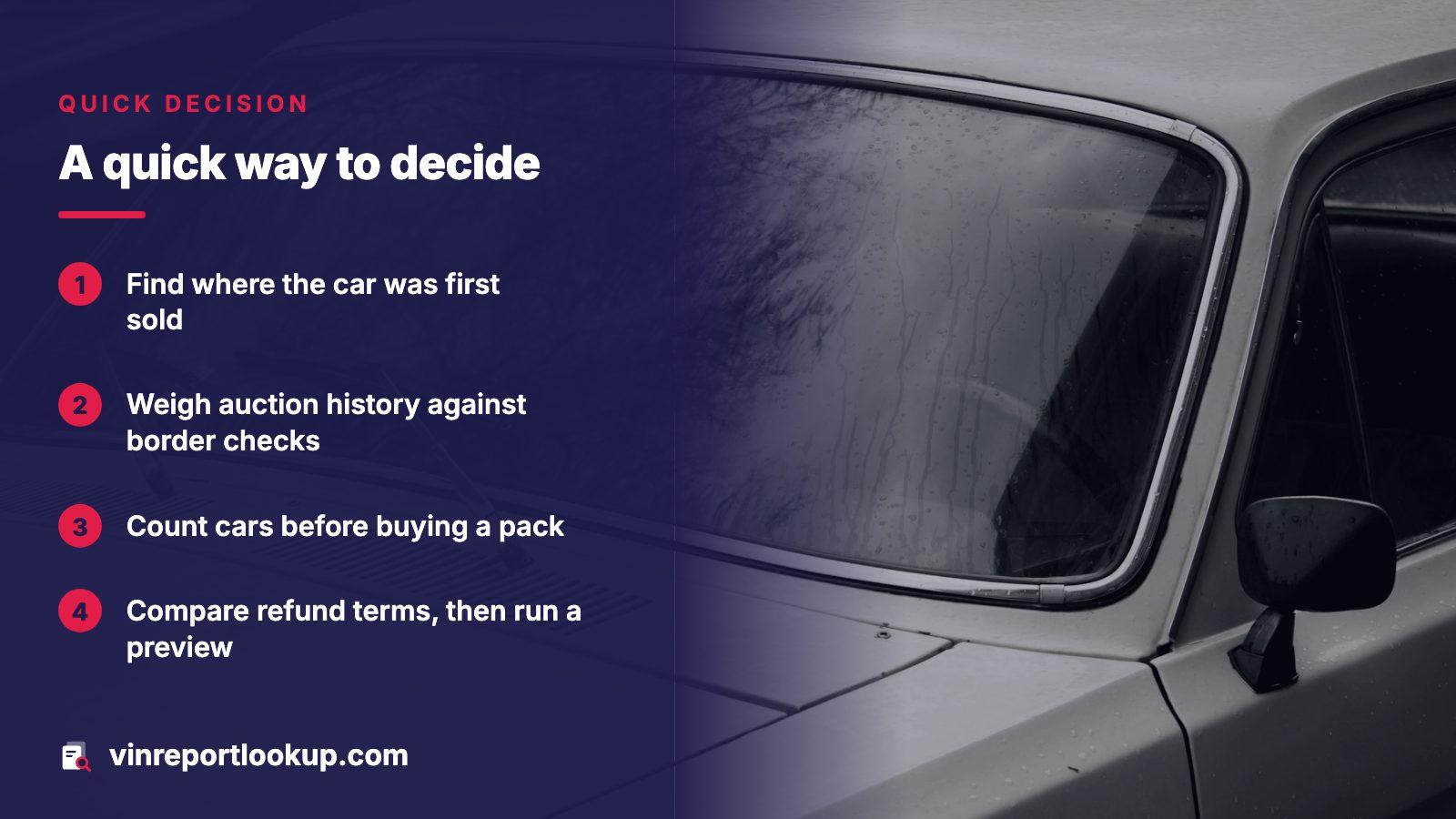
- Find out where the car was first sold. If it was outside the US or Canada, AutoCheck is out.
- Decide whether auction history or a cross-border mileage check worries you more.
- Count the cars on your list; a pack beats a single report only when you will use it.
- Read both companies' refund terms against your worst case: an empty report, or a missed brand.
- Run a free preview first, then buy one report for the car you are serious about.
Read the 17 characters off the vehicle, not off an ad, and check that they match the paperwork before you enter them into either service.
Running the check on VINReportLookup
VINReportLookup opens with a free preview for the VIN you type in. Only if the preview looks worth pursuing do you pay, once, for the whole record: one report, or a pack sized 3, 5 or 10. No subscription follows. The pricing page has the amounts.
The preview is free; the report is not. Use it to see whether title brands, damage entries, odometer readings or auction records exist before choosing what to buy, and keep the other report in reserve if the car is an import.
Where this information comes from
- AutoCheck: report plans — Plan prices, the 21-day access window and the auction coverage claim.
- AutoCheck: FAQ — What a report covers, data sources, market limits and renewal terms.
- AutoCheck: Score — How the 1 to 100 Score and the Score Range work.
- AutoCheck: Buyback Protection — What the buyback covers and excludes, and its registration deadline.
- carVertical: pricing — Single and bundle prices and the company's own data claims.
- carVertical: report return policy — Automatic returns, the 30-day request window and the 6-month validity.
- Bureau of Justice Assistance: approved NMVTIS data providers — Which providers sell the federal title record to the public, and the notice about dealer-only firms.
Sources and photos: Facts checked against the sources above in November 2026. Photos by Iain, Tigran Shishmanyan and Zoshua Colah on Unsplash; diagrams by VINReportLookup.
Keep reading
- AutoCheck review: when it earns its fee, what it misses, and what else to buyA closer look at AutoCheck alone before you commit.
- carVertical alternatives: other VIN reports, what they cost, what they showOther ways to cover a car with a foreign past.
- AutoCheck alternatives: other VIN reports, and what each one showsWhat else to weigh if the Score is not what you need.
- carVertical vs EpicVIN: which VIN report to buy, and what we could verifyThe same carVertical question against another approved seller.
Frequently asked questions
Is carVertical or AutoCheck cheaper?
For one car, AutoCheck's single report was listed lower than carVertical's when we read both pages. Packs change the math: carVertical's bundles lower the per-report cost, while AutoCheck's pack runs for a fixed 21 days. Compare the total for the number of cars you will check, and confirm prices at checkout.
Can AutoCheck run a car imported from Europe?
Its FAQ says it reports only on vehicles manufactured for the US and Canadian markets. A car built for a European market falls outside that, so the report may return little. carVertical describes searching registries in 48 countries, which is why it is the more logical first try for imports.
What does a clean report actually prove?
Only that nothing reached that company's sources by the day you ran it. AutoCheck says it may miss accidents, and a no-records message can also mean a very new car. Add an inspection and the title paperwork before you trust it.
Does AutoCheck's buyback protect me from accident history?
No. It covers a state-reported title brand that the report missed, and it excludes accidents, insurance loss and rollback from commercial sources. You also have to register within 90 days of buying the car, and only if the report carried the eligibility badge.
Which report should I buy if I can only afford one?
Choose by the car. A US-built car with a long domestic life points to AutoCheck's auction and title coverage. A car that may have lived abroad points to carVertical. When neither fits cleanly, run the free preview first and let what it shows decide which paid record is worth buying.
Now check the car itself
The guide explains what to look for. The report shows what this VIN has on record.