THE SHORT ANSWER
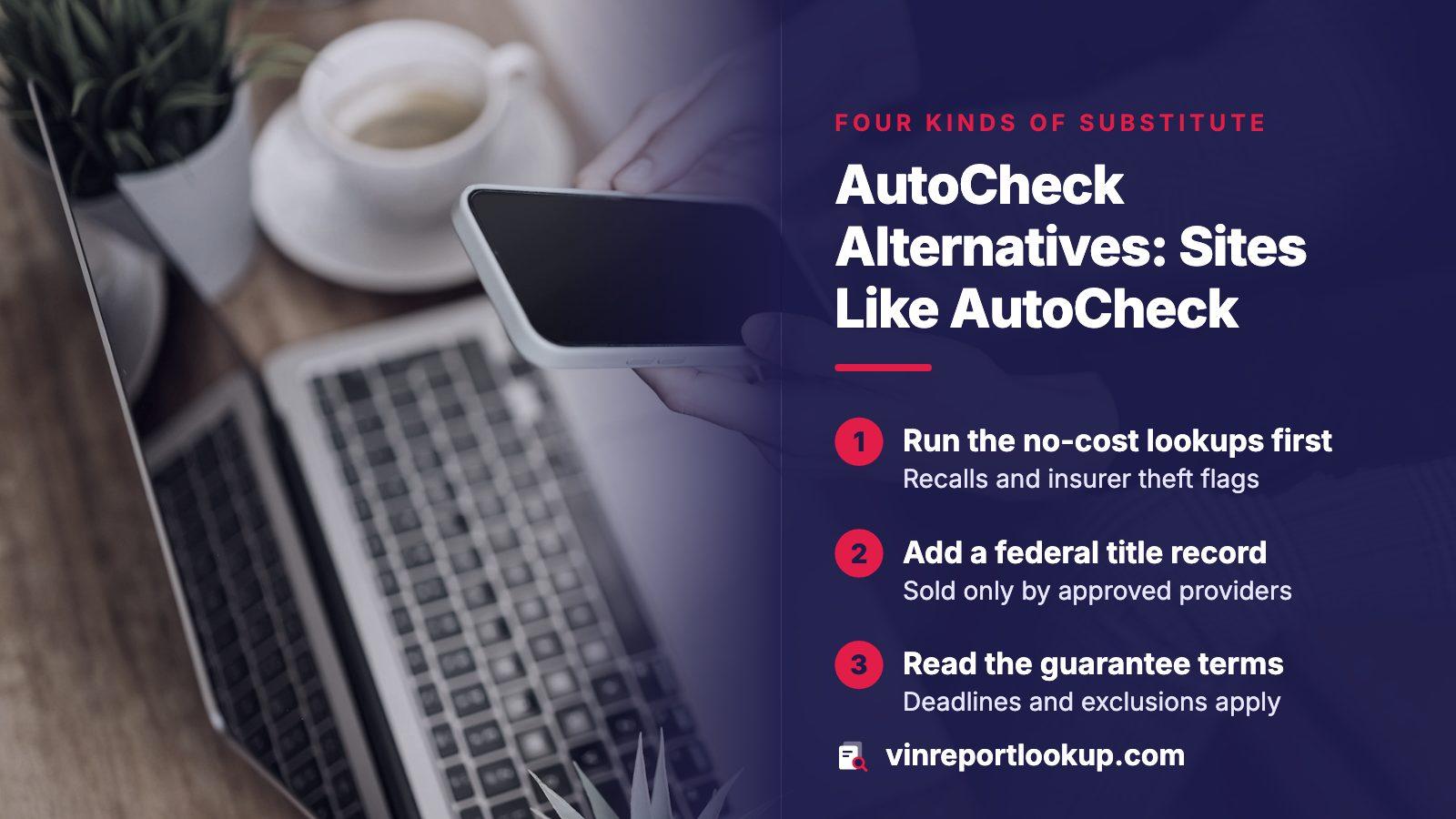
The nearest substitute for AutoCheck is another paid history report assembled from DMV, insurer and auction data. VINReportLookup is one: you see a preview of the VIN without paying, then buy once. Cheaper partial options exist. NICB VINCheck screens insurer theft and salvage flags, NHTSA lists open recalls, and an approved NMVTIS provider sells the federal title record. None replaces a full report alone.
- AutoCheck's own claim
- Data from hundreds of sources, with a 1 to 100 score
- NICB VINCheck
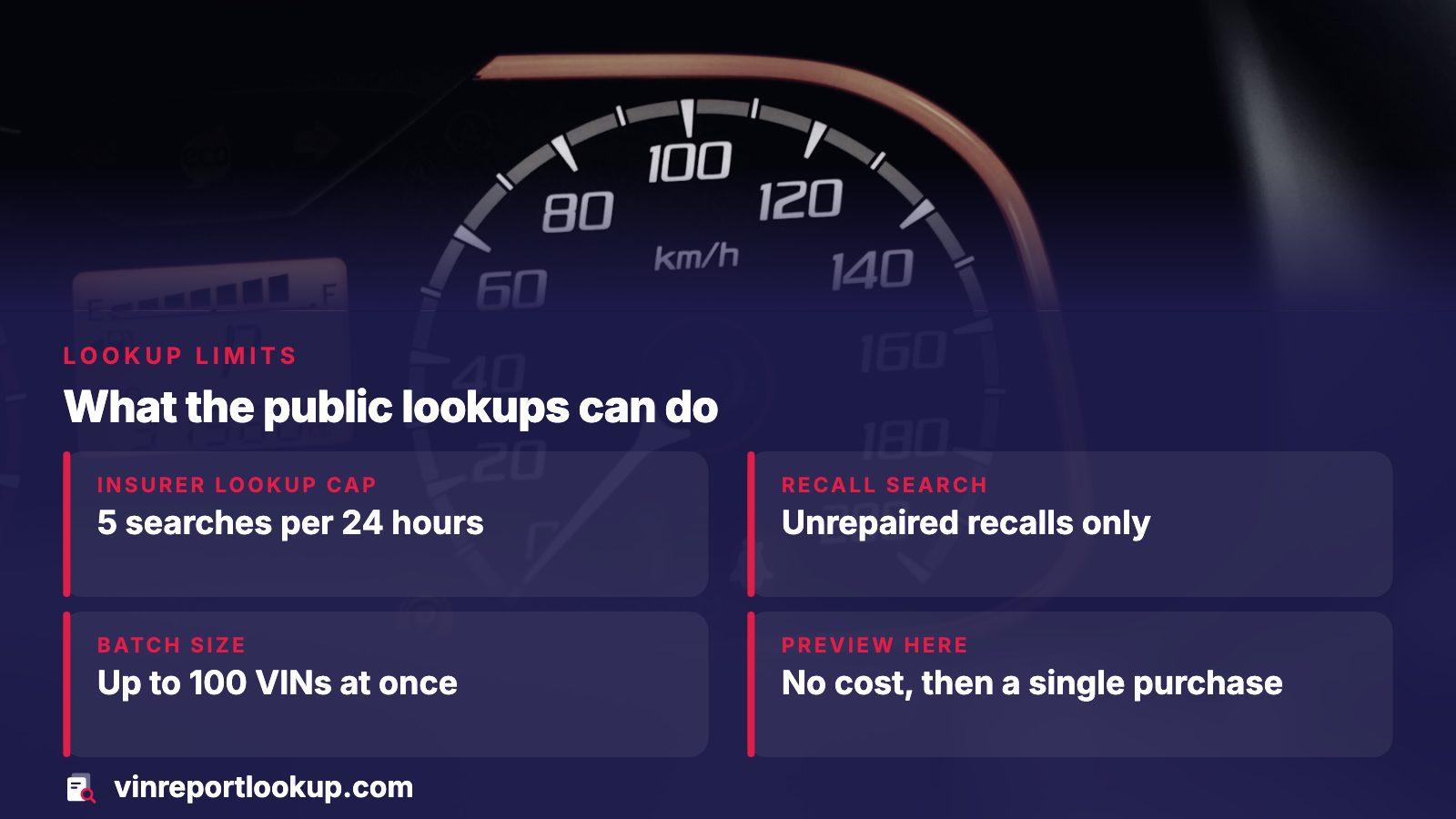
- Free, five searches per 24 hours per IP address
- NHTSA recall search
- Lists unrepaired recalls only, up to 100 VINs at once
- VINReportLookup
- Preview first at no cost, then a single purchase, nothing recurring
Why shoppers go looking for something other than AutoCheck
Three complaints come up more than any other. Some buyers want to see what a report holds before paying for it. Some dislike a plan that runs for a set term when only one car needs checking. Others want a second opinion, because one network can hold an entry that another never received.
All three are reasonable. AutoCheck's own pages say its multiple-reports plan lets you run any number of VINs for one fee during the subscription term, and that the plan renews only if you choose to renew it. That suits someone walking a dealer lot. It suits a buyer with a single car in mind less well. The pages I opened did not print a dollar price, so compare the figure shown at checkout with whatever else you are weighing.
What AutoCheck says its report covers
A fair comparison starts from the company's own description. Its FAQ lists salvage and junk records, hail, flood and fire damage, mileage discrepancies, gray market vehicles, lemon designations, rental, taxi and fleet use, abandoned or forfeited vehicles, theft and liens.
It also admits two limits. Accident damage shows up only when that information has reached the company, so some crashes will be missing. And it gives no names or details for earlier owners. Its data page lists insurers, auctions, collision shops, service facilities, state DMVs and manufacturers as sources, and the report carries a 1 to 100 score that rates a car against similar ones for the odds of it still being on the road 5 years out.
Scope worth knowing
AutoCheck reports only on vehicles built for the United States and Canadian markets. A gray-market import or a car from before 1981 may come back with nothing, and that blank is a limit of the product, not a clean bill of health.
The four kinds of substitute, and the question each answers
Most lists of alternatives mix products that do different jobs. Sorting by job is more useful than sorting by brand.
| Substitute | What it can tell you | What it leaves out |
|---|---|---|
| NICB VINCheck | Whether member insurers listed the VIN as an unrecovered theft, or as salvage or flood | Insurers that do not take part, plus accidents, owners and odometer history |
| NHTSA recall search | Unrepaired safety recalls on that VIN | Repaired recalls, very new campaigns, small makers and non-safety campaigns |
| Federal title record | Brand history, plus the newest odometer figure, insurer total-loss rulings and salvage yard hand-offs | Crash detail, service visits and most auction photos |
| Paid history report | One document drawn from several record types | Anything never reported to its sources |
Only the last row is a true like-for-like substitute. The other three are cheaper, narrower and worth running alongside it.
Start with the free lookups, and know their edges
NICB offers VINCheck at no charge. Type a correct 17-digit VIN and it looks for theft, salvage and flood entries supplied by participating member insurers, a group NICB says accounts for 92.49% of premium written nationwide. Each visitor gets five searches in any 24 hours. NICB is blunt that this is a screening tool, not a full history, and that buyers should do more homework.
NHTSA's search lists a recall only while it remains unrepaired, so a result of zero unrepaired recalls says nothing about the car's past. Older campaigns, beyond 15 years, fall away unless the maker extended coverage. Each lookup takes about a minute, so run them first. They tell you whether a car earns a paid report.
The federal title record and who may sell it to you
The Justice Department operates NMVTIS, and its consumer page says a search can surface the current title and its brand history, the odometer figure most recently reported, and an insurer's decision to treat the car as salvage or written off. Any hand-off to a recycler or salvage yard shows too. The department calls the report intentionally concise.
Its provider page splits sellers into two groups. One serves everyone, consumers included. The other is commercial only and includes Experian, and the page spells out that individuals cannot get NMVTIS reports through Experian, Carfax or DMVDesk, since those firms supply dealers. That is a point about the federal title product alone. It does not describe what AutoCheck's own report holds.
Gaps the government itself flags
The department cautions that a result can look clean when some reporting entities have not yet submitted their data, and it suggests also requesting the state's complete title record. A clean federal result is encouraging, not proof.
Where a one-time VINReportLookup report fits
VINReportLookup suits the buyer who wants a single car examined and no plan afterward. You type in the VIN, look over the preview that costs nothing, and make the call. Going ahead means one payment for that report. A bundle of 3, 5 or 10 is there if several cars are competing. Nothing renews, so no cancellation step exists.
Inside you get brands from the title, crash and damage entries, mileage readings over time, salvage and auction lines with photos, liens, theft entries and open recalls, all in one document. The pricing page carries the current amounts, and the sample report previews the layout before you spend a cent. Like any history product, it reflects only what its sources received.
Weigh the guarantee before it decides for you
AutoCheck's buyback program is a real feature and deserves a careful read. It carries no extra charge on qualifying vehicles. The payout is capped at 110% of J.D. Power's NADAguides retail figure plus as much as $500 for aftermarket items, and it applies only when a state title brand had reached Experian before the report date yet was left off.
- Registration is due within 90 days after the purchase.
- A claim has to be filed inside one year counted from the report date.
- The branded title needs to be at least 60 days old when the report was run.
- Accident, insurance-loss and odometer-rollback entries from commercial sources fall outside it.
- Claims travel by mail, and the company quotes 4 to 6 weeks as the typical review.
If a service you are considering advertises its own guarantee, put the same questions to it: which records it covers, what the deadlines are and what the payout is measured against.
A practical order for choosing
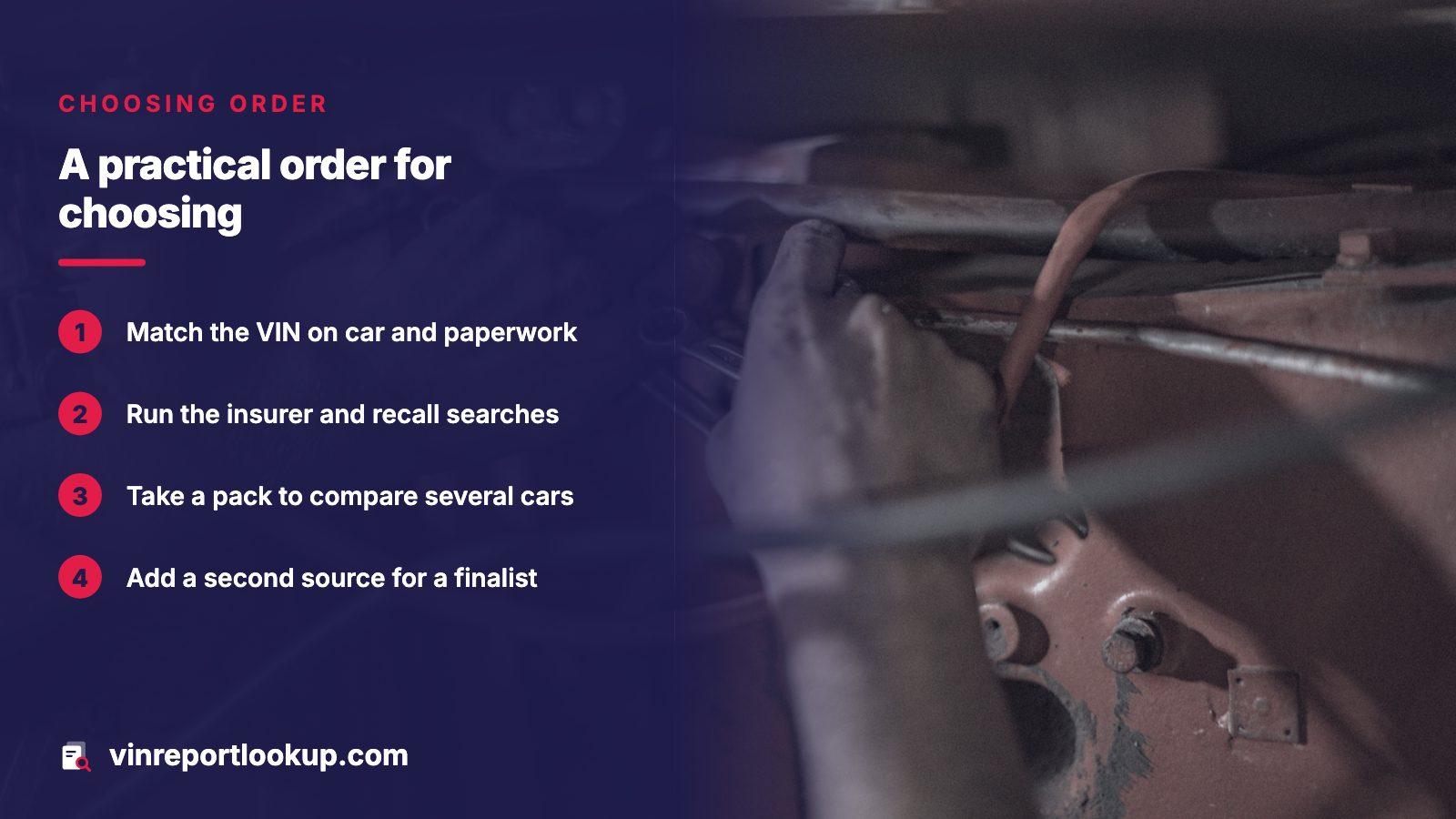
- Find the VIN on the car itself and on the paperwork, and confirm the two match.
- Run NICB VINCheck and the NHTSA recall search. Drop any car that fails either.
- For a short list of several cars, take a pack so each one gets the same report.
- For a final candidate, add a second source: a federal title record or another paid report.
- Book an independent mechanic's inspection, which no database replaces.
Two reports for one car may differ with neither being wrong, since each network is built from different reporters. Use a mismatch as a cue to question the seller.
Where this information comes from
- AutoCheck: frequently asked questions — What the company says its report covers, its limits and how its plans renew.
- AutoCheck: vehicle buyback protection — Payout basis, deadlines and exclusions of its guarantee.
- AutoCheck: data sources — The record sources the company lists for its reports.
- Justice Department NMVTIS: approved providers — Which providers sell federal title records to consumers and which sell only to dealers.
- Justice Department NMVTIS: for consumers — What a federal title search shows and where it can miss.
- NICB: VINCheck — Free insurer theft and salvage lookup with its daily limit and caveats.
- NHTSA: check for recalls — What the recall search does and does not show.
Sources and photos: Facts checked against the sources above in November 2026. Photos by Jakub Żerdzicki, Nina Mercado and muhammad dennisa on Unsplash; diagrams by VINReportLookup.
Keep reading
- AutoCheck review: when it earns its fee, what it misses, and what else to buyA closer look at what the AutoCheck report offers before you decide.
- AutoCheck cost: what its two plans charge and what the fee coversHow AutoCheck charges and how that compares with a single payment.
- AutoCheck vs NMVTIS: pick the report that matches your riskHow a premium report differs from the federal title record.
- Sample reportSee the layout of a full report before buying one.
Frequently asked questions
What is the best free alternative to AutoCheck?
No free tool replaces a full history, but two cover real ground. NICB VINCheck screens a VIN against insurer theft, salvage and flood entries, and NHTSA's search lists unrepaired recalls. Neither reports accidents, owners or odometer history, so use them to rule cars out, then pay for a report on the one you intend to buy.
Are there sites like AutoCheck that show a preview before I pay?
Yes. VINReportLookup begins with a preview of the VIN that costs nothing, then sells the full report as a one-off purchase, with bundles of 3, 5 or 10 for shortlists. No subscription needs cancelling. The preview alone carries no charge, and the report is paid, so see the pricing page for current amounts.
Can I get an AutoCheck-style report without a subscription?
Some services sell one report per purchase with no renewal. AutoCheck's own FAQ says its plans renew only if the customer chooses to renew, but its multiple-reports plan runs for a term. When comparing, look at whether you pay per report, per term or per pack, and what happens to your saved reports when the term ends.
Does the federal title record replace an AutoCheck report?
No, it is narrower. The Justice Department says a federal search covers title brands, the latest odometer reading, insurer total-loss entries and salvage yard transfers, and calls its report intentionally concise. Accident detail and service history are absent, so pair it with a fuller report instead of treating it as a stand-in.
Why do two VIN reports on the same car disagree?
Each service builds its report from the businesses and agencies that report to it. A body shop, insurer or auction feeding one network may never feed another, and reporting also trails events. A difference is a prompt to question the seller and book an inspection, not proof that one report is wrong.
Now check the car itself
The guide explains what to look for. The report shows what this VIN has on record.