THE SHORT ANSWER
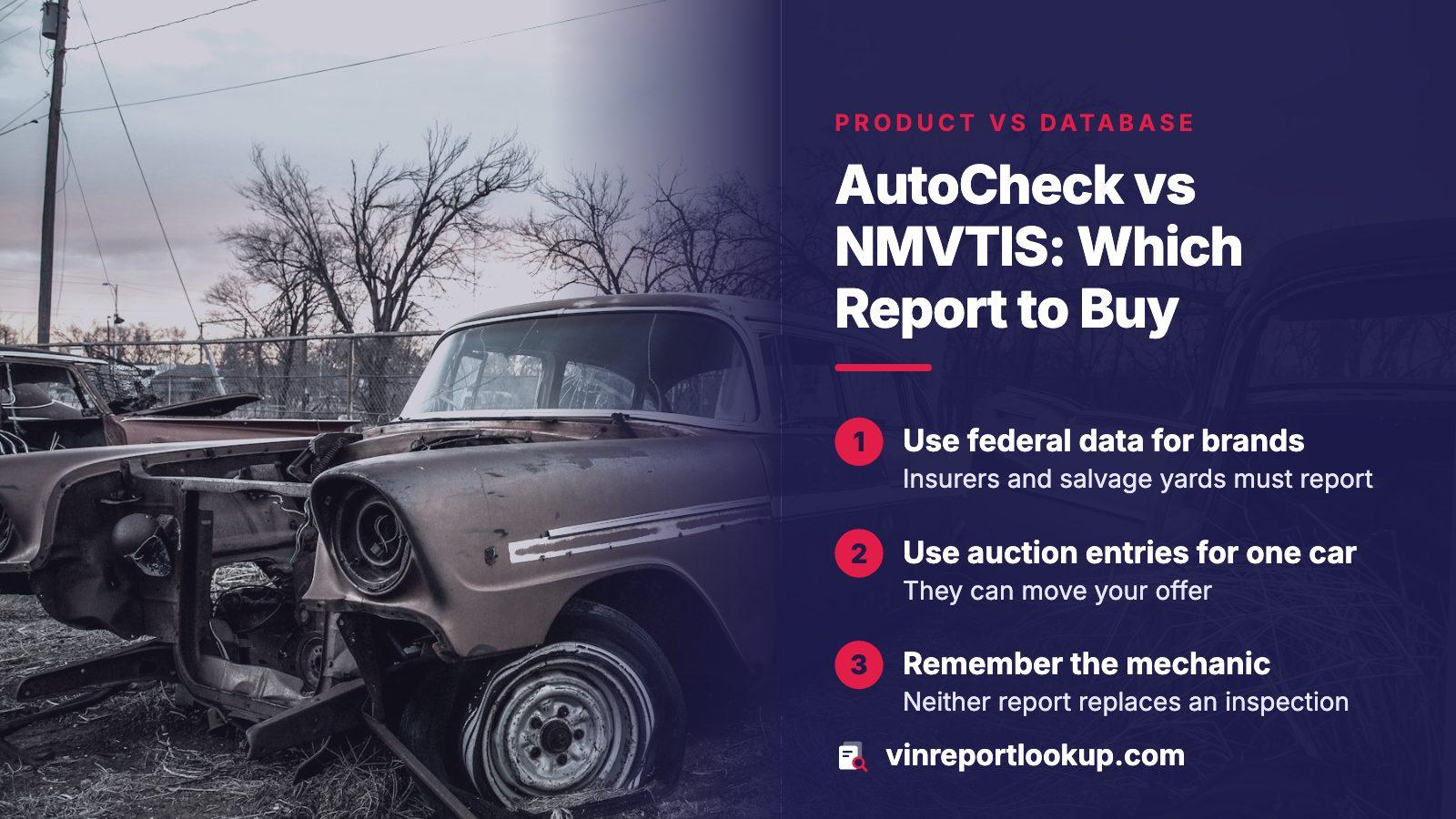
Buy the NMVTIS-based record when the worry is a hidden brand, a total loss or a salvage-yard stop, because federal law forces insurers and salvage businesses to report into it. Buy an AutoCheck report when auction and accident entries on a single car could move your offer. Neither one replaces a mechanic, and the two overlap only in part.
- NMVTIS items
- Title state, brands, mileage, write-offs, salvage
- AutoCheck score scale
- 1 to 100, read against a peer range
- AutoCheck own price page
- $29.99 for one, $59.99 for five over 21 days
- Federal fee per Justice Department
- Federal fee: up to $4, or $8 to $12.99, by page
A product and a database are not the same kind of thing
The comparison trips people up because the two names sit at different levels. AutoCheck is a report you buy from one company, Experian, whose pages describe it as backed by that company's data. NMVTIS, the federal title-information network for motor vehicles, has been operated by AAMVA since 1992 with the Justice Department overseeing it. Government-approved vendors sell reports drawn from it.
| Question | AutoCheck | NMVTIS report |
|---|---|---|
| Who stands behind it | Experian, per AutoCheck's own pages | Justice Department oversight, AAMVA as operator |
| Length | Long, with a score on top | Intentionally concise, shorter than most history reports |
| Repair and service entries | Listed among its source types | Outside its scope, per the Justice Department |
| Bought by a private buyer | Yes, on autocheck.com | Yes, from a vendor on the public half of the roster |
The five things a federal title record tells you
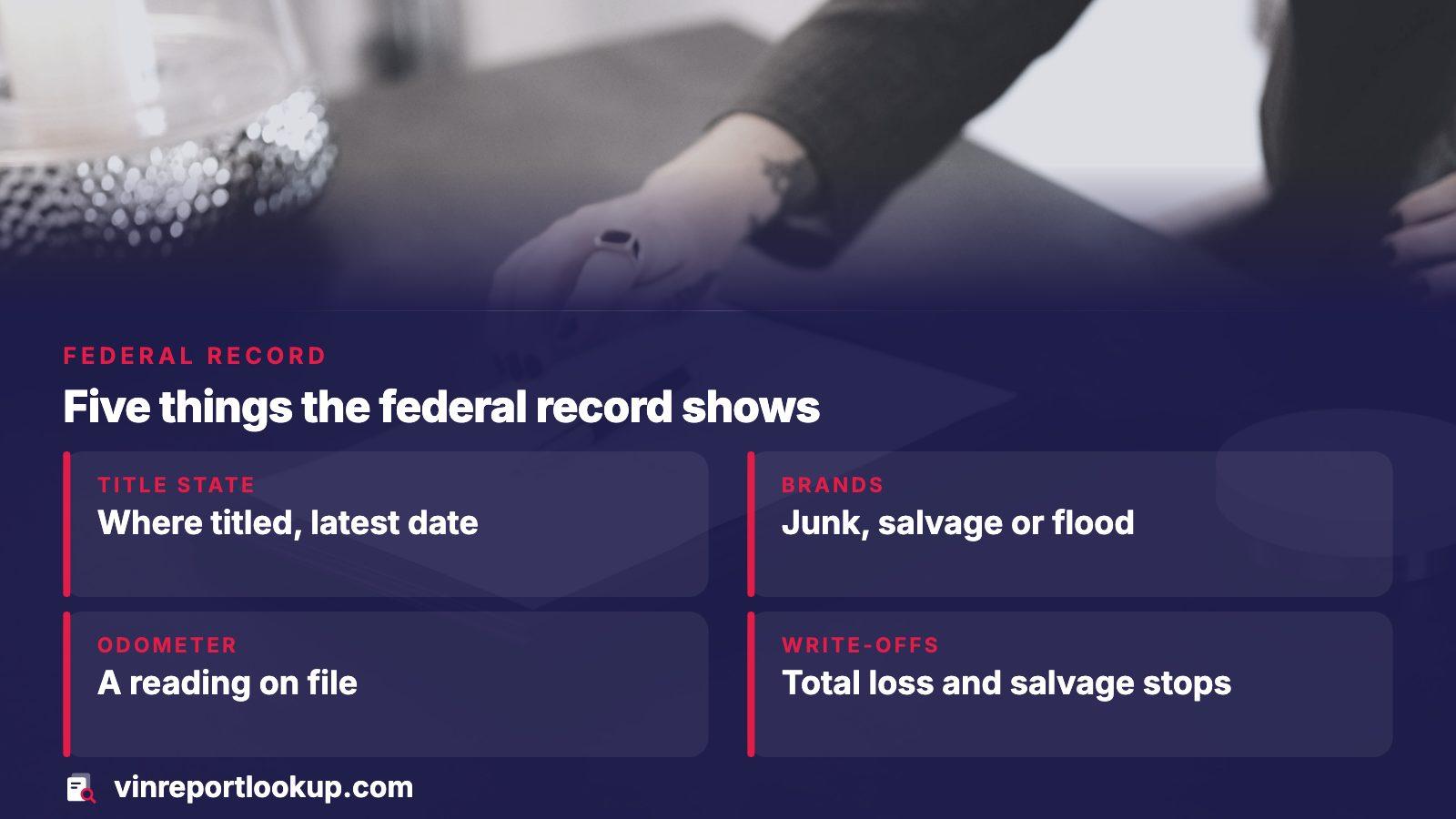
Per the Justice Department, the report is built around just five indicators:
- The state where the car is titled now, and the date of the latest title.
- Any brand a state has applied, like junk, salvage or flood.
- An odometer reading.
- Whether a total loss was ever declared on it.
- Whether it passed through salvage.
Its pull comes from who must report. Federal law obliges state title offices, insurance carriers, recyclers and both kinds of yard to send in data on a schedule. A short report is therefore not a weak one, and the government calls a clean result a good thing.
Where AutoCheck says its entries come from
AutoCheck's data page names a wide spread of feeds: state motor vehicle agencies, wholesale and salvage auctions, collision shops, service facilities, insurers, manufacturers, police, dealers, rental fleets and inspection stations. For a buyer, the interesting entries are the ones a title never carries. A salvage auction stop on a car that was never branded is the example the page itself gives.
The dealer packages on the order page boast of auction coverage at 95% of U.S. auction houses. That figure sits on the dealer-facing part of the order page, so treat it as the company's own description of a trade product, not a measured rate for the consumer report.
What this page could not confirm
AutoCheck's pages say state agencies feed it, but they do not say its report contains the NMVTIS federal record. The Justice Department roster does not list AutoCheck by name. Do not assume an AutoCheck report equals an NMVTIS report, or the reverse.
Why the roster matters before you pay anyone
The Justice Department publishes its approved providers in two groups. The public group serves consumers, dealers and lenders alike. The other group serves business customers only, and Experian.com sits there. A bold line on that page says Carfax, DMVDesk and Experian hand NMVTIS data to car dealers only, never to individual shoppers.
That line is about the federal data feed, not about AutoCheck's other records. It does mean the clean way to buy the federal record is from a seller on the public side, or a site the roster shows beneath one. VINReportLookup supplies its NMVTIS title, brand and odometer records through ClearVin LLC, an approved provider, and adds records from other sources.
A score is a summary, a brand is a fact
AutoCheck's score runs from 1 to 100 and means little alone. Its own page shows an 84 that beats a similar car's peer range of 76 to 81, and an 89 that falls short of a range of 90 to 95. The range depends on age, class, mileage and owner count, so the number compares you to peers, not to a standard.
A federal record has no score. It lists brands and loss events, so a hit is either there or not. Read the score for a quick sort between cars, then read the entries behind it on the one you like.
When the two disagree
A reassuring score beside a salvage entry is a contradiction in your favor to resolve before buying, not a pass. Believe the dated entry about this car over the statistic about its peers.
What each route costs
On its order page AutoCheck prices one report at $29.99 and five at $59.99, each with 21 days of data updates and no recurring fee. Those are the company's own figures, so check the page on the day you buy.
The Justice Department gives two federal price statements that disagree. Its buying tips page tells shoppers to expect up to $4 a report, while its FAQ answers with $8 to $12.99 per report, a range last cited for May 2020, and adds that vendors differ. Neither is a quote, so read the seller's price before paying.
VINReportLookup shows a free preview for any VIN. If the preview justifies it, the full report is one purchase here: a single report, or a pack of 3, 5 or 10 for a shopping spree. Nothing auto-renews, and amounts live on the pricing page.
Where both can mislead you
- Coverage is incomplete. The Justice Department counts 87 percent of the U.S. fleet inside NMVTIS, but its own page says fewer than all states report. That leaves room for false negatives, and the department says private databases share the problem.
- States brand differently. A car held by a salvage yard need not carry a brand, and others never created a flood designation.
- A total loss label can mislead. The federal pages warn that a total loss entry is not always a wreck: an insurer can write off a stolen car that stays missing for 30 days, and the entry survives if the car is found in good shape.
- AutoCheck's buyback promise covers state-reported title brands only. Accident entries and other commercial-source records fall outside it.
A record that says nothing proves the system saw nothing. It does not prove the car is clean, which is why a hands-on inspection stays on the list.
Picking one for the car in front of you
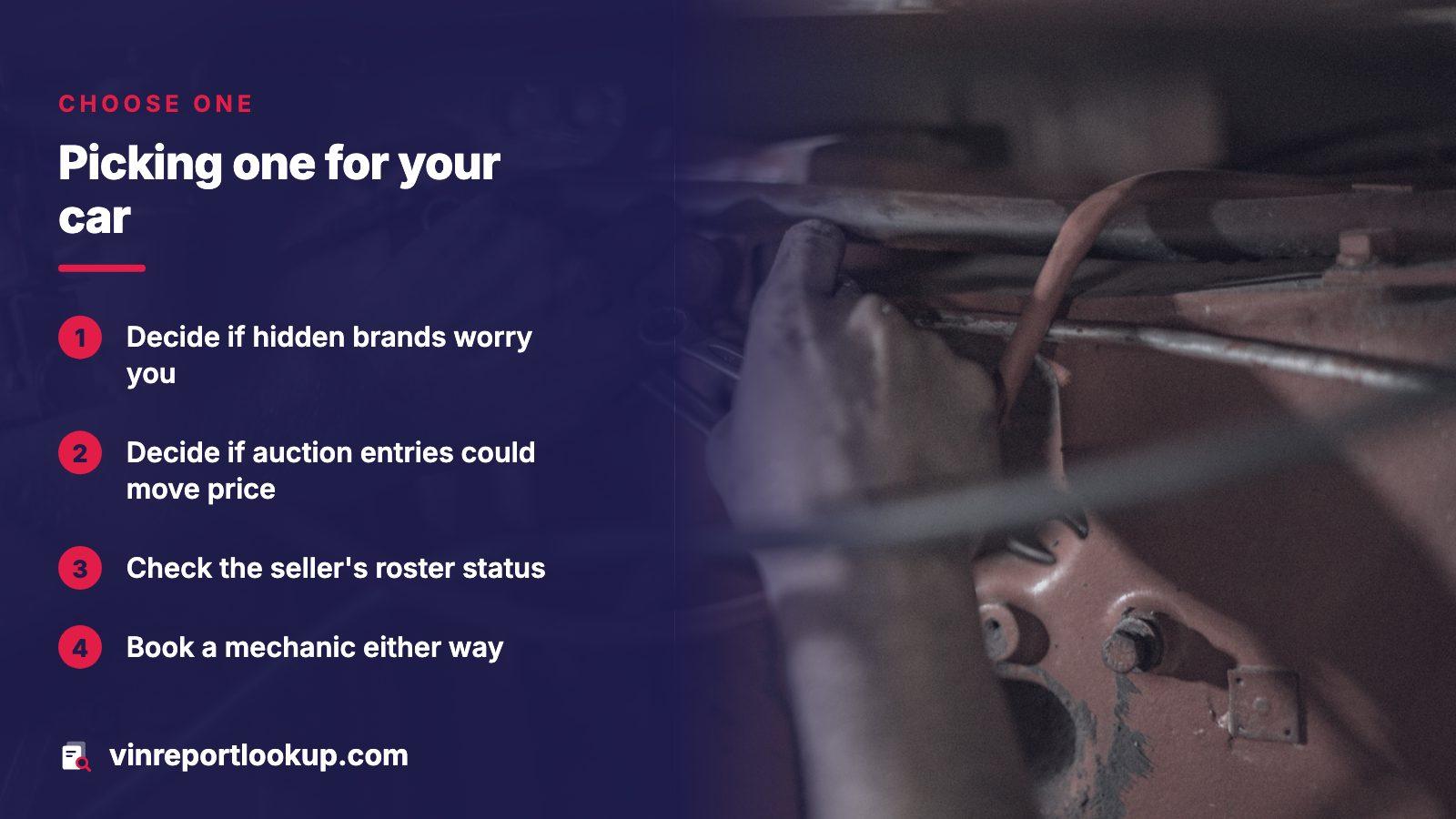
Start with the risk you can least afford. If the car comes from a flood region or sells far below market value, a title brand check is the priority, and a federal record answers it directly. If it is a late-model car with a clean-looking title, auction and accident entries matter more, and AutoCheck lists those as sources.
Run the VIN on VINReportLookup for the free preview before spending anywhere. It costs nothing and shows whether the report has anything for that car. If it does and you are close to buying, pay once, read the entries, then request the state agency's own title file, and put the car on a mechanic's lift before you pay.
Where this information comes from
- Justice Department: approved NMVTIS data providers — how the roster splits public sellers from dealer-only ones
- Justice Department: understanding an NMVTIS report — which five indicators it covers and where the data originates
- Justice Department: NMVTIS for consumers — coverage figures and why results can be false negatives
- Justice Department: NMVTIS FAQ — operator, fee range and what the record omits
- AutoCheck: vehicle history reports — the company's own prices and package terms
- AutoCheck: data backed by Experian — the source types AutoCheck names
- AutoCheck: the AutoCheck Score — scale, peer range and factors
Sources and photos: Facts checked against the sources above in November 2026. Photos by Leo_Visions, Nina Mercado and Annika Wischnewsky on Unsplash; diagrams by VINReportLookup.
Keep reading
- Carfax vs NMVTIS: what each report shows and which to buythe same federal-versus-company question for the other big name
- AutoCheck review: when it earns its fee, what it misses, and what else to buya closer look at AutoCheck alone
- AutoCheck cost: what its two plans charge and what the fee coverswhat AutoCheck charges and how its packages work
- Carfax vs inspection: what each shows and which to buy firstwhat a mechanic finds that no report lists
Frequently asked questions
Is an AutoCheck report just the NMVTIS record under another name?
No. NMVTIS is a federal system with approved resellers, while AutoCheck is one company's product. The Justice Department roster does not name AutoCheck, and AutoCheck's pages do not say its report carries the federal record, so treat them as separate.
Can a private buyer purchase NMVTIS data from Experian?
Not from Experian. The Justice Department's roster says three named entities, Experian among them, serve car dealerships only. A private buyer should look for the federal record at a vendor on the public half of that roster, or at a site listed under one.
Which is cheaper, AutoCheck or an NMVTIS report?
Based on published pages, the federal reports usually cost less per car, though the Justice Department's own figures conflict, from up to $4 to $8 through $12.99. AutoCheck shows $29.99 for one. Prices change, so confirm the seller's current figure before you pay.
Does a clean NMVTIS report mean the car has no accident history?
No. The federal record covers title, brands, odometer, total loss and salvage only. Accident and repair entries are outside it. A minor collision repaired privately could leave no trace in either system, so a blank result is encouraging but never proof.
Do I need both an AutoCheck report and an NMVTIS report?
Not always. For a cheap car with a title question, the federal record may be enough. For a pricier car where auction or accident entries matter, add a company report. Start with the free preview here, then decide whether a paid report is worth it.
Now check the car itself
The guide explains what to look for. The report shows what this VIN has on record.