THE SHORT ANSWER
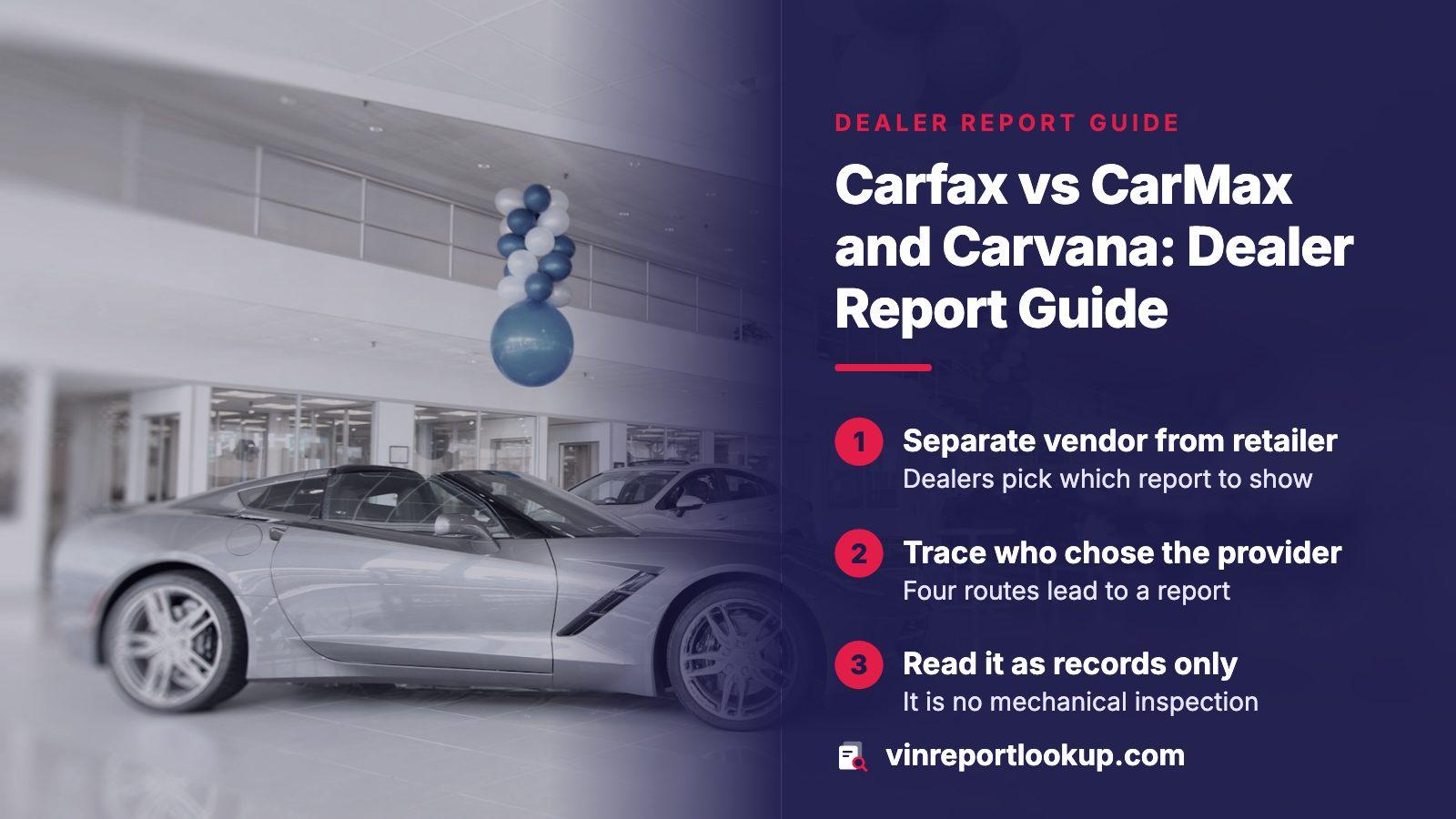
Carfax is a report brand. CarMax and Carvana are dealers, and a dealer chooses the report it displays. A 2011 CarMax release named AutoCheck as its provider. Any listing report is a search of recorded events, so it will not describe mechanical condition. Read the provider's name on the listing, run the VIN yourself, and have an independent mechanic go over the car before money changes hands.
- Carfax
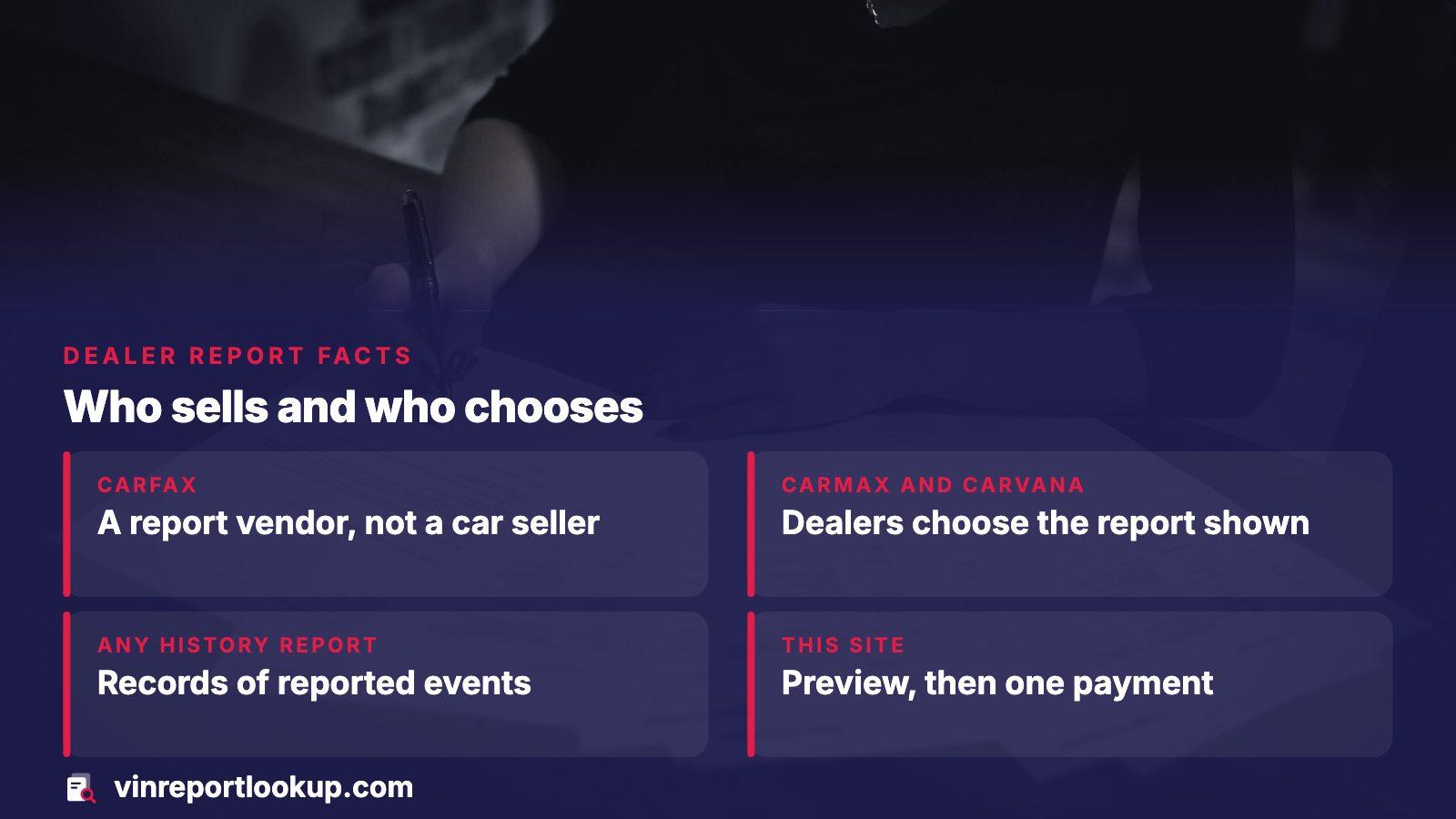
- A report vendor, not a car seller
- CarMax and Carvana
- Dealers that choose which report to show
- Any history report
- Records of reported events, not a mechanical inspection
- VINReportLookup
- Free preview, one payment, no subscription
A report vendor and two retailers are not rivals
Typing carfax vs carmax into a search box pits a company that sells reports against a company that sells cars. Carvana is the same story. The FTC lists Carfax beside AutoCheck and Vinaudit as commercial sources of accident and repair entries, and it endorses none of them. CarMax and Carvana are places to buy a vehicle, and neither name is a report you can order for a car sitting in someone else's driveway.
The comparison that helps a buyer is different. On one side is the report a dealer chooses to show you. On the other is a report you order yourself, from a provider you picked, about the exact VIN in front of you. When the two disagree, chase the gap before you sign.
What CarMax has put in writing about its reports
Two CarMax press releases, from 2008 and 2011, set out the company's position. The 2011 release stated that every used vehicle CarMax sells comes with an AutoCheck report, and the shopper pays nothing for it. The 2008 release said the same report sat on carmax.com for every car in stock, and it also told shoppers they could run Carfax by VIN as another look.
The 2008 release added a policy statement: the company would not put a used car on its lot if it had frame or flood damage, or an odometer reading that was inaccurate. That is a promise about what the retailer screens out, and it names the same problems a buyer wants a report to catch.
Read the label on the listing in front of you
Both releases are old, and providers change. Find the provider's name next to the report on the vehicle page, whether it is a CarMax lot, Carvana or any other seller, and note when it was pulled. A report can only repeat what was sent to its provider, so an event nobody reported will not appear.
Four routes to a report, and who picked the provider
| Route | Who chose the provider | What you get |
|---|---|---|
| Report shown on a dealer's listing | The dealer | A first screen before you travel or hand over a deposit |
| A brand report you order, such as Carfax or AutoCheck | You | Accident and repair entries, where the provider received them |
| An NMVTIS title record bought from a listed provider | You, from the Justice Department's list | Title status, junk or salvage status and the odometer figure recorded at titling |
| A one-time VINReportLookup report | You | A free preview, then one payment for damage, auction photos, liens, theft and recall entries |
CarMax's releases describe its report as costing the shopper nothing. Each route you order yourself involves a fee to the provider. Add a source only when the one in your hand leaves a question open, and see the pricing page for how VINReportLookup bills.
A history report reads records, not the car
The FTC says reports can include accident and flood entries but typically omit mechanical problems, and they cannot replace an independent inspection. The agency gives the same advice for cars a dealer calls certified: hire a mechanic, and expect to cover the fee yourself.
- If the car cannot leave the lot, book a mobile inspector or ask the dealer to take it to a shop you choose.
- Ask the mechanic for a written result that carries the make, model, VIN and an estimate for each repair.
- Use that estimate when you negotiate the price.
- Treat a flat refusal to allow an outside inspection as a reason to buy from someone else.
Where the federal title record fits
NMVTIS, the national title database, is a Justice Department program. Its consumer site says Carfax, DMVDesk and Experian hand that report only to car dealerships, and that Carfax supplies NMVTIS data to commercial customers in California alone. A shopper has to look elsewhere on the list: 12 of its 18 approved providers sell to the public as well as to businesses.
Federal regulation 28 CFR 25.53 names a prospective purchaser as someone the system must answer. It must show whether a car titled in a given state has ever been junked or salvaged, plus the odometer figure disclosed at the last title issue. State titling agencies, insurers and salvage businesses feed it, and insurers and yards have reported monthly since March 31, 2009. A yard that handles fewer than 5 salvage vehicles a year is exempt, so the record is deep on titles but not airtight.
When your report and the dealer's tell different stories
A mismatch is information. One provider may have pulled its data earlier, a record may have reached only one of them, or the dealer's version may have skipped something real. Screenshot both with their dates and ask the seller to explain the difference in writing.
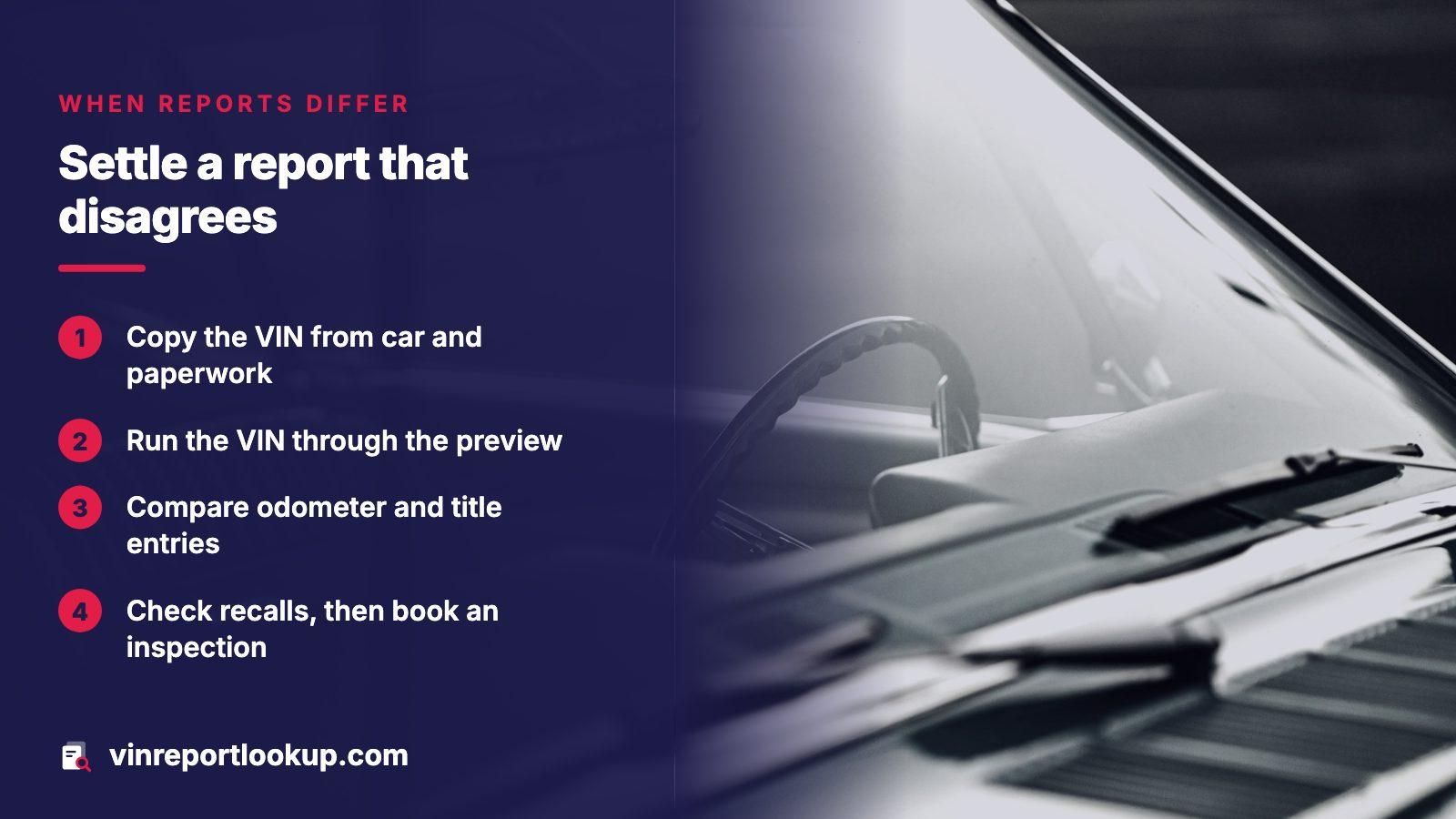
- Copy the VIN from the car itself and from the sales paperwork, then check that the two agree.
- Run the VIN through VINReportLookup for the free preview, and treat the full report as a one-off purchase if you want more.
- Set the odometer entries and title entries side by side with the dealer's report.
- Check the VIN on the government's recall lookup for unrepaired campaigns, which charges nothing.
- Book the independent inspection last, once the paperwork holds together.
Signs on the car that a clean report will not show
CarMax's own releases make a decent checklist, because they describe what its buyers look for on a car with a hidden past.
- Collision: gouges or holes on the frame rail, which CarMax called the biggest sign, plus broken paint on fender, door or trunk-lid bolts, filler or welds under the trunk lining, and overspray on moldings or gaskets.
- Fit: a hood, door or trunk lid that closes badly, and an odometer that does not advance as you drive.
- Flood: a musty smell, new carpet in an old car, silt or rust under the pedals and seats, a thin brown tide line, and electrical features that act up.
- Identity: the dashboard VIN and the door-jamb sticker should read the same.
CarMax also warned that rust and mold keep doing damage after a flood, and that a quick repair does not restore the car.
The Buyers Guide, and what a remote sale changes
A history report says what happened to the car. The Buyers Guide says who pays if something breaks. Dealers must display one on every used car offered for sale and give it to the buyer afterward, and its terms override conflicting contract language. In an as-is sale the dealer owes nothing for later problems, and verbal assurances are difficult to hold a dealer to, so anything promised should be written on the Guide. Maine and Wisconsin use their own forms.
The FTC pages describe cars displayed on a lot and do not discuss online sales. Nothing in federal law gives a buyer three days to cancel, so any return window comes from the seller's own policy. For a purchase made remotely, get the warranty and return terms in writing before you pay.
Where this information comes from
- FTC: Buying a Used Car From a Dealer — what reports miss, mechanic inspections, the Buyers Guide and as-is sales
- FTC: Used cars — where to find report providers and the recall lookup
- NMVTIS: approved providers and consumer access — who sells the federal title record to consumers and who sells only to dealers
- NMVTIS: who reports to the system — reporting entities, schedule and exemption
- 28 CFR 25.53: NMVTIS operator responsibilities — what the national title system must let a user establish
- CarMax press release, 2011: avoiding flood-damaged cars — the report provider CarMax named and its flood checklist
- CarMax press release, 2008: spotting hidden damage — the listing report on carmax.com and its collision checklist
Sources and photos: Facts checked against the sources above in November 2026. Photos by Richard R, Dylan Michaud and Dimitri Karastelev on Unsplash; diagrams by VINReportLookup.
Keep reading
- Carfax alternatives: what each VIN report option covers and costsCompare every report option by what it covers before you buy one.
- AutoCheck vs Carfax: which VIN report to buy, and when to buy bothThe two named premium reports set against each other.
- Vehicle history report cost: what each kind charges and coversWhat reports cost and when each purchase is worth it.
- Best VIN check: how to choose a report and what each one includesHow to pick a VIN check that fits your question.
Frequently asked questions
Is CarMax's history report the same as a Carfax report?
Not necessarily. A 2011 CarMax release named AutoCheck as the report it provides, and a 2008 release mentioned Carfax only as something shoppers could run themselves by VIN. A dealer chooses its provider and can change it, so read the provider's name on the listing and treat each report as its own document.
If the listing report is clean, was the car definitely accident-free?
No. A report lists events that someone reported to its provider, so an unreported accident or an unrecorded repair will not appear. The FTC adds that reports typically leave out mechanical problems and cannot stand in for an independent inspection, which is why a mechanic's look still matters.
Can a shopper buy an NMVTIS report from Carfax?
Not according to the Justice Department's NMVTIS site, which says Carfax, DMVDesk and Experian provide those reports to car dealerships only. Its list shows 12 approved providers that sell to the public. The site shows no prices, so check each provider's current fee before you order.
Should I run my own VIN check on a car from a large dealer?
It is a sensible step before a deposit. The VINReportLookup preview carries no charge, and going further means paying once for the full report, with no subscription attached. Pair it with a mechanic's inspection, since a records search cannot tell you how the brakes or transmission behave on the road.
Do dealers have to show a Buyers Guide?
Yes, on every used car they offer for sale, and they must hand it to the buyer after the sale. The FTC says the form discloses any dealer warranty or an as-is sale. Maine and Wisconsin use their own versions, and promises made aloud belong on the form in writing.
Now check the car itself
The guide explains what to look for. The report shows what this VIN has on record.