THE SHORT ANSWER
Choose ClearVin when the question is title brands, total loss, salvage, odometer entries and auction photos, because it sells the federal title record to consumers and says it does not hold maintenance records. Choose Carfax only if you need what ClearVin says Carfax adds, such as service entries, and read Carfax's own page for what it includes and costs. For one car, a free preview comes before any one-time payment.
- Federal title data for the public
- ClearVin is on the public list; Carfax is commercial only, California only
- ClearVin's own limit
- No maintenance records, and no accidents that never reached an insurer
- Carfax's own pages
- Refused to open, so price and contents are unconfirmed
- Saved reports
- U.S. reports with title data may be limited after 60 days
Who may sell you the title record
Before comparing features, check the one thing a government page settles. The Justice Department publishes a roster of businesses cleared to sell records from the national title system, split into those that serve everyone and those limited to commercial buyers. Clearvin.com is filed with the first group, with no extra storefronts under it.
CARFAX.com sits in the second group, with a department note that Carfax supplies that data to business buyers in California alone. Elsewhere on the same page, the department says consumers cannot receive these reports from Carfax, DMVDesk or Experian, since they serve car dealerships. The order on the roster is simply alphabetical, and the department says it endorses no firm over another. It tells you where the federal data may legally come from, not who writes the better report.
Carfax and ClearVin side by side
The table keeps three kinds of fact apart: what the Justice Department says, what ClearVin says about itself, and what could not be confirmed because the page would not load.
| Question | Carfax | ClearVin |
|---|---|---|
| Federal title data sold to the public? | No. Commercial customers in California only, per the Justice Department | Yes. Listed for all interested parties |
| Maintenance records | ClearVin says Carfax often includes them. Not confirmed from Carfax | ClearVin says its reports do not include them |
| Auction photos and sale prices | Not confirmed | Shown in its sample report |
| Free preview before paying | Not confirmed | Yes, per its home page |
| Price | Read it on Carfax's own order page | Shown on its preview page and tied to how many reports you order |
| Refund terms | Not confirmed | Published, with exclusions |
What a ClearVin report holds, from its own sample
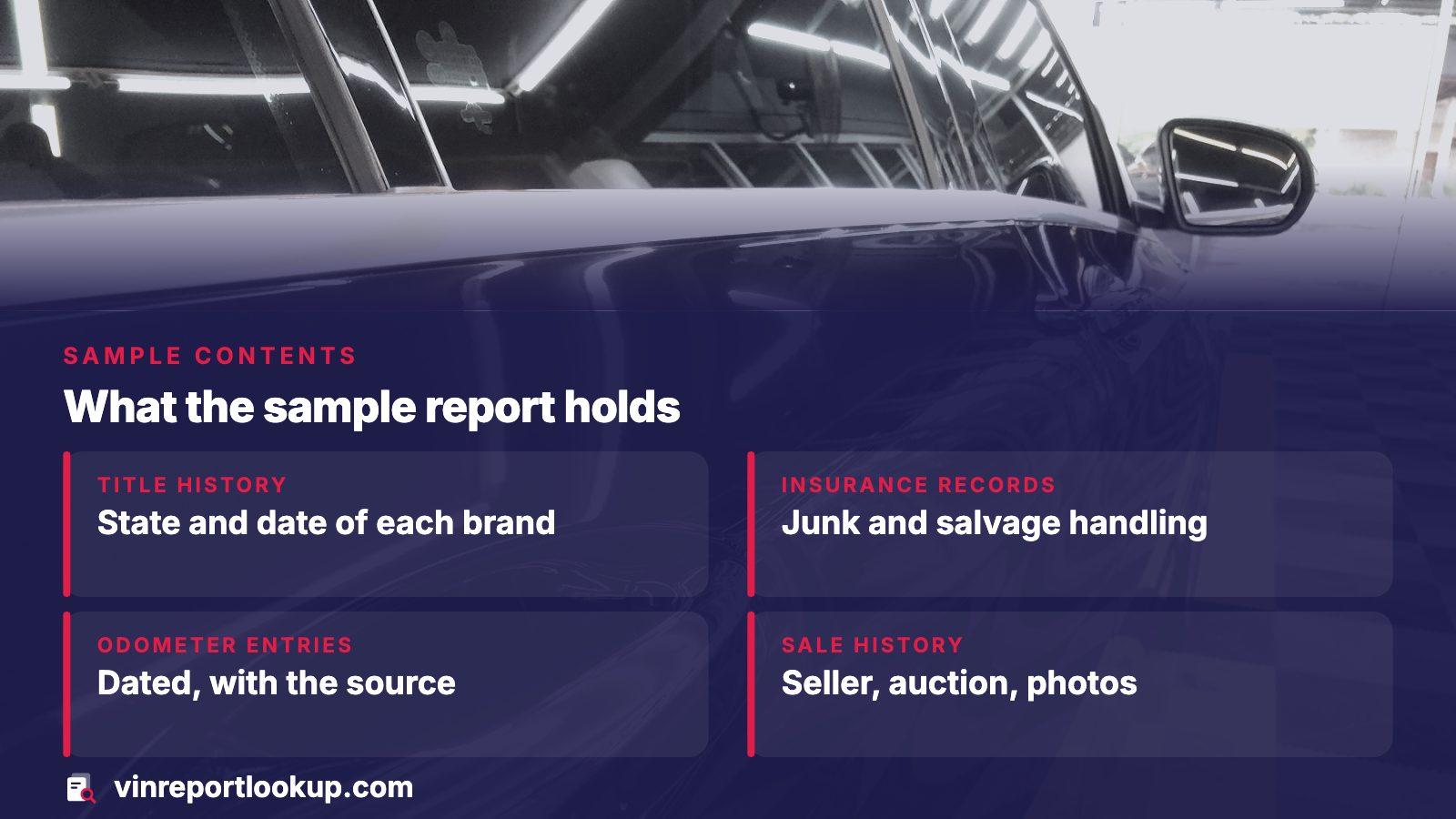
ClearVin publishes a sample report for a 2021 Toyota Corolla, which is the fairest way to judge the product before spending anything. Each section carries a count of records found and a badge, and the page also shows an overall ClearVin Rating. The sections worth reading first are these.
- Title history and title brands, drawn from the federal system, with the state and date of each entry.
- Insurance, junk and salvage records, which cover cars an insurer or a salvage yard handled.
- Odometer entries, each tagged with its date and where the reading came from.
- Sale history, showing seller, auction or dealer, sale price and a set of photos for each listing.
- Lien and impound records, plus theft, ownership and recalls.
The company describes its ownership count as an estimate built from DMV title records, so treat it as a guide to the number of owners rather than a certificate.
What Carfax may add, and what is unconfirmed
Carfax's website returned an access error to both a plain request and the browser pane, and nothing was done to get around that. Its price, sample report, guarantee and coverage claims are therefore not repeated here. Read them on Carfax's own pages before you decide.
Two outside descriptions do exist. ClearVin describes Carfax as a private company that gathers records from dealers, repair shops, auctions and insurers, and names maintenance entries as the main difference. That is a competitor's account, so weigh it that way. The Justice Department makes a related point in general terms: private providers offer repair, recall and maintenance information that the federal system is not designed to hold.
How to use this gap
If service entries matter for the car you are buying, open Carfax's sample report yourself and see whether it shows them in a form you would use. Do not rely on a rival's description, or on this page, for what Carfax contains.
Prices, and why none are copied here
ClearVin's home page has shown a comparison table listing its own report at $17.99 against $44.99 for Carfax, and a starting figure of $5.80 per report. Those are ClearVin's claims about a competitor. A second load of the same address a few minutes later showed neither the table nor the figures, and ClearVin's help page says the price appears on the preview page and depends on the number of reports ordered.
That is enough reason to treat any price in a comparison as stale. Compare the amount on each checkout screen, for the same single VIN, on the day you buy. ClearVin accepts cards, PayPal, Google Pay and Apple Pay, and sells packages that turn into credits on an account, which only helps if you will run several cars.
Choosing by the car in front of you
- Private sale where the seller says the title is clean: you want the federal record, so a provider on the public list fits.
- A car that has crossed state lines: a brand applied in one state can be missing in the next, which is why the national record matters.
- A late-model car with a thin story: auction photos and sale history show how it looked when it last changed hands.
- A car where service entries decide the price: check what Carfax shows on its own pages, and plan to pay a mechanic anyway.
- A car you have not yet seen: run the preview before buying any report, since a mistyped VIN returns a different car.
Most buyers need one report, not two. Picking the one that answers your largest worry costs less than buying both.
Reading a report and the red flags
ClearVin marks sections with an orange Attention badge for a potential risk, a Warning badge for a high-risk or confirmed problem, and a green check when nothing was reported. Read the Warning sections first, then check the odometer dates against what the seller told you.
- A junk, salvage or flood brand, or any total-loss entry: ask for repair paperwork and have the structure inspected.
- Mileage that falls or stalls between dated entries.
- Sale photos that show damage the seller never mentioned.
- A clean result: the Justice Department calls a clean NMVTIS report a good sign, but ClearVin states that accidents never reported to insurers will not appear.
Save your copy
ClearVin warns that U.S. reports containing title data can become harder to open once 60 days have passed since the order. Download or print yours the day you buy, before you negotiate.
Running the check on VINReportLookup
Take the 17-character VIN off the vehicle, then match it to the title or registration papers. Type it into VINReportLookup and read the free preview before paying anything. When the preview fits the car and the seller's story, a single purchase gets you the report, with no plan that renews. The pricing page lists the amount.
Use the report to decide whether to keep going, then book an inspection. The Justice Department itself urges buyers to get an independent inspection alongside a title report, and no history report replaces that.
Where this information comes from
- Justice Department NMVTIS: approved data providers — Which group each company is in, and the note on Carfax.
- Justice Department NMVTIS: understanding a report — What the federal record is meant to hold and what it leaves to private providers.
- Justice Department NMVTIS: consumer information — What a brand is and why a national record matters.
- ClearVin: home page — Its own description of the service, its Carfax comparison and its search options.
- ClearVin: help and pricing — Payment methods, credits, badge meanings, refund terms and the 60-day limit.
- ClearVin: sample report — The sections a report contains, shown on a 2021 Corolla.
Sources and photos: Facts checked against the sources above in November 2026. Photos by Jake Kling, Mustafa Sheikhmouss and Clarence Tioh on Unsplash; diagrams by VINReportLookup.
Keep reading
- Carfax alternatives: what each VIN report option covers and costsEvery route from official lookups to a one-time report.
- Carfax vs NMVTIS: what each report shows and which to buyHow the federal record differs from a private history report.
- How much a Carfax vehicle history report costs and what it coversWhere to read the current Carfax price.
- Vehicle history report providers: who sells VIN reports and how they differWho sells vehicle history reports and how they differ.
Frequently asked questions
Is ClearVin cheaper than Carfax?
ClearVin's home page has shown figures putting itself well below Carfax, but those are its own claims and a later load of the page did not show them. Carfax's price could not be read because its site refused to open. Compare both checkout screens for the same VIN on the day you buy.
Does ClearVin show maintenance records?
No. ClearVin says so plainly in its answers about accident and damage history. Its report leans on title, salvage, odometer and sale records. If service entries matter to your decision, read Carfax's sample report and ask the seller for shop receipts.
Can I buy Carfax's title data as a consumer?
On the Justice Department's roster, Carfax is listed for business buyers in California alone, and the department states that consumers cannot get these reports from it. That is about the federal record, not about every report Carfax sells. Check Carfax's own pages for the product it offers you.
What if my ClearVin report comes back empty?
ClearVin lists empty reports, duplicate charges and database errors as grounds for a refund request by email, with the VIN and proof. It excludes information it cannot see, such as unreported accidents and title events from states outside the federal system.
Do I need a report if I already have an inspection?
Yes, they answer different questions. A mechanic sees the car as it is today. A history report shows brands, total losses and mileage entries the car cannot show. The Justice Department encourages buyers to get both before paying.
Now check the car itself
The guide explains what to look for. The report shows what this VIN has on record.