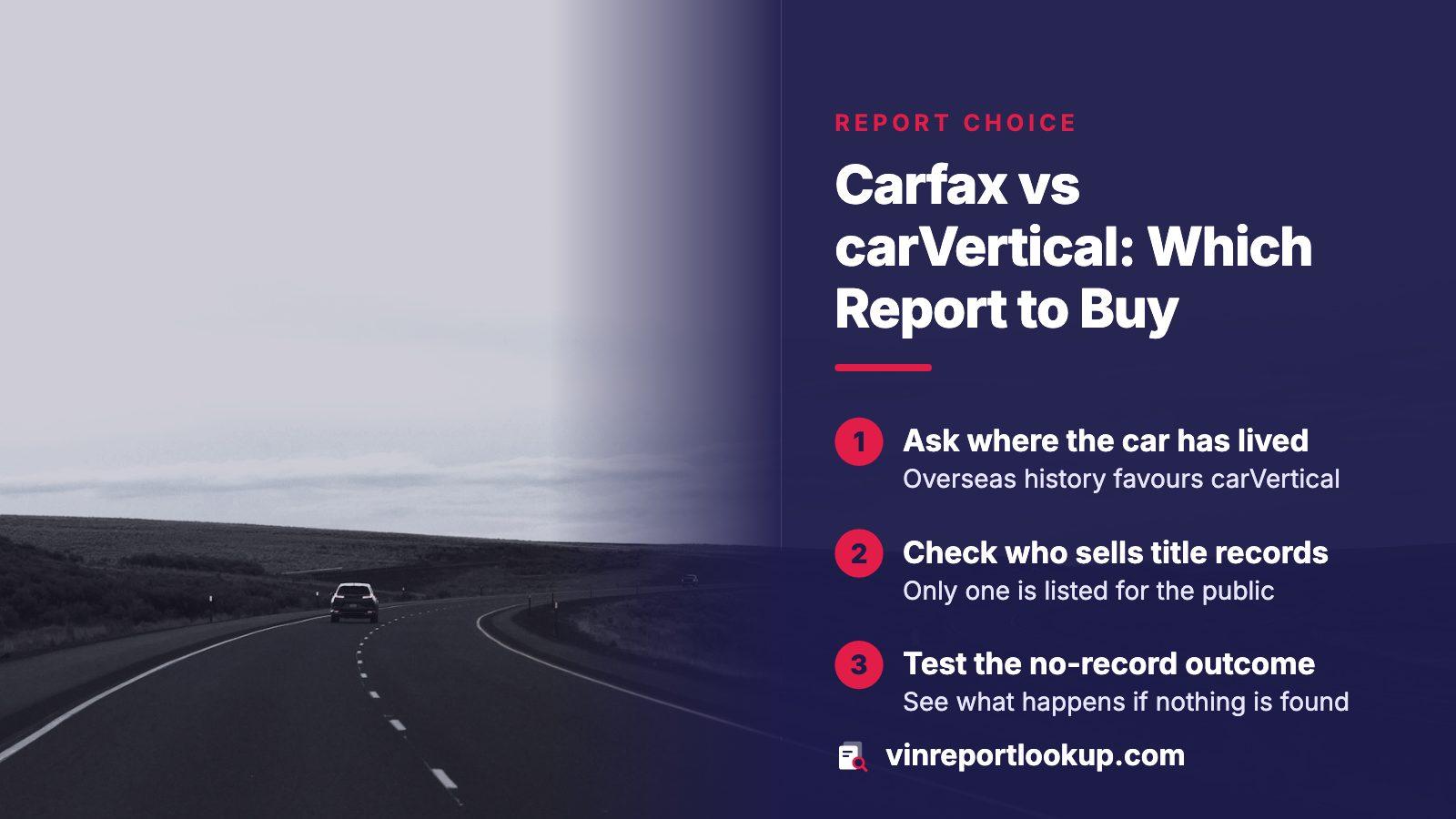
THE SHORT ANSWER
Lean toward carVertical when the car may have lived outside the US, or when you want the federal title record sold to you directly. It says it searches registries in 48+ countries. Lean toward Carfax when accident and repair entries on a domestic car matter most, since the FTC says Carfax may carry them. For title brands, damage and mileage on one car, a one-time VINReportLookup report after a free preview adds no plan.
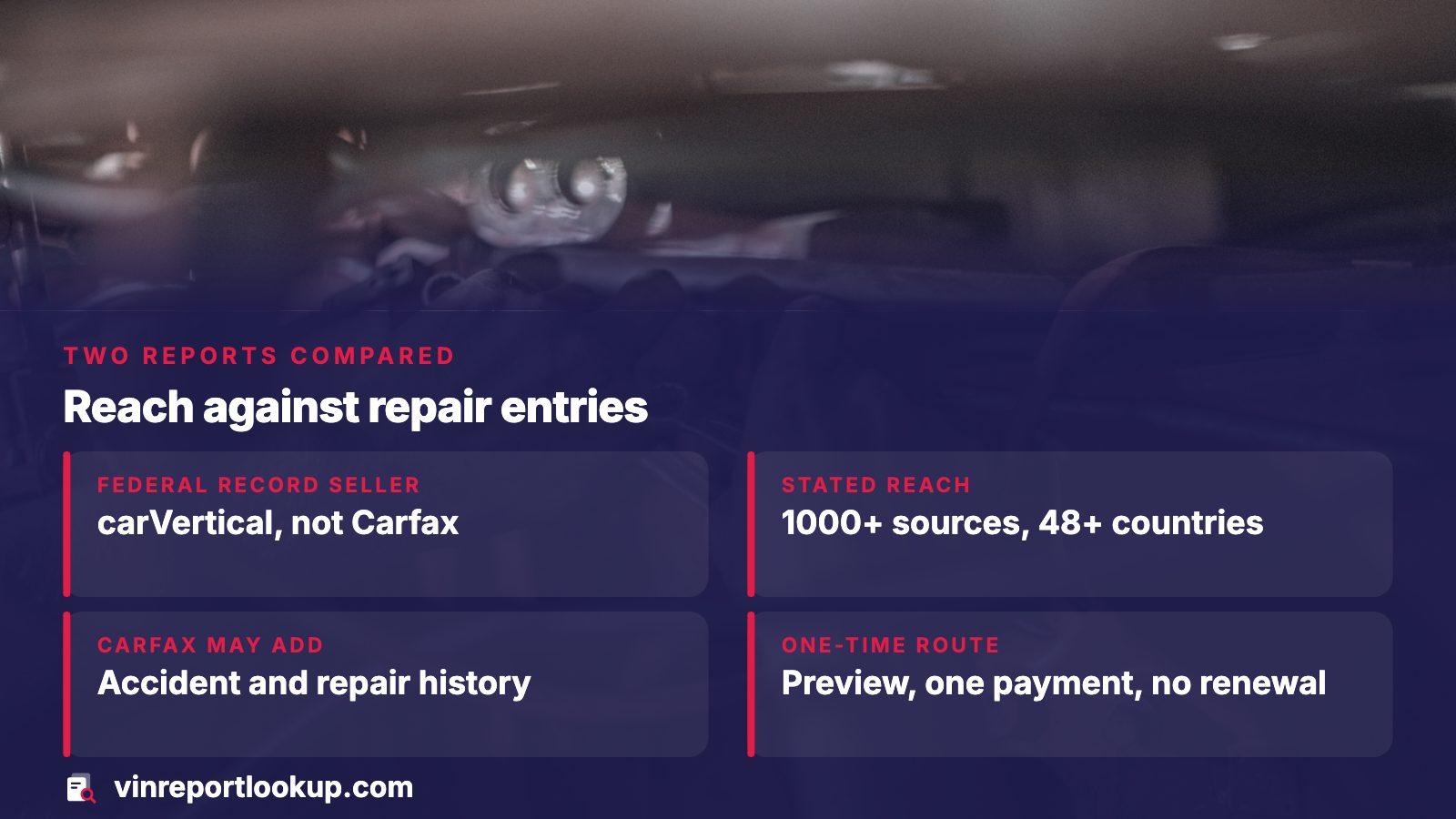
- Federal title record for private buyers
- carVertical is on the public list; Carfax is commercial only, California only
- carVertical's stated reach
- 1000+ sources in 48+ countries, no US-only breakdown
- What the FTC says Carfax may add
- Accident and repair history
- One-time route
- Free preview, one payment, nothing renews
Carfax and carVertical side by side, as far as public pages go
Government pages describe both companies from the outside, and carVertical's help pages describe carVertical from the inside. Carfax's own website refused to open during research, so its price, sample report and promises are yours to read there.
| Question | Carfax | carVertical |
|---|---|---|
| May it sell you the federal title record? | No. The Justice Department roster limits it to commercial customers in California | Yes. Listed for public and commercial customers |
| Accident and repair entries | The FTC says Carfax sometimes carries them | A listed section, shown where its sources hold the data |
| How far the data reaches | Not confirmed by any page that opened | The company says 1000+ sources across 48+ countries |
| How you pay | Read Carfax's order page | A package for one, two or three cars; credits last 6 months |
| Does the seller admit gaps? | The FTC says an inspection is still needed | Yes, events nobody logged never appear |
The federal title record: only one of the two may sell it to you
The Justice Department publishes a roster of firms cleared to sell records from the national title system, in two groups. Carvertical.com sits with the firms that serve private buyers as well as businesses, with no note beside the name. CARFAX.com sits with the business-only firms, and its entry limits it to California.
A bold notice on that page adds that private buyers cannot receive these reports through Carfax or two other named firms, which supply dealerships only. The notice concerns one government feed. It says nothing about the other records Carfax collects, and the FTC lists Carfax among sellers that may add accident and repair history.
Read the roster on the day you pay
Find the exact company name on the Justice Department's list before paying, because that listing, not a banner on a sales page, settles who may sell you the federal record.
Carfax's repair entries against carVertical's reach abroad
Each company leans on a different strength. The FTC puts Carfax among report sellers that sometimes include accident and repair history, and a federal title record is not built around repair entries. That makes Carfax worth a look when the car has a long local life.
carVertical's argument is geography. It says it searches databases in 48+ countries and draws on 1000+ sources: state registries, police files, repair shops, inspection stations, lenders and connected fleets. It gathers the data rather than creating it, and its help pages print no list of US sources. A careful buyer can conclude that the reach pays off most for a car that spent years abroad, and least for one that never left. That is an inference, not a claim either company makes.
How carVertical sells a report, and what happens when it finds nothing
Buying runs through an account. You enter the VIN, pick a package covering one, two or three cars, pay, and open the finished report on screen, in the app or as a PDF. Packages for several cars become credits that stay valid for 6 months.
- A report with nothing in its mileage, damage or timeline sections goes back onto your account as an unused report, good for another car until 6 months after the original purchase.
- Any other return, such as an error or a report that never arrived, must be requested by email within 30 days, quoting the VIN and the purchase date.
- Unused reports can be redeemed from any page with a VIN box while you are logged in, with no second payment.
Carfax's current price and terms appear on its own order page. Set its all-in total beside a carVertical package covering the same number of cars.
Choosing by the car in front of you
The brand matters less than the match between report and car. Confirm each claim on the company's own page.
| The car | Lean toward | Why |
|---|---|---|
| A domestic car with years of local service | Carfax, after reading its terms | The FTC says Carfax may add accident and repair entries to the title data |
| A car that was registered or driven abroad | carVertical | It states a reach of 48+ countries and prints no US-only source list |
| A private sale where the federal record matters | A provider on the public list | Only that group may sell it to you directly |
| One car, with title brands or damage as the worry | A one-time VINReportLookup report | You read a free preview first, pay once and nothing renews |
| Several cars on a shortlist | A bundle for three, five or ten cars | One payment covers every car, with no plan to cancel |
VINReportLookup takes a VIN and shows a free preview before it asks for money. Its pricing page lists today's amounts for a single report and for each bundle.
Running the check from a VIN
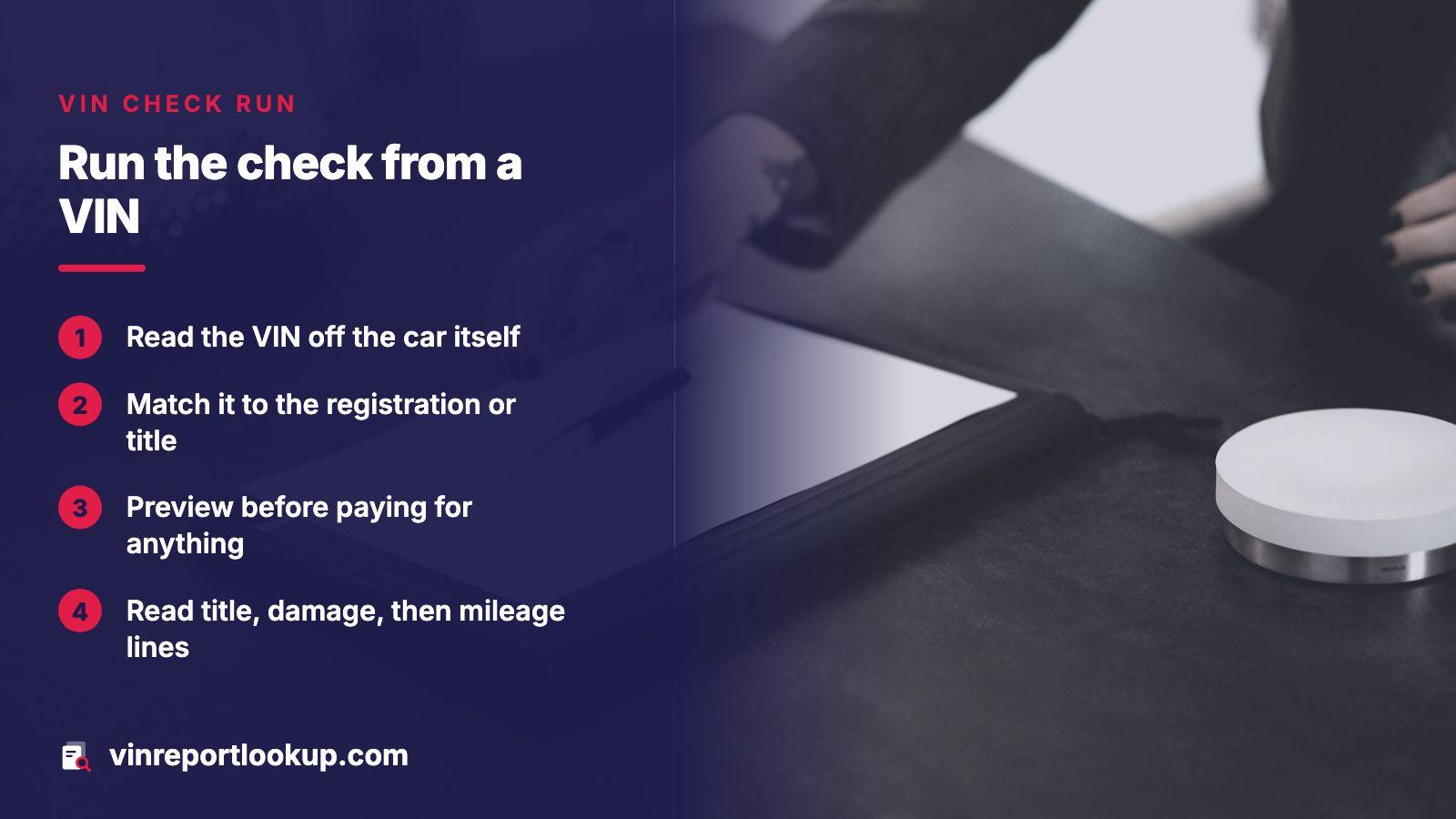
Whichever report you choose, the input is the same: one VIN, typed exactly.
- Read the 17-character code off the car, not the listing. The pillar inside the driver's door and the dash corner nearest the driver are the usual places.
- Match it against the registration or title papers. A mismatch between car and paperwork is a reason to stop before buying anything.
- Enter the VIN in the preview first and read what it shows before paying anyone.
- Buy the report that fits this VIN, rather than a larger package you may never use.
- Read the title and damage lines first, then the mileage entries, then the rest.
Reading the result and spotting red flags
Start with the title lines. A salvage, junk or flood brand, or a total-loss entry, means a state or an insurer once treated the car as badly damaged.
- A brand of any kind: ask the seller for repair paperwork and photos, and pay a mechanic to examine the structure.
- Mileage that drops or stalls between dated entries: line the dates up against what the seller told you.
- A brand in one state and none in the next: each state keeps its own standards, the Justice Department says, so identical damage may earn a brand in one place only.
- An empty record: it shows only that nothing was recorded. The Justice Department says 87 percent of US vehicles appear in the federal system and over half of the states report to it, so a gap in reporting can yield a false negative.
Clean on paper, unknown underneath
The FTC says an independent inspection can find hidden damage, and a history report cannot stand in for one. carVertical's own help pages add that events nobody officially logged, such as unrecorded crashes and repairs, never appear in its reports.
What it costs and what to do next
No Carfax or carVertical price is printed here. Prices move, Carfax's site would not open, and carVertical's US pages showed no consumer figure when read. Check the amount on each checkout screen before entering a card.
On VINReportLookup the free preview comes first, then a single payment buys the report. Pay only after the preview matches the car, the seller's story fits the mileage entries and a mechanic has a slot booked.
Where this information comes from
- Bureau of Justice Assistance: NMVTIS approved data providers — The public and commercial-only groups, where each company is filed, and the notice about consumers and Carfax.
- Bureau of Justice Assistance: NMVTIS for consumers — Coverage figures, false negatives and why one state's brand may not exist in another.
- FTC: Used cars — What the federal system offers, where Carfax may add accident and repair history, and why an inspection still matters.
- carVertical: where the data comes from — The company's own count of sources and countries, and the kinds of records it gathers.
- carVertical: what information may appear in the report — The report sections it lists and its own warning that unlogged events will not show.
- carVertical: how to get a report — The buying steps, package sizes and how long unused reports stay valid.
- carVertical: report return policy — What happens to a report that finds nothing and the deadline for other return requests.
Sources and photos: Facts checked against the sources above in November 2026. Photos by John Kakuk, Annika Wischnewsky and Nina Mercado on Unsplash; diagrams by VINReportLookup.
Keep reading
- Carfax alternatives: what each VIN report option covers and costsEvery route from official lookups to a one-time report, sorted by the question each one answers.
- Vehicle history report providers: who sells VIN reports and how they differWho sells vehicle history reports and how the sellers differ.
- How much a Carfax vehicle history report costs and what it coversWhere to read the current Carfax price and what to weigh it against.
- AutoCheck vs Carfax: which VIN report to buy, and when to buy bothThe same side-by-side approach applied to the other report seller most buyers meet.
Frequently asked questions
Can the public buy federal title records from carVertical?
The Justice Department roster files Carvertical.com under providers serving public and commercial customers, with no note beside it. Read the entry yourself on the day you buy. A listing covers the federal title feed only, not how complete the rest of a report is.
Can a private buyer get an NMVTIS report through Carfax?
No, according to the Justice Department. Its notice says consumers cannot receive these reports from Carfax, which supplies dealerships only. A buyer who wants the federal record specifically should pick a company from the public group instead.
Does carVertical cover American cars or only European ones?
Its help pages say the title check shows past branding, such as salvage or junk, on vehicles used or registered in the US, and they list state registries among its sources. They give no separate list of US sources, so read the preview for your VIN before leaning on it.
What if a carVertical report finds nothing about the car?
A report with no mileage, damage or timeline entries is credited back as an unused report, usable on another car within 6 months of purchase. Other problems need an email within 30 days of generating the report. Expect a credit rather than cash, since the policy never mentions refunds.
Do I need either company to check a single used car?
No. VINReportLookup shows a free preview from the VIN, then sells one report or a bundle for three, five or ten cars as a single payment with no plan attached. Whichever route you take, the FTC advises an independent mechanic's inspection as well.
Now check the car itself
The guide explains what to look for. The report shows what this VIN has on record.