THE SHORT ANSWER
Use CarGurus to find cars and to judge whether an asking price looks fair. Use a history report to learn what the car went through before it reached the lot. A Deal Rating compares prices and is no title search, so a low price says nothing about brands or damage. For the car you intend to buy, run its VIN through a report source and have a mechanic inspect it.
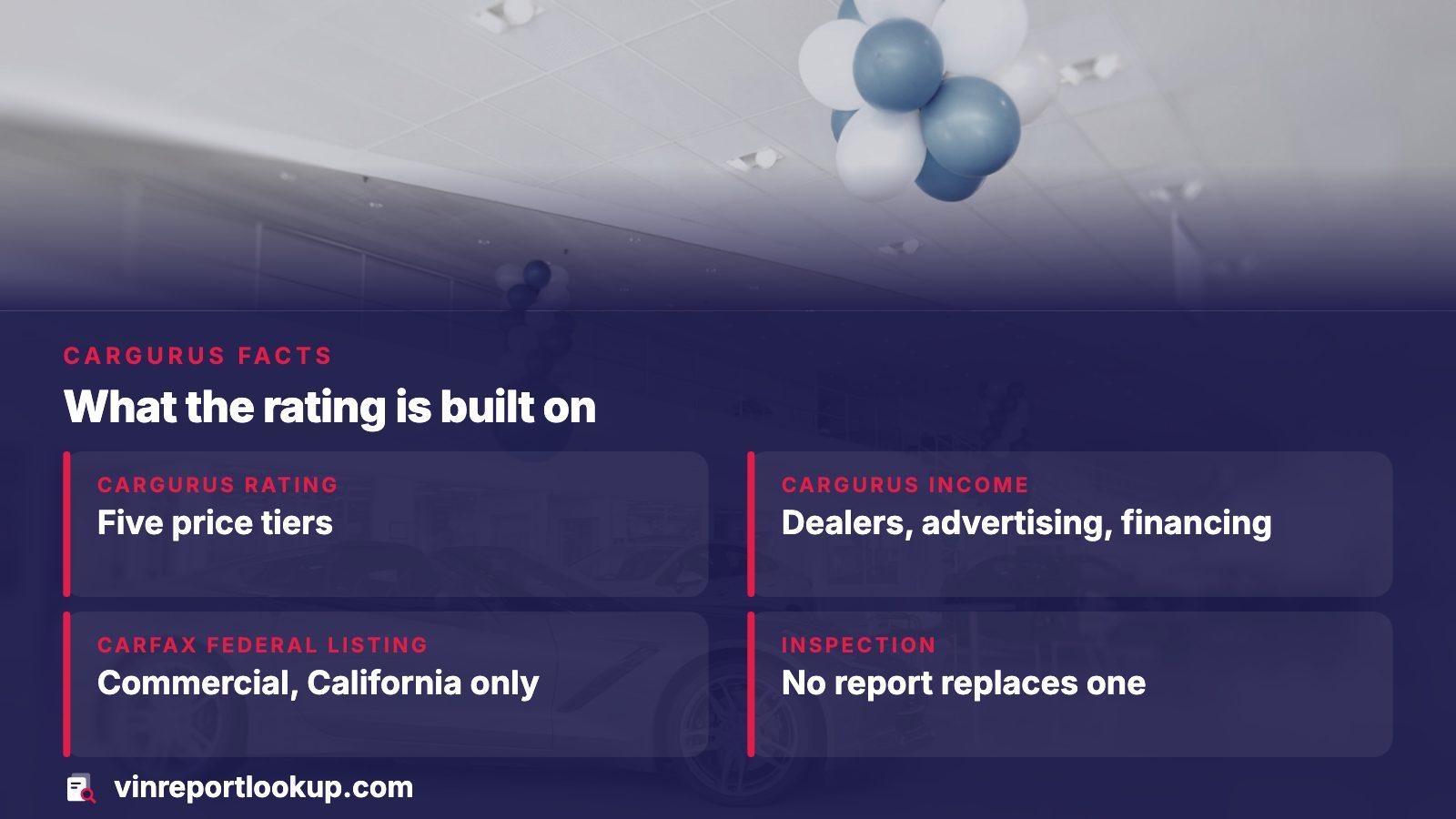
- CarGurus rating
- Five price tiers built on an estimate of local market value
- CarGurus income
- Dealer subscriptions, advertising and financing partners, per its SEC filing
- Carfax on the federal list
- Commercial customers only, California only
- Inspection
- The FTC says no report replaces one
A marketplace and a record keeper, side by side
People who search this phrase usually want to know whether a CarGurus listing is enough or the car also needs a Carfax. The two sit at opposite ends of a purchase. CarGurus helps you find a car and spot a price that looks off. A history report reads the car's recorded past. The table lines up what each is built to answer, using the Justice Department, the FTC and CarGurus's own annual report to the SEC.
| Question | CarGurus | A history report such as Carfax |
|---|---|---|
| What is it? | An automotive platform where consumers and dealers buy and sell vehicles, as its filing describes it | A report on one VIN. The FTC lists Carfax among companies that may add accident and repair entries |
| What does it mainly tell you? | How an asking price compares with an estimate of the local market | Which records exist: owners, accidents, salvage declarations |
| Does it cover the car's past? | History is one item on a listing page, and its business description says no more about it | That is the product, though reporting gaps mean a clean result proves little |
| Federal title record for private buyers | CarGurus is absent from the Justice Department's provider roster | Not sold: Carfax is listed for commercial customers in California only |
What a CarGurus Deal Rating tells you
Per its annual report, eligible used listings get one of five tiers, from Great Deal down through Good and Fair to High Priced and Overpriced. Each rests on Instant Market Value, the company's own algorithm for what a used car should fetch locally. It draws on tens of millions of data points, among them make, trim, year, features, condition, mileage, location and history.
So the tier is a price call. History is one ingredient, listed beside mileage and trim, and the filing defines the rating by way of that price estimate, not by way of a title search. The same document warns that its valuation models depend on the inventory shown on its sites, that regulators, shoppers or dealers may dispute a valuation, and that bogus listings exist for cars the named dealer does not actually own.
A good price on a car with a problem
A Great Deal tier on a car with a salvage brand is still a car with a salvage brand. The rating cannot say which you are looking at. The VIN's record can.
The history line on a listing page
The filing places vehicle history among the items on a listing page, beside dealer reviews, payment calculators and photos, and its business description gives no detail on what that line contains or who supplies it. Until you have checked the VIN yourself, treat that line as the seller's presentation of the car.
- Is a named report attached, or only a summary line with no company behind it?
- Is the report dated? A record pulled weeks ago can miss a claim filed since.
- Does the VIN on the report match the one stamped on the car itself?
What a history report adds that a listing does not
The FTC says a report might list past owners, accidents, repairs and any salvage declaration. It names Carfax among companies that may supply accident and repair entries beyond the federal title data, and says it endorses none of them. Reports tend to surface crashes and flooding, rarely mechanical faults.
The companies overlap more than their labels suggest. CarGurus names CARFAX.com among its rival marketplaces, and a traffic footnote in its filing separates visits to Carfax listings from visits to its history reports. They meet at the shopping end and part ways at the records end.
The federal title record, and who may sell it to you
The Justice Department keeps a roster of approved NMVTIS data providers. CARFAX.com sits in the group serving commercial customers only, annotated as California only, and the page states plainly that Carfax, DMVDesk and Experian do not hand the federal report to consumers. CarGurus does not appear on the roster. The record is short by design: title status and its latest date, brands, mileage, total-loss entries and salvage history.
Coverage is wide but not total. Roughly 87 percent of the nation's vehicle population is covered, more than half the states feed it, and a gap can yield an empty search for a car with a salvage past. The buying tips say a bare federal record costs up to $4.
Read the roster on the day you buy
Providers come and go. Open vehiclehistory.gov yourself and look for the company's name before paying for a federal title record.
A sensible order for one car
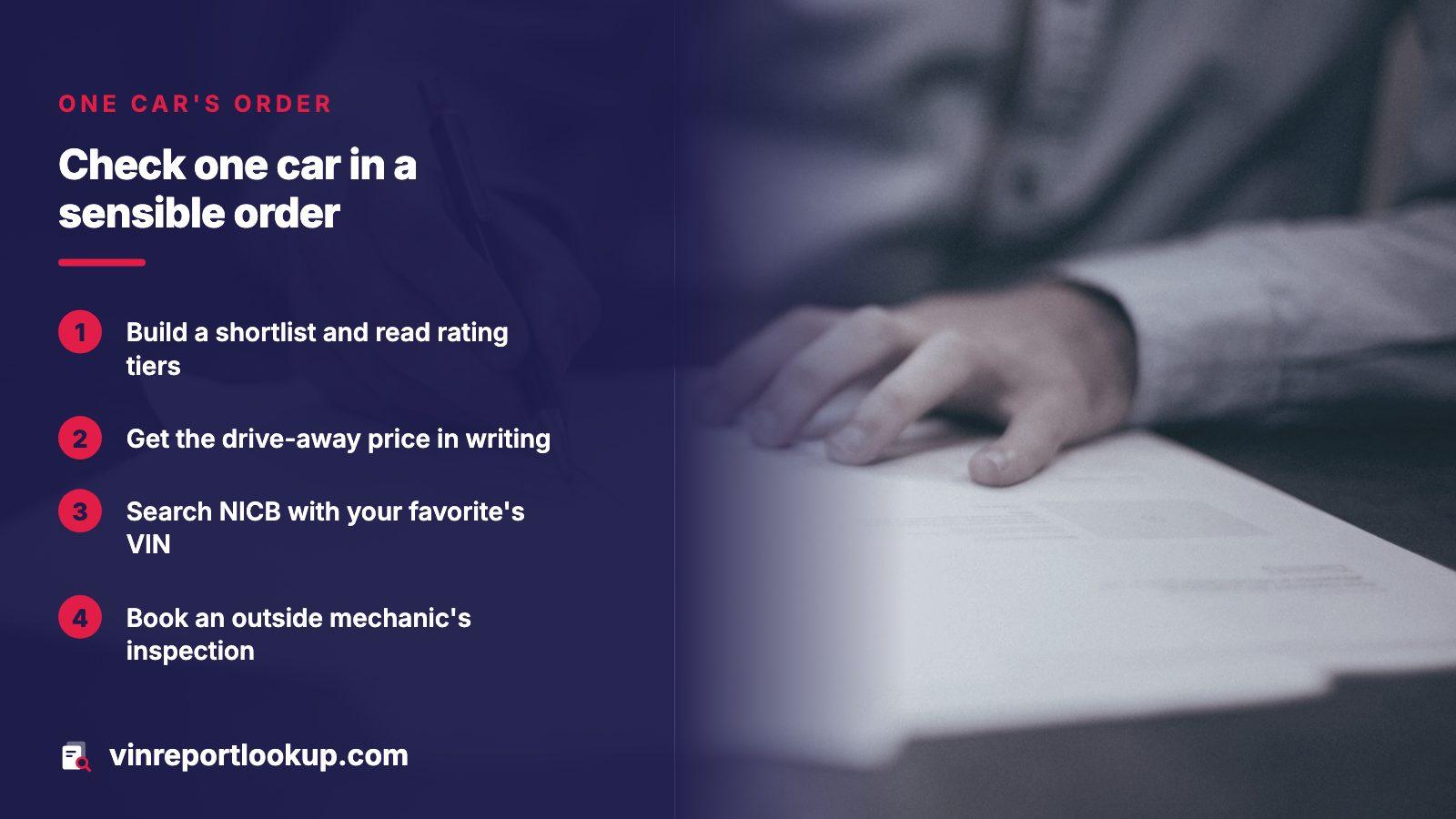
- Browse CarGurus, build a shortlist and read each tier as a price view only.
- Ask every dealer to put the full drive-away price in writing and confirm the car is on the lot, as the FTC advises.
- Take the VIN of your favorite from the listing, or ask the dealer, and run a free preview before spending anything.
- Search the NICB database by VIN for flooding, theft never recovered and salvage declarations, and check open recalls through the federal lookup the FTC names.
- Book an outside mechanic and request a repair estimate that lists the VIN, which gives you something to bargain with.
When the record changes the price
A Fair Deal tier on a car with a troubling entry is no bargain, and a High Priced tier on a clean car may leave room to talk. These entries move the conversation most:
| Entry in the record | Why it matters | Next step |
|---|---|---|
| Salvage, junk or flood brand | The Justice Department warns the car may be unsafe, whatever the asking price | Pull the state's full title record and have the structure inspected |
| Total loss entry | Not always a wreck: a theft unsolved after 30 days can earn the label, which sticks even if the car returns undamaged | Ask the seller what the entry was for |
| A brand from one state only | Each state writes its own brand rules, so identical damage can be labeled differently | Compare entries from every state that titled the car |
| Odometer reading below an earlier one | A price built on mileage rests on a number you cannot trust | Ask for the dated entries and match them to the seller's story |
Running the history side with VINReportLookup
VINReportLookup takes the VIN from your shortlist and shows a free preview first. If the car stays in the running, you pay once for a single report, or for a pack sized three, five or ten if your shortlist is long. Nothing renews, so there is no plan to cancel, and the pricing page carries current amounts.
The parts that matter to a CarGurus shopper: any brand on the title, damage logged by insurers or auctions with photos where they exist, the odometer trail, open recalls, and a market value to set beside the asking price. For one shop's service visits, ask the seller for maintenance records. Per the Justice Department's tips, the repair shop used most often may hand over its own records.
Where this information comes from
- Bureau of Justice Assistance: NMVTIS approved data providers — Where CARFAX.com sits on the roster and the note on who cannot get reports through it.
- Bureau of Justice Assistance: NMVTIS consumer page — Coverage figures, reporting gaps, total loss labels and how states differ on brands.
- Bureau of Justice Assistance: NMVTIS used car buying tips — The upper price of a federal title record, the NICB lookup and the maintenance-record advice.
- FTC: Used cars — What a history report may list, which providers may add detail and why an inspection still matters.
- FTC: Buying a used car from a dealer — Independent inspection, written estimates, total-price quotes and the Buyers Guide.
- SEC: CarGurus annual report (Form 10-K) — CarGurus's own description of Deal Ratings, listing pages, revenue and the risks to its valuation.
Sources and photos: Facts checked against the sources above in November 2026. Photos by Michal Biernat, Scott Graham and Richard R on Unsplash; diagrams by VINReportLookup.
Keep reading
- Carfax vs KBB trade-in value: which figure to trust and whyAnother price-versus-history comparison, this time for the value figure on a report.
- Used car price history by VIN: what exists and what does notHow a listing's price has moved over time and what that says about the seller.
- Carfax alternatives: what each VIN report option covers and costsEvery route to a car's record, from official lookups to a one-time report.
- Vehicle history report cost: what each kind charges and coversWhat each kind of report charges, from federal records up to premium names.
Frequently asked questions
Does CarGurus include a Carfax report on its listings?
The filing lists vehicle history among the items on a listing page without naming a supplier. What a given listing shows depends on the page you open, so look for a named report with a date. If none appears, ask the dealer for one or run the VIN yourself.
Is a Great Deal on CarGurus the same as a clean Carfax?
No. The filing defines the rating through estimated local market value, a price comparison in which history is one input beside mileage and trim. Nothing in that definition rules out a salvage brand or an accident entry, so the VIN's record still needs reading.
Can I buy the federal title record through Carfax?
Not as a private buyer, going by the Justice Department's roster. CARFAX.com sits in the commercial-only group for California customers, and the page says consumers cannot receive the federal report from Carfax. Approved providers that do sell to the public are listed on that same site, and the Justice Department says to expect up to $4.
Should I pay for a report on every car on my shortlist?
Usually not. Run the preview on each VIN, then buy a full report only for the car or two that still look good. The three, five and ten packs suit a long shortlist.
Is an inspection still needed when the record looks clean?
Yes. The FTC says a report typically will not show mechanical problems and is no substitute for an inspection, even on a dealer-certified car. The Justice Department adds that an empty federal record is no guarantee.
Now check the car itself
The guide explains what to look for. The report shows what this VIN has on record.