THE SHORT ANSWER
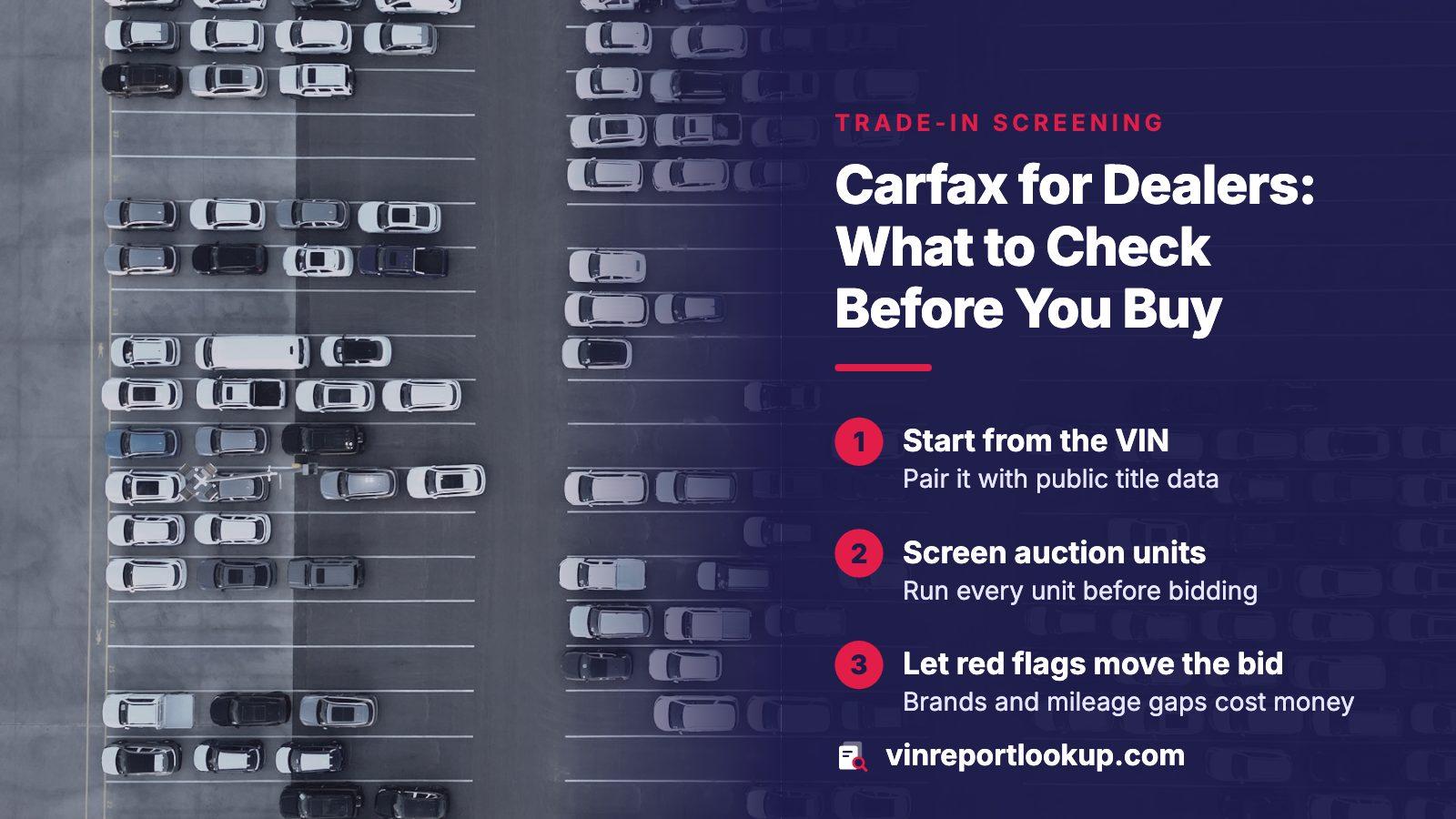
A dealer-grade history check starts with the VIN and public title data: title brands, mileage records and write-off history held in the Justice Department's title system, plus the free NICB theft and flood lookup. Dealer subscriptions from report brands add their own records, but we could not read Carfax's dealer terms, so ask any provider for its contract in writing before signing.
- Carfax dealer terms
- Could not be read; its pages blocked us
- Federal title report
- Five indicators, intentionally short
- Dealers as reporters
- Not listed among required reporters
What dealers mean by Carfax for dealers
On a used lot the brand name works as shorthand. A manager typing this phrase usually wants one of three things: a report to hand a retail customer, a quick screen on cars bought at auction, or a bulk arrangement that covers a whole month of acquisitions. Those are different jobs, and a single login rarely fits all three.
This page is written for the second and third jobs, the buying side. A car you have not yet paid for is where a history check saves the most money, because walking away costs nothing. Once it is on your lot with reconditioning invested, every surprise comes out of your margin.
Which Carfax details stayed out of reach
We tried to read Carfax's dealer pages directly. The server refused both a plain request and a request through a browser, and we do not work around a block. That means we cannot tell you what a Carfax dealer plan costs, what its contract length is, whether it bundles window-sticker style add-ons, or how many reports a plan allows.
A gap, stated plainly
Nothing on this page describes Carfax's dealer pricing or terms. Anyone quoting them to you second-hand is repeating something we could not verify. Get the quote and the cancellation clause from the provider itself.
What we could read is the federal side of the picture, and that is where a careful dealer can build a first screen at almost no cost.
The title data every report leans on
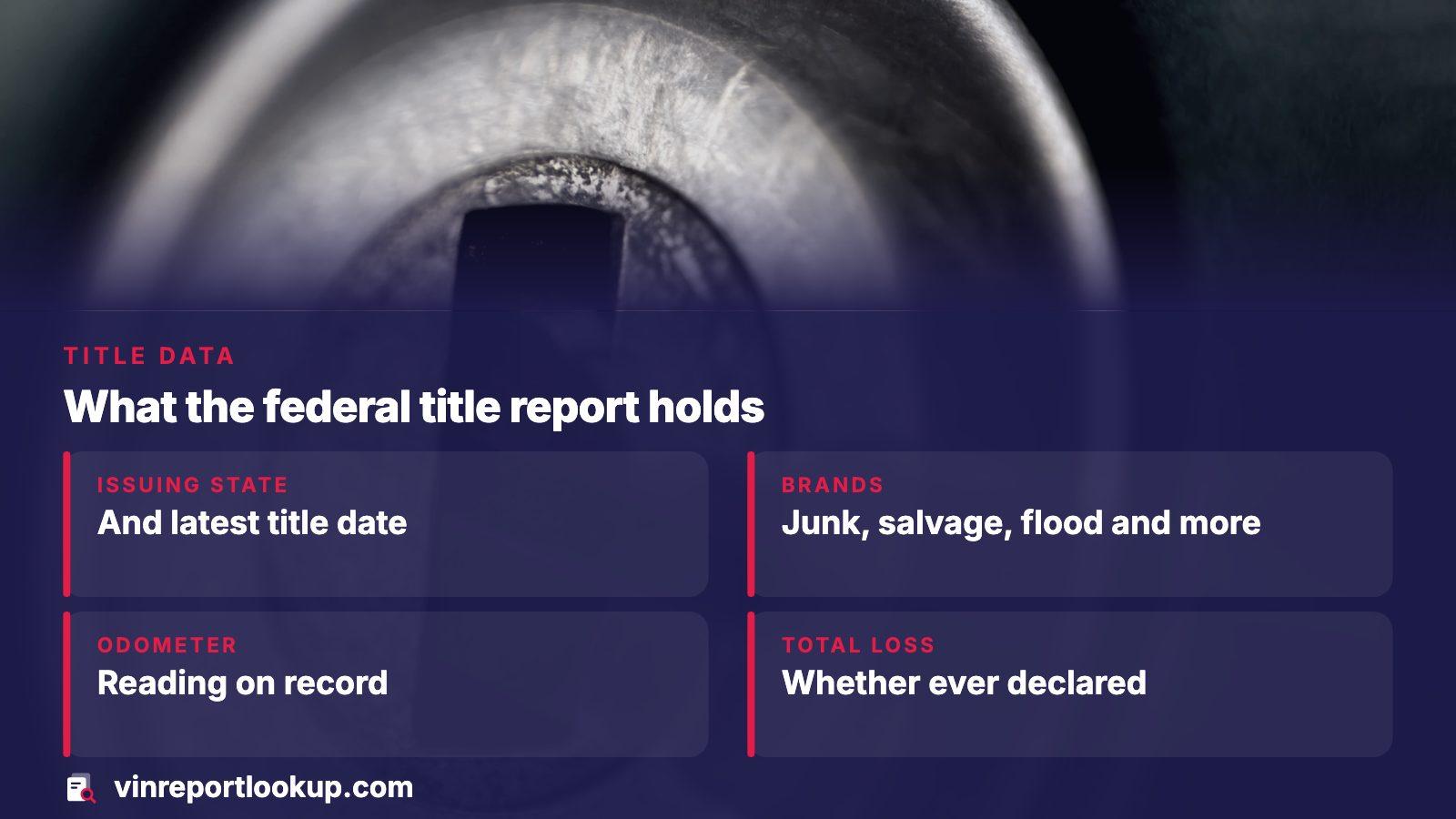
The Justice Department keeps a national title database aimed at stopping stolen or dangerous cars from returning to sale. An approved report from it answers five questions about a VIN.
- The issuing state today, plus when that title was most recently issued
- Each brand any state has stamped on it, like junk, salvage or flood
- The odometer reading on record
- Whether the vehicle was ever declared a total loss
- Whether it has a salvage history
The Justice Department says a clean result is a good thing, because the report is deliberately short. Commercial brands add other material on top, and the federal site says private providers carry service histories, recall details and upkeep records that the title database is not built to hold.
Where the records come from, and what that means for a lot
Federal law makes four groups send data in: state title offices, insurers, scrap and salvage operators, and recyclers. Salvage pools and salvage auctions share that duty, though a small yard handling under 5 salvage vehicles annually is excused.
Dealers are not on that list. A retail lot's own service visits, trade-in appraisals and reconditioning work do not flow into the federal database just because you did them. If a car passed through your hands, any record of it exists only if a state agency, an insurer or a salvage business created one.
Monthly reporting from insurers and salvage operations began on March 31, 2009, so the federal feed covers a long stretch of used inventory, but a car damaged and repaired off the books leaves no trace in it.
A screening routine for auction and trade-in units
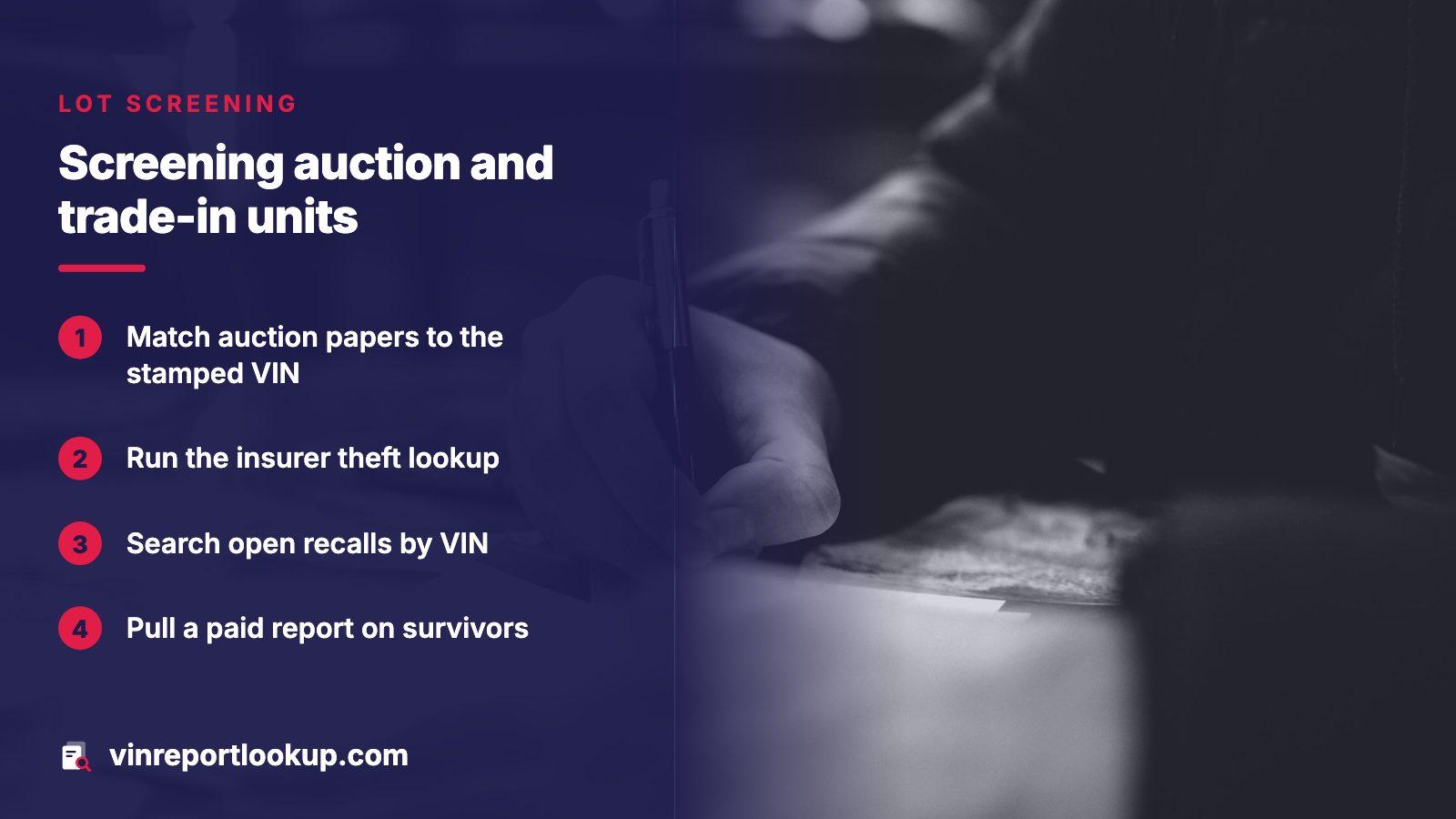
Dealers move fast at the block, so the first screen has to be quick. This order keeps the cost low and drops the weakest cars early.
- Compare the auction paperwork against the VIN as stamped in two separate spots on the car.
- Run the free NICB lookup for theft and flood or salvage flags.
- Search NHTSA by VIN for open recalls, since an unfinished campaign is work you will have to schedule.
- Pull a paid report only on cars that survive the first three steps.
- Hold the car for a mechanic's inspection before the title transfers, whenever the auction terms allow it.
Doing it in that order means you pay for a full report on a short list instead of on every unit in the run sheet.
Red flags that should change your bid
| What shows up | What it tells a dealer |
|---|---|
| Any salvage, junk or flood brand, from any state | The car may be hard to retail and may need disclosure; price it as damaged |
| A later mileage figure below an earlier one | Possible rollback or a clerical error; do not bid until you know which |
| A total loss or salvage entry with a clean title today | Branding may have been dropped when the car crossed state lines |
| A record gap of several years | Could be harmless storage, or work done off the books |
None of these proves wrongdoing alone. They are reasons to slow down, ask the consignor questions and read the titling history line by line before money moves.
Handing a report to a retail customer
Shoppers now expect a history on the windshield or in the listing. Giving one is a trust move, but it also sets a standard: the customer will read it, and anything in it becomes part of the sale conversation. If you show a report, make sure the car you are showing matches the VIN on it.
The Justice Department's own buying tips, which summarize Federal Trade Commission advice, point shoppers toward a mechanic's inspection, a test drive on varied roads and a request for maintenance records. A dealer who has those documents ready answers objections before they are raised.
Choosing a report source for your lot
Compare options on what your lot actually buys. A store that mostly retails late-model trade-ins needs different data than one buying older cars at salvage-heavy auctions.
- Ask each provider whether it sells one-time reports or only subscriptions, and what cancellation looks like.
- Ask which data feeds sit behind the report and how often they refresh.
- Run the same three VINs through each candidate and compare what comes back.
- Keep a free federal and NICB screen in the workflow regardless of the paid brand.
A one-time report with a free preview suits a lot that checks cars irregularly. If you check dozens a week, price a volume plan from several providers and read the contract before you sign.
Run a VIN before you commit
When a specific car is on the table, put its VIN into the preview tool, then decide whether the purchase is worth it for that unit. You buy the report once, nothing renews, and the pricing page carries current rates.
Treat the report as one input. A clean record, a clean NICB result and a clean inspection together are what justify a bid.
Where this information comes from
- U.S. Department of Justice: Understanding an NMVTIS report — the five title indicators and what private reports add
- U.S. Department of Justice: Who reports to NMVTIS — required reporters, exemption and start date
- U.S. Department of Justice: Used car buying tips — inspection and record advice summarized from the FTC
- U.S. Department of Justice: About NMVTIS — who operates the system and how it is funded
Sources and photos: Facts checked against the sources above in November 2026. Photos by Iain, Owen Michael Grech and Derek Nelson on Unsplash; diagrams by VINReportLookup.
Keep reading
- Best VIN check for dealers: screening trade-ins and auction unitsCompare report options built for a lot.
- Bulk VIN check: screening a list of cars without overspendingSee how checking many VINs at once works.
- Carfax alternatives: what each VIN report option covers and costsWeigh other report brands against each other.
- Car history report subscription: when a plan pays and when to skip itUnderstand subscription terms before signing.
Frequently asked questions
Does Carfax offer a dealer program?
We could not confirm it. Carfax's dealer pages refused our requests, so we cannot describe any plan, fee or contract. Contact the company directly, ask for terms in writing, and compare them with other providers before you commit.
Do dealers report vehicle history to the federal title system?
Dealers are not among the required reporters the Justice Department lists. Title offices, insurers and salvage or scrap businesses are. So work a dealer performs may never reach the federal record unless one of those parties creates an entry.
Is a federal title report enough for a dealer?
It makes a sound base: current title, brands, mileage, total loss and salvage entries, kept brief. It leaves out repair and maintenance data, so most lots pair it with a commercial report and an inspection.
What is the cheapest first screen on an auction car?
The NICB lookup is free and flags theft and flood or salvage records, and NHTSA's VIN search shows open recalls. Together they cost nothing and drop weak units before you pay for a full report.
Can I preview a report before paying?
Yes, the preview costs nothing once you enter a VIN. Paying for the whole report is a one-off charge that never renews; check the pricing page for rates.
Now check the car itself
The guide explains what to look for. The report shows what this VIN has on record.