THE SHORT ANSWER
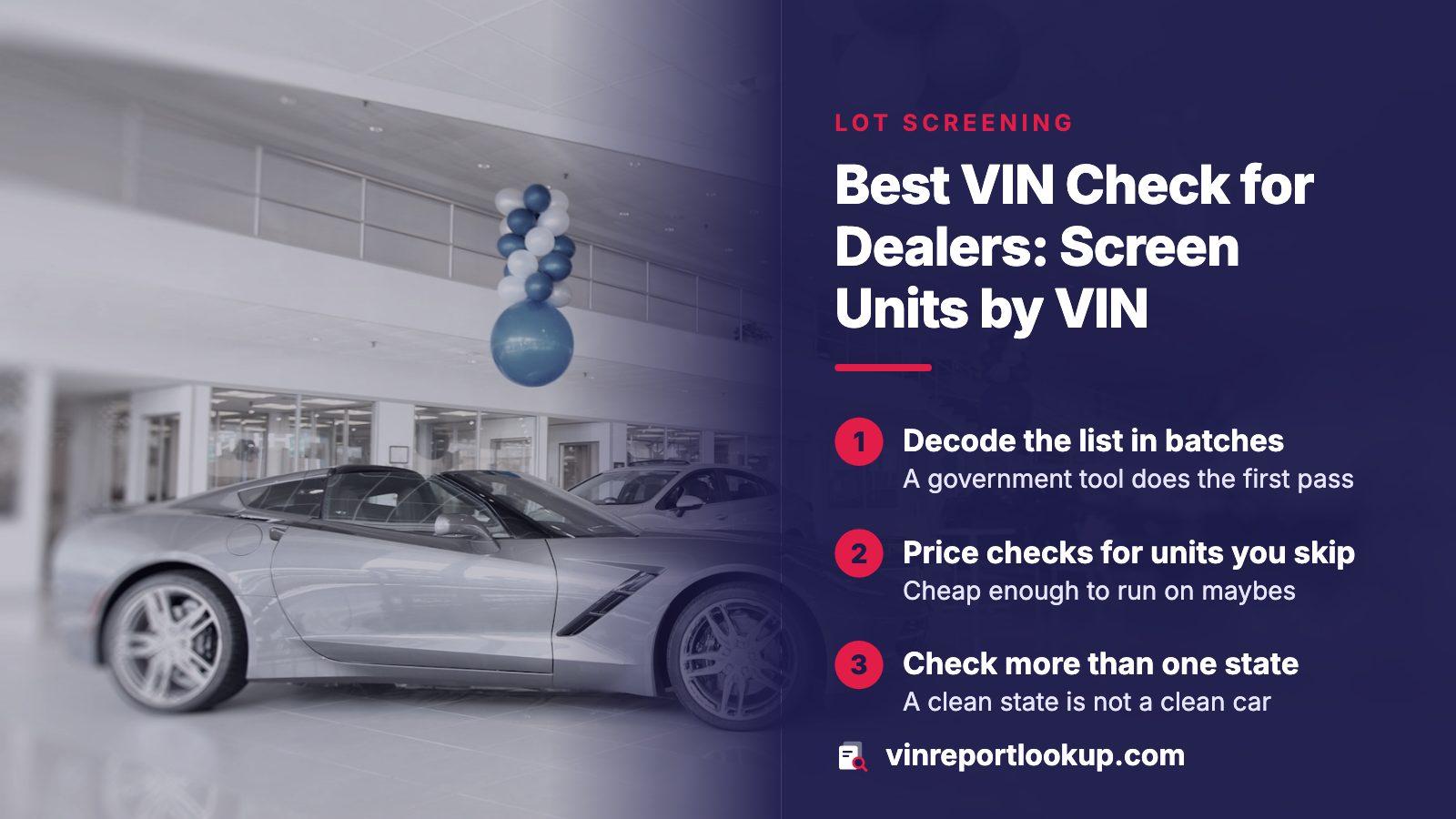
Pick a dealer VIN check by three tests: it must show title brands, odometer readings and salvage or total-loss history; it must be cheap enough to run on units you may not buy; and a retail customer should be able to read the result. A VINReportLookup report is a one-time payment, bought singly or in packs, and the preview costs nothing.
- Free first pass
- NHTSA decodes VINs in batches of up to 50
- Federal title record
- Five indicators, deliberately short
- Carfax on the federal list
- Commercial customers only, California only for NMVTIS data
- Billing here
- One payment per report or pack, no subscription
What a lot needs from a VIN check
A retail buyer runs one report on one car. A dealer runs the same screen on a trade-in at the curb, a unit in an online auction queue and a wholesale offer from another lot, and most of those cars never reach the front line. That changes what counts as best. Depth matters, but so does the cost of a check you throw away.
Three things decide it. The report has to expose the problems that kill a unit's margin: a brand on the title, an odometer that goes backward, a total loss or salvage entry. It has to be priced so that screening a dozen cars to buy one does not eat the profit. And the result has to be something you can put in front of a skeptical customer without a long explanation.
Run the free government lookups before you pay for anything
NHTSA publishes a VIN decoder through its vPIC service. It turns a VIN into the maker's own build data, copes with partial VINs, and has a batch mode that takes up to 50 VINs in one request, each with an optional model year. If you pull a list of auction units, one request can flag a listing whose stated year, model or engine does not fit its VIN.
The decoder reads data that manufacturers submit, and NHTSA says a blank field is not proof that a feature is missing. NHTSA's recalls service adds campaigns by make, model and model year, with the component, the stated consequence and the remedy. Neither tool tells you anything about the car's life after it left the factory. That is the job of a history report.
What the report has to show before you bid
The Justice Department boils its federal title record down to five items. Where the car is titled and when that last changed, any brands, an odometer figure, and two loss histories, one for total losses and one for salvage. The record is brief by design. Commercial vendors layer on material outside that scope, including service records and recall status.
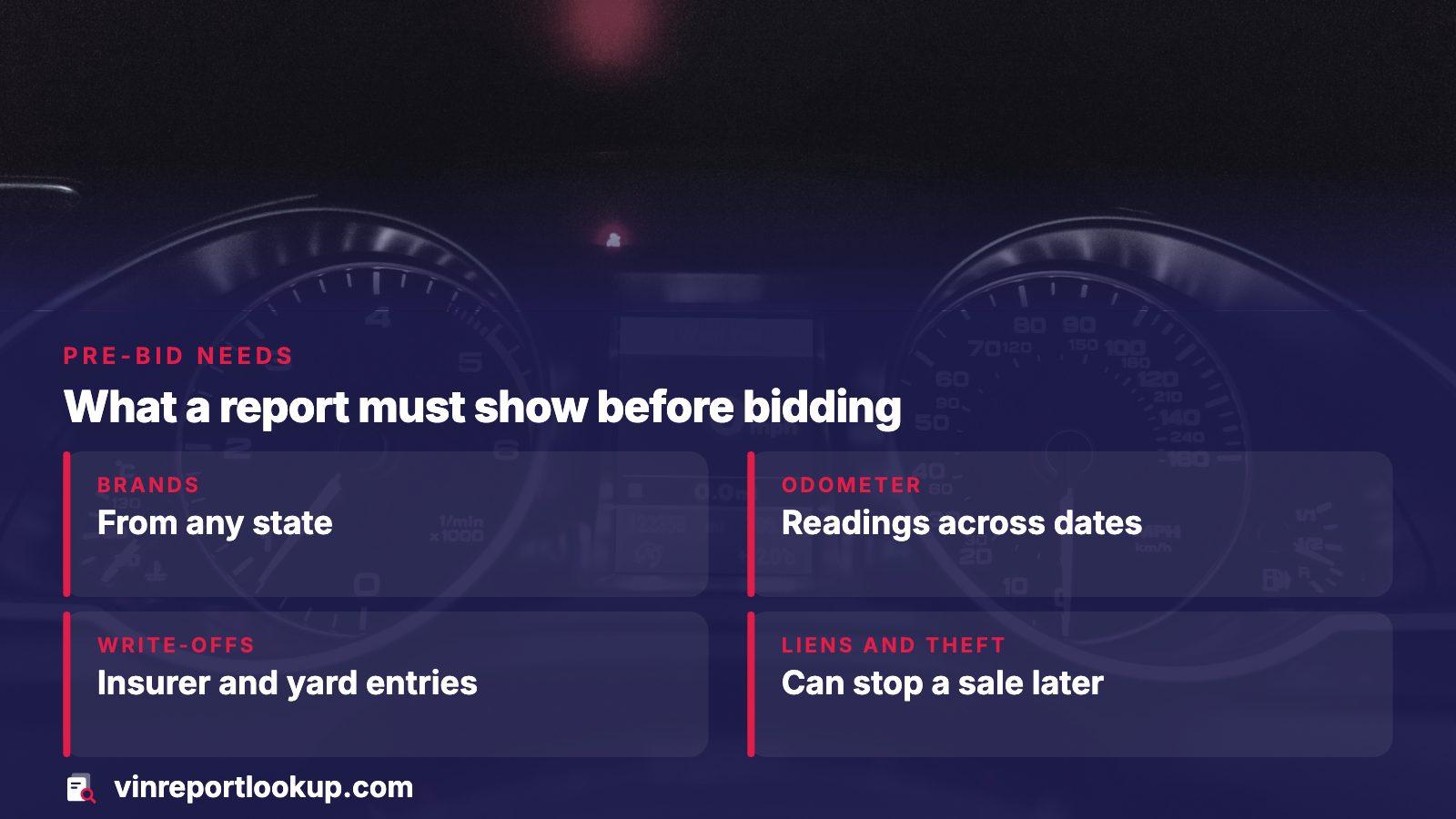
- Title brands from any state, since a brand follows the VIN across state lines.
- Odometer readings spread across dates, so a drop or a long stall stands out.
- Total-loss and salvage entries reported by insurers, yards and auctions.
- Open recalls, which affect reconditioning cost and the sales conversation.
- Liens, theft and impound records, which can stop a sale after you have paid.
A report missing the first three is not a dealer tool, whatever it costs.
Where dealer-only products fit
Some dealers ask about products sold only to the trade. The Justice Department's approved-provider page splits providers into two groups: those that serve everyone, dealers included, and those that serve commercial customers only. Carfax sits in the second group, and the page notes that it offers federal title data to commercial customers in California only. It adds a warning for the public: Carfax, DMVDesk and Experian hand information to dealerships alone, so a private buyer cannot get an NMVTIS report from them.
Carfax's dealer pages refused our requests, so its program terms and fees are not described here. If you already hold a dealer contract, keep using it. The point of this page is narrower: a provider that sells to the public, and to dealers, can cover the same title checks without a contract.
Why a clean report from one state is not a clean car
States do not brand damage the same way. Federal guidance says one state may label a wrecked car salvage while another leaves the title untouched because its damage-to-value threshold was not reached. Flood is similar: some states have a flood brand, others have no such label at all. The record keeps every brand that any state reported, so moving a car across a border does not wash its history.
Takeaway for auction buyers
A car titled in a state with loose branding can still carry a total-loss or salvage entry from an insurer or yard. Read those entries, not only the title line, and expect a branded unit to retail for less than a clean one.
The Justice Department tells buyers to learn these state differences before leaning on any report, from any provider.
How buying by volume works here
Every VIN gets a free preview on VINReportLookup, so you can see what the record holds before spending. The full report is a single charge. For lots that screen several cars a week there are bundles of 3, 5 or 10 reports, and no plan renews itself. The pricing page carries the amounts.
That model suits a lot with uneven volume. A subscription charges you in a slow month. A pay-per-report pack lets you spend only when a unit is worth the check. We do not offer a feed or a bulk upload, so a lot that needs hundreds of automated lookups a day should look elsewhere for that part of its workflow.
A screening routine that keeps checks cheap
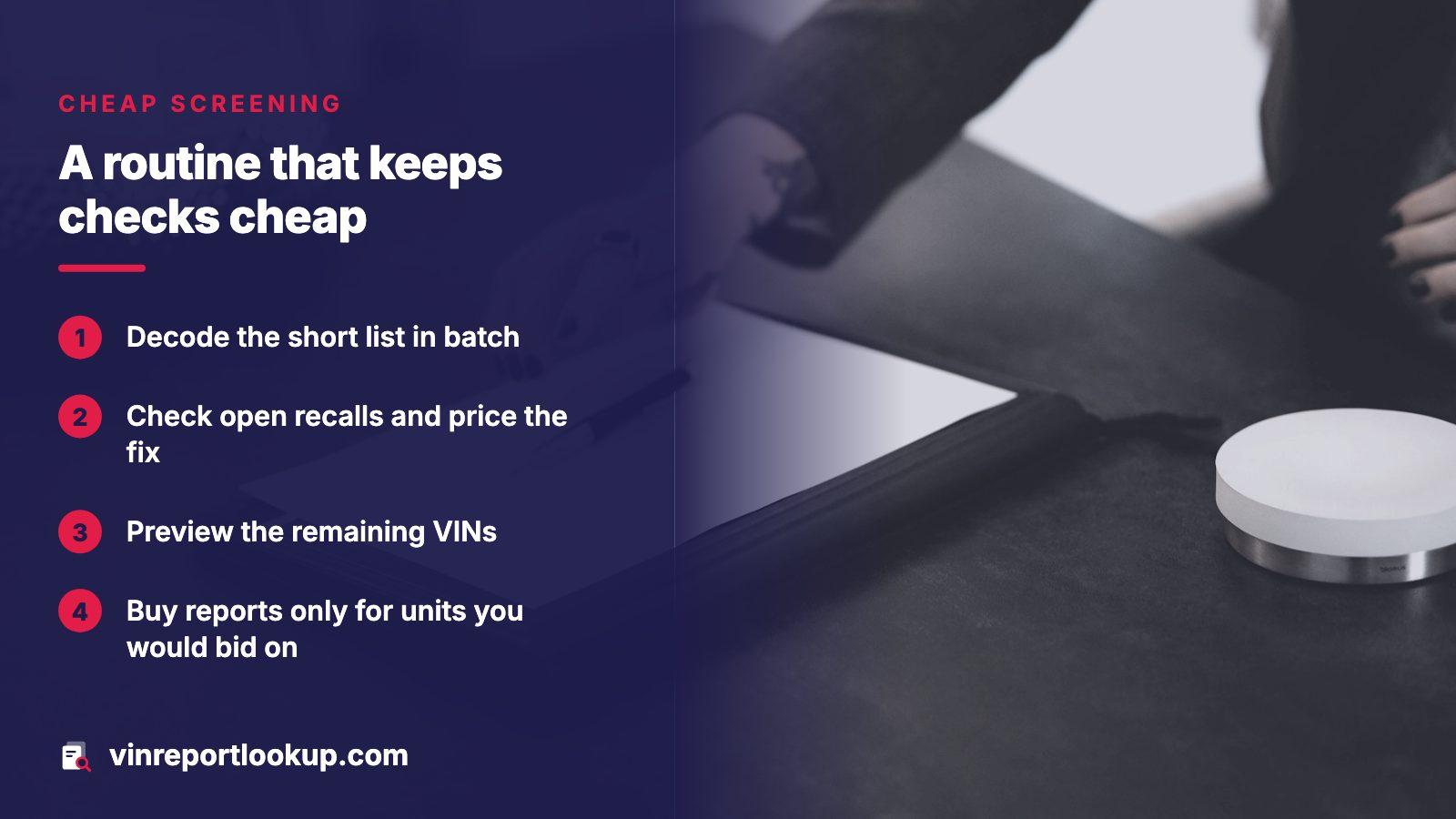
- Decode the VINs on your short list with NHTSA's free tool and drop any listing that disagrees with the decode.
- Check open recalls and price the repair or the wait into your bid.
- Preview the remaining VINs here at no cost.
- Buy a full report only for units you would bid on.
- Walk away from any car with an unexplained brand, a rolled-back odometer or a theft record.
- Keep the report with the deal file for the retail conversation.
This order means the paid step happens late, once the cheap filters have cut the list.
Using the report with a retail customer
Customers often arrive with their own history report. Having yours ready, and having read it, shortens the haggling. If a car carries a past insurance claim or a repaired-damage entry, say so first and let the customer look at the inspection record beside it.
The Justice Department notes that dealers and lenders are central to buying and titling, and that their ability to avoid fraud protects individual buyers too. A report that you pulled before purchase, not after a complaint, is the cleanest evidence that you checked.
Run your next unit
Type the VIN into the form at the top to see the preview. If the unit survives your cuts, buy its report, or a bundle when several cars are waiting. Compare the result with the title paperwork before you commit.
Where this information comes from
- U.S. Department of Justice: Approved NMVTIS data providers — which providers serve dealers only and which serve everyone
- U.S. Department of Justice: NMVTIS information for consumers — state differences in salvage and flood branding, and the role of dealers
- U.S. Department of Justice: Understanding an NMVTIS report — the five title indicators and what private reports add
- NHTSA: vPIC API documentation — VIN decoding and the batch limit
Sources and photos: Facts checked against the sources above in November 2026. Photos by Richard R, Annika Wischnewsky and Ambitious Studio* | Rick Barrett on Unsplash; diagrams by VINReportLookup.
Keep reading
- Carfax for dealers: what a lot manager can and cannot confirmWhat federal sources confirm about dealer-only report programs.
- Vehicle history report providers: who sells VIN reports and how they differHow the approved providers are grouped and what that means for buyers.
- Carfax vs inspection: what each shows and which to buy firstWhy a report and a mechanic's look answer different questions.
- PricingCurrent prices for a single report and for packs.
Frequently asked questions
Which VIN check suits a used car dealer best?
The best one shows title brands, odometer readings and salvage or total-loss history, costs little enough to run on cars you may not buy, and gives a result you can show a customer. Run NHTSA's free decoder and recall data first, then buy a report only for units still on your list.
Can a dealer decode many VINs for free?
NHTSA's vPIC service decodes VINs in batches of up to 50 per request and returns JSON, CSV or XML. It gives build data from the maker, not title or accident history, so it screens listings for mismatches before you spend on a history report.
Does VINReportLookup offer a dealer subscription?
No. Each report is a single charge, with bundles of 3, 5 or 10 available, and nothing renews itself. Previews cost nothing. We have no bulk upload or data feed, so very high volume lookups need a different tool for that step.
Why can't consumers buy reports from dealer-only providers?
Some providers on the Justice Department's list serve commercial accounts only, and the page names Carfax, DMVDesk and Experian as dealership-only suppliers. Public buyers use providers that serve everyone. Dealers can use either kind, depending on the contract and the coverage they need.
Is an inspection still needed after a clean report?
Yes. A report shows only what someone recorded, and the Justice Department calls its own federal record short. Damage nobody reported, or fixed privately, stays invisible. Have a mechanic look over any unit you intend to retail.
Now check the car itself
The guide explains what to look for. The report shows what this VIN has on record.