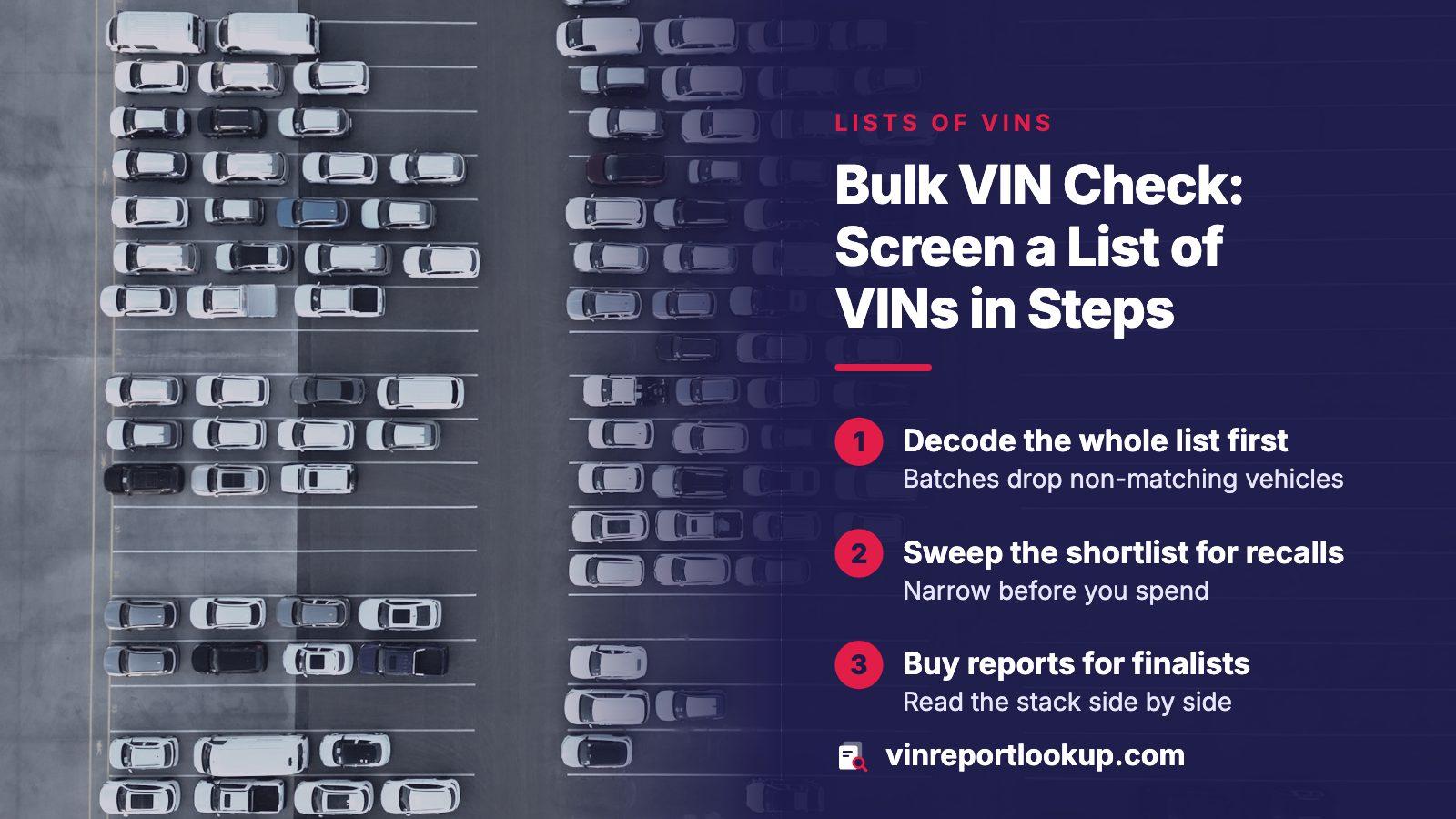
THE SHORT ANSWER
To check many VINs at once, run the list through NHTSA's batch decoder, which accepts up to 50 VINs per request, and drop anything that does not match its listing. Then order history reports for the finalists. Each bundle is a single payment, and the preview shows whether a VIN has records before you buy.
- Free decoding
- NHTSA batch decode takes up to 50 VINs per request
- What decoding is not
- Build data from the maker, not title or accident history
- Bundle sizes here
- Lots of three to ten reports, one payment, no subscription
- Federal title record
- Five indicators, intentionally short
Why a long list needs two passes
Anyone checking a stack of VINs faces the same arithmetic. Most cars on the list will be rejected for ordinary reasons: wrong trim, wrong year, an asking price that never worked. Paying for a full history on every one of them wastes money that belongs to the car you finally buy.
So split the job. Pass one is cheap and mechanical: check that each VIN matches the car in the ad. Pass two costs money and goes after the expensive surprises, like a washed title or mileage that was wound back. Only survivors of the first earn the second.
This page walks through both, then covers where a bulk approach stops working and a different tool is the better fit.
Pass one: decode the list with NHTSA
NHTSA publishes a vehicle API called vPIC, and one of its methods decodes VINs in a batch. You send a single string of VINs, each followed by an optional model year, separated by semicolons, and get one row back per VIN. The ceiling is 50 VINs per request, so a list of several hundred means a handful of requests. Output can be JSON, CSV or XML, which drops straight into a spreadsheet.
- Copy the VINs into one column and remove duplicates.
- Split the column into groups of 50 or fewer.
- Send each group to the batch decode method and save the CSV.
- Compare make, model and year in the output against what each listing claims.
NHTSA says the service is subject to automated traffic rate control, so pace large jobs instead of firing everything at once.

What a decode tells you, and what it hides
A decode reads the build record the manufacturer filed: make, model, model year, plant and equipment codes. That is enough to catch a mismatched listing, such as a VIN that decodes to a base trim when the ad says top of the line. It will not tell you whether the car was ever totaled.
Blank does not mean absent
NHTSA states that an empty field in a decode means it has no data on that item. It does not prove the car lacks the feature. Treat blanks as unknown and check the car itself.
Rows that carry error flags usually point to a mistyped or incomplete VIN. Correct the typo before you pay for anything, since one wrong character sends a history lookup to another vehicle or to an empty result.
Adding a recall sweep for the shortlist
Once the decode confirms what each car is, you have the make, model and year needed for NHTSA's recalls lookups. The recalls API returns campaigns for a given make, model and model year, each with a campaign number, report date, the affected component, the consequence and the remedy.
That lookup is by model, not by individual VIN, so it tells you which campaigns exist for that vehicle type. It cannot say whether this particular car had the repair done. Use it to rank cars: a model with several safety campaigns deserves a closer look at whether the work was completed before you pay for anything else.
Pass two: buy reports for the finalists
By now a list of dozens has probably shrunk to a handful. This is where a history report earns its price. The federal title record is built on five indicators, among them brand history, mileage readings and total-loss or salvage entries. A private report adds more around that core.
Run the free preview on each finalist first, since it shows whether a VIN has records before any money changes hands. Then buy. On VINReportLookup one report is one payment, and the multi-report lots, three at the low end and ten at the high end, cover a shortlist in a single purchase. Current prices are on the pricing page.
| Stage | Tool | Cost | Answers |
|---|---|---|---|
| Identity | NHTSA batch decode | Free | Is this the car in the ad |
| Safety | NHTSA recalls by model | Free | Which campaigns exist |
| History | Paid report, single or pack | One payment | Brands, odometer, salvage |
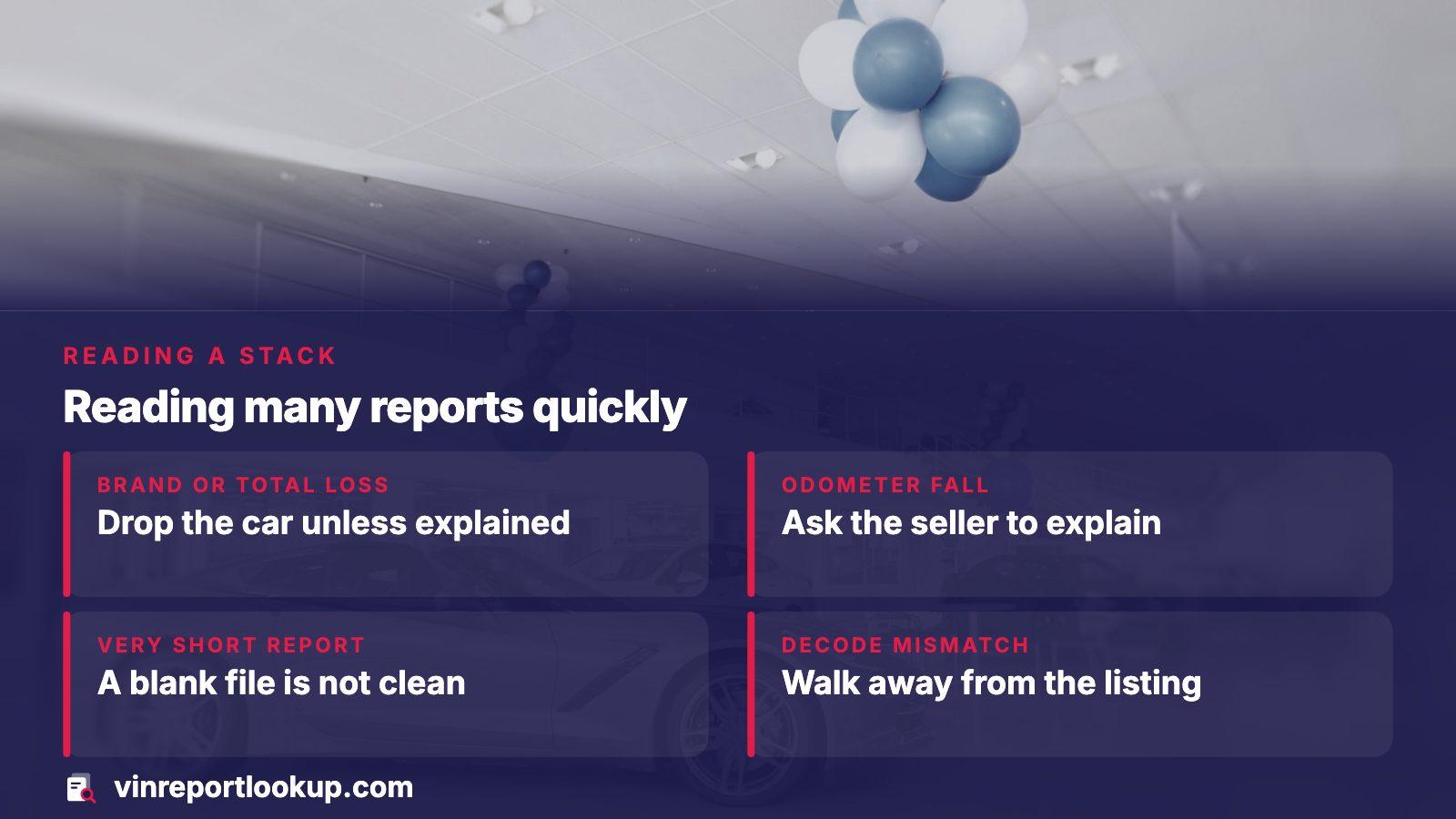
Reading a stack of reports quickly
When several reports land together, sort before you read. A brand on the title, a total loss entry or a salvage record ends the conversation for most buyers. Branding rules differ by state: one state can brand a wrecked car salvage while the next state skips the label, and some states have no flood brand at all. The Justice Department advises learning those differences before trusting any report.
- Any brand, total loss or salvage entry: drop the car unless the price reflects it and an inspector agrees.
- Odometer readings that fall between dates: ask the seller to explain in writing.
- A very short report: the Justice Department calls a blank federal record a good thing, since the format is deliberately concise.
- Mismatch with the decode: walk away from the listing.
Who benefits from checking in volume
Shoppers comparing five or six listings across a weekend are the easy case: decode, shortlist, then buy a pack. Small dealers screening trade-ins and auction units fit too, since they expect to reject most of what they look at. Fleet buyers and lenders sometimes check hundreds of units, and the Justice Department names dealers and lenders among commercial users of federal title data.
Be honest about scale. The purchase options here top out at a pack of 10. A lot manager screening hundreds of VINs daily needs a commercial data arrangement, not a shopper's pack, and should confirm volume terms with a provider directly.
Cost and what to do next
Keep the sequence short: clean the list, decode it, remove mismatches, check recalls by model, preview the finalists, then buy. The preview is free and the report is paid, so you learn whether a VIN has records before spending.
Prices change, so read the pricing page for the current figures rather than relying on a number quoted anywhere else. If a car passes the report, an independent inspection is still worth doing, because no record shows how the brakes feel or whether the frame was straightened without a claim.
Where this information comes from
- NHTSA: vPIC API documentation — batch decode limit, formats and the blank-value warning
- NHTSA: Recalls API example — recall campaigns returned by make, model and year
- U.S. Department of Justice: Understanding an NMVTIS report — the five title indicators and the short-report point
- U.S. Department of Justice: NMVTIS information for consumers — state brand differences and commercial users
Sources and photos: Facts checked against the sources above in November 2026. Photos by Iain, Alejandro Escamilla and Richard R on Unsplash; diagrams by VINReportLookup.
Keep reading
- Best VIN check for dealers: screening trade-ins and auction unitsWhat a lot needs from a check when most units get rejected.
- Best VIN check for auction cars: what to run before you bidScreening cars before bidding.
- PricingCurrent single-report and pack prices.
- Vehicle history report providers: who sells VIN reports and how they differHow report providers differ.
Frequently asked questions
How many VINs can I check at once?
NHTSA's free batch decoder accepts up to 50 VINs per request, so larger lists are split into groups. For history reports, VINReportLookup sells a single report or a lot of reports from three up to ten, so cut a long list down by decoding first.
Is a bulk VIN check free?
The decoding step is free through NHTSA, and the preview on VINReportLookup costs nothing. The full history report is a paid, one-time purchase. Nothing is billed until you choose to buy, and there is no subscription attached.
Does a batch decode show accidents or salvage titles?
No. A decode reports the build data the manufacturer filed, such as make, model and year. Accident, brand and salvage information comes from title and insurance records, which a history report draws on.
Can I upload a spreadsheet of hundreds of VINs?
The options described here are single reports and bundles that stop at ten. For hundreds of VINs a day, talk to a data provider about commercial volume terms, and use the free decode to remove obvious mismatches before paying.
What should I drop from the list first?
Remove duplicates, VINs with error flags from the decode, and cars whose decode contradicts the listing. After that, anything with a brand, total loss or salvage entry on the report is the next cut.
Now check the car itself
The guide explains what to look for. The report shows what this VIN has on record.