THE SHORT ANSWER
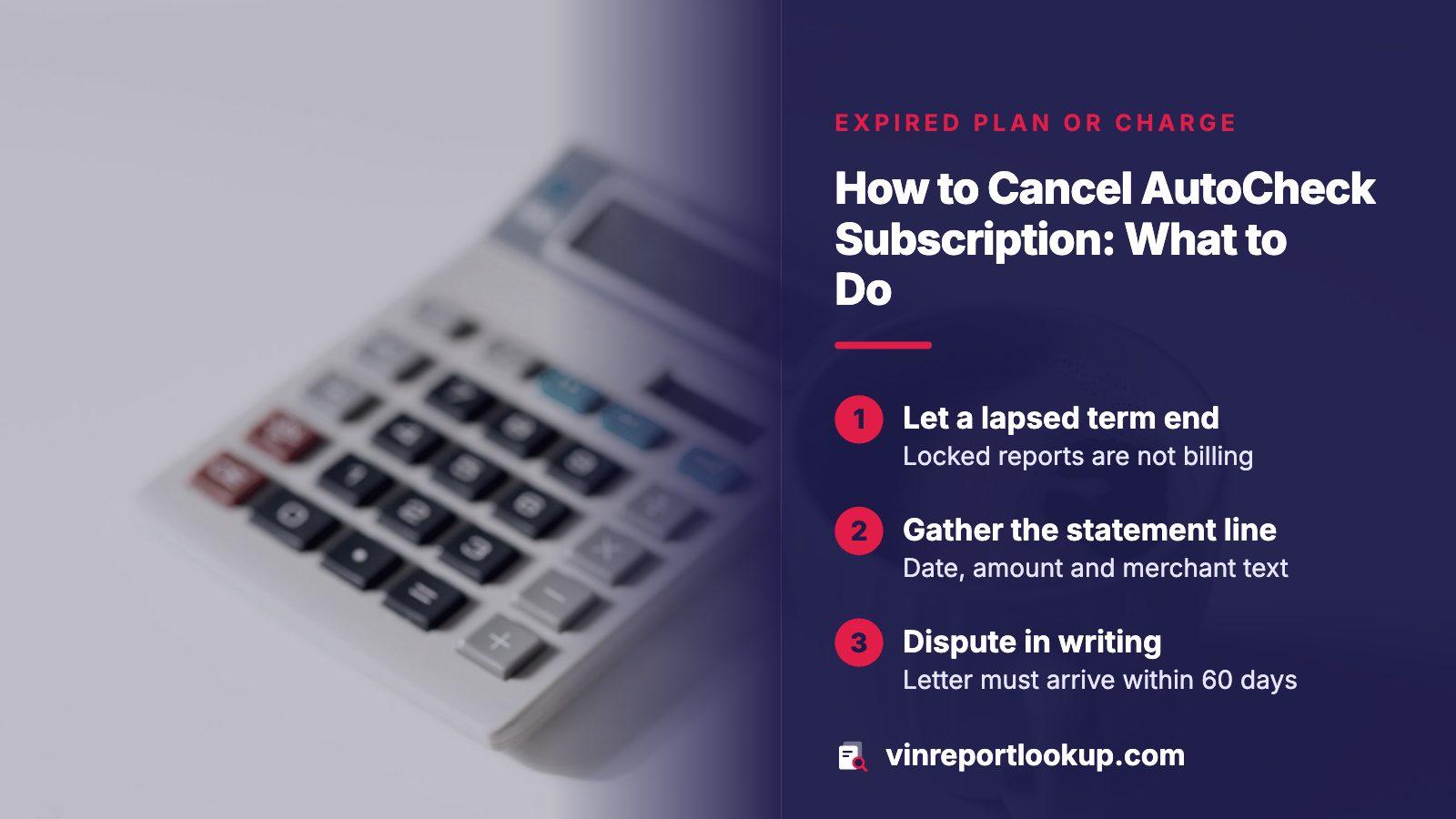
AutoCheck states that the card is billed only when you buy, renew or extend a plan, and an expired account is simply locked until you reactivate it. Its pages show no cancel button, so if you were billed again, contact customer service by form or phone with your order details, then dispute the charge with your card issuer in writing if it is not fixed.
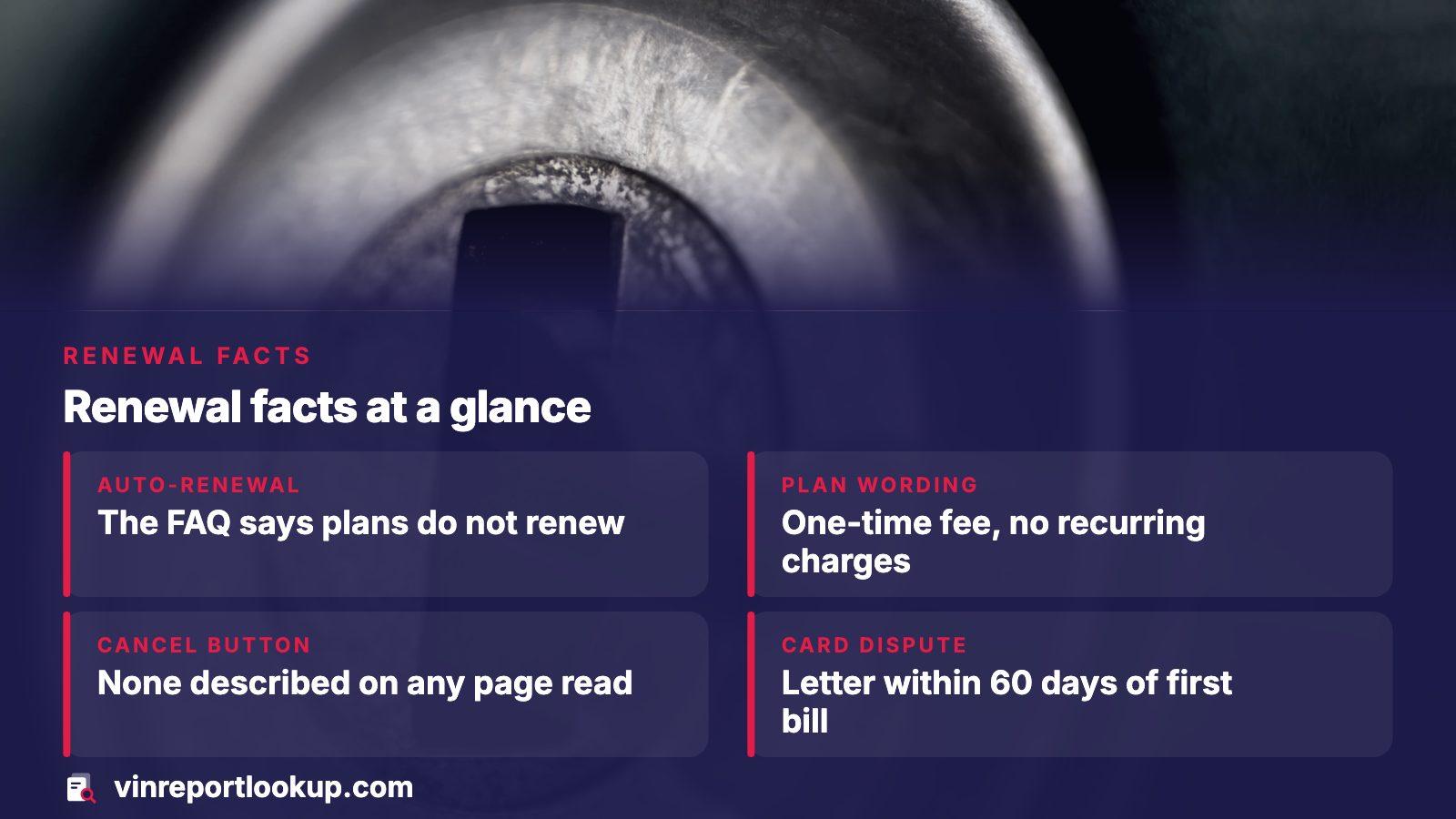
- Auto-renewal
- AutoCheck's FAQ says its subscription does not renew itself
- Plan wording
- Both consumer plans are labeled one-time fee, no recurring charges
- Cancel button
- None described on any AutoCheck page we read
- Card dispute
- Your letter has to arrive within 60 days of the first bad bill
What AutoCheck's own pages say about renewal
The FAQ has a question worded almost exactly like your search, asking whether the subscription renews automatically. The answer is a flat no. The card is charged when a customer buys a plan or deliberately chooses to renew or extend one, and at no other time.
The order page repeats the point for both consumer plans. A single report costs $29.99 and a bundle of five reports for 21 days costs $59.99, and each carries the line one-time fee, no recurring charges. Read together, the pages describe a purchase that runs for a term and then stops.
What we did not find
No page we opened, including the FAQ and the consumer terms, describes a cancel button or a cancellation procedure. We are not going to invent one. What follows is limited to what AutoCheck and the Federal Trade Commission actually publish.
What happens when the term simply runs out
Reports bought on a multi-report plan live in an online dashboard, and they stay viewable only while the term lasts. When it ends, nothing is deleted. AutoCheck says your earlier VIN lookups are held in storage, locked, until you reactivate.
That explains a common confusion. Someone returns weeks later, finds old VINs blocked, and assumes the plan was cancelled or broken. The FAQ's own answer is that the term has probably expired, and pressing Activate in the dashboard is how you pick a plan and pay again. Until you press it, there is no new charge.
- Letting the term lapse is the whole cancellation for a plan that does not renew.
- Locked reports are not a billing problem; they are what an expired term looks like.
- Reactivating is a fresh purchase that you start yourself.
If you see a second charge anyway
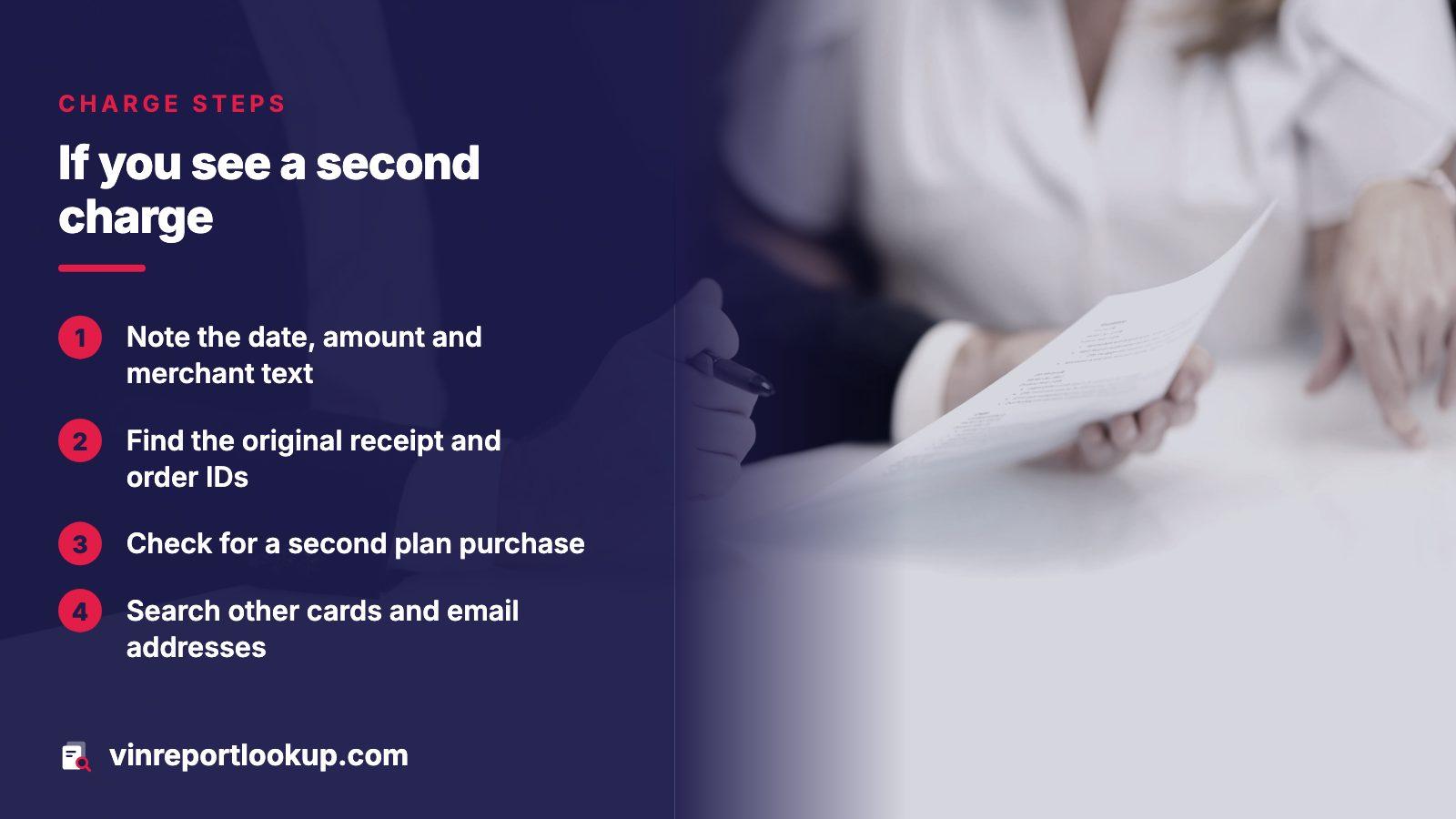
Given what AutoCheck publishes, an unexpected second charge deserves a question, not a shrug. Before you contact anyone, gather the facts so the conversation is short.
- Pull up the statement line and note the date, the amount and the exact merchant text.
- Search your email for the original receipt, and note the VIN, Transaction ID and Order ID if it lists them.
- Check whether you pressed Activate or bought a second plan; a repeat purchase of the same size is easy to forget.
- Look at your other cards and email addresses, since a plan can sit under an address you rarely use.
If the charge is a real mistake, you have a clear complaint: the company's own FAQ says it bills only when you choose to buy or renew.
Reaching AutoCheck customer service
The FAQ points subscription questions to a Contact Us form and a phone line, 888-409-2204. For a particular report, it asks you to include the VIN, the Transaction ID and the Order ID, so have those ready before you call or write.
Sign-in matters too. Returning customers sign in from the top corner of the site using the email address they bought with; a reset link goes to that address if the password is lost. If you cannot sign in, the cause is often a different email, not a closed account.
Write down the date and time of every call, the name of the person you spoke with and what they promised. If you use the form, keep a copy of the message and any confirmation. This record is what you hand to your card issuer later if the problem is not settled.
Disputing the charge on a credit card
The FTC explains that the Fair Credit Billing Act covers credit cards and similar revolving accounts. Disputable items include unauthorized charges, a wrong amount or date, and something you did not accept or that was not delivered as agreed.
| Step | What the FTC says |
|---|---|
| Where to write | The issuer's billing-inquiries address, not the payment address |
| What to include | Name, address, account number and a description of the mistake, with copies of receipts |
| Deadline to send | It has to arrive within 60 days of the first statement showing the error |
| Issuer's reply | Written acknowledgement within 30 days, resolution within 90 days |
| While it is open | Hold back only the disputed sum; the rest of the bill stays due |
Certified mail with a return receipt gives you proof of delivery. Keep your own copy of the letter. For a truly unauthorized charge, the FTC says your liability is limited to $50, and it can point to identity theft.
A different product: the dealer and business plans
Not every AutoCheck account is the consumer kind. The order page has a separate business panel for dealerships, lenders, insurers and similar buyers, reached through a request for information, and the consumer terms send commercial users to a different subscription site.
The terms also say Experian can suspend or end an account it judges to be used commercially, without refunding prepaid fees, and may bill its standard fee for each report so used. If you resell reports or run them for a business, ask about the right plan rather than assuming the consumer one fits.
Skipping the question next time
Most buyers want one car checked, not a plan to manage. A single payment for a single VIN leaves nothing to track, which is how our own checks work: you enter the VIN, see the free preview, and pay once only if you want the full report.
Whichever service you use, read the checkout line before paying, and screenshot it. Look for words like one-time or renews. A pack of reports is worth it only if you will really run several cars; otherwise you pay for access you will not use.
Where this information comes from
- AutoCheck: frequently asked questions — renewal answer, locked reports after expiry, contact form and phone line
- AutoCheck: order vehicle history reports — the two consumer plans, their wording and the business panel
- AutoCheck: consumer terms and conditions — who the agreement is with and the commercial-use rules
- FTC: using credit cards and disputing charges — the billing-error letter and the 60, 30 and 90 day timelines
Sources and photos: Facts checked against the sources above in November 2026. Photos by Ben Wicks, Carrie Allen www.carrieallen.com and Derek Nelson on Unsplash; diagrams by VINReportLookup.
Keep reading
- Car history report subscription: when a plan pays and when to skip itWhen a subscription makes sense for one car, and when it does not
- AutoCheck cost: what its two plans charge and what the fee coversWhat AutoCheck's two consumer plans include
- How to cancel a Carfax subscription when Carfax's own pages will not openA sourced stop-the-charge walkthrough for another report service
- AutoCheck review: when it earns its fee, what it misses, and what else to buyWhat an AutoCheck report covers and where it falls short
Frequently asked questions
Does AutoCheck renew automatically?
Its FAQ says no. The card is charged only when you buy a subscription or choose to renew or extend it. An expired account keeps your earlier lookups, but they stay locked until you reactivate, so letting the term lapse is how a non-renewing plan ends.
Why can't I open reports I ran before?
AutoCheck's answer is that your term has probably expired. Reports on a multi-report plan can be viewed only during the term. Signing in and pressing Activate in the dashboard lets you choose a plan and restore access, which is a new purchase you start yourself.
Who do I contact about an AutoCheck charge?
The FAQ lists a Contact Us form and a phone number, 888-409-2204, for subscription help. Have the VIN, the Transaction ID and the Order ID ready, since it asks for them. Keep notes on each contact in case you later need to dispute the charge.
Can I get a refund from AutoCheck?
We did not find a refund policy on the pages we read, and the consumer terms we opened do not set out a refund process for ordinary purchases. Ask customer service directly. If a charge is wrong, your card issuer's dispute process is the fallback.
How long do I have to dispute a card charge?
The FTC says a written billing-error letter has to be in the card issuer's hands inside 60 days of the statement where the mistake first appeared. The issuer must acknowledge it within 30 days and resolve it within 90 days. Send it to the billing-inquiries address.
Now check the car itself
The guide explains what to look for. The report shows what this VIN has on record.