THE SHORT ANSWER
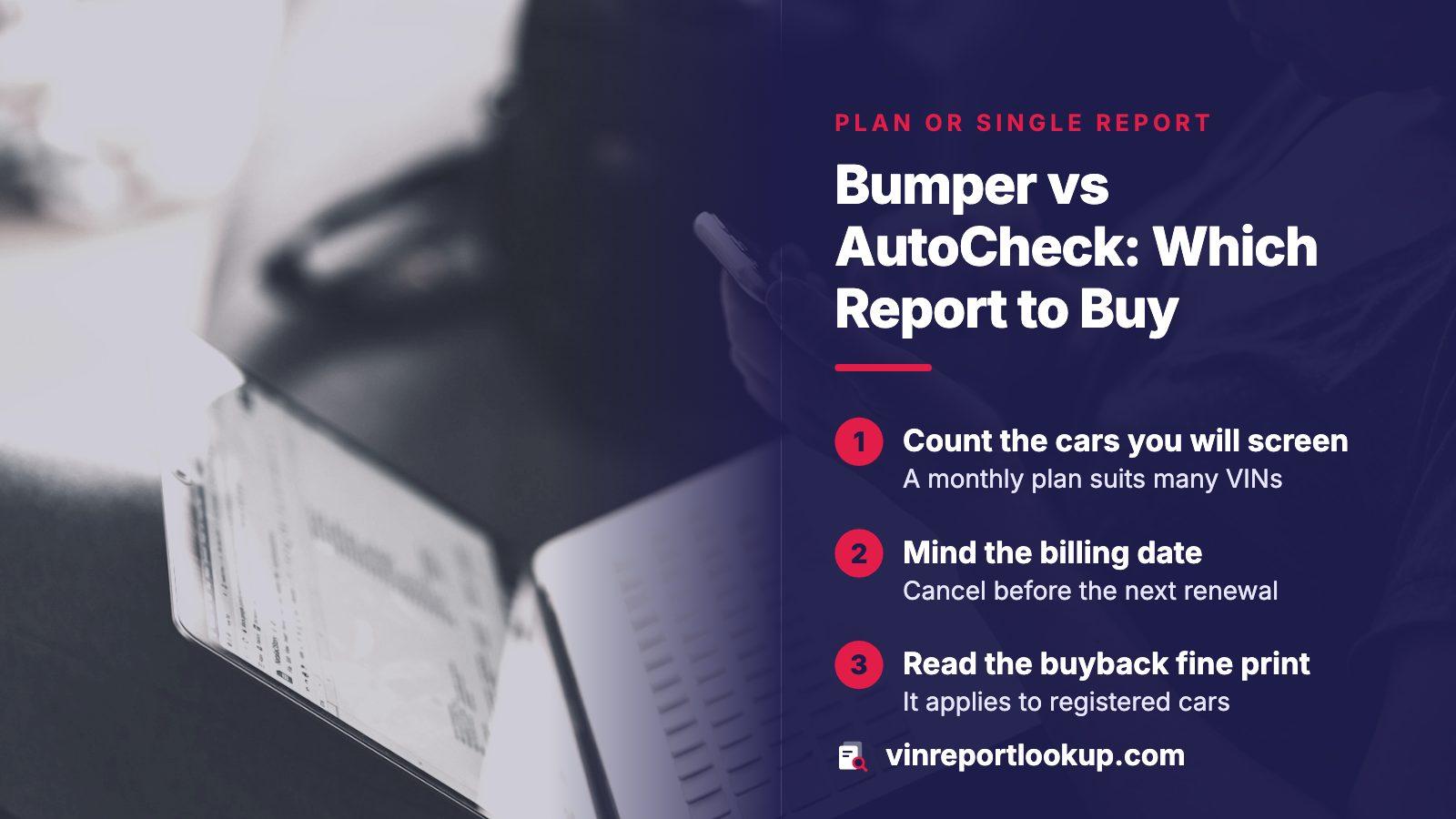
Choose Bumper when you will screen many cars within a month and will cancel before the next billing date. Choose AutoCheck when you want a single report with no renewal and the title-brand buyback promise on a car you plan to buy. If you only need one VIN checked, a one-time report here follows a free preview and never renews.
- Bumper billing
- Plan renews every 30 days
- AutoCheck billing
- Single or multiple reports, no auto-renewal
- Bumper monthly allowance
- 50 reports
- AutoCheck extra
- Title-brand buyback on registered cars
How each service takes your money
Billing is where these two differ most, so read it before comparing report pages. Everything in the table below comes from the companies' own help and FAQ pages, as they read this month. AutoCheck's plan prices did not appear in the page text I could open, so no AutoCheck price is printed here.
| Question | Bumper | AutoCheck |
|---|---|---|
| Plan shape | A membership with a capped number of reports each period | A single report, or multiple reports for the length of a subscription term |
| Renewal | Renews every 30 days and bills at the start of each period | Its FAQ says no automatic renewal; the card is charged only when you buy, renew or extend |
| Published price | $19.99 per 30 days, or $12.99 per 30 days on a three-period plan ($38.97) | Not shown on the pages I read |
| Unused reports | Do not roll over to the next period | Reports stay viewable in a dashboard while the term lasts |
What the two reports actually look at
AutoCheck describes its report as a title, registration and usage record. It searches for salvage or junk status, hail, flood and fire damage, mileage discrepancies, lemon buybacks, rental, taxi or fleet use, theft, and liens. Accident entries appear only when someone supplied them, and owner names are never given.
Bumper lists accident, salvage and theft history, ownership and lien details, recall notices and a market value estimate. It also says accident records come from 44 state-level agencies, and only where the state has digitized them. Salvage records are described as available for all 50 states.
The buyback promise, and its fine print
Only AutoCheck's pages describe a repurchase promise. Suppose a state title brand reached Experian before your report date and the report left it out. Experian says it will then repurchase the car, paying up to 110% of the NADAguides retail figure, with up to $500 more for accessories.
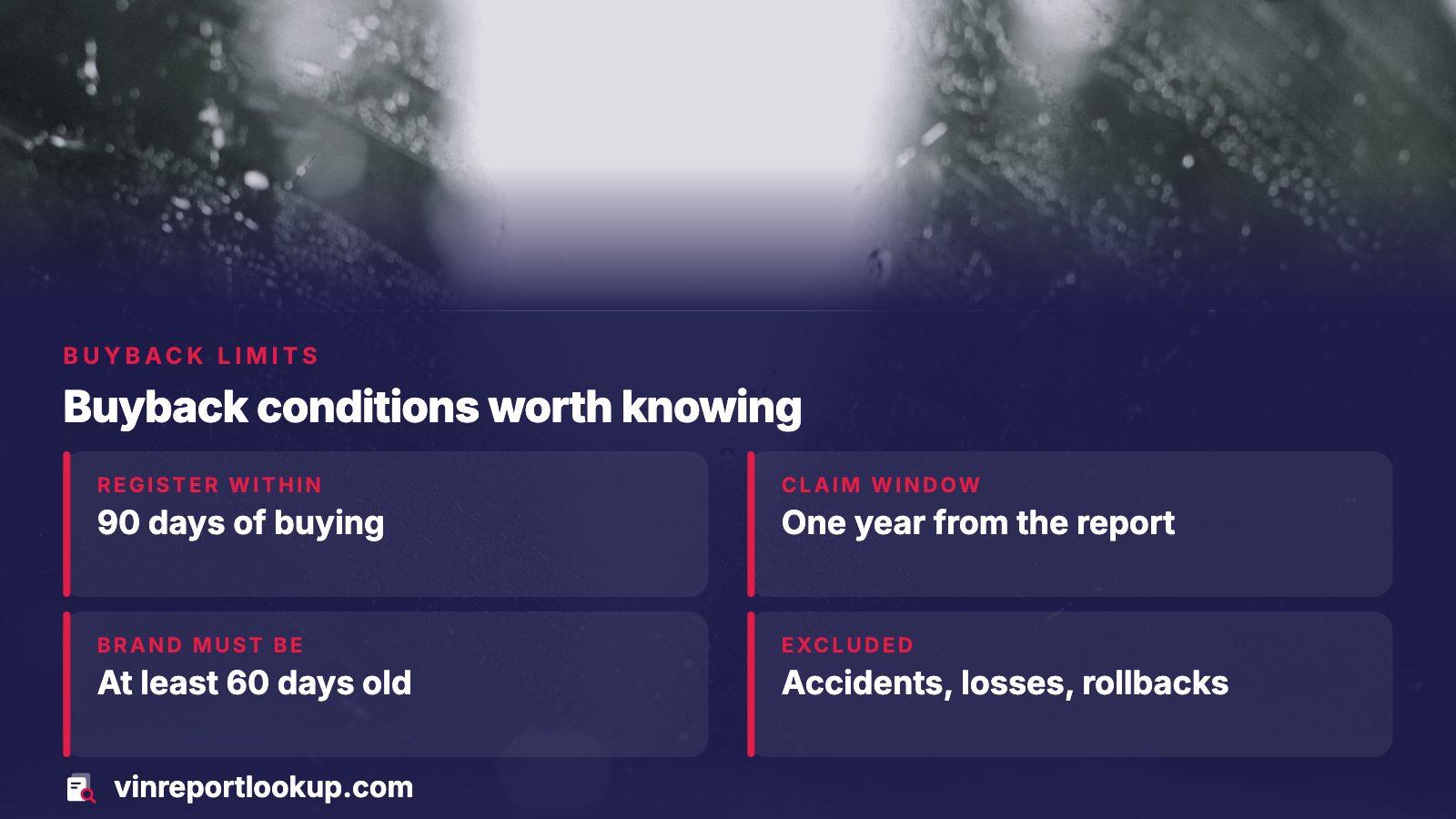
- Register within 90 days of buying the car, after you own it.
- The report must predate the purchase, and a claim must be filed inside one year of that report.
- A branded title must be at least 60 days old on the day the report was run.
- Accidents, insurance losses and rollbacks from commercial sources are excluded.
The program covers state-reported brands only, such as flood, fire, hail, salvage, lemon, odometer wording and rebuilt. Read it as a safety net for one narrow failure, not a promise that the report is complete.
Federal title data and what the Justice Department says
The Justice Department keeps the roster of approved NMVTIS data providers. Bumper.com sits in the group that sells to both commercial and public customers, and its roster entry shows BeenVerified.com as a second site it owns. Experian.com appears in the commercial-only group, and the page tells consumers they cannot receive NMVTIS reports from Experian.
What that does and does not tell you
The roster is about who may sell the federal NMVTIS report to the public. AutoCheck's own FAQ lists other sources: state motor vehicle departments, auctions, dealers and consumer agencies. I could not confirm from either company's pages how much federal data each report draws on, so ask each seller before paying.
Matching the report to how you shop
Count the cars first. A buyer comparing a dozen listings over a few weeks gets the most out of a capped monthly allowance, provided the cancellation happens on time. Bumper lists several ways to stop: email, chat, a contact form, phone, or the Apple or Google subscription screen if the plan was bought in the app.
A buyer with one finalist in a driveway has no use for a monthly allowance. AutoCheck's single-report plan fits there, and so does a one-off report from any seller. If the deal is days away, pay for the report that ends the same day instead of a plan you must remember to cancel.
Reading either report without being fooled
No records found is not the same as nothing happened. AutoCheck says that message means nothing turned up at that moment, and that very old cars may lack the VIN format it needs. Bumper admits some records are incomplete or carry keying mistakes it has no power to edit.
- Any brand, salvage or total-loss line deserves a hard look at repair quality.
- Mileage that drops between entries points to odometer trouble.
- Rental, taxi or fleet use explains heavy wear even on a clean title.
- An open lien means a lender could still hold rights over the vehicle.
The FTC advises paying a mechanic to inspect the car, because a history report can show accidents and flooding but usually says nothing about mechanical faults.
Fine print worth a minute before you pay
Bumper's terms send disputes to individual arbitration and waive class actions, say fees can hit your card repeatedly, and add that cancelling stops future renewals but leaves charges already incurred. Its billing page says refunds are decided case by case and can take up to 10 days to reach your bank.
I found nothing on either company's pages to suggest a problem beyond ordinary subscription rules, and I am not judging either one's reputation. If you buy Bumper, save the confirmation of your cancellation, and if you buy AutoCheck, save a copy of the report for any buyback claim.
The one-payment route on VINReportLookup
VINReportLookup starts with a free preview, so you can learn whether a VIN has records before spending anything. The full report is a single payment, for one car or a bundle of 3, 5 or 10 cars. No plan renews afterward. Current amounts sit on the pricing page.
What it covers is the list that hurts a buyer most: brands on the title, damage, odometer readings, salvage and auction entries with photos, liens, theft and open recalls. A mechanic's inspection still has to follow.
A short path to a decision
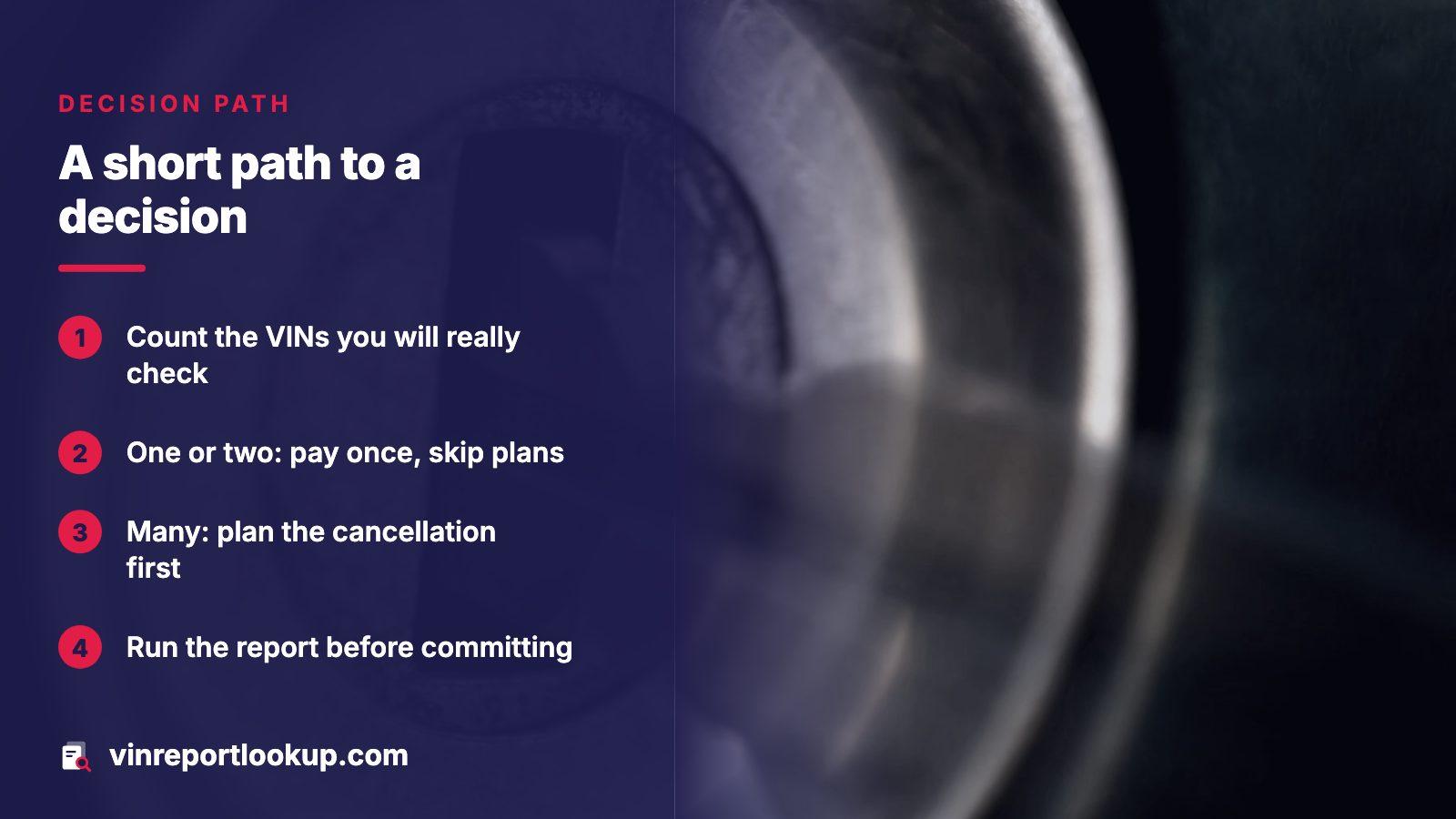
- Write down how many VINs you will really check this month.
- If it is one or two, pick a single payment and skip any plan that renews.
- If it is many, price the monthly plan, set a calendar reminder and plan the cancellation route first.
- Run the report before you commit to the car, not afterward.
- Book an independent inspection for the car that survives.
Where this information comes from
- Bumper: common questions — plan price, 30-day renewal, no rollover of reports
- Bumper: billing help — cancellation routes, refunds and the 44-agency accident coverage note
- AutoCheck: frequently asked questions — no auto-renewal, record types searched, data sources
- AutoCheck: Buyback Protection — buyback terms and exclusions
- Justice Department: approved NMVTIS data providers — which providers sell federal title data to the public
- FTC: buying a used car from a dealer — why a history report does not replace an inspection
Sources and photos: Facts checked against the sources above in November 2026. Photos by Michal Biernat, Derek Nelson and Cole Keister on Unsplash; diagrams by VINReportLookup.
Keep reading
- Bumper VIN check cost: what the plan bills and cheaper ways to check a carwhat Bumper costs and how its billing works in more detail
- AutoCheck cost: what its two plans charge and what the fee covershow AutoCheck plans are priced
- Bumper alternatives: sites that sell a VIN report without a monthly planother ways to buy a report besides a monthly plan
- AutoCheck alternatives: other VIN reports, and what each one showsother report options if AutoCheck is not a fit
Frequently asked questions
Is Bumper or AutoCheck cheaper?
That depends on volume. Bumper publishes a monthly price on its help page and gives you many reports inside the period, so it can cost less per car for a long shortlist. AutoCheck did not show plan prices in the text I could open, so check its checkout before comparing for one car.
Does AutoCheck renew automatically?
Its FAQ says no. The card is charged only when you buy, renew or extend, and saved VIN history stays locked until you reactivate. Bumper works the other way, since its plan renews every 30 days until you cancel it through one of its listed routes.
Can I cancel Bumper at any time?
Its help pages say you can, by email, chat, the contact form, phone, or through Apple or Google if you subscribed in the app. Bumper says a Google Play plan keeps working through the paid period after cancelling. Deleting the app does not stop an app-store plan, so cancel inside the store account.
Which one catches more problems on a used car?
I could not confirm that either catches more, and neither company claims completeness. AutoCheck says it may miss accidents, and Bumper tells buyers not to rely on its data alone. Treat any report as one input, then pay for an independent inspection.
Should I run both reports on the same car?
Usually not as a first move. Run the free checks, then one paid report, and look hard at any brand or odometer line. A second report makes sense when the first leaves a question open or the car is expensive enough that the extra cost is small.
Now check the car itself
The guide explains what to look for. The report shows what this VIN has on record.