THE SHORT ANSWER
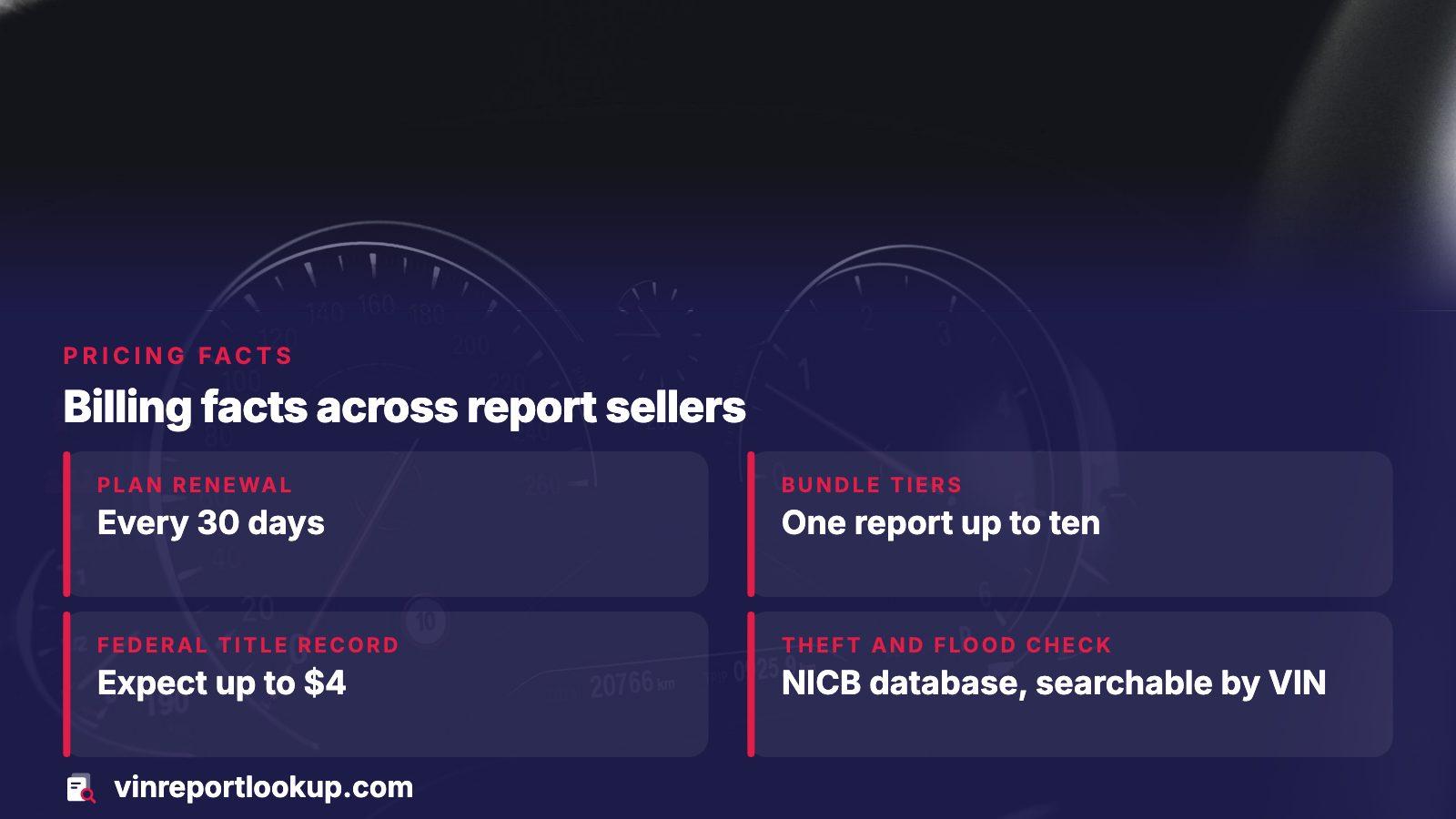
Pick by billing model first. Bumper sells a plan that renews every 30 days. VinAudit prints per-report prices and bundles on its homepage. carVertical sells credit bundles, and GoodCar and others sit on the Justice Department's approved list. Here, you get a free preview, then pay once for one report or a small pack, with no subscription.
- Bumper billing
- Renews each 30 days; its pages quote $27.99, $19.99 and $12.99 in different spots
- VinAudit bundles
- Three tiers on its homepage, from $9.99 for one report to $29.99 for ten
- Federal title record
- The Justice Department says to expect as much as $4
- Free first step
- NICB runs a VIN-searchable database for flood and theft claims
Why buyers shop around after seeing Bumper's plan
Most people searching for sites like Bumper are checking one car, maybe two. Bumper's help page describes a paid membership billed at the front of every 30-day period, and it says outright that the site is not free. That structure suits someone who looks at cars every week. It fits badly when you are buying a single sedan from a neighbor and want the record on Saturday.
Bumper's pages also disagree on cost. The homepage says plans start at $27.99 a month, the help page lists $19.99 for a period, or $12.99 a period if you commit to three, which totals $38.97, and the billing page prints no amount. None of that proves anything bad. It means only the order screen shows what you will be billed, and any rival should be judged the same way.
What Bumper itself says about its reports
To compare fairly, start with the baseline. These are statements from Bumper's own pages, not independent findings.
| Topic | Bumper's own wording, summarized |
|---|---|
| Payment model | Membership with a limited report count each period; one-time searches exist but no price is printed |
| Report allowance | One page mentions 50 reports a month, another says only a limited number |
| Trial | Cheaper for a short time, then the standard recurring rate unless you cancel |
| State accident data | May include records from 44 state agencies, and it urges extra checks elsewhere |
| Completeness | States it does not hold the full history of every vehicle |
Those last two rows matter for every provider, not only this one. No seller holds every record.
The main alternatives and how each one charges
The table below uses only what each company's own site showed when this guide was written. Carfax and EpicVin refused automated page requests, and AutoCheck's homepage returned no readable text, so nothing is claimed about them here beyond what the Justice Department's list shows.
| Seller | How it charges | What its page offers |
|---|---|---|
| VinAudit | Per report or bundle, starting at $9.99 for one and reaching $29.99 for ten | Describes itself as an approved federal title-data provider; adds theft, lien, impound and sale records |
| carVertical | Credit bundles, with savings of up to 40 percent; no dollar figure on the US page | Says it searches over 1000 sources in 48 countries; sample report available |
| GoodCar | No report price on its homepage | Names itself an approved federal title-data provider |
| This site | Free preview, then a single purchase of one report or a pack; amounts are on the pricing page | Title, damage, odometer, theft and recall sections in one report |
Subscription, bundle or single report
A subscription pays off when you will pull many reports in a month, for example a flipper working through auction listings. A bundle fits a shopper who wants to compare three or four finalists and then stop. A single report suits the person who has already chosen one car.
- One car, decision this week: one report, with no account to remember to close.
- Three or four finalists: a small pack, so the records can be compared side by side.
- Weekly volume: a plan can be cheaper per report, provided you will actually cancel when the buying spree ends.
- Unsure which car: use free tools first and spend only on the survivor.
Whatever you choose, write down the renewal date the minute you pay. A calendar reminder costs nothing.
What to run before paying anyone
The Justice Department's used-car tips send buyers to the National Insurance Crime Bureau, whose free VIN search covers flood damage and assorted insurer data. Bumper's own report page makes a similar point and warns that sites advertising a free full report often just run your VIN through that same tool.
Free tools answer narrow questions: is it flagged as stolen, was it written off by an insurer, is there an open recall. They do not give a title timeline or odometer series. If the free results are clean and you still like the car, that is the moment a paid report earns its cost.
Pair the report with a mechanic
The federal tips list a hands-on inspection and a varied test drive as separate steps. A clean record does not replace either one.
Check that the seller is on the federal approved list
The Justice Department keeps a roster of companies cleared to sell national title data to consumers. It names Bumper.com, Carvertical.com, GoodCar.com, Vinaudit.com, EpicVin.com, Clearvin.com and several others, and states that the order is alphabetical, not a ranking. The same page shows Carfax offering that data to commercial customers in California only.
Being on the list tells you the seller can obtain the federal title record. It says nothing about price, layout, or support. Use it to rule out unknown storefronts, then compare the rest on billing terms and what the sample report shows.
On its own the federal title record is cheap: the Justice Department puts it at no more than $4 each. Commercial reports add layers on top, which is where prices diverge.
Where every provider has gaps
A report can only show what was reported. VinAudit's page warns that details may be missing because of state rules and reporting practices. Bumper lists the 44 state agencies it may draw accident records from and recommends further checks for the rest. A repair paid in cash and never filed with an insurer will not appear anywhere.
Names are another limit. VinAudit says previous owners are normally not shown by a VIN search; names take a request to the state DMV or a legal process. Treat any site promising owner names with suspicion.
A five-step way to choose
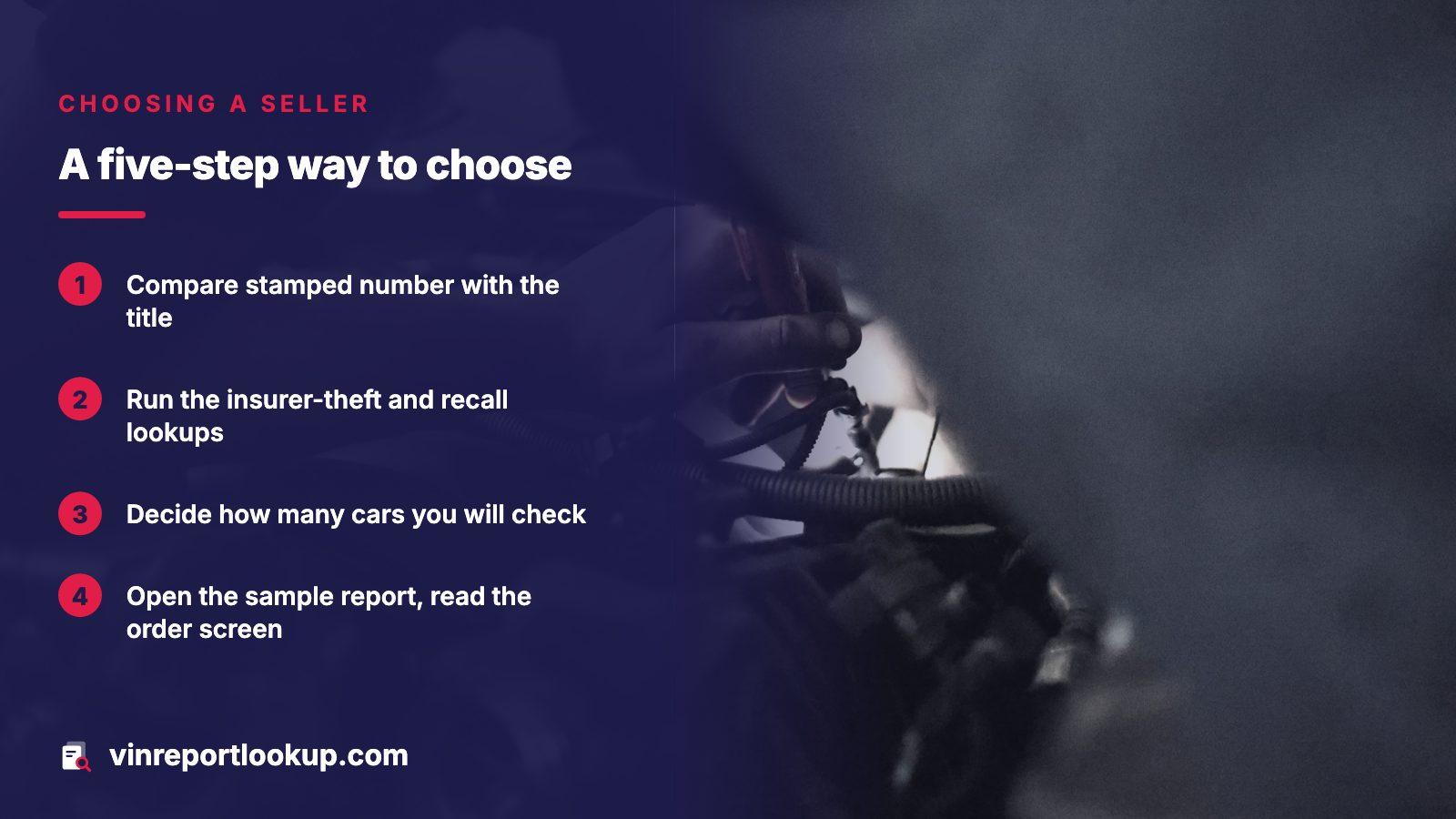
- Compare the number stamped on the car with the title before spending anything.
- Run the free insurer-theft and recall lookups.
- Decide how many cars you will really check.
- Open the seller's sample report and see whether the sections match your worry, such as title brands or odometer history.
- Read the order screen for renewal wording before entering a card.
Using this site instead
Type the 17-character VIN into the home page search and a preview appears without payment. When the full record looks worth it, you buy one report, or a pack of 3, 5 or 10 when several cars are in play. Nothing renews afterward. The pricing page holds the amounts; this guide leaves them out.
The preview is the free part. The report is a paid product, so only buy after the preview and the free tools have not already ruled the car out.
Where this information comes from
- Bumper: common questions — plan prices, data sources, state agency count and cancel routes as Bumper states them
- Bumper: billing — no printed price, app-store billing, and access to old reports
- VinAudit: homepage — single and bundle prices, record types, and its stated limits
- carVertical: US page — bundle savings claim, source count and sample report
- Justice Department: approved NMVTIS data providers — which sellers may provide national title data to the public
- Justice Department: used car buying tips — the up-to-$4 figure, the free NICB database and inspection steps
Sources and photos: Facts checked against the sources above in November 2026. Photos by Cht Gsml, Mustafa Sheikhmouss and Viktor Theo on Unsplash; diagrams by VINReportLookup.
Keep reading
- Bumper VIN check cost: what the plan bills and cheaper ways to check a carWhat Bumper's own pages say about each plan price and the trial
- How to cancel a Bumper subscription, and what to do if you are still billedThe cancel routes Bumper lists, if you already signed up
- Best VIN check: how to choose a report and what each one includesChoosing a report by the question you need answered
- Vehicle history report providers: who sells VIN reports and how they differWho sells reports and where the federal title data comes from
Frequently asked questions
What is a good alternative to Bumper?
That depends on how you want to pay. VinAudit publishes per-report and bundle prices, carVertical sells credit bundles, and this site gives a free preview ahead of a single purchase. Check each seller's sample report and order screen, since pages change and prices may differ from what any guide printed.
Are there sites like Bumper with no monthly plan?
Yes. VinAudit lists single reports and bundles on its homepage, and carVertical sells bundles of credits. This site charges once per report or pack. Whoever you pick, read the order page for renewal wording before typing in a card.
Is there a completely free Bumper alternative?
Not for a full history. The NICB database is free and covers flood damage and theft claims by VIN, and NHTSA offers a recall lookup. Neither gives a title timeline or odometer series. Sites advertising a free full report usually show only that minimal data.
Do I need an approved federal provider?
It is a sensible filter. The Justice Department lists the businesses approved to sell national title data to the public, and it says the list is alphabetical, not a ranking. Being listed does not tell you the price or how readable the report is.
Can any report show who owned the car?
Usually not by name. VinAudit states that privacy law keeps past owners off a VIN search, so names mean going to the state DMV or a legal process. Reports show how many owners and title dates instead, depending on the data available.
Now check the car itself
The guide explains what to look for. The report shows what this VIN has on record.