THE SHORT ANSWER
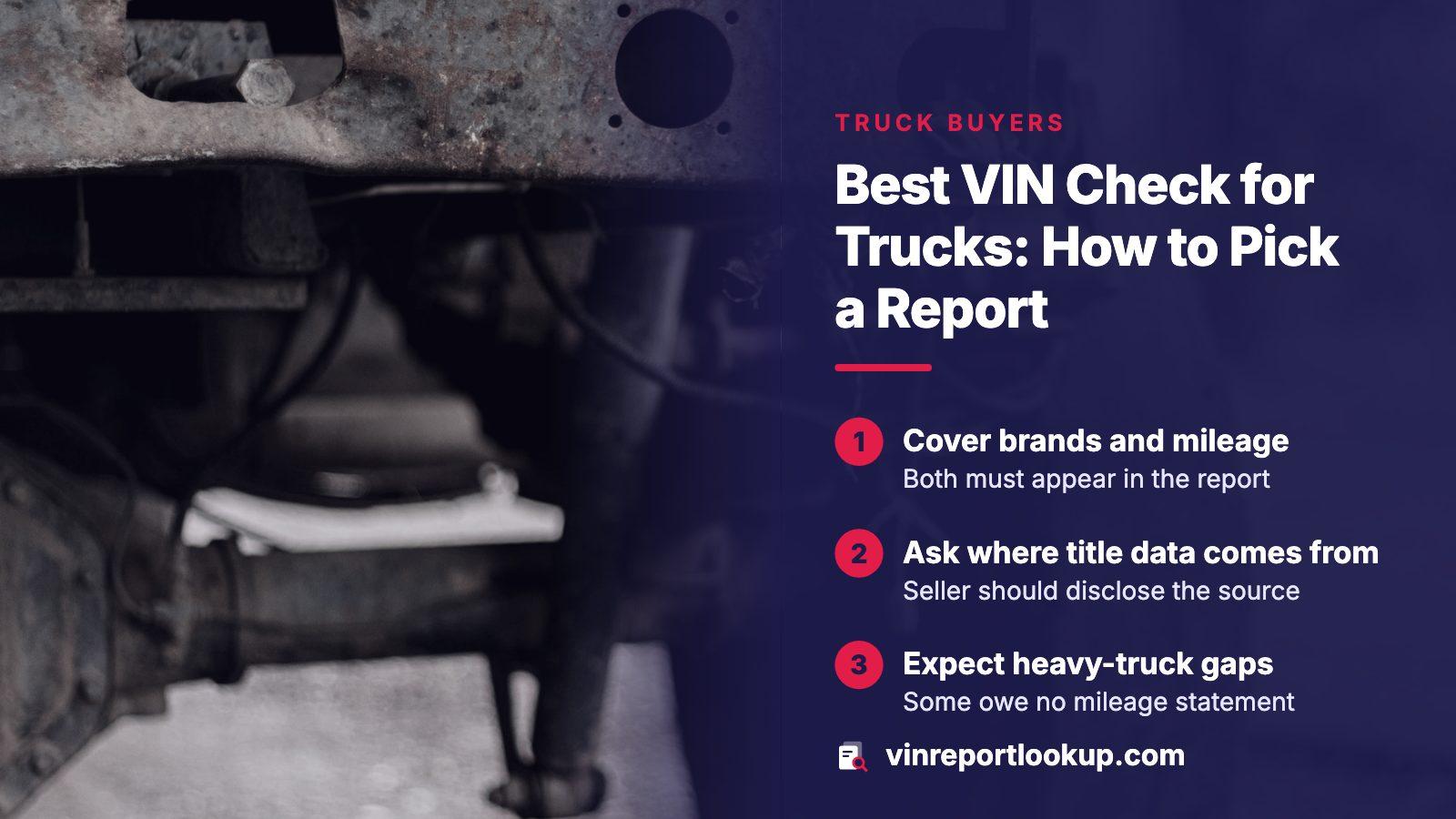
Pick a truck VIN check on three tests: it must cover title brands and odometer readings, it must be sold by a business that discloses what comes from the federal title database, and you should be able to preview the VIN before paying. Decode the VIN with NHTSA first, run the recall search, then buy one report for the finalist and still pay for an inspection.
- Federal title data
- Brands, latest odometer, salvage decisions
- Heavy trucks
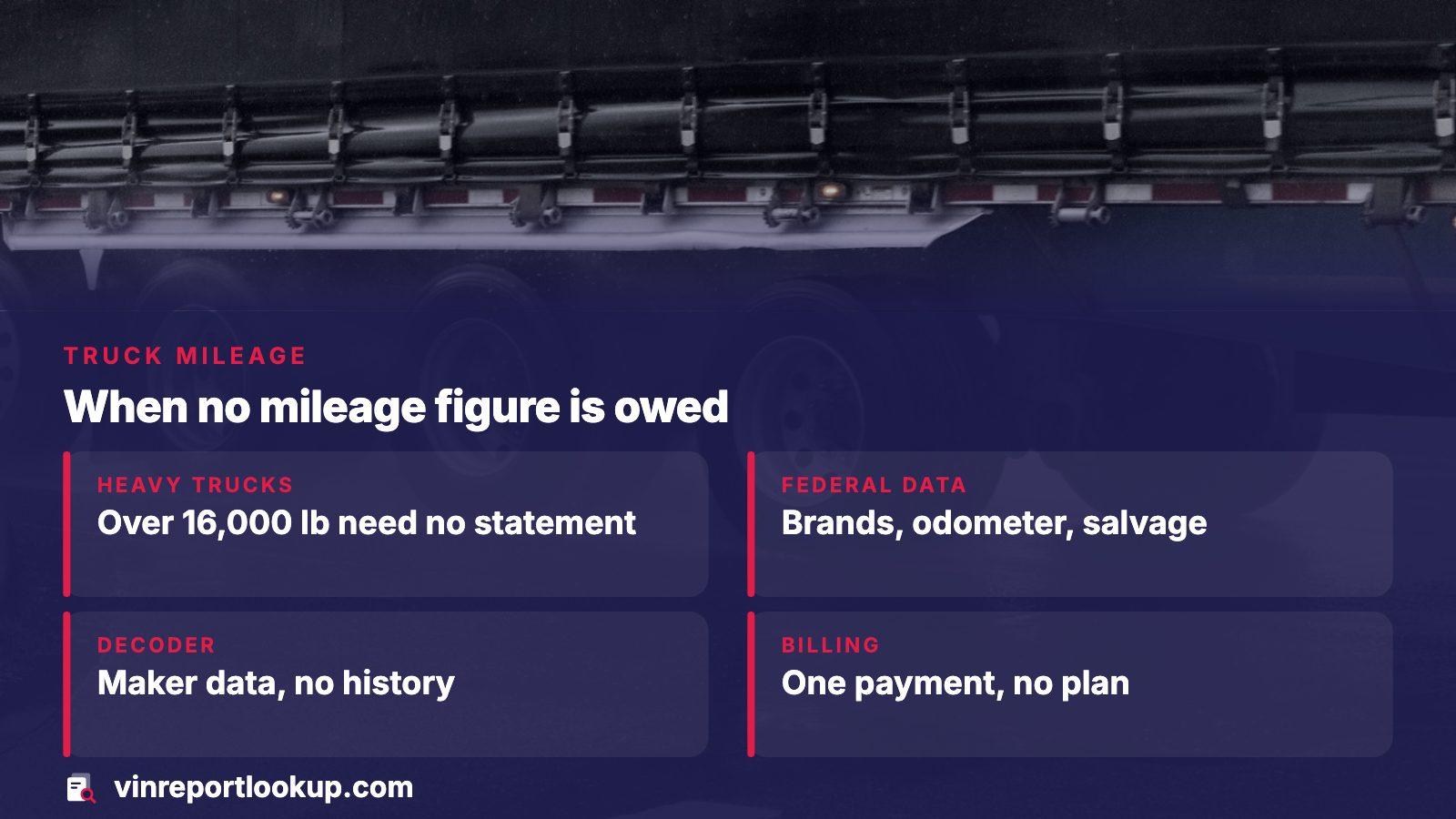
- Over 16,000 lb GVWR need no mileage statement
- NHTSA decoder
- Shows maker data only, no history
- VINReportLookup
- Free preview, one payment, no subscription
What a truck check has to catch that a sedan check can skip
A hard-worked pickup and a commuter sedan can share a model year and little else. When you compare VIN checks for a truck, weigh the records that go wrong most often on working vehicles. A title brand tells you the state once called the truck junk, salvage or flood. The odometer trail shows whether mileage climbs sensibly from one record to the next. Salvage and auction entries show whether an insurer wrote it off before it reached the lot you are standing on.
Use type counts as well. A fleet unit has had a harder life than a retiree's truck, which should shape your offer.
Government lookups to run before you pay anyone
Start with NHTSA, which costs nothing and tells you whether the VIN is even coherent. I ran a partial VIN from a 2017 Ford F-150 through its decoder API. It came back as a Ford pickup built in Kansas City, rear-drive, six cylinders, gasoline, with the error text warning that the VIN was incomplete. That is useful: it confirms the truck matches the listing. It is also all you get. The decoder reports what the maker encoded and holds no ownership, accident or title history.
NHTSA's recall data works from the same VIN. The recalls API listed 18 campaigns for that one model year, two of them dated 2026. A recall search shows open repairs, though, not what happened to the truck on the road.
What the free steps leave out
Neither lookup says whether the title was branded, whether the odometer has been rolled back or whether an insurer declared the truck a total loss. Closing that gap is the job of a paid history report.
Where the title records come from, and who can sell them
The federal title system pools data from state titling agencies, auto recyclers, scrapyards and insurers. Per the Justice Department's consumer page, a buyer can see the current title with its brand history, the newest odometer reading, an insurer's salvage ruling and any handoff to a salvage or junk yard. A state's brand stays in the record for good. That matters because a paper title can lose its brand when the truck is retitled somewhere that never asks the first state.
The department also keeps a list of every business approved to sell these reports to the public, in alphabetical order with no preference shown. The same page says Carfax, DMVDesk and Experian do not hand these reports to individual consumers; they serve dealerships. When you compare sellers, ask each one whether its report draws on this federal data.
A checklist for comparing report sellers
- Does a preview show you what the VIN returns before you pay, so you can see coverage for your own truck?
- Is the charge one payment per report, or does the card keep billing after the first purchase?
- Does the seller say where its title and odometer records come from?
- Are salvage and auction entries shown with photos, so you can compare them with the truck in front of you?
- Are open recalls included, or do you have to run that search separately?
Heavier trucks deserve one extra question. The odometer rule exempts some vehicles from mileage disclosure, so a thin odometer trail on a large truck may be normal rather than suspicious. Test the VIN in a preview and read what comes back before you spend anything.
When a seller owes you no mileage figure at all
Some sellers never have to write down mileage at all. Under the federal rule, a truck rated above 16,000 pounds GVWR is exempt, and so is anything that cannot move under its own power. Age matters too. Models from 2010 or earlier drop out of the requirement once 10 years have run from the first of January of their model year; for 2011 models and newer the wait is 20 years. By the rule's own worked example, a 2031 transfer would exempt every 2011 model.
So a heavy or older truck can change hands with no signed mileage figure, leaving only the dash reading. Any odometer entry in a history report is then worth more, and the dates between readings tell you more than the last number.
What an odometer gap looks like to the buyer who finds it
From an NHTSA owner complaint
A man or woman who purchased a used 2017 Ford F-150 from a private seller filed odometer fraud with NHTSA this year. The dash read roughly 170,000 miles on the day of sale, and an outside source later gave 250,000. The buyer found out after the money changed hands, the wrong order.
The gap surfaced from an outside record, after the sale. Pull the odometer history before you hand over cash, and compare each entry with the truck's wear, not only the dash.
Running the check at the truck itself
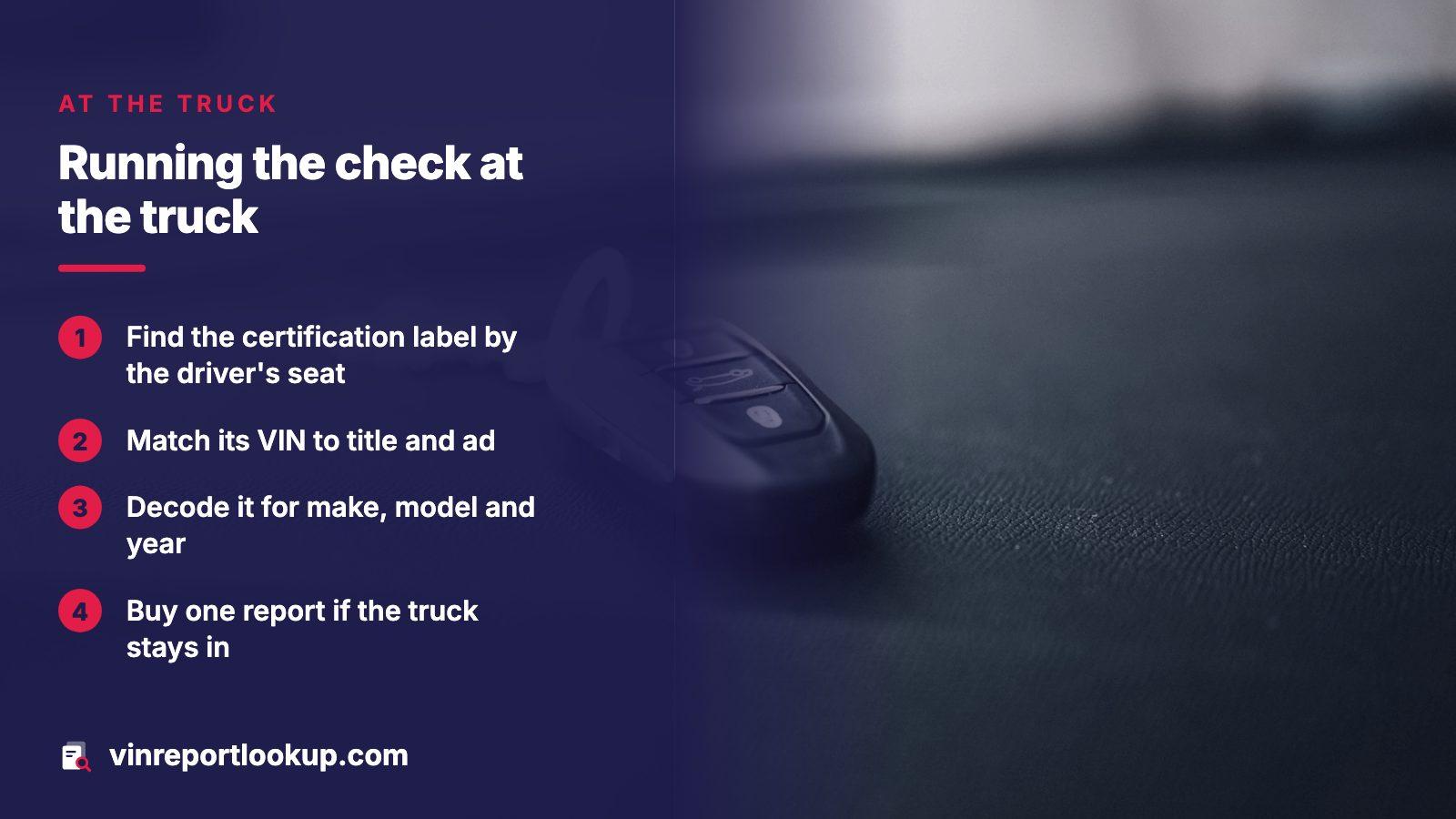
- Locate the maker's certification label by the driver's seat, usually on the door-latch post or hinge pillar. It is riveted or bonded on so that removing it wrecks it; a trailer carries its label near the front of the left side.
- Read the label's VIN against the title and the ad, one character at a time.
- Decode it with NHTSA and confirm that make, model, year and body style agree with the ad.
- Preview the VIN on VINReportLookup and read what the records show.
- Buy a single report only if the truck is still in the running.
A label that looks scraped, re-glued or different from the paperwork is a reason to walk away. Cloning is documented: the Justice Department describes a Florida ring that cloned more than 250 cars, putting VINs from matching vehicles on stolen ones.
Red flags worth acting on in a truck report
- A salvage, junk or flood brand, or a sale to a salvage yard, that the seller cannot explain.
- Mileage that stalls, drops or jumps between records.
- A total-loss decision by an insurer on a truck now priced like a clean one.
- A title history spread across several states in a short period, which can be a sign of brand washing.
- Auction photos that show damage the seller never mentioned.
Flood damage deserves its own caution. The Justice Department warns that a saltwater soaking leaves wiring and airbag sensors more likely to quit later, even if the truck seems normal on a short test drive.
Cost, and the step after the report
Previewing a VIN costs nothing here. After that you pay once per report, or once for a pack when several trucks are in play. Nothing renews. Rates are listed on the pricing page.
A report covers paper, while a truck is machinery. When the report clears it, hire a mechanic you trust to go over the frame, drivetrain and hitch. If the report finds a problem, you negotiate with evidence or walk away before the repair bill.
Where this information comes from
- Justice Department: consumer page on the title system — what the federal title records hold, plus washing, flood and cloning cases
- Justice Department: approved NMVTIS report providers — who may sell reports to the public, dealer-only names
- eCFR: 49 CFR 580.17 odometer exemptions — which vehicles need no mileage statement
- eCFR: 49 CFR 567.4, maker's vehicle label — label position and how it must be fixed
- NHTSA: vPIC VIN decoder — maker-supplied data only, tested on a partial pickup VIN
- NHTSA owner complaint 11761260 — owner experience, paraphrased
Sources and photos: Facts checked against the sources above in November 2026. Photos by Zoshua Colah, Bence Balla-Schottner and fr0ggy5 on Unsplash; diagrams by VINReportLookup.
Keep reading
- Best VIN check: how to choose a report and what each one includesThe general version of this comparison for any vehicle.
- Best VIN check for dealers: screening trade-ins and auction unitsUseful if you buy trucks to resell.
- Best VIN check for auction cars: what to run before you bidAuction trucks carry their own record risks.
- Carfax vs inspection: what each shows and which to buy firstWhat a report cannot replace on a work truck.
Frequently asked questions
Is there a different VIN check for pickup trucks and semis?
The check itself runs on the VIN either way, but what comes back can differ by vehicle type. A pickup usually decodes like a car, while a heavy truck may have fewer records. Preview the VIN first and read what the report returns for your exact truck before paying for it.
Will a VIN check reveal a rolled-back odometer on a truck?
It lists odometer readings recorded over time, and a drop or a stall between entries is the warning. It proves nothing alone. Weigh the entries against the worn pedals, driver's seat and bed liner, and make the seller account for any gap.
Do I need a report if NHTSA shows no recalls?
Yes, because a recall search answers only one question: is there an unrepaired safety defect. It says nothing about title brands, salvage history, odometer readings or theft. A clean recall result and a branded title can sit side by side on the same truck.
Does a heavy truck need an odometer statement when sold?
Not always. Federal rules exempt a vehicle with a GVWR above 16,000 pounds, along with vehicles past certain ages. Ask for maintenance receipts and old inspection papers, and read odometer entries in a report as supporting evidence.
Should I buy a report for every truck on my shortlist?
Preview each VIN, which costs nothing, and eliminate trucks with obvious problems. Buy a full report only for the one or two you would actually purchase. If you are comparing several, a pack can be cheaper per report than single purchases; check the pricing page.
Now check the car itself
The guide explains what to look for. The report shows what this VIN has on record.